
Consolidated science and user requirements for a next
- Slides: 23
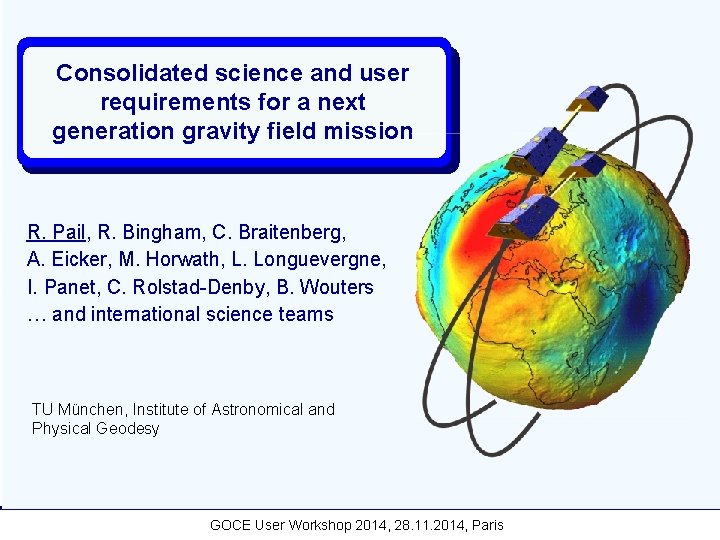
Consolidated science and user requirements for a next generation gravity field mission R. Pail, R. Bingham, C. Braitenberg, A. Eicker, M. Horwath, L. Longuevergne, I. Panet, C. Rolstad-Denby, B. Wouters … and international science teams TU München, Institute of Astronomical and Physical Geodesy GOCE User Workshop 2014, 28. 11. 2014, Paris
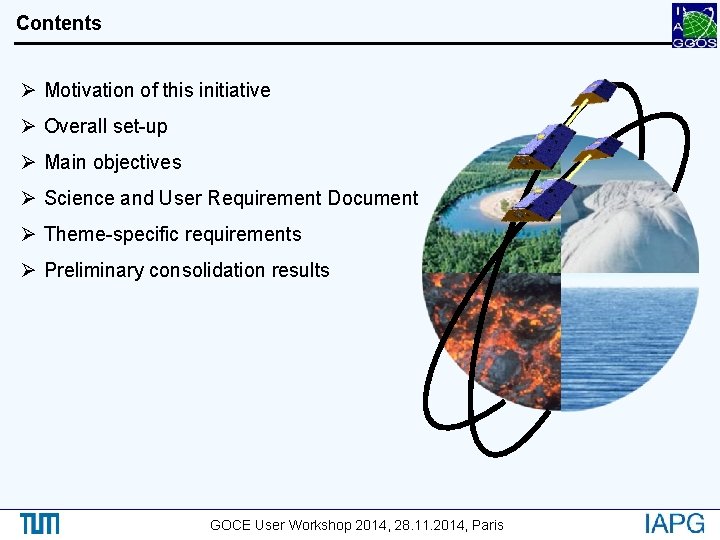
Contents Ø Motivation of this initiative Ø Overall set-up Ø Main objectives Ø Science and User Requirement Document Ø Theme-specific requirements Ø Preliminary consolidation results GOCE User Workshop 2014, 28. 11. 2014, Paris
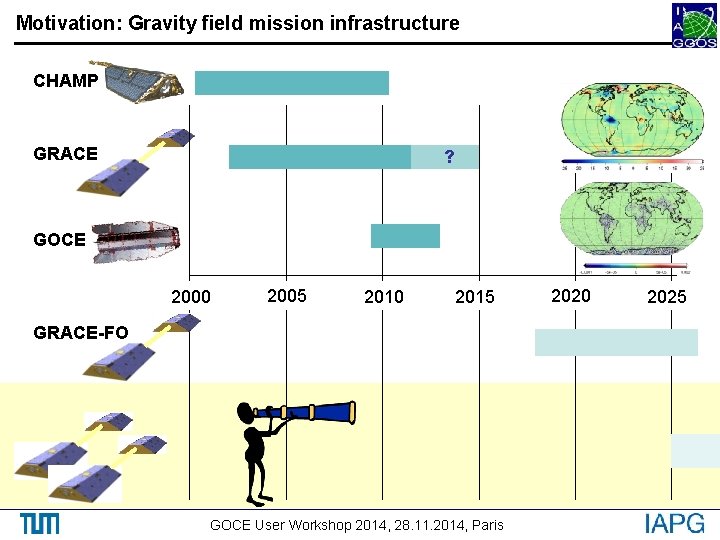
Motivation: Gravity field mission infrastructure CHAMP GRACE ? GOCE 2000 2005 2010 2015 GRACE-FO GOCE User Workshop 2014, 28. 11. 2014, Paris 2020 2025
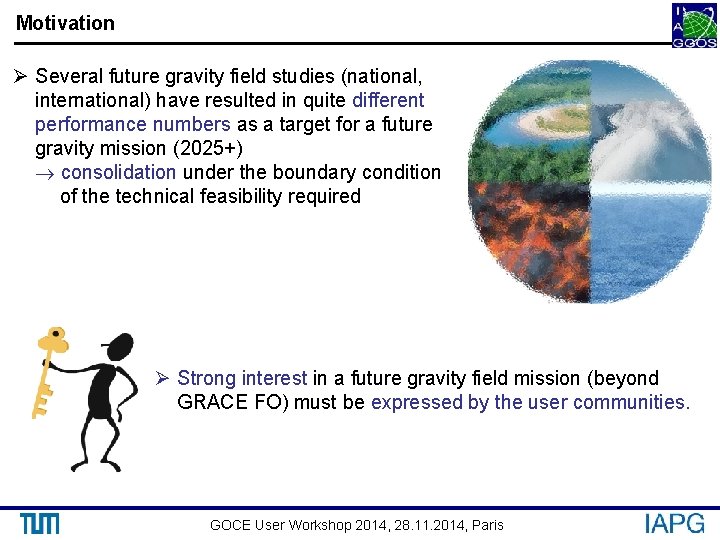
Motivation Ø Several future gravity field studies (national, international) have resulted in quite different performance numbers as a target for a future gravity mission (2025+) consolidation under the boundary condition of the technical feasibility required Ø Strong interest in a future gravity field mission (beyond GRACE FO) must be expressed by the user communities. GOCE User Workshop 2014, 28. 11. 2014, Paris
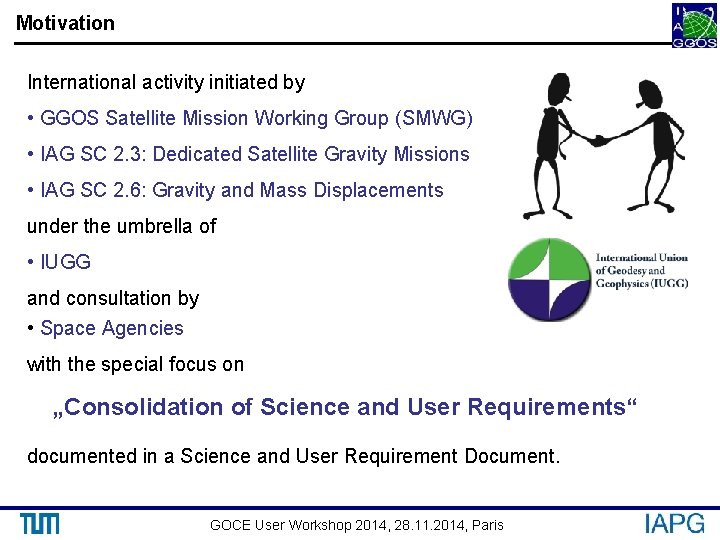
Motivation International activity initiated by • GGOS Satellite Mission Working Group (SMWG) • IAG SC 2. 3: Dedicated Satellite Gravity Missions • IAG SC 2. 6: Gravity and Mass Displacements under the umbrella of • IUGG and consultation by • Space Agencies with the special focus on „Consolidation of Science and User Requirements“ documented in a Science and User Requirement Document. GOCE User Workshop 2014, 28. 11. 2014, Paris
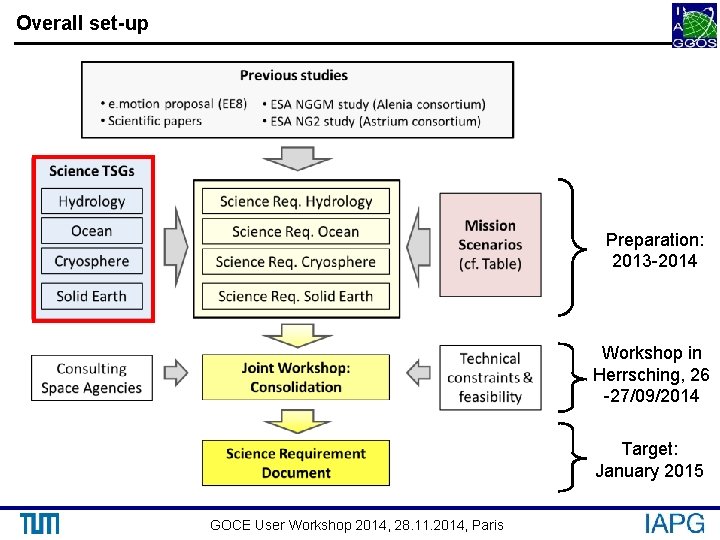
Overall set-up Preparation: 2013 -2014 Workshop in Herrsching, 26 -27/09/2014 Target: January 2015 GOCE User Workshop 2014, 28. 11. 2014, Paris
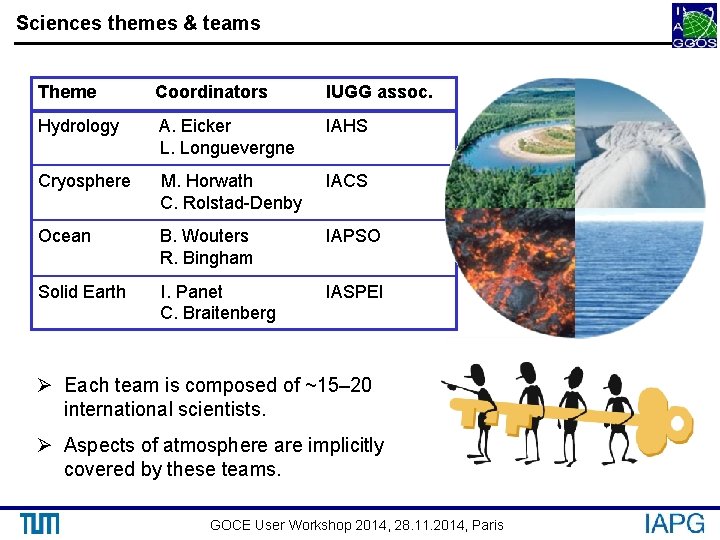
Sciences themes & teams Theme Coordinators IUGG assoc. Hydrology A. Eicker L. Longuevergne IAHS Cryosphere M. Horwath C. Rolstad-Denby IACS Ocean B. Wouters R. Bingham IAPSO Solid Earth I. Panet C. Braitenberg IASPEI Ø Each team is composed of ~15– 20 international scientists. Ø Aspects of atmosphere are implicitly covered by these teams. GOCE User Workshop 2014, 28. 11. 2014, Paris
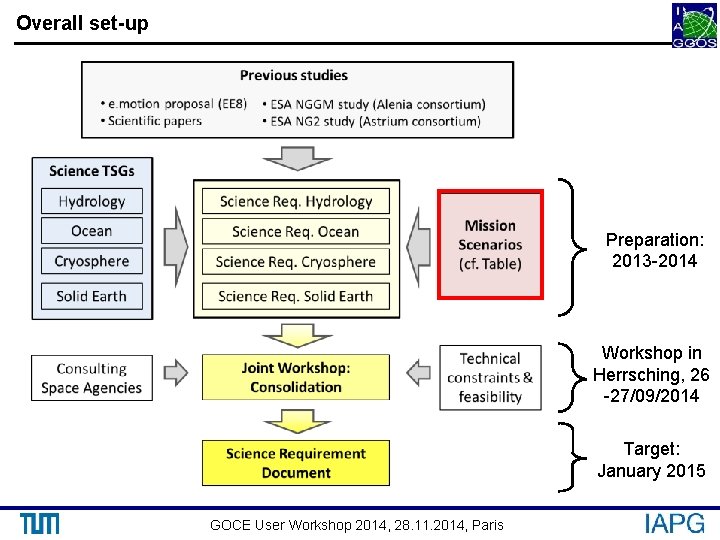
Overall set-up Preparation: 2013 -2014 Workshop in Herrsching, 26 -27/09/2014 Target: January 2015 GOCE User Workshop 2014, 28. 11. 2014, Paris
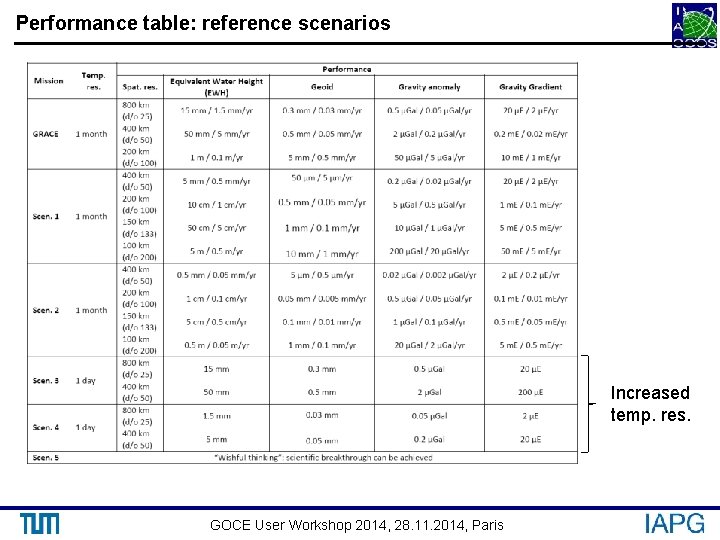
Performance table: reference scenarios Increased temp. res. GOCE User Workshop 2014, 28. 11. 2014, Paris
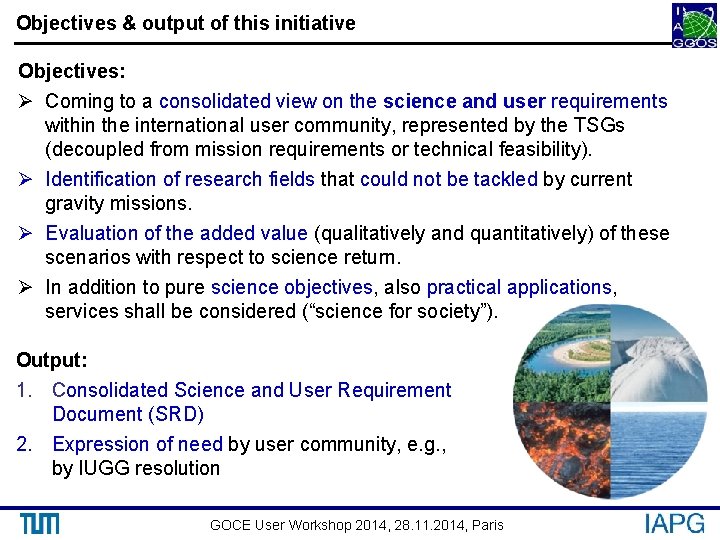
Objectives & output of this initiative Objectives: Ø Coming to a consolidated view on the science and user requirements within the international user community, represented by the TSGs (decoupled from mission requirements or technical feasibility). Ø Identification of research fields that could not be tackled by current gravity missions. Ø Evaluation of the added value (qualitatively and quantitatively) of these scenarios with respect to science return. Ø In addition to pure science objectives, also practical applications, services shall be considered (“science for society”). Output: 1. Consolidated Science and User Requirement Document (SRD) 2. Expression of need by user community, e. g. , by IUGG resolution GOCE User Workshop 2014, 28. 11. 2014, Paris
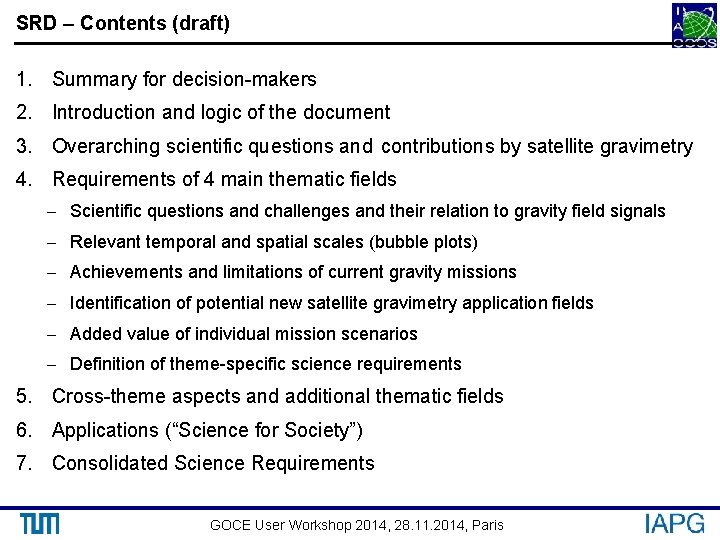
SRD – Contents (draft) 1. Summary for decision-makers 2. Introduction and logic of the document 3. Overarching scientific questions and contributions by satellite gravimetry 4. Requirements of 4 main thematic fields - Scientific questions and challenges and their relation to gravity field signals - Relevant temporal and spatial scales (bubble plots) - Achievements and limitations of current gravity missions - Identification of potential new satellite gravimetry application fields - Added value of individual mission scenarios - Definition of theme-specific science requirements 5. Cross-theme aspects and additional thematic fields 6. Applications (“Science for Society”) 7. Consolidated Science Requirements GOCE User Workshop 2014, 28. 11. 2014, Paris
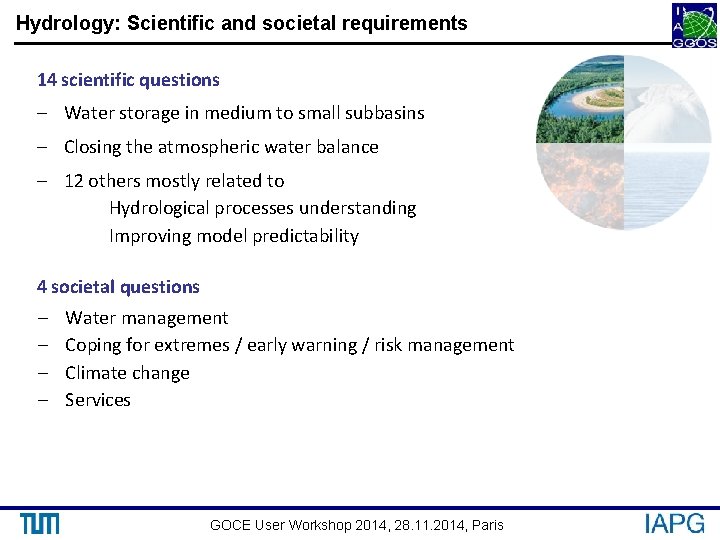
Hydrology: Scientific and societal requirements 14 scientific questions - Water storage in medium to small subbasins - Closing the atmospheric water balance - 12 others mostly related to Hydrological processes understanding Improving model predictability 4 societal questions - Water management Coping for extremes / early warning / risk management Climate change Services GOCE User Workshop 2014, 28. 11. 2014, Paris
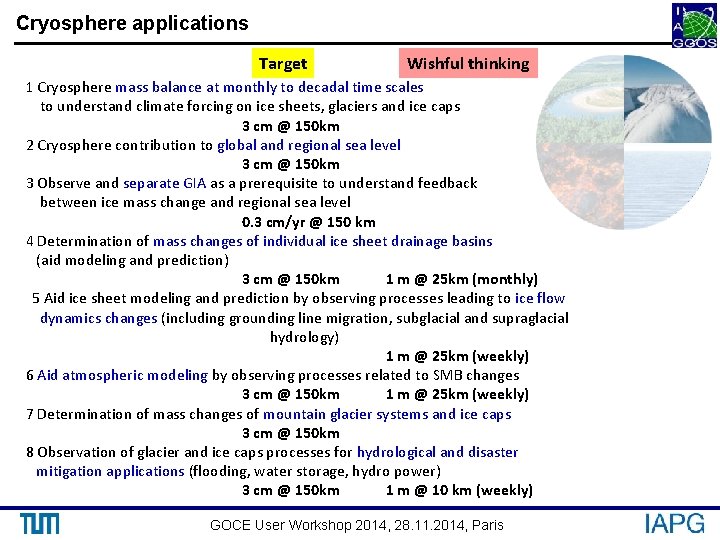
Cryosphere applications Target Wishful thinking 1 Cryosphere mass balance at monthly to decadal time scales to understand climate forcing on ice sheets, glaciers and ice caps 3 cm @ 150 km 2 Cryosphere contribution to global and regional sea level 3 cm @ 150 km 3 Observe and separate GIA as a prerequisite to understand feedback between ice mass change and regional sea level 0. 3 cm/yr @ 150 km 4 Determination of mass changes of individual ice sheet drainage basins (aid modeling and prediction) 3 cm @ 150 km 1 m @ 25 km (monthly) 5 Aid ice sheet modeling and prediction by observing processes leading to ice flow dynamics changes (including grounding line migration, subglacial and supraglacial hydrology) 1 m @ 25 km (weekly) 6 Aid atmospheric modeling by observing processes related to SMB changes 3 cm @ 150 km 1 m @ 25 km (weekly) 7 Determination of mass changes of mountain glacier systems and ice caps 3 cm @ 150 km 8 Observation of glacier and ice caps processes for hydrological and disaster mitigation applications (flooding, water storage, hydro power) 3 cm @ 150 km 1 m @ 10 km (weekly) GOCE User Workshop 2014, 28. 11. 2014, Paris
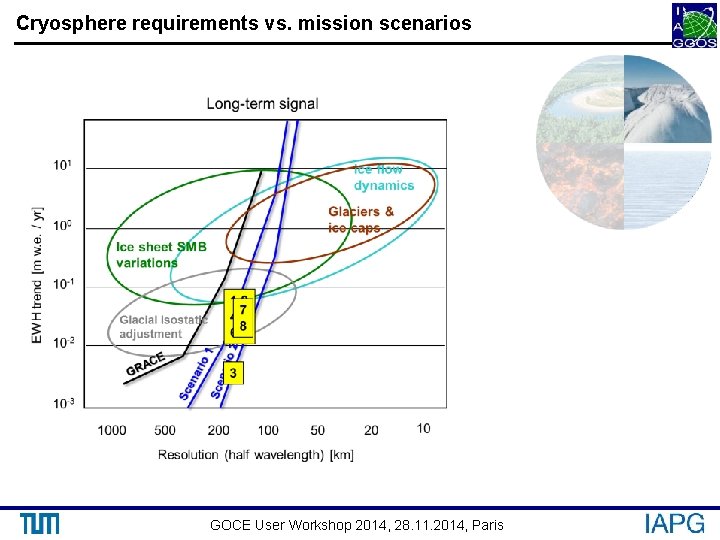
Cryosphere requirements vs. mission scenarios GOCE User Workshop 2014, 28. 11. 2014, Paris
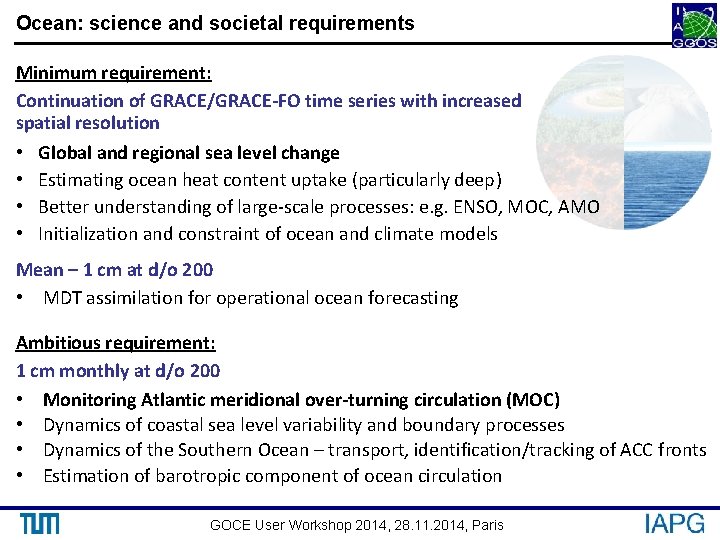
Ocean: science and societal requirements Minimum requirement: Continuation of GRACE/GRACE-FO time series with increased spatial resolution • Global and regional sea level change • Estimating ocean heat content uptake (particularly deep) • Better understanding of large-scale processes: e. g. ENSO, MOC, AMO • Initialization and constraint of ocean and climate models Mean – 1 cm at d/o 200 • MDT assimilation for operational ocean forecasting Ambitious requirement: 1 cm monthly at d/o 200 • Monitoring Atlantic meridional over-turning circulation (MOC) • Dynamics of coastal sea level variability and boundary processes • Dynamics of the Southern Ocean – transport, identification/tracking of ACC fronts • Estimation of barotropic component of ocean circulation GOCE User Workshop 2014, 28. 11. 2014, Paris
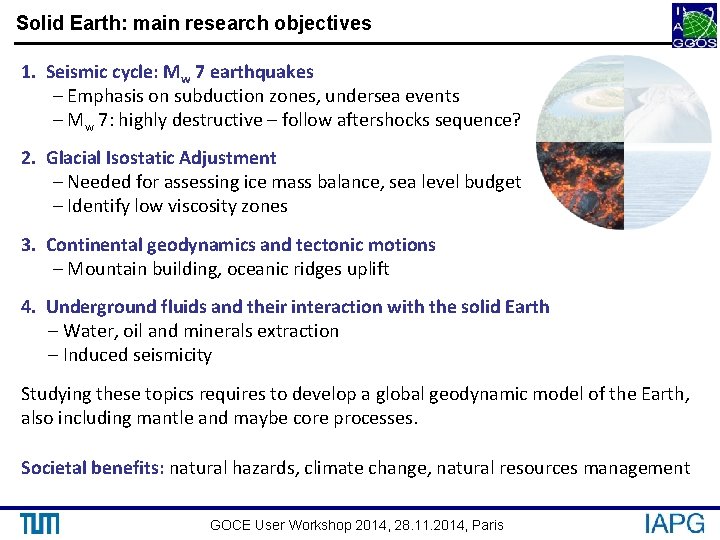
Solid Earth: main research objectives 1. Seismic cycle: Mw 7 earthquakes – Emphasis on subduction zones, undersea events – Mw 7: highly destructive – follow aftershocks sequence? 2. Glacial Isostatic Adjustment – Needed for assessing ice mass balance, sea level budget – Identify low viscosity zones 3. Continental geodynamics and tectonic motions – Mountain building, oceanic ridges uplift 4. Underground fluids and their interaction with the solid Earth – Water, oil and minerals extraction – Induced seismicity Studying these topics requires to develop a global geodynamic model of the Earth, also including mantle and maybe core processes. Societal benefits: natural hazards, climate change, natural resources management GOCE User Workshop 2014, 28. 11. 2014, Paris
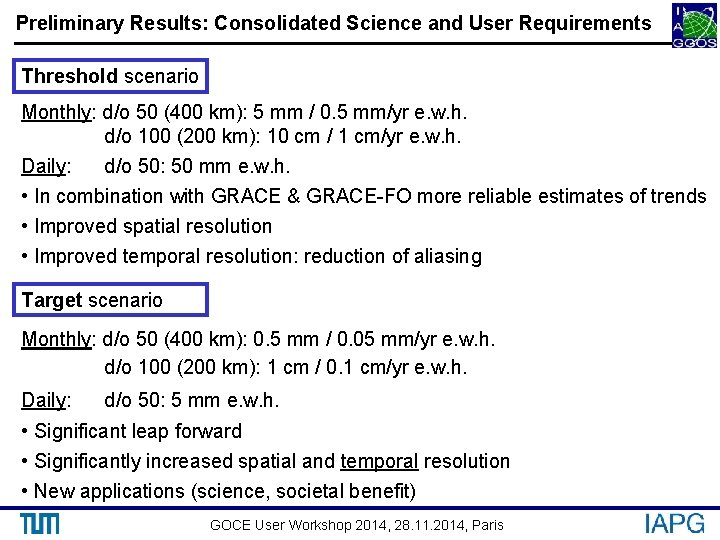
Preliminary Results: Consolidated Science and User Requirements Threshold scenario Monthly: d/o 50 (400 km): 5 mm / 0. 5 mm/yr e. w. h. d/o 100 (200 km): 10 cm / 1 cm/yr e. w. h. Daily: d/o 50: 50 mm e. w. h. • In combination with GRACE & GRACE-FO more reliable estimates of trends • Improved spatial resolution • Improved temporal resolution: reduction of aliasing Target scenario Monthly: d/o 50 (400 km): 0. 5 mm / 0. 05 mm/yr e. w. h. d/o 100 (200 km): 1 cm / 0. 1 cm/yr e. w. h. Daily: d/o 50: 5 mm e. w. h. • Significant leap forward • Significantly increased spatial and temporal resolution • New applications (science, societal benefit) GOCE User Workshop 2014, 28. 11. 2014, Paris
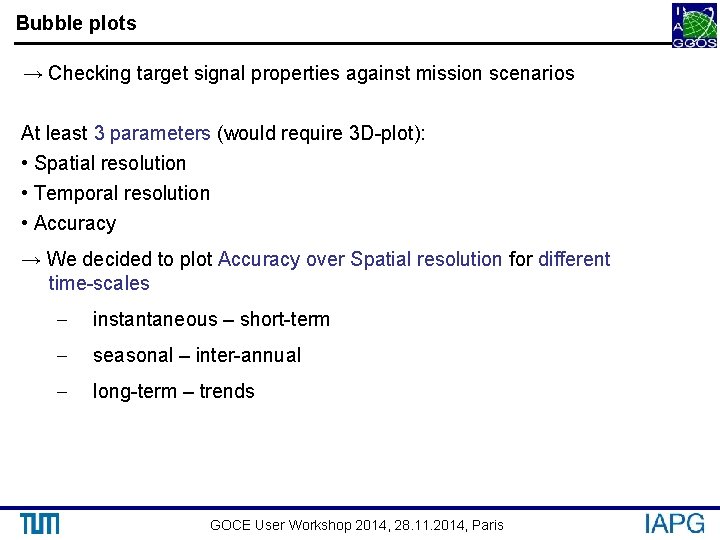
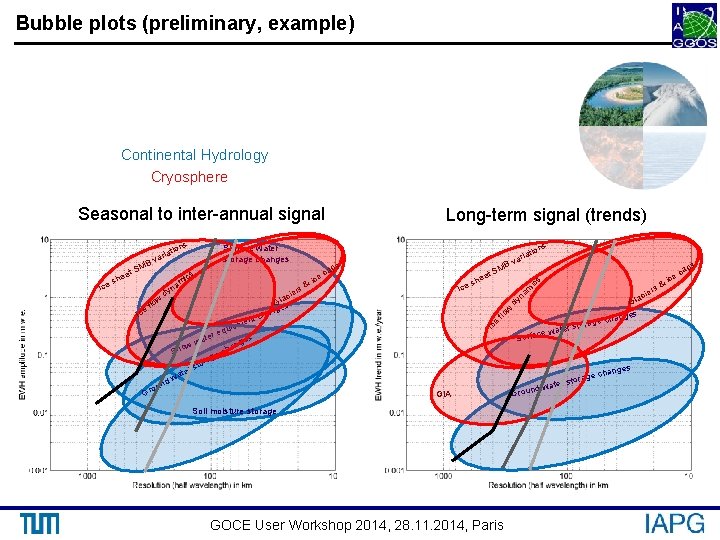
Bubble plots → Checking target signal properties against mission scenarios At least 3 parameters (would require 3 D-plot): • Spatial resolution • Temporal resolution • Accuracy → We decided to plot Accuracy over Spatial resolution for different time-scales - instantaneous – short-term - seasonal – inter-annual - long-term – trends GOCE User Workshop 2014, 28. 11. 2014, Paris
Bubble plots (preliminary, example) Continental Hydrology Cryosphere Seasonal to inter-annual signal f Gr n ou c lent a v i u r eq ate es w ng w ha Sno c e ag tor s r ate dw s ic s ier m Ice ac Gl na c &i B SM dy Ice low s ier ac l Ges g han et she w am n dy ps a ec flo Ice ics ns atio i var GIA Soil moisture storage GOCE User Workshop 2014, 28. 11. 2014, Paris hange rage c r sto e wate e t e she Surface water storage changes Ic s tion a ari Bv M S Long-term signal (trends) Surfac d wa Groun rag ter sto nges e cha s c ce &i s ap
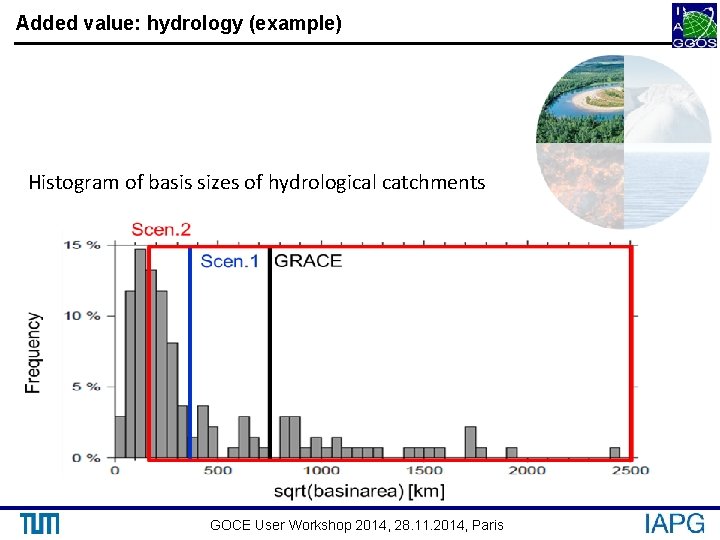
Added value: hydrology (example) Histogram of basis sizes of hydrological catchments GOCE User Workshop 2014, 28. 11. 2014, Paris
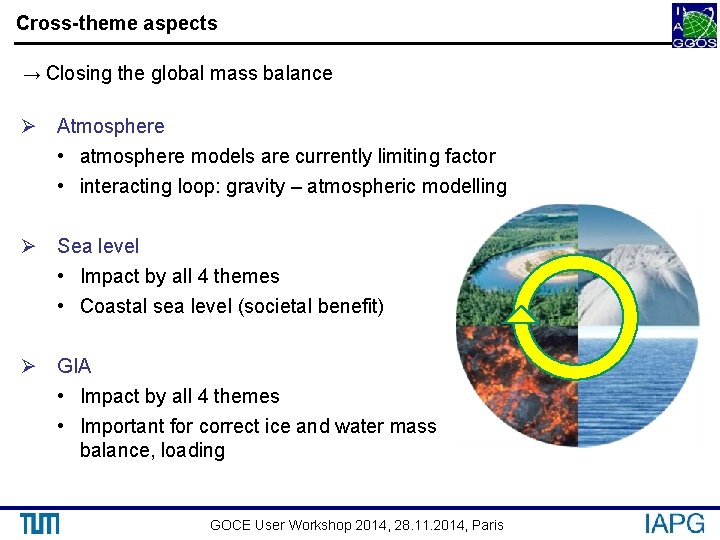
Cross-theme aspects → Closing the global mass balance Ø Atmosphere • atmosphere models are currently limiting factor • interacting loop: gravity – atmospheric modelling Ø Sea level • Impact by all 4 themes • Coastal sea level (societal benefit) Ø GIA • Impact by all 4 themes • Important for correct ice and water mass balance, loading GOCE User Workshop 2014, 28. 11. 2014, Paris
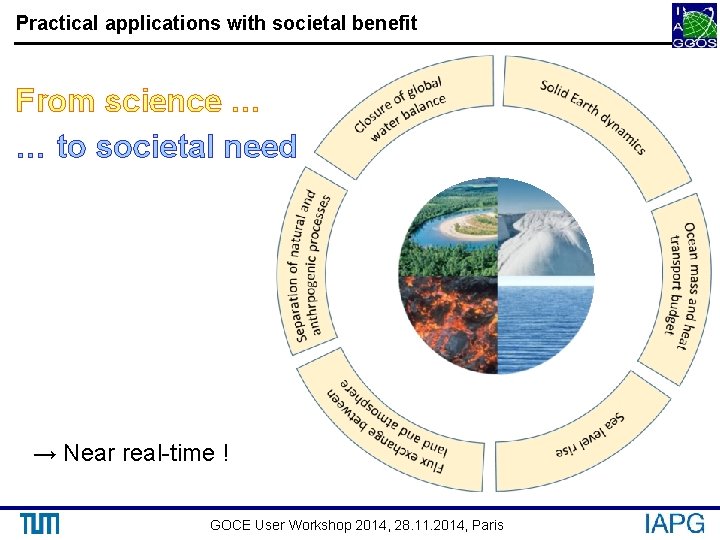
Practical applications with societal benefit From science … … to societal need → Near real-time ! GOCE User Workshop 2014, 28. 11. 2014, Paris
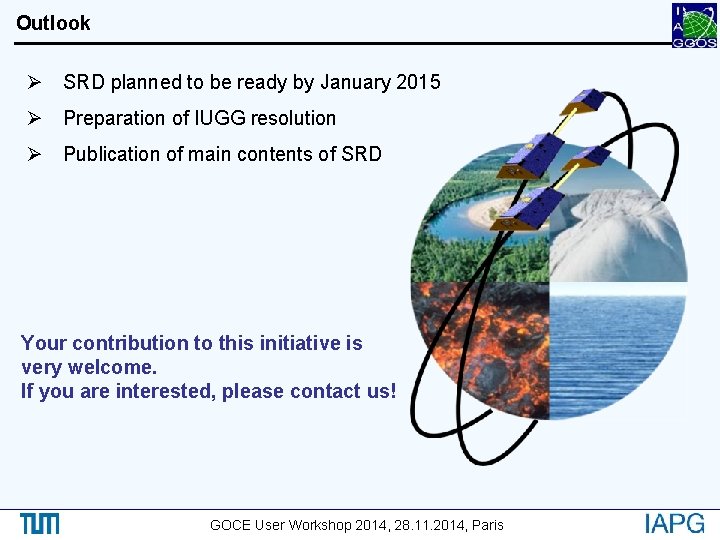
Outlook Ø SRD planned to be ready by January 2015 Ø Preparation of IUGG resolution Ø Publication of main contents of SRD Your contribution to this initiative is very welcome. If you are interested, please contact us! GOCE User Workshop 2014, 28. 11. 2014, Paris