
Considerations for LBNF Optimized Horn Preliminary Design Cory
Considerations for LBNF Optimized Horn Preliminary Design Cory Crowley January 31 st, 2019 C. Crowley | LBNF Optimized Horns FEA Review 01/31/19
Outline • Status of Horn A Preliminary Design – – – U. S. Geometry Revised Equalization Sections Stripline Design / Mounting Differences D. S. Outer Conductor / Transition Changes Modeling Updates • Design Philosophy of D. S. Transition • Design Intentions for Horns B & C • Summary 2 C. Crowley | LBNF Optimized Horns FEA Review 01/31/19
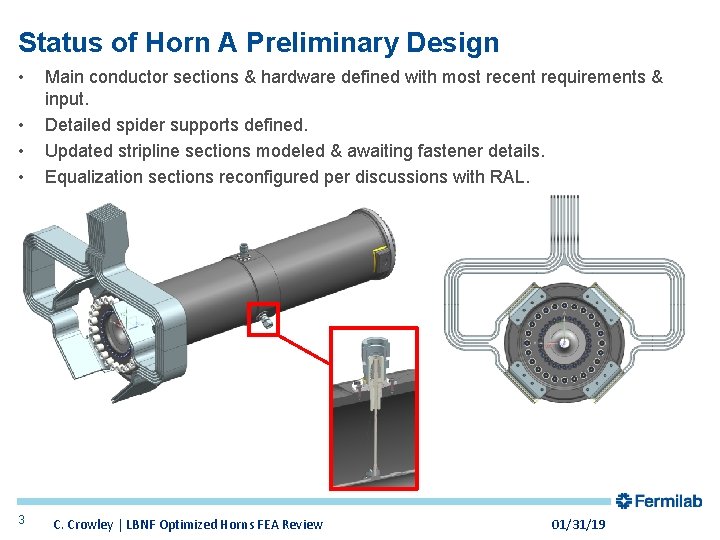
Status of Horn A Preliminary Design • • 3 Main conductor sections & hardware defined with most recent requirements & input. Detailed spider supports defined. Updated stripline sections modeled & awaiting fastener details. Equalization sections reconfigured per discussions with RAL. C. Crowley | LBNF Optimized Horns FEA Review 01/31/19
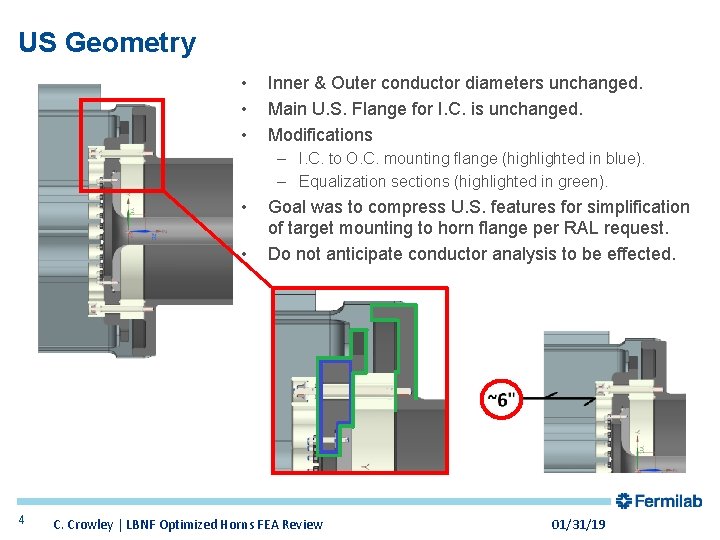
US Geometry • • • Inner & Outer conductor diameters unchanged. Main U. S. Flange for I. C. is unchanged. Modifications – I. C. to O. C. mounting flange (highlighted in blue). – Equalization sections (highlighted in green). • • 4 Goal was to compress U. S. features for simplification of target mounting to horn flange per RAL request. Do not anticipate conductor analysis to be effected. C. Crowley | LBNF Optimized Horns FEA Review 01/31/19
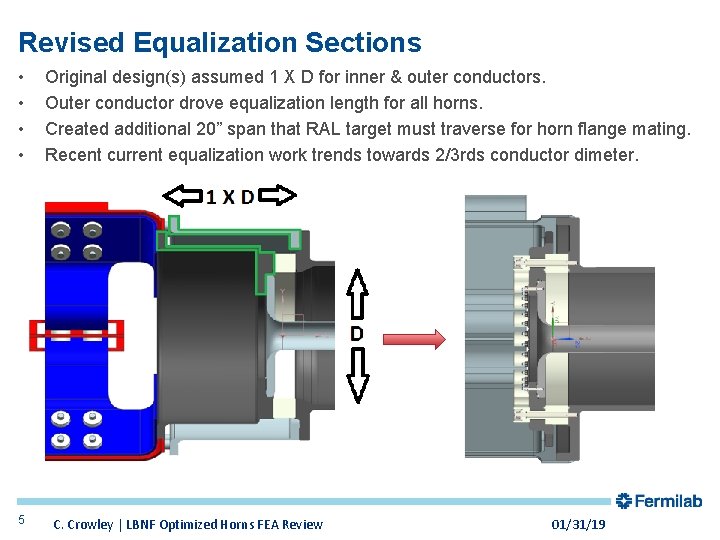
Revised Equalization Sections • • 5 Original design(s) assumed 1 X D for inner & outer conductors. Outer conductor drove equalization length for all horns. Created additional 20” span that RAL target must traverse for horn flange mating. Recent current equalization work trends towards 2/3 rds conductor dimeter. C. Crowley | LBNF Optimized Horns FEA Review 01/31/19
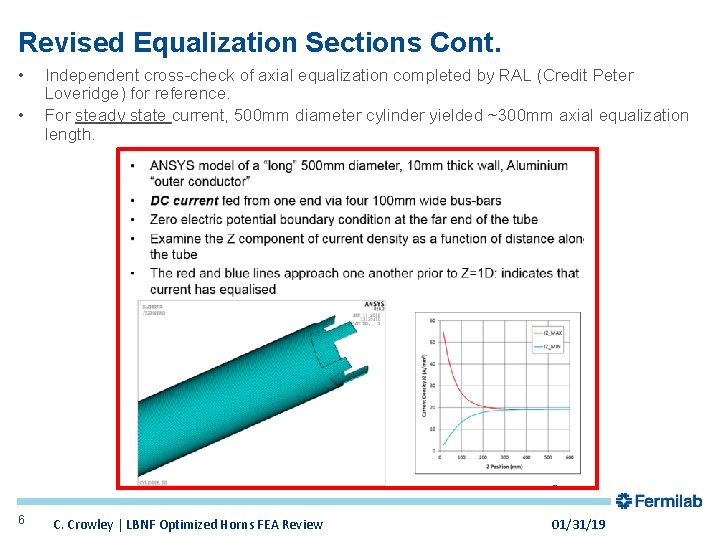
Revised Equalization Sections Cont. • • 6 Independent cross-check of axial equalization completed by RAL (Credit Peter Loveridge) for reference. For steady state current, 500 mm diameter cylinder yielded ~300 mm axial equalization length. C. Crowley | LBNF Optimized Horns FEA Review 01/31/19
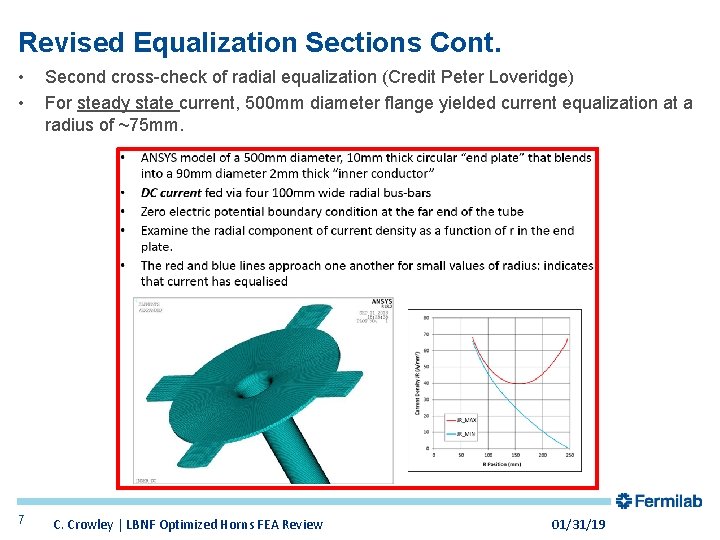
Revised Equalization Sections Cont. • • 7 Second cross-check of radial equalization (Credit Peter Loveridge) For steady state current, 500 mm diameter flange yielded current equalization at a radius of ~75 mm. C. Crowley | LBNF Optimized Horns FEA Review 01/31/19
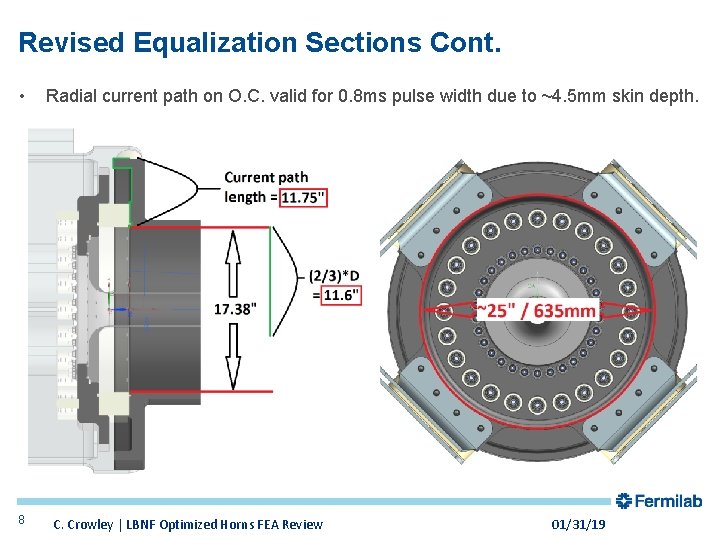
Revised Equalization Sections Cont. • 8 Radial current path on O. C. valid for 0. 8 ms pulse width due to ~4. 5 mm skin depth. C. Crowley | LBNF Optimized Horns FEA Review 01/31/19
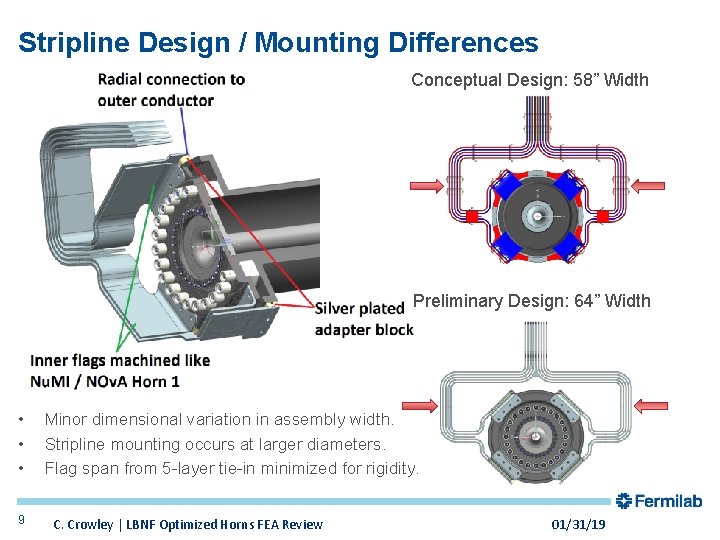
Stripline Design / Mounting Differences Conceptual Design: 58” Width Preliminary Design: 64” Width • • • 9 Minor dimensional variation in assembly width. Stripline mounting occurs at larger diameters. Flag span from 5 -layer tie-in minimized for rigidity. C. Crowley | LBNF Optimized Horns FEA Review 01/31/19
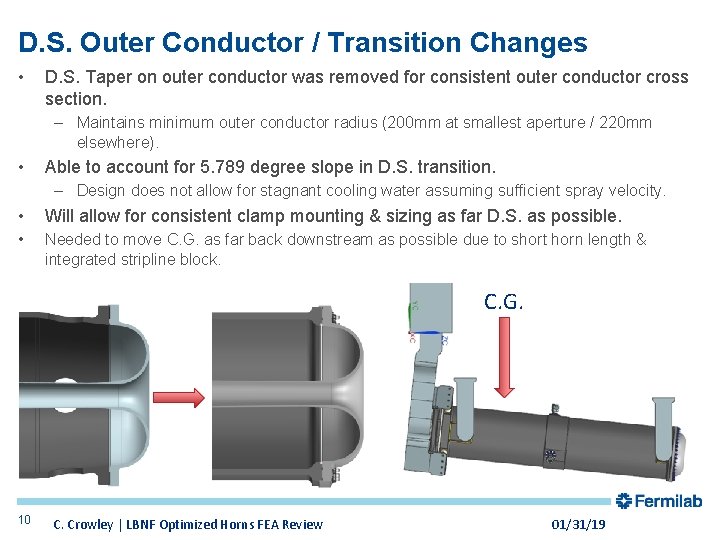
D. S. Outer Conductor / Transition Changes • D. S. Taper on outer conductor was removed for consistent outer conductor cross section. – Maintains minimum outer conductor radius (200 mm at smallest aperture / 220 mm elsewhere). • Able to account for 5. 789 degree slope in D. S. transition. – Design does not allow for stagnant cooling water assuming sufficient spray velocity. • Will allow for consistent clamp mounting & sizing as far D. S. as possible. • Needed to move C. G. as far back downstream as possible due to short horn length & integrated stripline block. C. G. 10 C. Crowley | LBNF Optimized Horns FEA Review 01/31/19
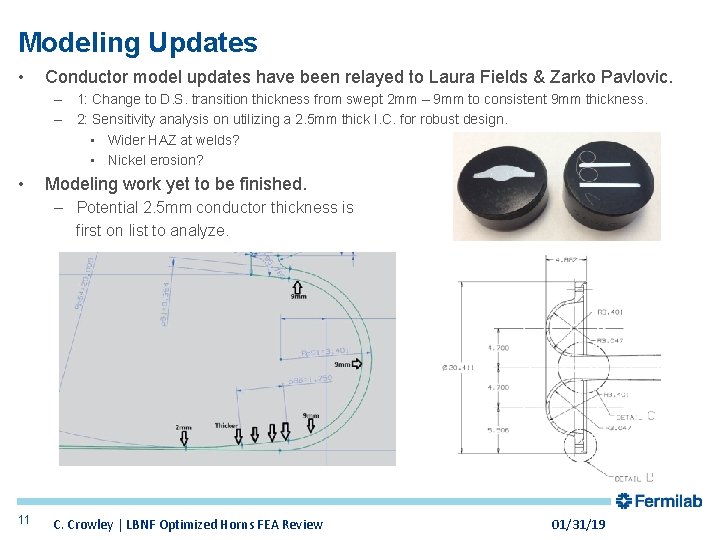
Modeling Updates • Conductor model updates have been relayed to Laura Fields & Zarko Pavlovic. – 1: Change to D. S. transition thickness from swept 2 mm – 9 mm to consistent 9 mm thickness. – 2: Sensitivity analysis on utilizing a 2. 5 mm thick I. C. for robust design. • Wider HAZ at welds? • Nickel erosion? • Modeling work yet to be finished. – Potential 2. 5 mm conductor thickness is first on list to analyze. 11 C. Crowley | LBNF Optimized Horns FEA Review 01/31/19
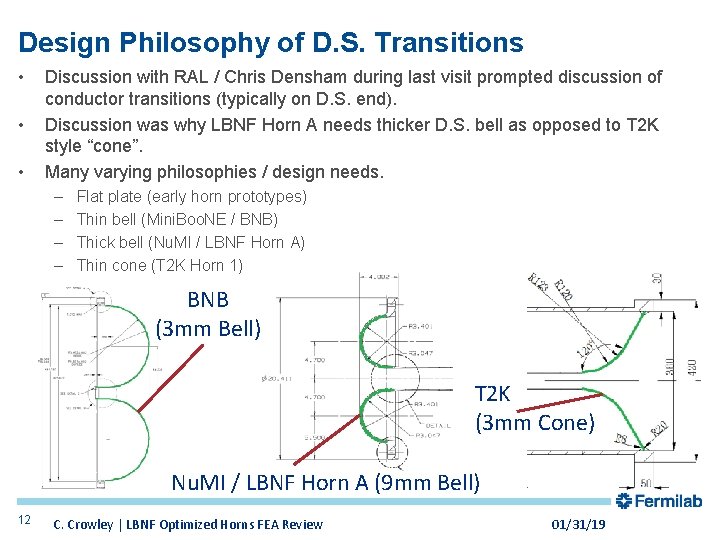
Design Philosophy of D. S. Transitions • • • Discussion with RAL / Chris Densham during last visit prompted discussion of conductor transitions (typically on D. S. end). Discussion was why LBNF Horn A needs thicker D. S. bell as opposed to T 2 K style “cone”. Many varying philosophies / design needs. – – Flat plate (early horn prototypes) Thin bell (Mini. Boo. NE / BNB) Thick bell (Nu. MI / LBNF Horn A) Thin cone (T 2 K Horn 1) BNB (3 mm Bell) T 2 K (3 mm Cone) Nu. MI / LBNF Horn A (9 mm Bell) 12 C. Crowley | LBNF Optimized Horns FEA Review 01/31/19
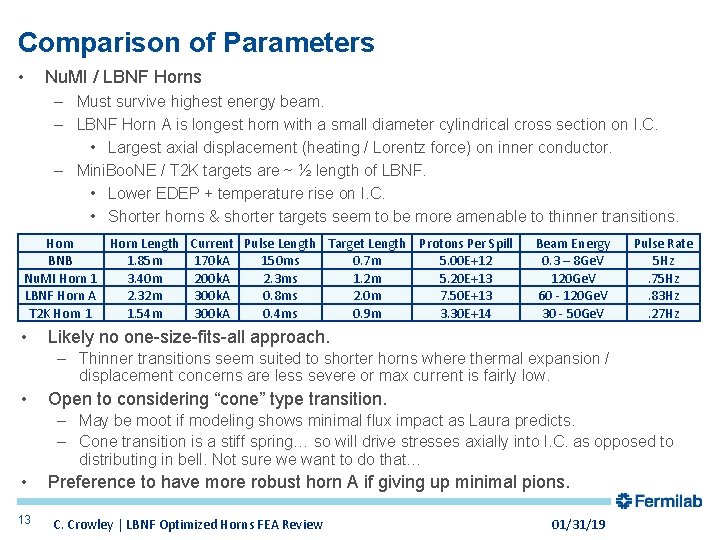
Comparison of Parameters • Nu. MI / LBNF Horns – Must survive highest energy beam. – LBNF Horn A is longest horn with a small diameter cylindrical cross section on I. C. • Largest axial displacement (heating / Lorentz force) on inner conductor. – Mini. Boo. NE / T 2 K targets are ~ ½ length of LBNF. • Lower EDEP + temperature rise on I. C. • Shorter horns & shorter targets seem to be more amenable to thinner transitions. Horn Length Current Pulse Length Target Length Protons Per Spill BNB 1. 85 m 170 k. A 150 ms 0. 7 m 5. 00 E+12 Nu. MI Horn 1 3. 40 m 200 k. A 2. 3 ms 1. 2 m 5. 20 E+13 LBNF Horn A 2. 32 m 300 k. A 0. 8 ms 2. 0 m 7. 50 E+13 T 2 K Horn 1 1. 54 m 300 k. A 0. 4 ms 0. 9 m 3. 30 E+14 • Beam Energy 0. 3 – 8 Ge. V 120 Ge. V 60 - 120 Ge. V 30 - 50 Ge. V Pulse Rate 5 Hz. 75 Hz. 83 Hz. 27 Hz Likely no one-size-fits-all approach. – Thinner transitions seem suited to shorter horns where thermal expansion / displacement concerns are less severe or max current is fairly low. • Open to considering “cone” type transition. – May be moot if modeling shows minimal flux impact as Laura predicts. – Cone transition is a stiff spring… so will drive stresses axially into I. C. as opposed to distributing in bell. Not sure we want to do that… • 13 Preference to have more robust horn A if giving up minimal pions. C. Crowley | LBNF Optimized Horns FEA Review 01/31/19
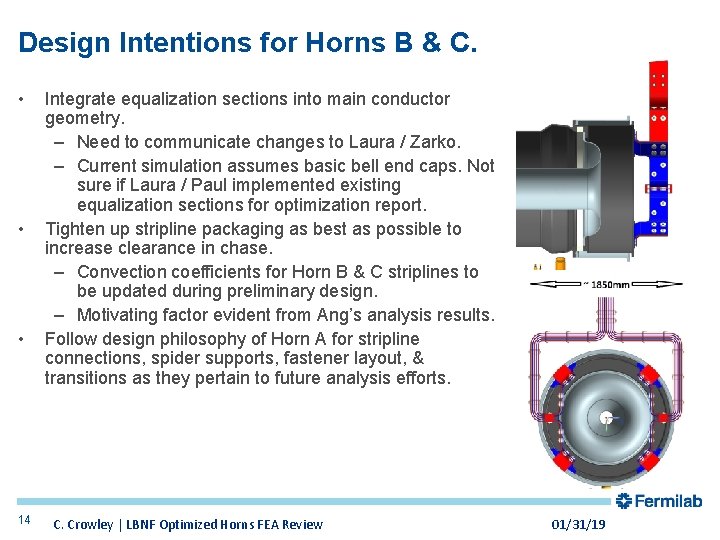
Design Intentions for Horns B & C. • • • 14 Integrate equalization sections into main conductor geometry. – Need to communicate changes to Laura / Zarko. – Current simulation assumes basic bell end caps. Not sure if Laura / Paul implemented existing equalization sections for optimization report. Tighten up stripline packaging as best as possible to increase clearance in chase. – Convection coefficients for Horn B & C striplines to be updated during preliminary design. – Motivating factor evident from Ang’s analysis results. Follow design philosophy of Horn A for stripline connections, spider supports, fastener layout, & transitions as they pertain to future analysis efforts. C. Crowley | LBNF Optimized Horns FEA Review 01/31/19
Summary • Preliminary design revisions for Horn A have been minimal thus far. – Primarily focused on compressing U. S. features. – Different stripline mounting method (for O. C. ). • Existing analysis is useful guide for finishing design. – Fastener locations for new stripline will be matched to conceptual model analyzed. – Horn mounts are treated as rigid connections, so likely not much stress variance compared to existing analysis. • Horns schedule / cost accounts for revised analysis efforts at end of final design. • Need to capture as much group input as possible for implementation into both Horn A (current work item) & Horns B / C for subsequent preliminary design. • Details of modeling update from Laura / Zarko / John (RAL) will be advertised ASAP when complete to help constrain design. 15 C. Crowley | LBNF Optimized Horns FEA Review 01/31/19
- Slides: 15