
Consideration Make yourself necessary to someone Ralph Waldo
- Slides: 20
Consideration “Make yourself necessary to someone. ” Ralph Waldo Emerson, The Conduct of Life (1860)
Learning Objectives • Elements of consideration – Legal value – Bargained-for exchange • Exchanges that fail to meet consideration • Exceptions to consideration requirement 12 - 2
Elements of Consideration • Consideration is legal value bargained for and given in exchange for an act or a promise • Consideration in the form of an act or promise may have legal value if the person 12 - 3 – Refrains from doing something the person has the legal right to do – Does something the person had no
Bargained-for Exchange • A promisee’s act or promise must have been bargained for and given in exchange for the promisor’s promise – Example: Gottlieb v. Tropicana Hotel and Casino in which participating in a promotion that benefited the company was adequate consideration to form a contract 12 - 4
Illusory Promises • If promisee’s promise really does not bind promisee to do or refrain from doing a thing, promise is illusory and cannot serve as consideration – See Heye v. American 12 - 5
No Consideration • Generally, performing or agreeing to perform a preexisting duty is not consideration – Promisor effectively made gratuitous promise – Includes public duties (obey the law) and preexisting contractual duties • Past consideration is an act or benefit given in the past that was not given in exchange for the promise in question, 12 - 6 thus it cannot be consideration
Reality of Consent “Necessity never made a good bargain. ” Benjamin Franklin, 1735
Learning Objectives • Five doctrines that permit people to avoid their contracts because of the absence of real consent: – Misrepresentation – Fraud – Mistake – Duress, and – Undue influence 13 - 8
Effect of Doctrines • Contracts induced by mistake, fraud, misrepresentation, duress, or undue influence are generally considered to be voidable – Person claiming non-consent has power to rescind (cancel) the contract – Person claiming non-consent must not act in a manner to ratify (affirm) the contract 13 - 9
Misrepresentation or Fraud? • A misrepresentation is a false statement and may be negligent (innocent) or fraudulent (knowledge of falsity and intent to deceive) • Elements: – Defendant made an untrue assertion of fact – Fact asserted was material or was fraudulent 13 - 10
Mistake & Duress • A mistake is a belief about a fact that is not in accord with the truth – A unilateral mistake will not render a contract unenforceable unless unequal bargaining position existed • Duress is wrongful threat or act that coerces a person to enter or modify contract – Physical, emotional, or economic harm 13 - 11
Undue Influence • Undue influence involves wrongful pressure exerted on a person during the bargaining process – Pressure exerted through persuasion rather than coercion 13 - 12
Capacity to Contract “No brilliance is needed in the law. Nothing but common sense, and relatively clean fingernails. ” John Mortimer
Learning Objectives • The meaning of capacity • The classes of persons without capacity • The rights to disaffirm or ratify • The duties of disaffirmance 14 - 14
Definition • Person must have ability to give consent before being legally bound to agreement, thus capacity is the ability to incur legal obligations and acquire legal rights • A person who contracts 14 - 15 without necessary
The Lack of Capacity • Status incapacity refers to minors, factual incapacity includes those suffering from a mental disability and intoxicated persons • Contract in which one party lacks capacity is voidable at the option of person lacking capacity • Right to avoid a contract is 14 - 16 disaffirmance
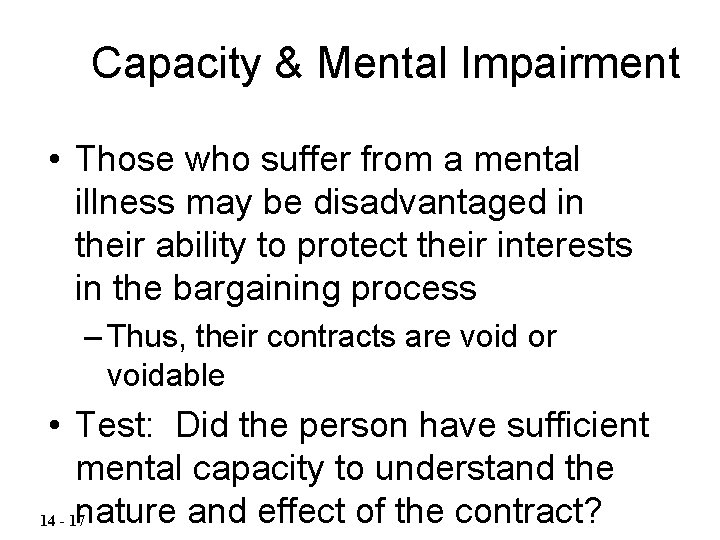
Capacity & Mental Impairment • Those who suffer from a mental illness may be disadvantaged in their ability to protect their interests in the bargaining process – Thus, their contracts are void or voidable • Test: Did the person have sufficient mental capacity to understand the nature and effect of the contract? 14 - 17
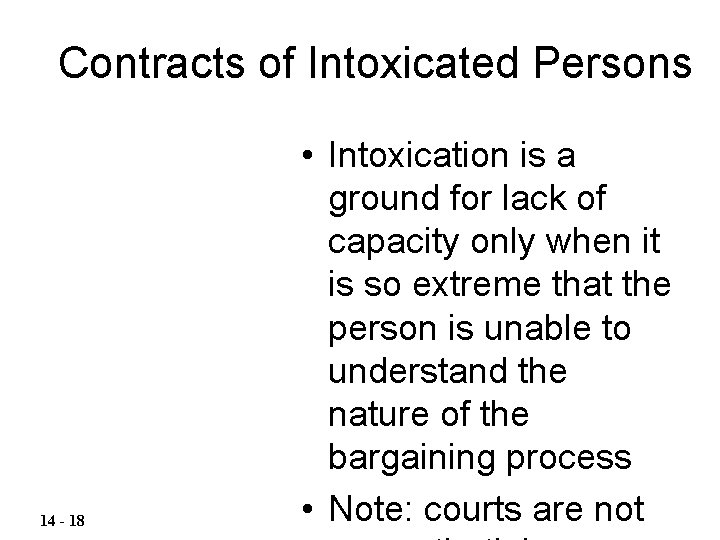
Contracts of Intoxicated Persons 14 - 18 • Intoxication is a ground for lack of capacity only when it is so extreme that the person is unable to understand the nature of the bargaining process • Note: courts are not
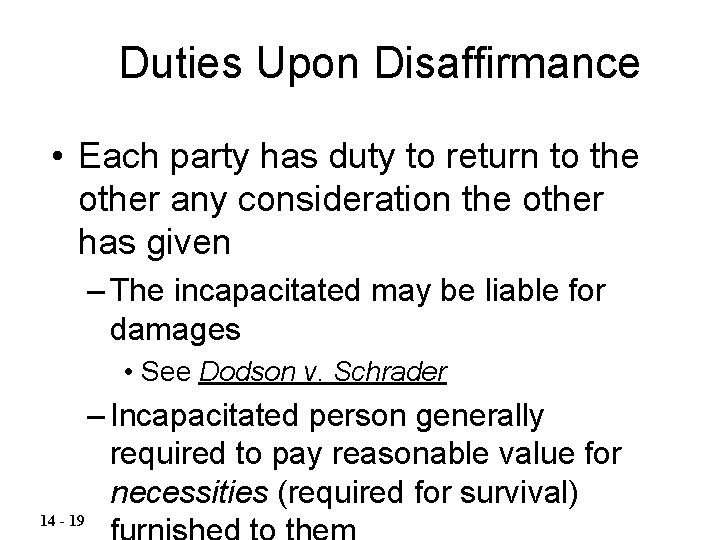
Duties Upon Disaffirmance • Each party has duty to return to the other any consideration the other has given – The incapacitated may be liable for damages • See Dodson v. Schrader – Incapacitated person generally required to pay reasonable value for necessities (required for survival) 14 - 19
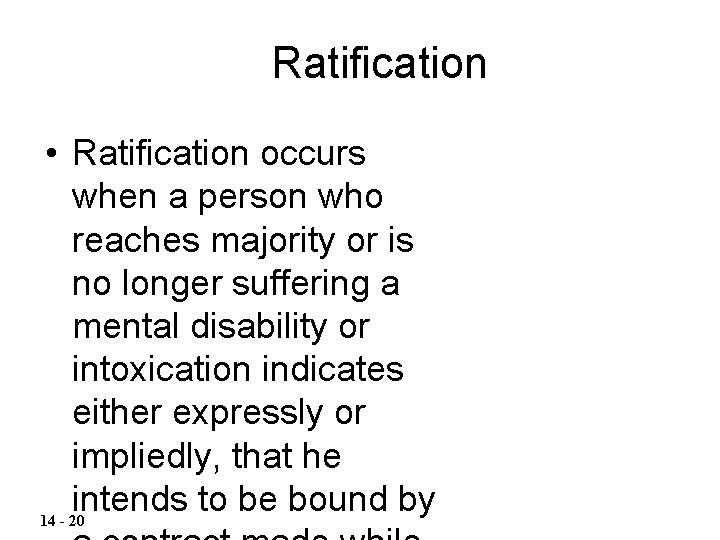
Ratification • Ratification occurs when a person who reaches majority or is no longer suffering a mental disability or intoxication indicates either expressly or impliedly, that he intends to be bound by 14 - 20