
Conserving Wildlife and Wildlife Habitat Lesson Plan NRES
Conserving Wildlife and Wildlife Habitat Lesson Plan: NRES C 4 -2 1
Anticipated Problems 1. What are the effects of pollution on wildlife? 2. In what ways can habitat be destroyed? 3. What are some national conservation policies affecting wildlife? 4. What are some examples of wildlife conservation management? 5. What are the steps in developing a wildlife management plan? 6. What are some small area management practices? 2
Terms l l l l l 3 Banding Biological magnification Direct effects Forest service Girdling Habitat management plan Indirect effects Lacey Act Mast
Terms l l l l l 4 National park service Pittman-Robertson Act Shelterbelt Snag Vegetation survey Wildlife population survey Wildlife refuge system Woodland Woodlot
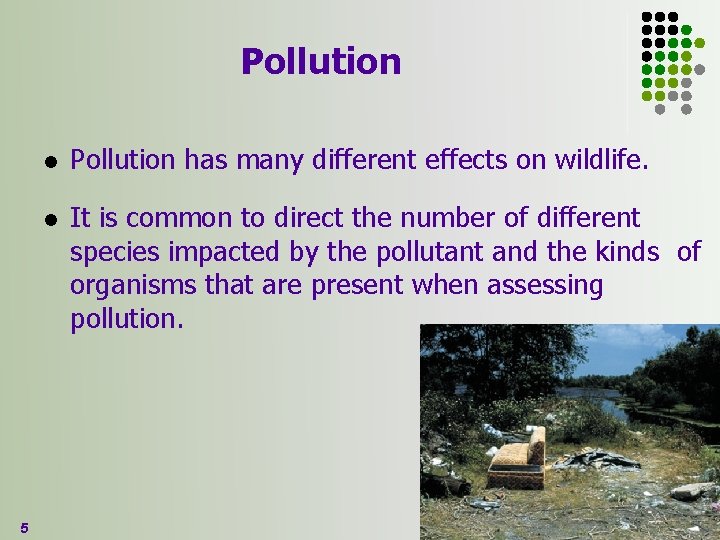
Pollution 5 l Pollution has many different effects on wildlife. l It is common to direct the number of different species impacted by the pollutant and the kinds of organisms that are present when assessing pollution.
Biological Magnification l l Pollutants are measured through biological magnification. Biological magnification is the process in the food chain where pollutants increase to a concentrated level. 6
Direct Effects l Pollution can have direct effects on wildlife. l Direct effects are those that are initially present in the species. 7 l Disease l Physical impairements l Infertility

Indirect Effects l Pollution can have indirect effects on wildlife. l Indirect effects of pollution on wildlife includes habitat that fails in its support of the species. 8 l Damaged habitat – inadequate shelter l Unable to obtain the needed nutrients
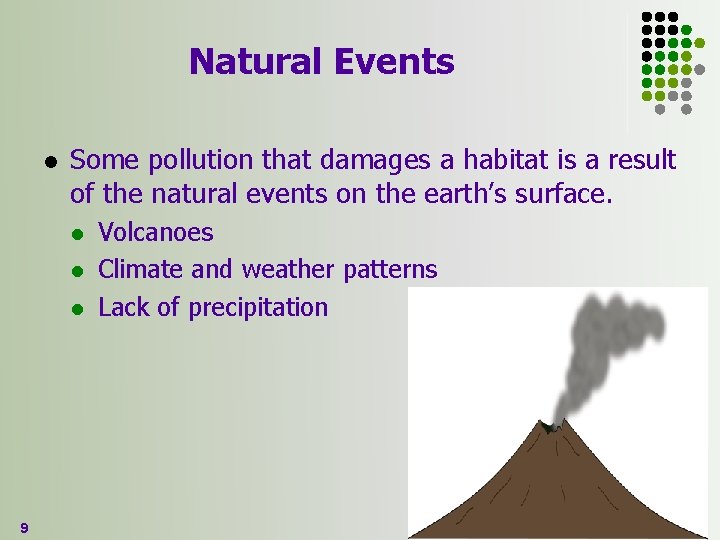
Natural Events l Some pollution that damages a habitat is a result of the natural events on the earth’s surface. l l l 9 Volcanoes Climate and weather patterns Lack of precipitation
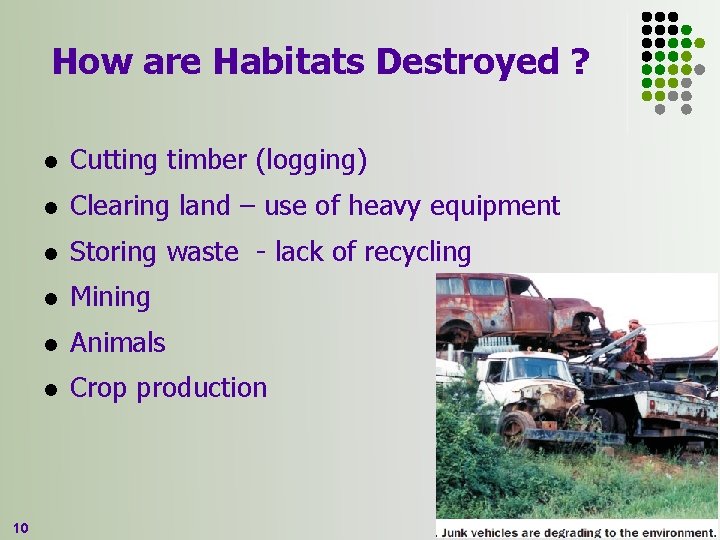
How are Habitats Destroyed ? 10 l Cutting timber (logging) l Clearing land – use of heavy equipment l Storing waste - lack of recycling l Mining l Animals l Crop production
Natural Conservation Policies l 11 The National Park Service was established in 1916. l 330 protected areas such as Yosemite, Sequoia, the Great Smoky Mountains, Carlsbad Caverns l Oversees monuments and parkways
Natural Conservation Policies l 12 The Lacey Act was passed in 1900 as the Game Bird and Wild Bird Preservation Act. l Regulates the shipment of illegally killed animals and international trade of protected wildlife l The Migratory Bird Hunting Stamp Act (1934)
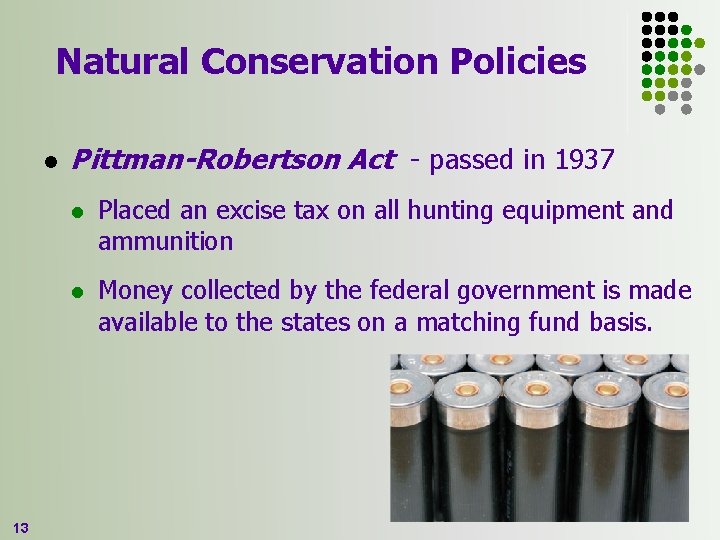
Natural Conservation Policies l 13 Pittman-Robertson Act - passed in 1937 l Placed an excise tax on all hunting equipment and ammunition l Money collected by the federal government is made available to the states on a matching fund basis.
Natural Conservation Policies l 14 A Wildlife Refuge System was organized in 1966 as part of the U. S. Fish and Wildlife Service. l More than 400 refuges that contain vast land areas in the US l The National Park Service and the Fish and Wildlife Service are part of the U. S. Dept of the Interior.
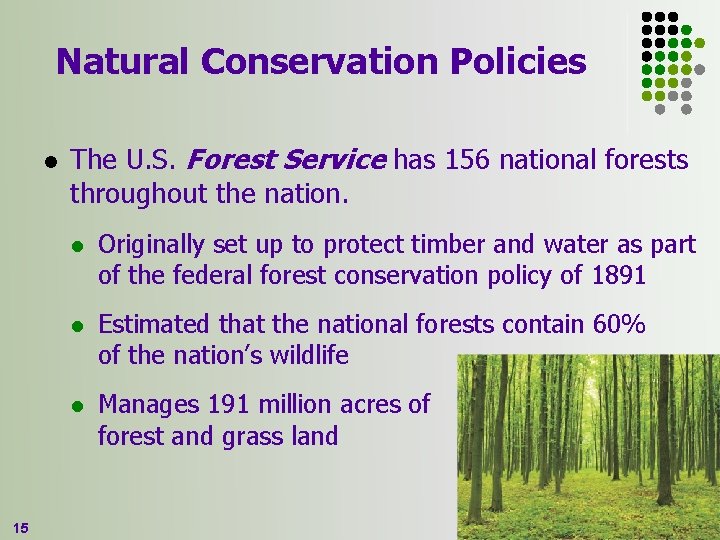
Natural Conservation Policies l 15 The U. S. Forest Service has 156 national forests throughout the nation. l Originally set up to protect timber and water as part of the federal forest conservation policy of 1891 l Estimated that the national forests contain 60% of the nation’s wildlife l Manages 191 million acres of forest and grass land
Wildlife Conservation Banding l Bird banding is used to provide information on migration routes and the numbers of birds that survive each year. l Banding is placing a band around the leg of a bird to identify it for study. l l l 16 Captured in traps or with rocket-propelled nets Bands attach to their legs before they are released Ensures bird populations are maintained
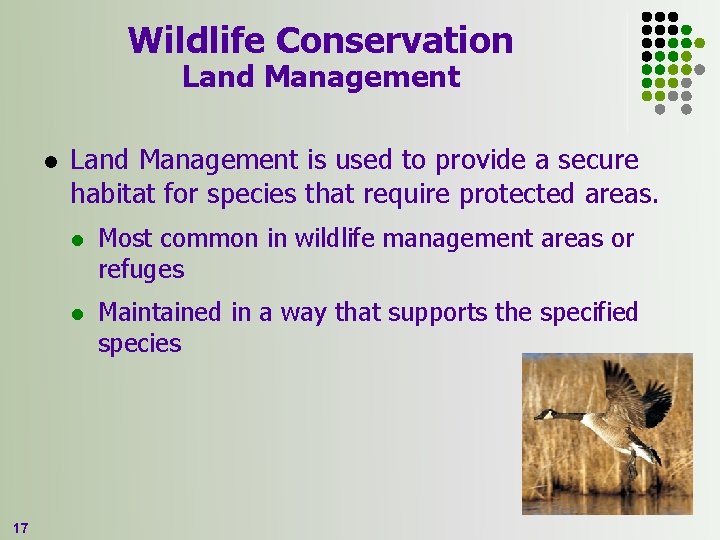
Wildlife Conservation Land Management l 17 Land Management is used to provide a secure habitat for species that require protected areas. l Most common in wildlife management areas or refuges l Maintained in a way that supports the specified species
Wildlife Conservation Trapping & Transplanting l 18 Trapping and transplanting are processes used to boost low populations or to develop a new population. l Trapping animals in highly populated areas and moving them to another suitable location l The animals are expected to reproduce and increase in population numbers.
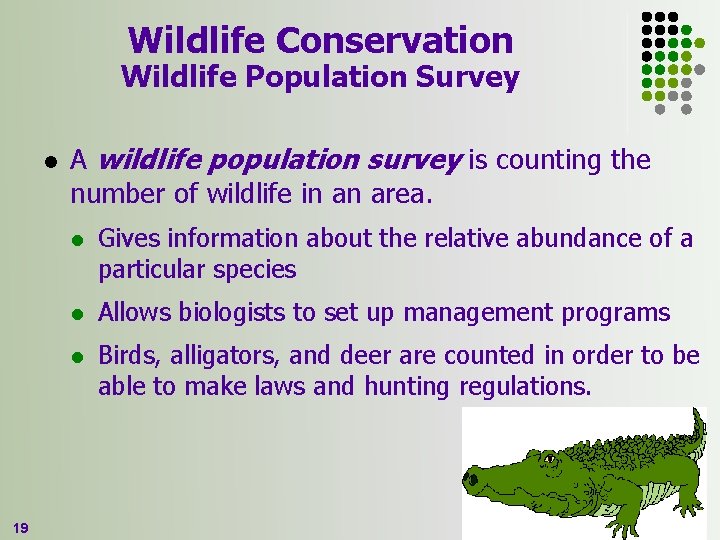
Wildlife Conservation Wildlife Population Survey l 19 A wildlife population survey is counting the number of wildlife in an area. l Gives information about the relative abundance of a particular species l Allows biologists to set up management programs l Birds, alligators, and deer are counted in order to be able to make laws and hunting regulations.
Wildlife Conservation Vegetation Survey l 20 A vegetation survey determines the kinds and amounts of vegetation present in important wildlife areas. l To make certain the plants needed by wildlife are in adequate supply l To make sure there is no danger of the plant supply being depleted
Habitat Management Plan l 21 A habitat management plan is a written document describing the needs of an area to improve a habitat for a featured species and specifies how and when the work will be done. l Often require several years to implement l Without a good plan money and time may be wasted on projects that do not give good results
22
Habitat Management Plan Step 1 l 23 Animal inventory - Make a list of the animal wildlife in the area, including: l A short description of the species l The size of the population
Habitat Management Plan Step 2 l 24 Plant inventory - Make a list of the plant species and the number found. l Animals depend on these plants for food l A note should also be made where the plant materials are typically found.
Habitat Management Plan Step 3 l 25 An analysis should be made on the plant and animal inventories. l A comparison should be made on what is found with the climate and other conditions that species need to flourish. l Costs and benefits should be estimated l Assess what can be done quickly and at a low cost
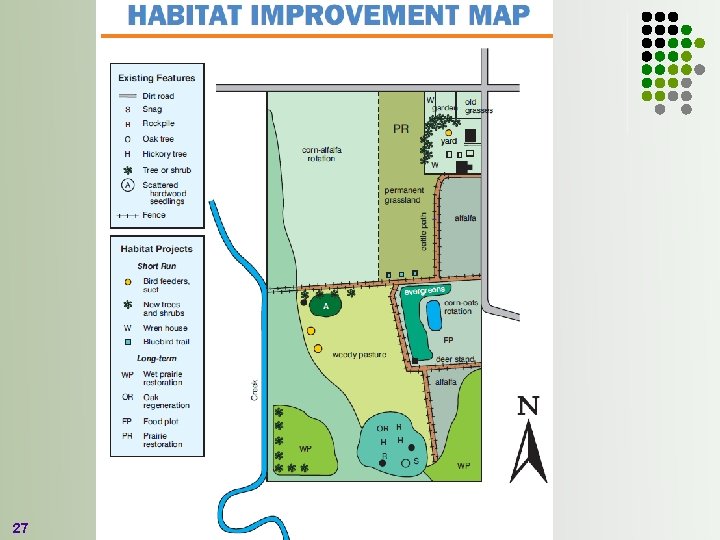
Habitat Management Plan Step 4 l 26 A map should be prepared of the area selected for improvement. l Show streams, trees, and elevation changes l Improvement locations should be marked on the map.
27
Habitat Management Plan Step 5 l 28 A plan should be written that lists the goals to be achieved and how they will be done. l Should be indicated as short-term or long-term l Describe how and when the projects will be carried out
Habitat Management Plan Step 6 l 29 A regular assessment on the progress and the results should be made of the habitat improvement. l Make the needed changes l Use experts assistance if necessary
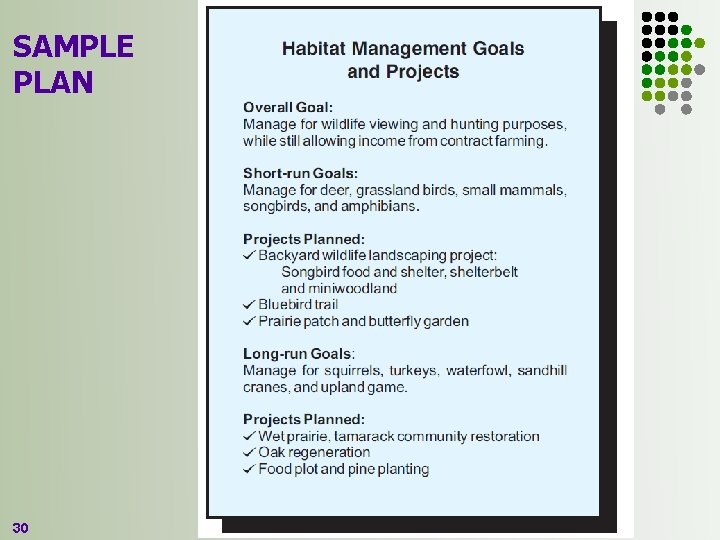
SAMPLE PLAN 30
Small Area Management Practices l 31 Woodland is land that has some covering of trees. l Often has a variety of stages of maturity and mixed species. l Forests that have the same woodland characteristics with uniform species at the same stage of growth are called tree farms.
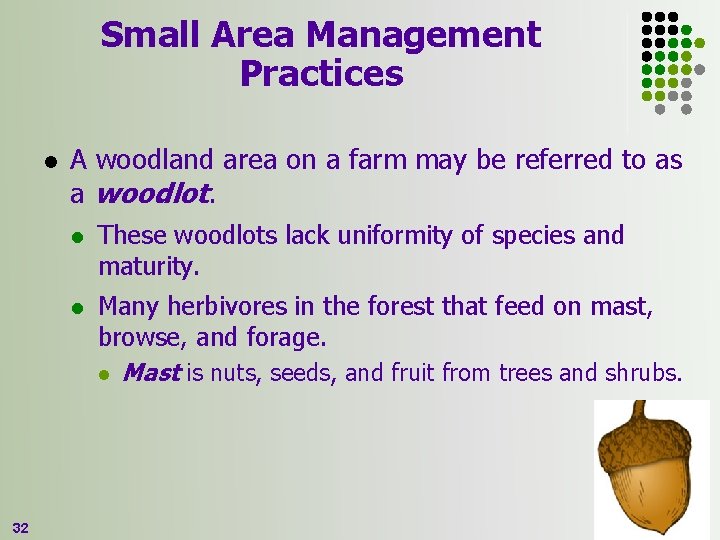
Small Area Management Practices l 32 A woodland area on a farm may be referred to as a woodlot. l These woodlots lack uniformity of species and maturity. l Many herbivores in the forest that feed on mast, browse, and forage. l Mast is nuts, seeds, and fruit from trees and shrubs.
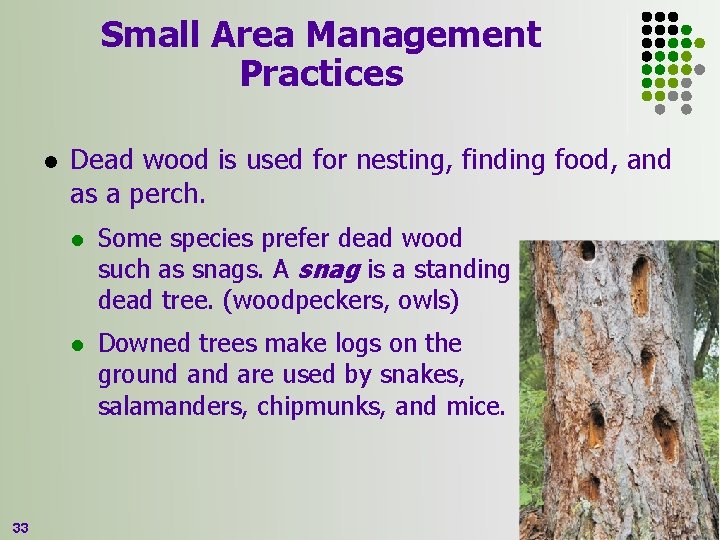
Small Area Management Practices l 33 Dead wood is used for nesting, finding food, and as a perch. l Some species prefer dead wood such as snags. A snag is a standing dead tree. (woodpeckers, owls) l Downed trees make logs on the ground are used by snakes, salamanders, chipmunks, and mice.
Small Area Management Practices l The amount of dead wood in an area can be increased by causing the death of live trees or leaving old trees to fall naturally. l Girdling can be used to kill a tree. l Girdling is the cutting a small trench around the circumference of a tree trunk. 34
Small Area Management Practices l 35 Brush piles attract fox, skunks, rabbits, snakes and many other species. l Made of twigs, logs, limbs, stones, other materials. l Can be created artificially to serve as habitats for many animals
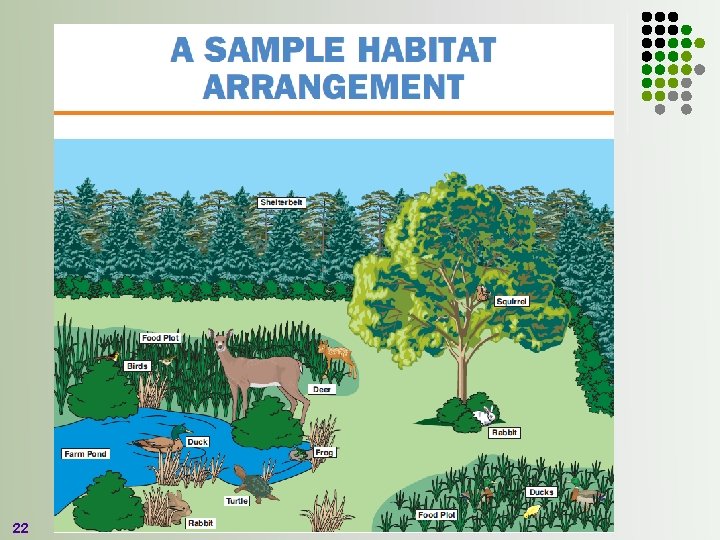
Small Area Management Practices l A shelterbelt (or windbreak) is a row or several parallel rows of trees and shrubs planted to reduce wild currents and drifting snow in northern climates. l 36 Shelterbelts and food plots are helpful in attracting wildlife.
Small Area Management Practices l 37 Grasslands are important for many species of animals. l Wolves, prairie chickens, meadowlarks, badgers l Require moisture than desert land are often used for livestock production. l Cutting once a year should control the growth of scrub trees. l Examples: red clover, alfalfa, wild oats, switch grass
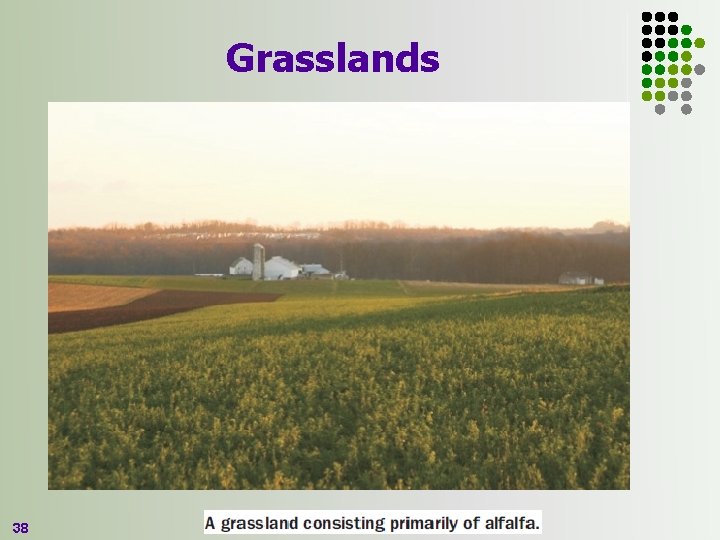
Grasslands 38
Review 1. Name two direct and two indirect effects on wildlife. 2. Explain why and when the Lacey Act was passed. 3. What is bird banding? 4. What is a written document describing the needs of an area to improve a habitat for a featured species? 5. What is the purpose of shelterbelts? 39
- Slides: 39