
Conservatism Russian International Relations Theory Most Influential Russian
- Slides: 21
Conservatism & Russian International Relations Theory
Most Influential Russian IR Theorists �Nikolai Danilevsky (1822 -1885) �Konstantin Leontyev (1831 -1891) �Aleksandr Panarin (1940 -2003)
Binary nature of conservatism �Conservativism as ideology: Belief in universal values – justice, conscience, family, patriotism, etc. �Conservatism as worldview: Positional and organic Particularist – each nation is different; no universal values �Inevitable tension between universalism and particularism
Origins of Russian conservatism �Arose in early 19 th Century �In part an offshoot of Western European conservatism Reaction to Enlightenment rationalism, French revolution etc. �In part also a reaction to process of Westernization This leads to desire to develop Russian culture and identity Which requires a philosophy which asserts nations’ right to distinctive development �Russian conservatism therefore inherently particularist
But … �Russian conservatives often very Westernized See Russia’s future as connected to West Mission to save the West �Russia’s distinctive feature = Russian Orthodoxy But Orthodoxy is universalist �Thus, Russian conservatism is also universalist.
Reconciling the universal and the particular �Russia is the repository of universal truth Must therefore resist West and defend its sovereignty and independent identity for the sake of mankind as a whole, including the West. �The universal good is served by national diversity Rejection of universalism, but not of idea of universal good Anti-universalism gives Russia a universal mission �Support for multipolar world Based on sovereign nations which defend their right to separate development
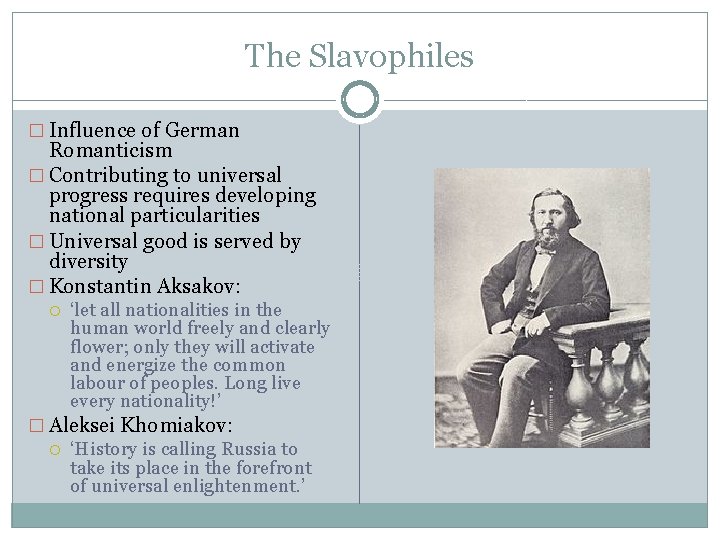
The Slavophiles � Influence of German Romanticism � Contributing to universal progress requires developing national particularities � Universal good is served by diversity � Konstantin Aksakov: ‘let all nationalities in the human world freely and clearly flower; only they will activate and energize the common labour of peoples. Long live every nationality!’ � Aleksei Khomiakov: ‘History is calling Russia to take its place in the forefront of universal enlightenment. ’
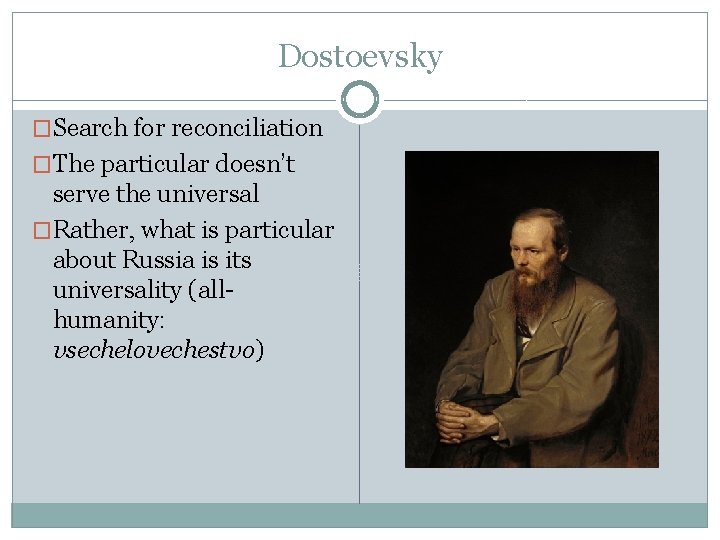
Dostoevsky �Search for reconciliation �The particular doesn’t serve the universal �Rather, what is particular about Russia is its universality (allhumanity: vsechelovechestvo)
Dostoevsky’s letter to Grand Duke Aleksandrovich �We have forgotten that we … contain in ourselves as Russians the capacity perhaps to bring new light to the world, on the condition that our development is independent. … We have forgotten that all great nations displayed their great powers only to the extent that they were arrogant in their assessment of themselves, and precisely in this way they have benefited the world, and each of them has brought something into it, be it only a single ray of light, because they have remained themselves, proud and steady, arrogantly independent.
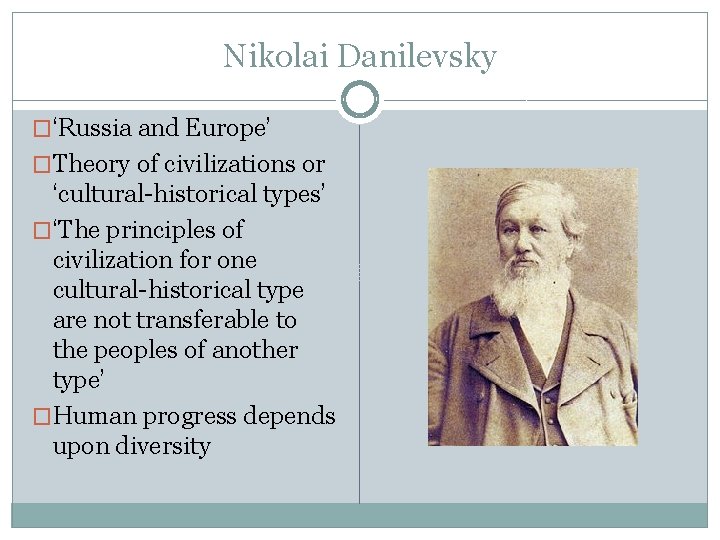
Nikolai Danilevsky �‘Russia and Europe’ �Theory of civilizations or ‘cultural-historical types’ �‘The principles of civilization for one cultural-historical type are not transferable to the peoples of another type’ �Human progress depends upon diversity
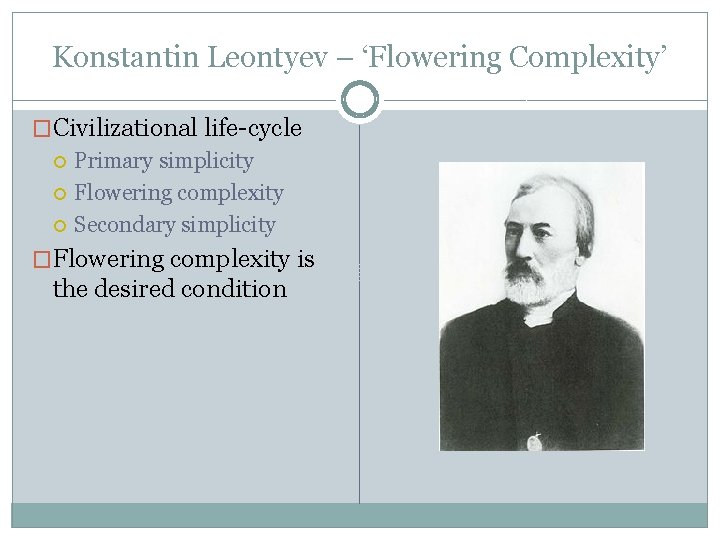
Konstantin Leontyev – ‘Flowering Complexity’ �Civilizational life-cycle Primary simplicity Flowering complexity Secondary simplicity �Flowering complexity is the desired condition
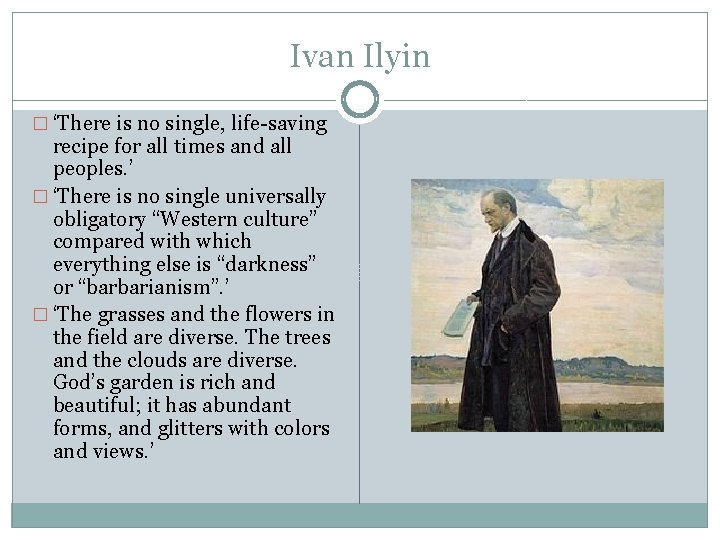
Ivan Ilyin � ‘There is no single, life-saving recipe for all times and all peoples. ’ � ‘There is no single universally obligatory “Western culture” compared with which everything else is “darkness” or “barbarianism”. ’ � ‘The grasses and the flowers in the field are diverse. The trees and the clouds are diverse. God’s garden is rich and beautiful; it has abundant forms, and glitters with colors and views. ’
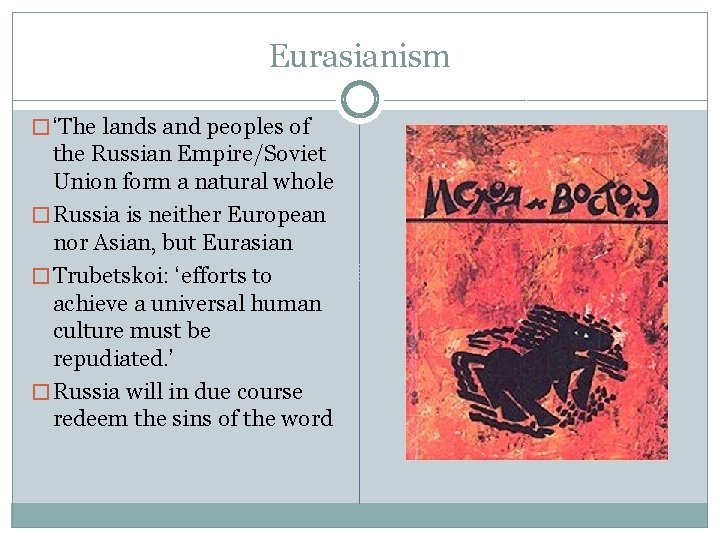
Eurasianism � ‘The lands and peoples of the Russian Empire/Soviet Union form a natural whole � Russia is neither European nor Asian, but Eurasian � Trubetskoi: ‘efforts to achieve a universal human culture must be repudiated. ’ � Russia will in due course redeem the sins of the word
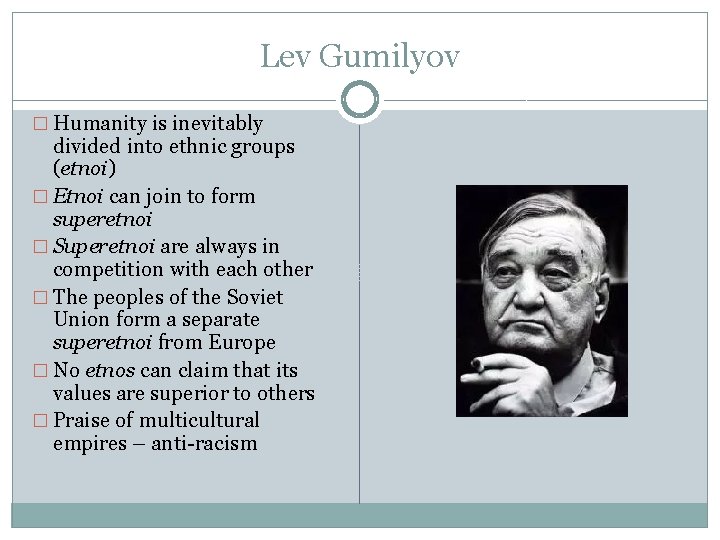
Lev Gumilyov � Humanity is inevitably divided into ethnic groups (etnoi) � Etnoi can join to form superetnoi � Superetnoi are always in competition with each other � The peoples of the Soviet Union form a separate superetnoi from Europe � No etnos can claim that its values are superior to others � Praise of multicultural empires – anti-racism
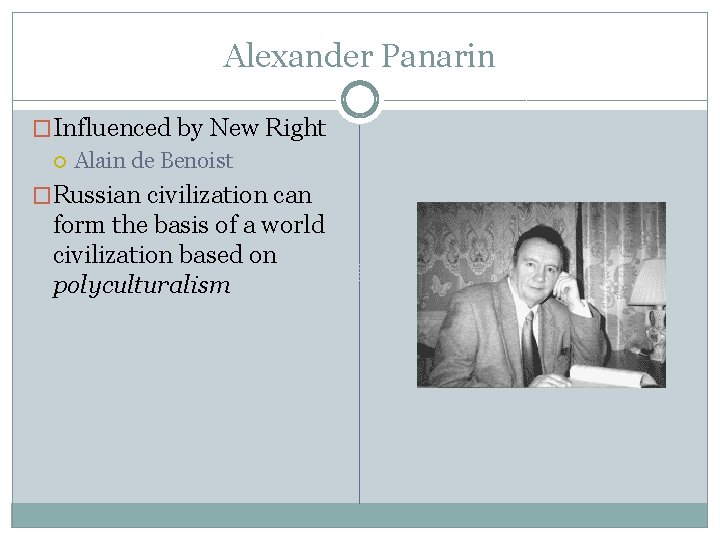
Alexander Panarin �Influenced by New Right Alain de Benoist �Russian civilization can form the basis of a world civilization based on polyculturalism
Alexander Dugin �Combination of Eurasianism and Geopolitics �Russia to forge a global alliance against US hegemony �Katechon Russia as the nation which will shield the world against the Anti-Christ
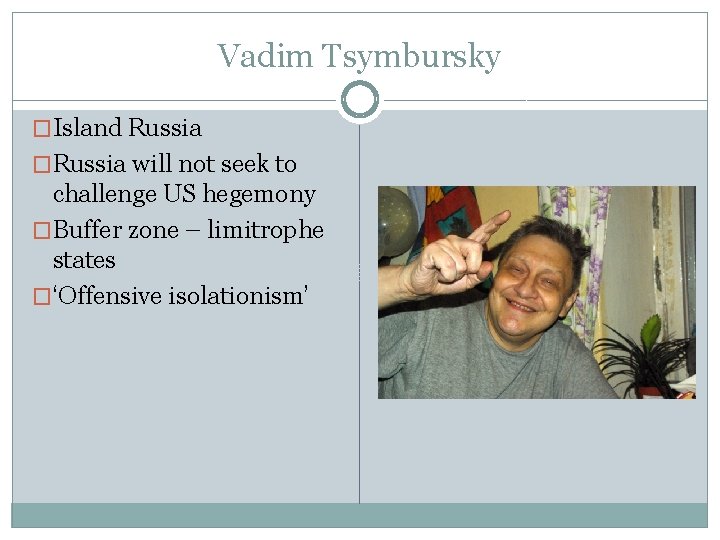
Vadim Tsymbursky �Island Russia �Russia will not seek to challenge US hegemony �Buffer zone – limitrophe states �‘Offensive isolationism’
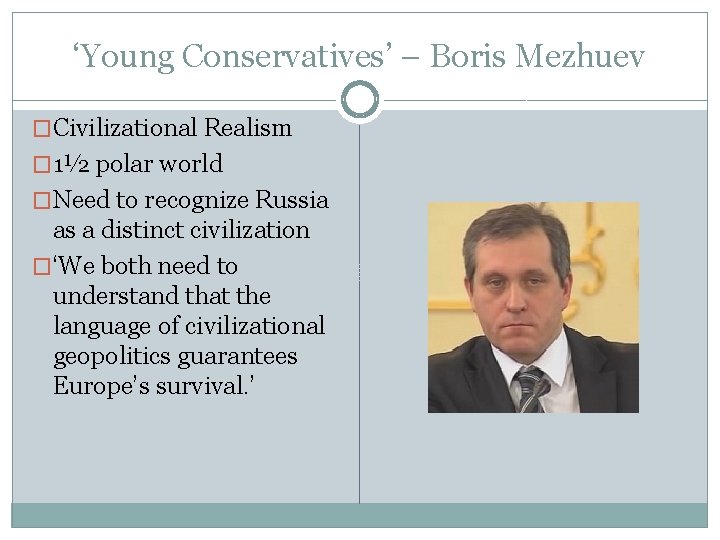
‘Young Conservatives’ – Boris Mezhuev �Civilizational Realism � 1½ polar world �Need to recognize Russia as a distinct civilization �‘We both need to understand that the language of civilizational geopolitics guarantees Europe’s survival. ’
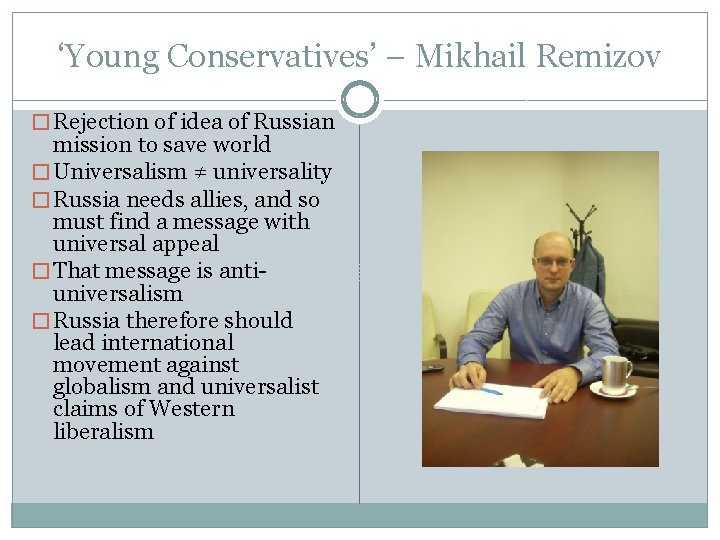
‘Young Conservatives’ – Mikhail Remizov � Rejection of idea of Russian mission to save world � Universalism ≠ universality � Russia needs allies, and so must find a message with universal appeal � That message is antiuniversalism � Russia therefore should lead international movement against globalism and universalist claims of Western liberalism
Conservatism and the Russian state �State conservatism is very different from intellectual conservatism �Russian state rejects conservatives’ anti-globalism �But does share some of conservatives’ perspective �Conservative discourse commonplace among elites: e. g. discourse of ‘civilizations’; idea of polyculturalism �Sergei Lavrov: There are many development models … long-term success can only be achieved on the basis of movement to the partnership of civilizations based on respectful interaction of diverse cultures and religions. �Conservative ideas have seeped into public consciousness
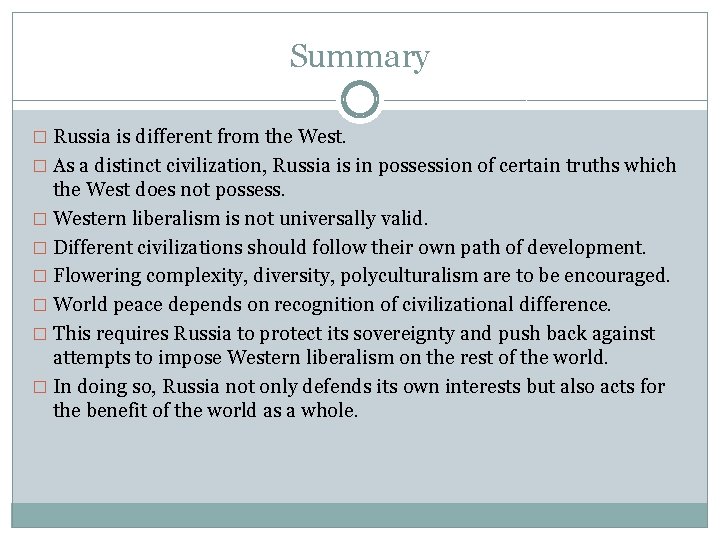
Summary � Russia is different from the West. � As a distinct civilization, Russia is in possession of certain truths which the West does not possess. � Western liberalism is not universally valid. � Different civilizations should follow their own path of development. � Flowering complexity, diversity, polyculturalism are to be encouraged. � World peace depends on recognition of civilizational difference. � This requires Russia to protect its sovereignty and push back against attempts to impose Western liberalism on the rest of the world. � In doing so, Russia not only defends its own interests but also acts for the benefit of the world as a whole.