
Conservatism Liberalism Nationalism 1815 1848 The French Revolution

Conservatism, Liberalism & Nationalism 1815 -1848

• The French Revolution, the Industrial Revolution and the new ideologies of the time period contributed towards change in the political and social attitudes throughout Europe. . .
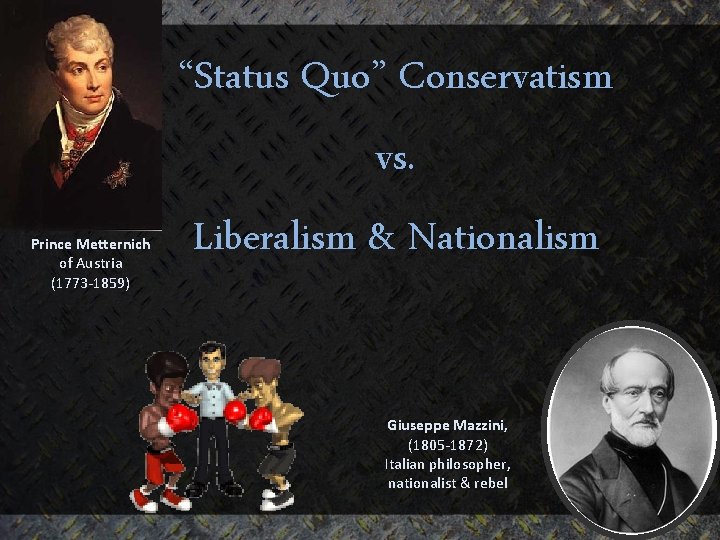
Prince Metternich of Austria (1773 -1859) “Status Quo” Conservatism vs. Liberalism & Nationalism Giuseppe Mazzini, (1805 -1872) Italian philosopher, nationalist & rebel
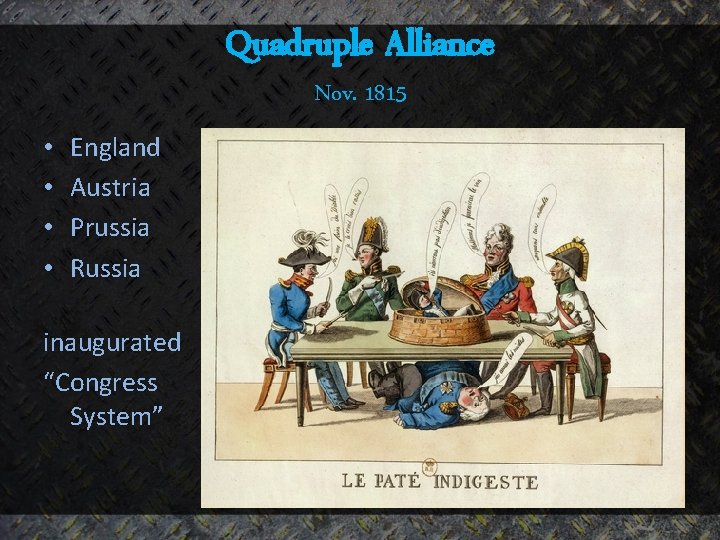
Quadruple Alliance Nov. 1815 • • England Austria Prussia Russia inaugurated “Congress System”
Quintuple Alliance Sept. 1818 • • • England Austria Prussia Russia France
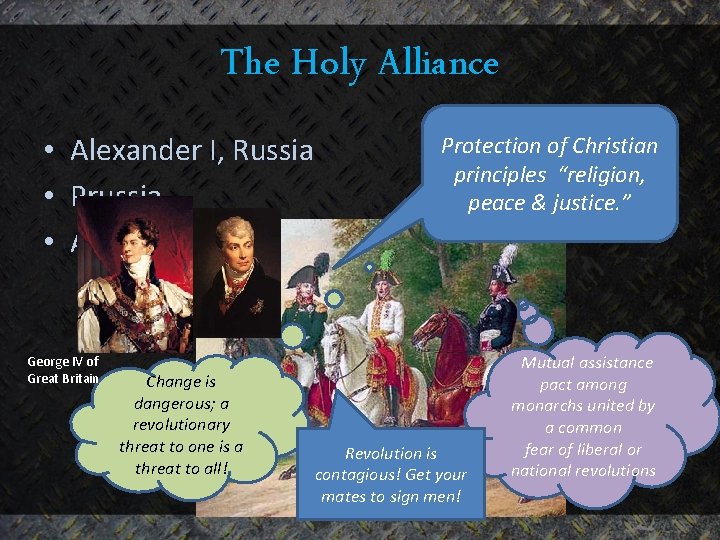
The Holy Alliance • Alexander I, Russia • Prussia • Austria George IV of Great Britain Change is dangerous; a revolutionary threat to one is a threat to all! Protection of Christian principles “religion, peace & justice. ” Revolution is contagious! Get your mates to sign men! Mutual assistance pact among monarchs united by a common fear of liberal or national revolutions
Was there good reason to fear revolutionaries? • Naples 1820 Liberals threaten Austrian authority Metternich + Prussia and Russia endorse • Spain 1820 Liberals rebel against King Ferdinand VII Declare a constitutional monarchy France sends army in; 1823 throne restored • Latin America 1823 US President James Monroe issues Monroe Doctrine British interests (trade) at stake, fleet keeps European nations from western hemisphere. • Greece 1827 - 30 Desire and sympathy for Greek independence from Ottoman Empire of Turkey = Romantics Liberal Britain and France supported + Conservative Russia (power in Slavic areas of the Balkans)
Congress System • No longer acting as a stabilizer • National self-interest replaced European co-operation • Europe divided: Liberal West / Conservative East i. e. 1830 revolt in Belgium united with Holland in 1815, resented Dutch king (Co. V), British & French sympathetic to liberal national revolt, intervened & 1831 Belgium a neutral state, sovereignty guaranteed by mutual agreement.
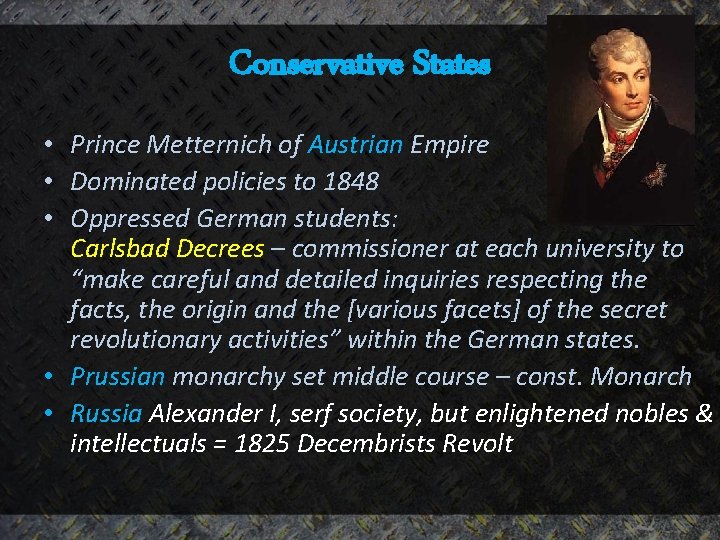
Conservative States • Prince Metternich of Austrian Empire • Dominated policies to 1848 • Oppressed German students: Carlsbad Decrees – commissioner at each university to “make careful and detailed inquiries respecting the facts, the origin and the [various facets] of the secret revolutionary activities” within the German states. • Prussian monarchy set middle course – const. Monarch • Russia Alexander I, serf society, but enlightened nobles & intellectuals = 1825 Decembrists Revolt
Liberal States • England’s Tory (Conservative) Party dealing with serious internal economic slump/crisis of unemployed soldiers & craftsworkers • 1 st Reactionary repression i. e. 1819 Six Acts passed • 1820 s sees change in reforms to collectively bargain, parliament and public office open up to non-Cof. E’s. • Movement for Parliamentary reform, increased representation in House of Commons. • Change by public opinion vs. revolution set precedent • Slavery in British Empire ended in 1833, Ten Hours Act 1847
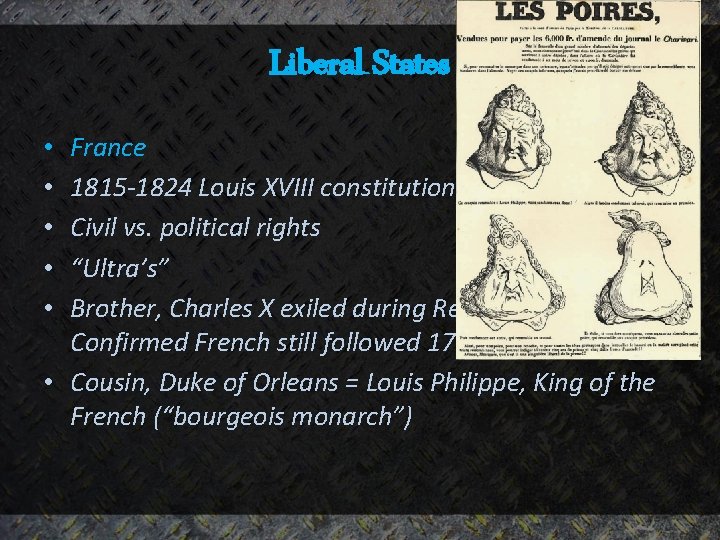
Liberal States France 1815 -1824 Louis XVIII constitutional monarchy Civil vs. political rights “Ultra’s” Brother, Charles X exiled during Revolution of 1830 Confirmed French still followed 1789 ideals • Cousin, Duke of Orleans = Louis Philippe, King of the French (“bourgeois monarch”) • • •
By 1848. . . • Most important areas where people wanted new national states were southern and central Europe. • Upon to 1848, efforts were suppressed & underground • Austrian Empire = Germans, Hungarians, Bohemians, Italians, & others. • Turkish/Ottoman Empire = Balkan Peninsula, Bulgarians, Rumanians, Serbians & others • Russian control = Poles Virtually impossible to sort out distinct groups or “nations. ” Union of Liberalism and Nationalism to oppose Conservatism Rights Duties
- Slides: 12