
Conservation of Mechanical Energy is neither created nor

- Slides: 24
Conservation of Mechanical Energy is neither created nor destroyed. It is only converted to another form of energy. It does not disappear! It only dissipates or scatter in all directions! ME=GPE and KE Eric Angat Teacher http: //www. bbc. co. uk/schools/gcsebitesize/science/add_gateway_pre_2011/forces/themeridesrev 1. shtml
Essential Question How do I explain the relationship between kinetic energy and potential energy and illustrate that total energy is conserved in mechanical systems such as a pendulum, roller coaster, cars/balls on ramps, etc. ?
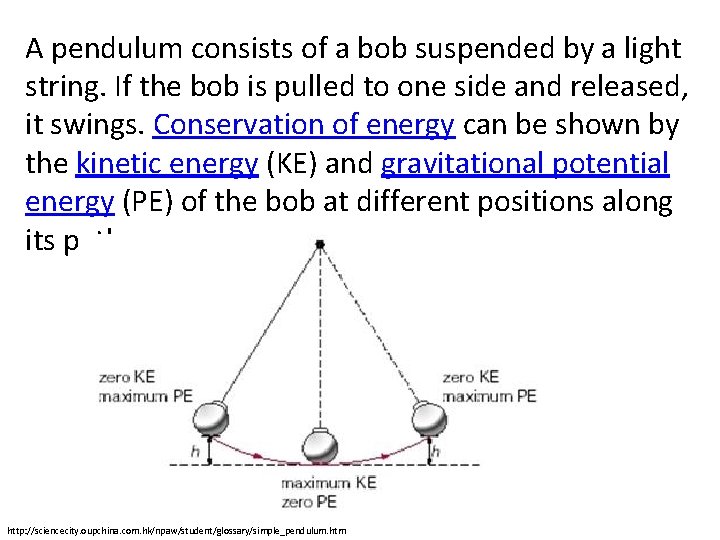
A pendulum consists of a bob suspended by a light string. If the bob is pulled to one side and released, it swings. Conservation of energy can be shown by the kinetic energy (KE) and gravitational potential energy (PE) of the bob at different positions along its path. http: //sciencecity. oupchina. com. hk/npaw/student/glossary/simple_pendulum. htm
Energy can neither be created nor destroyed. http: //www. youtube. com/watch? v=jy. HFXTZm. Wg. I&NR=1&feature=fvwp
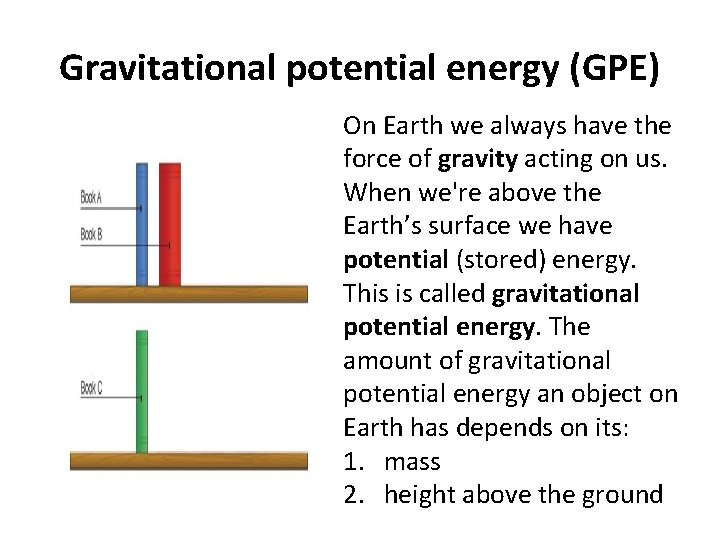
Gravitational potential energy (GPE) On Earth we always have the force of gravity acting on us. When we're above the Earth’s surface we have potential (stored) energy. This is called gravitational potential energy. The amount of gravitational potential energy an object on Earth has depends on its: 1. mass 2. height above the ground
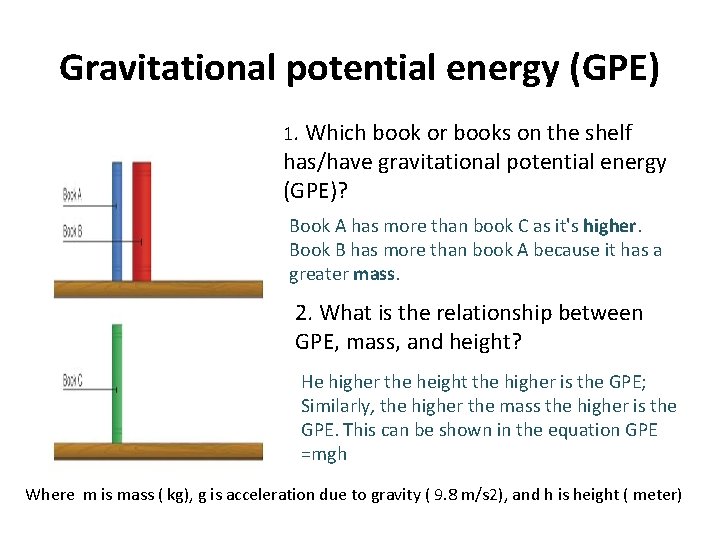
Gravitational potential energy (GPE) 1. Which book or books on the shelf has/have gravitational potential energy (GPE)? Book A has more than book C as it's higher. Book B has more than book A because it has a greater mass. 2. What is the relationship between GPE, mass, and height? He higher the height the higher is the GPE; Similarly, the higher the mass the higher is the GPE. This can be shown in the equation GPE =mgh Where m is mass ( kg), g is acceleration due to gravity ( 9. 8 m/s 2), and h is height ( meter)
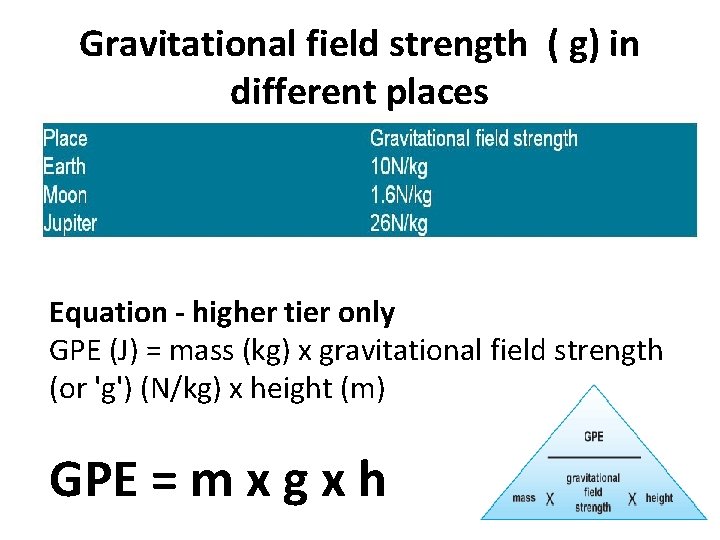
Gravitational field strength ( g) in different places Equation - higher tier only GPE (J) = mass (kg) x gravitational field strength (or 'g') (N/kg) x height (m) GPE = m x g x h
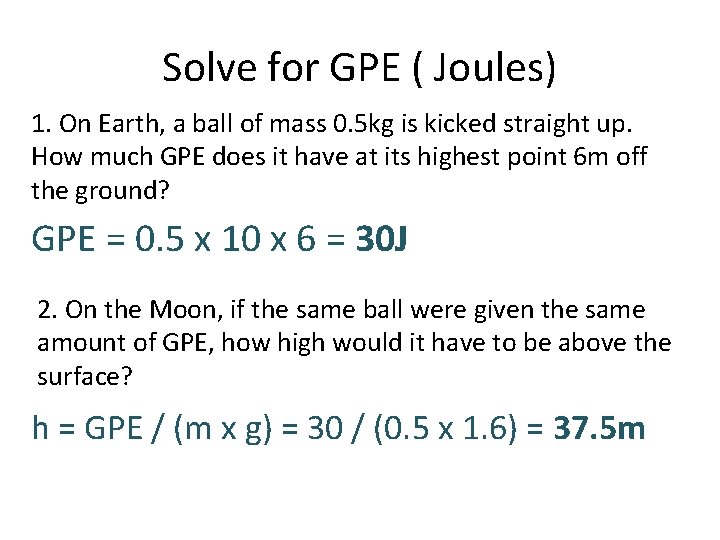
Solve for GPE ( Joules) 1. On Earth, a ball of mass 0. 5 kg is kicked straight up. How much GPE does it have at its highest point 6 m off the ground? GPE = 0. 5 x 10 x 6 = 30 J 2. On the Moon, if the same ball were given the same amount of GPE, how high would it have to be above the surface? h = GPE / (m x g) = 30 / (0. 5 x 1. 6) = 37. 5 m
What is Weight ( Fg)? The weight of an object is the size of the force of gravity pulling the object down. An astronaut weighs more on Earth than on the Moon as the Earth’s gravity is stronger than the Moon's. weight (N) = mass (kg) x gravitational field strength (N/kg) w = mg
Weight ( Newton or kg 2 m/s ) 1. On Earth, what is the weight of a person whose mass is 45 kg? w=mxg W= 45 kg x 10 m/s/s = 450 N
Kinetic Energy of KE ( Joules) Kinetic energy is the energy of motion. An object that has motion - whether it is vertical or horizontal motion - has kinetic energy. There are many forms of kinetic energy - vibrational (the energy due to vibrational motion), rotational (the energy due to rotational motion), and translational (the energy due to motion from one location to another). KE = ½ 2 mv http: //www. physicsclassroom. com/Class/energy/u 5 l 1 c. cfm
Kinetic Energy ( KE) Problems 1. Determine the kinetic energy of a 625 -kg roller coaster car that is moving with a speed of 18. 3 m/s. KE = 0. 5*m*v 2 KE = (0. 5) * (625 kg) * (18. 3 m/s)2 KE = 1. 05 5 x 10 Joules http: //www. physicsclassroom. com/Class/energy/u 5 l 1 c. cfm
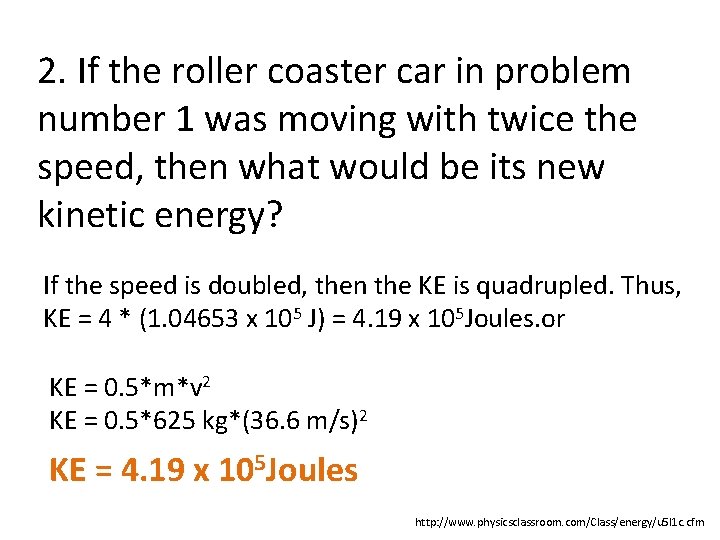
2. If the roller coaster car in problem number 1 was moving with twice the speed, then what would be its new kinetic energy? If the speed is doubled, then the KE is quadrupled. Thus, KE = 4 * (1. 04653 x 105 J) = 4. 19 x 105 Joules. or KE = 0. 5*m*v 2 KE = 0. 5*625 kg*(36. 6 m/s)2 KE = 4. 19 x 105 Joules http: //www. physicsclassroom. com/Class/energy/u 5 l 1 c. cfm
GPE and KE When an object falls it converts gravitational potential energy (GPE) to kinetic energy (KE). This is what happens when a. . . • book falls off a shelf • rollercoaster rolls down the track • skydiver jumps out of a plane
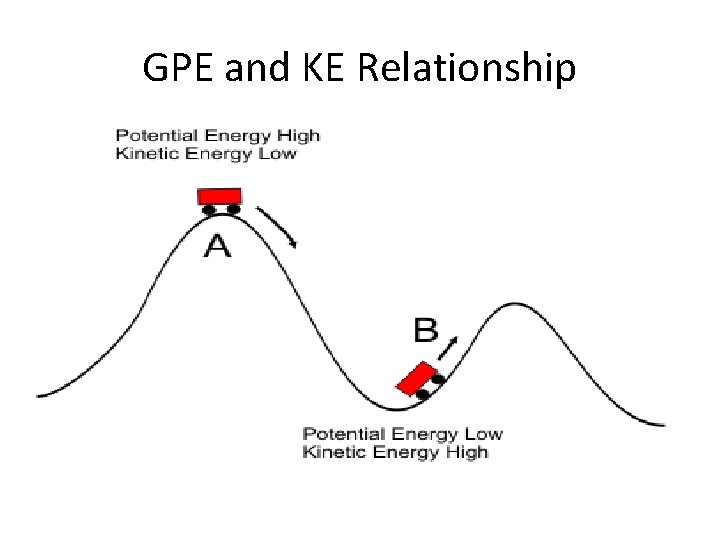
GPE and KE Relationship When an object falls at its terminal speed, the speed doesn't increase, so the kinetic energy doesn’t increase. However, the gravitational potential energy continues to decrease as it's changed into heat and sound as the object does work against friction. Many theme park rides use the transfer of gravitational potential energy to kinetic energy and kinetic energy to gravitational potential energy.
GPE and KE Relationship
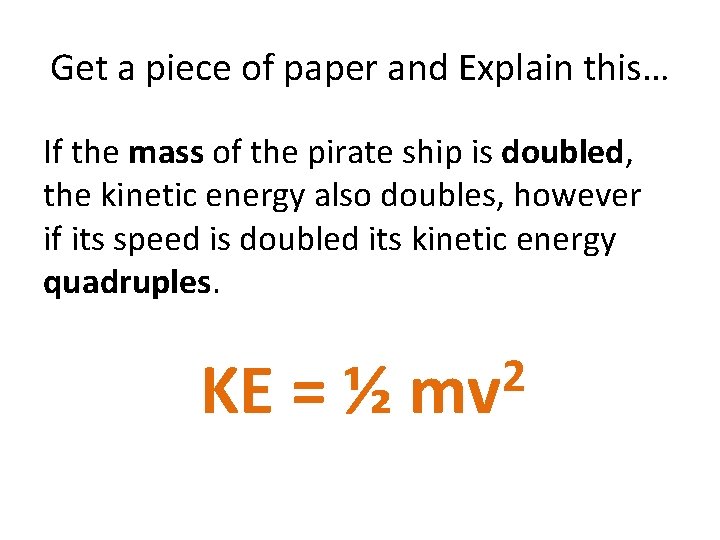
Get a piece of paper and Explain this… If the mass of the pirate ship is doubled, the kinetic energy also doubles, however if its speed is doubled its kinetic energy quadruples. KE = ½ 2 mv
Review
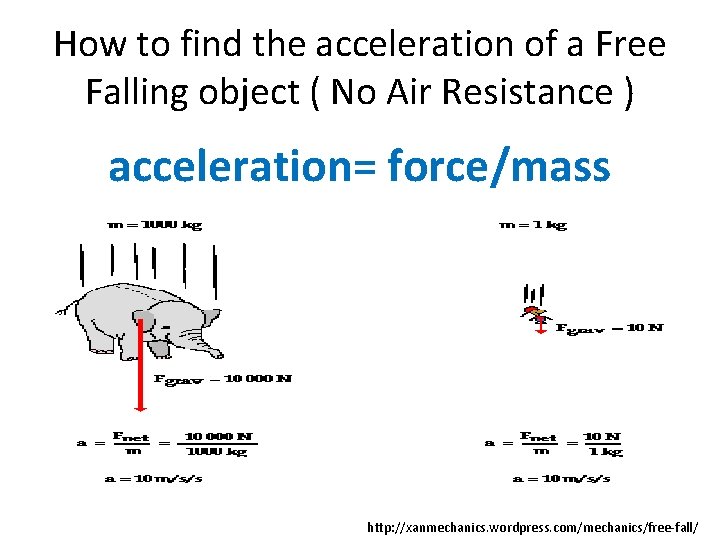
How to find the acceleration of a Free Falling object ( No Air Resistance ) acceleration= force/mass http: //xanmechanics. wordpress. com/mechanics/free-fall/
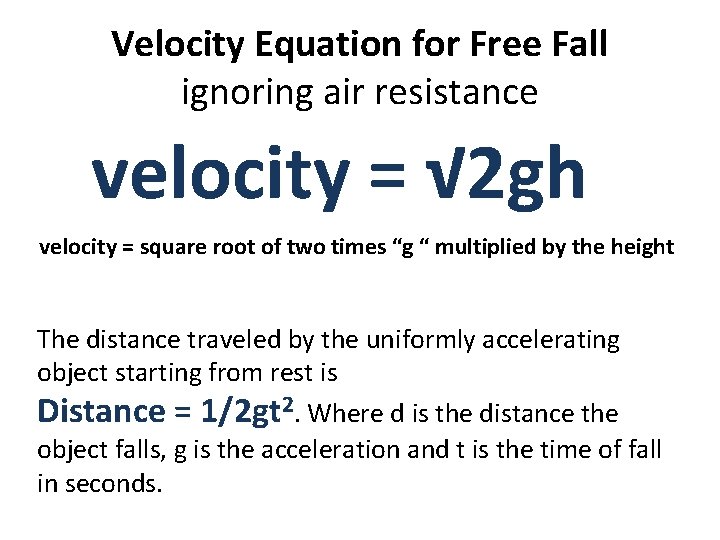
Velocity Equation for Free Fall ignoring air resistance velocity = √ 2 gh velocity = square root of two times “g “ multiplied by the height The distance traveled by the uniformly accelerating object starting from rest is Distance = 1/2 gt 2. Where d is the distance the object falls, g is the acceleration and t is the time of fall in seconds.
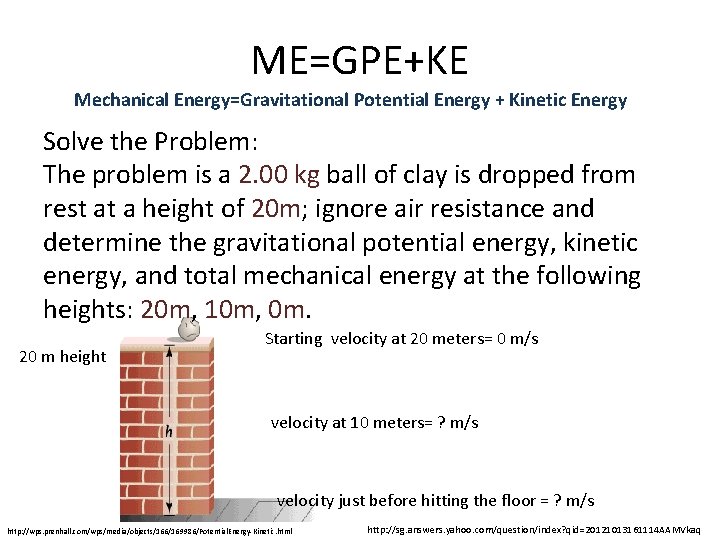
ME=GPE+KE Mechanical Energy=Gravitational Potential Energy + Kinetic Energy Solve the Problem: The problem is a 2. 00 kg ball of clay is dropped from rest at a height of 20 m; ignore air resistance and determine the gravitational potential energy, kinetic energy, and total mechanical energy at the following heights: 20 m, 10 m, 0 m. 20 m height Starting velocity at 20 meters= 0 m/s velocity at 10 meters= ? m/s velocity just before hitting the floor = ? m/s http: //wps. prenhall. com/wps/media/objects/166/169986/Potential. Energy-Kinetic. html http: //sg. answers. yahoo. com/question/index? qid=20121013161114 AAMVkaq
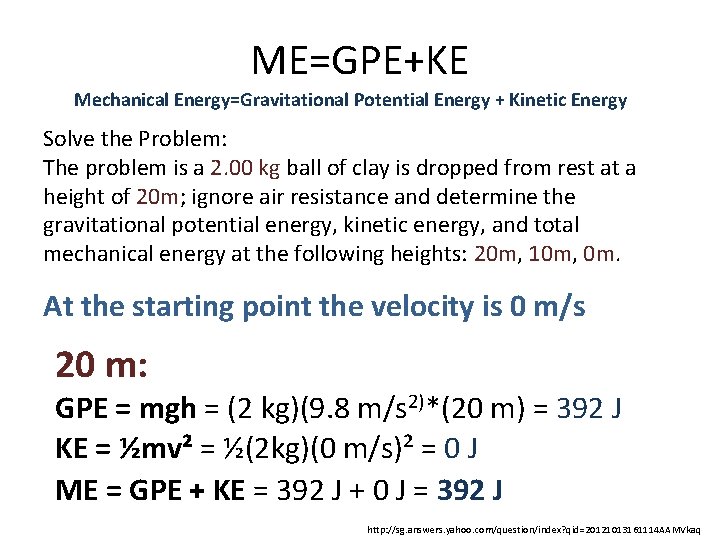
ME=GPE+KE Mechanical Energy=Gravitational Potential Energy + Kinetic Energy Solve the Problem: The problem is a 2. 00 kg ball of clay is dropped from rest at a height of 20 m; ignore air resistance and determine the gravitational potential energy, kinetic energy, and total mechanical energy at the following heights: 20 m, 10 m, 0 m. At the starting point the velocity is 0 m/s 20 m: GPE = mgh = (2 kg)(9. 8 m/s 2)*(20 m) = 392 J KE = ½mv² = ½(2 kg)(0 m/s)² = 0 J ME = GPE + KE = 392 J + 0 J = 392 J http: //sg. answers. yahoo. com/question/index? qid=20121013161114 AAMVkaq
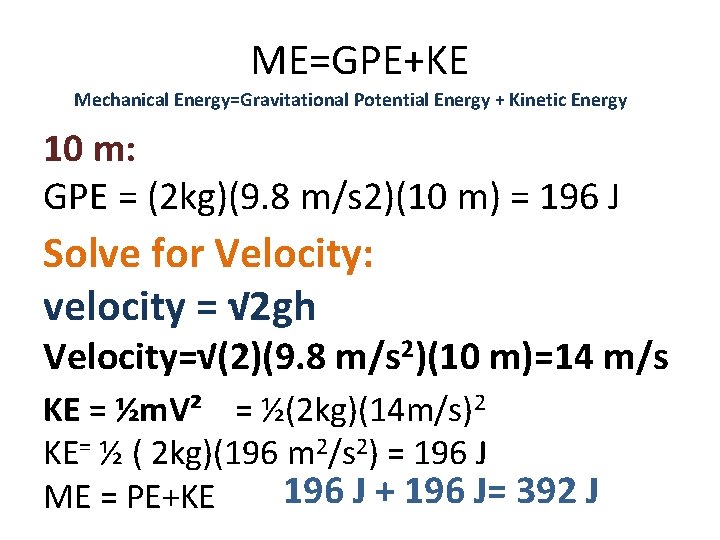
ME=GPE+KE Mechanical Energy=Gravitational Potential Energy + Kinetic Energy 10 m: GPE = (2 kg)(9. 8 m/s 2)(10 m) = 196 J Solve for Velocity: velocity = √ 2 gh Velocity=√(2)(9. 8 m/s 2)(10 m)=14 m/s KE = ½m. V² = ½(2 kg)(14 m/s)2 KE= ½ ( 2 kg)(196 m 2/s 2) = 196 J + 196 J= 392 J ME = PE+KE
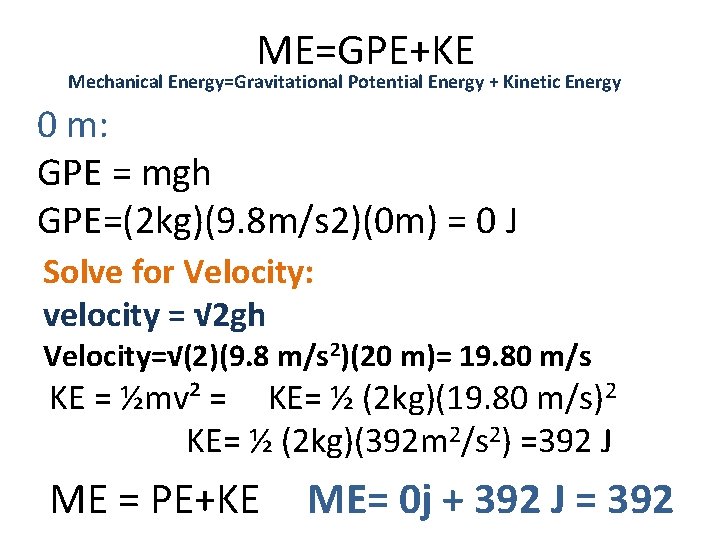
ME=GPE+KE Mechanical Energy=Gravitational Potential Energy + Kinetic Energy 0 m: GPE = mgh GPE=(2 kg)(9. 8 m/s 2)(0 m) = 0 J Solve for Velocity: velocity = √ 2 gh Velocity=√(2)(9. 8 m/s 2)(20 m)= 19. 80 m/s KE = ½mv² = KE= ½ (2 kg)(19. 80 m/s)2 KE= ½ (2 kg)(392 m 2/s 2) =392 J ME = PE+KE ME= 0 j + 392 J = 392