
CONSERVATION OF ENERGY Conservative Force A conservative force
- Slides: 13
CONSERVATION OF ENERGY
Conservative Force • A conservative force converts potential energy to other forms of mechanical energy when it does work. • In other words, a conservative force does not change the mechanical energy of a system • Remember that mechanical energy is potential energy + kinetic energy
Non. Conservative Force • So, what would be a nonconservative force? ? ? • Friction is most common example (air resistance is a form of friction) • Work done by friction becomes microscopic internal energy in the object, raising its temperature • The internal energy cannot be recovered and turned back into kinetic energy
Thermal Energy • When is thermal energy a desirable outcome and when is is undesirable?
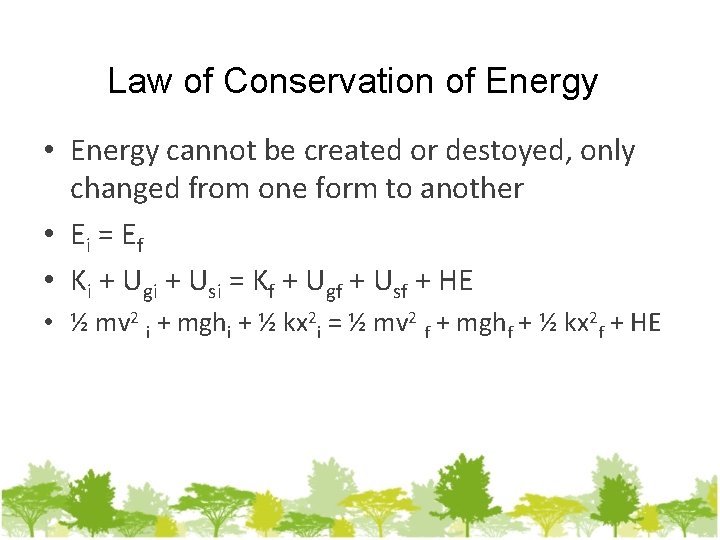
Law of Conservation of Energy • Energy cannot be created or destoyed, only changed from one form to another • Ei = Ef • Ki + Ugi + Usi = Kf + Ugf + Usf + HE • ½ mv 2 i + mghi + ½ kx 2 i = ½ mv 2 f + mghf + ½ kx 2 f + HE
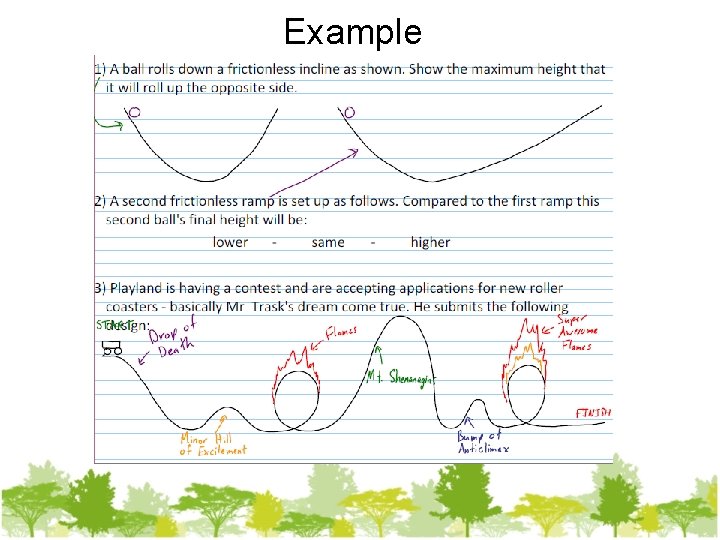
Example
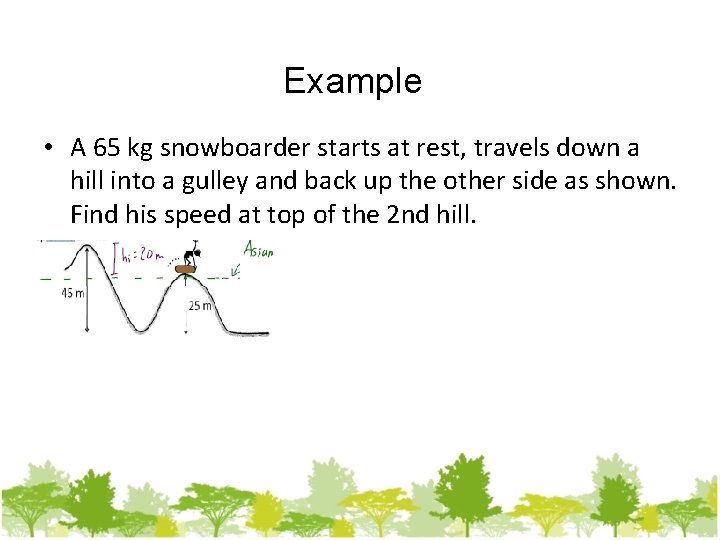
Example • A 65 kg snowboarder starts at rest, travels down a hill into a gulley and back up the other side as shown. Find his speed at top of the 2 nd hill.
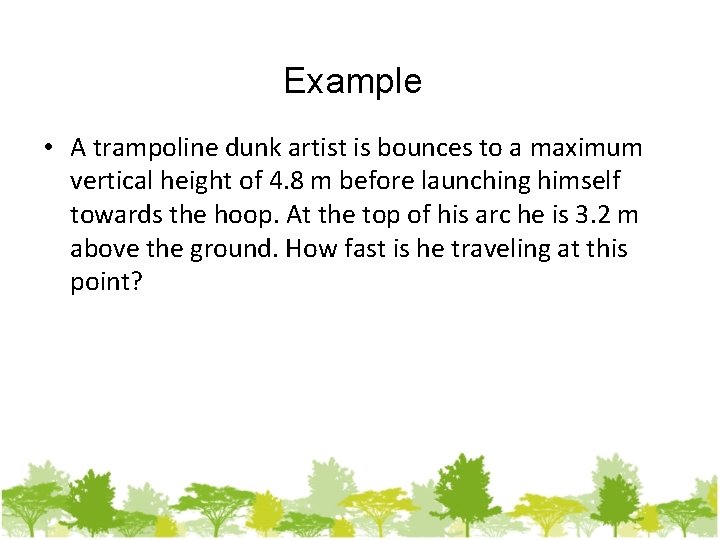
Example • A trampoline dunk artist is bounces to a maximum vertical height of 4. 8 m before launching himself towards the hoop. At the top of his arc he is 3. 2 m above the ground. How fast is he traveling at this point?
Example • A 5. 0 kg block of wood is pushed down a ramp with a velocity of 6. 0 m/s. The ramp is 1. 5 m tall and 3. 5 m long. At the bottom of the ramp it is traveling at 7. 5 m/s. How much thermal energy is generated due to friction? Determine the force of friction and the coefficient of friction.
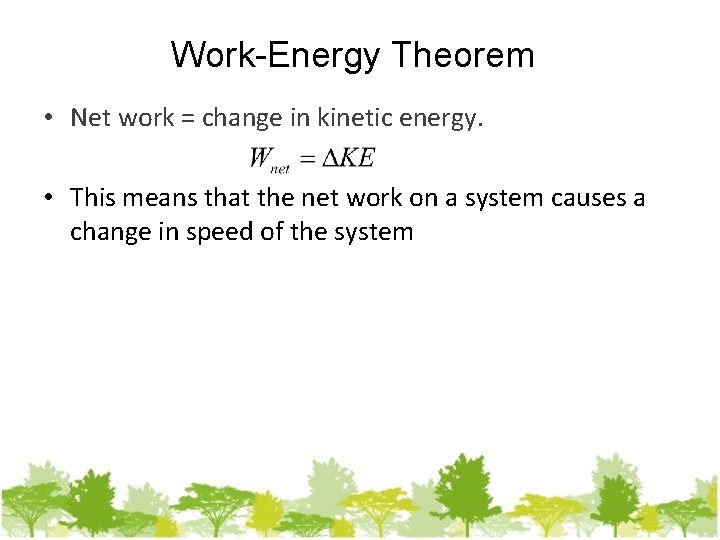
Work-Energy Theorem • Net work = change in kinetic energy. • This means that the net work on a system causes a change in speed of the system
Work-Energy Theorem • If you know how much energy you want a system or object to have, then you can calculate how much work you need to perform to get it there. Conversely, if you know how much energy a system has, you can calculate how much work that energy can perform. This has literally MILLIONS of real-life examples: • The energy of wind movement performs work when it turns a Wind Turbine • The chemical energy in gasoline performs work on a piston, which in turn performs work on a vehicle to create kinetic energy. • Work is performed on air as it enters a Jet Engine to speed up the air, which results in higher kinetic energy of the air particles, which pushes the airplane • Stirring a pot of water performs work in the form of heat transfer, which results in a higher temperature in the water (higher temp = higher energy) • When you throw a water balloon at someone’s face, their face performs work on the balloon, which then increases in pressure (higher pressure = higher energy) until it pops.
Example • A 60 kg sprinter exerts a net force of 260 N over a distance of 35 m. What is his change in kinetic energy? If started at rest, what is speed at finish?
Example • A student pushes a 25 kg crate which is initially at rest with a force of 160 N over a distance of 15 m. If there is 75 N of friction, what is the final speed of the crate?