
Conservation Biology Conservation biology is the discipline that
Conservation Biology Conservation biology is the discipline that studies why species become rare, threatened, or extinct and methods that can be used to prevent species loss. The current belief is that four major factors act to cause extinctions: 1. habitat alteration and/or destruction 2. introduction of exotic species 3. overexploitation of species, and 4. indirect effects that cause species to enter an ‘extinction vortex’
1. Habitat alteration/destruction Habitat destruction occurs when humans clear forested areas to turn the land into pastures, fields, or housing. The effect is to fragment natural habitat. The fragments are frequently too small to maintain minimum viable populations of vulnerable species. This happens in tropical rain forest in Brazil and elsewhere, but also happens in North America. Figure 38. 6 A shows you the fragmentation that has occurred in the northwestern U. S. as a result of clearcuts in forests.
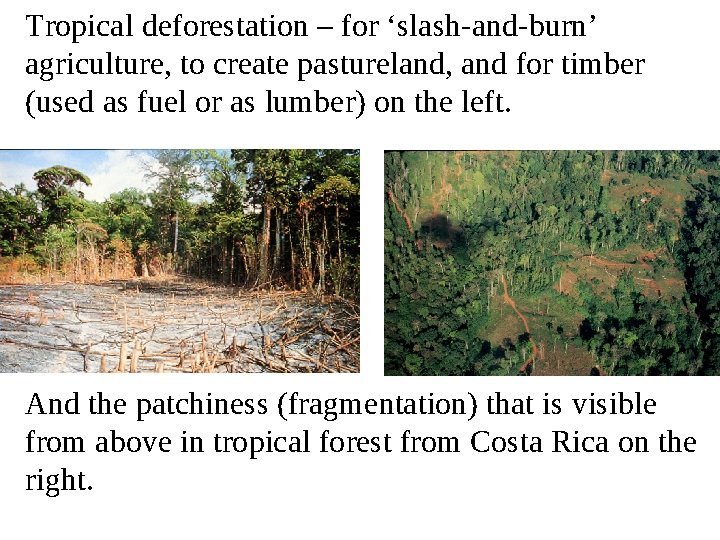
Tropical deforestation – for ‘slash-and-burn’ agriculture, to create pastureland, and for timber (used as fuel or as lumber) on the left. And the patchiness (fragmentation) that is visible from above in tropical forest from Costa Rica on the right.
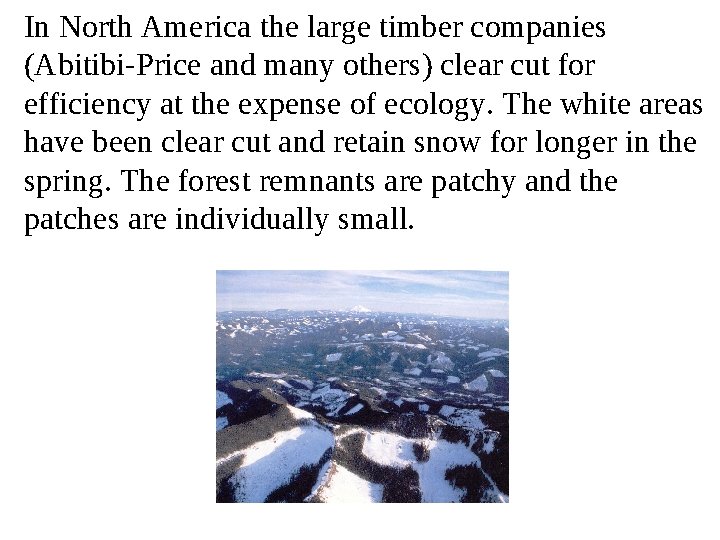
In North America the large timber companies (Abitibi-Price and many others) clear cut for efficiency at the expense of ecology. The white areas have been clear cut and retain snow for longer in the spring. The forest remnants are patchy and the patches are individually small.
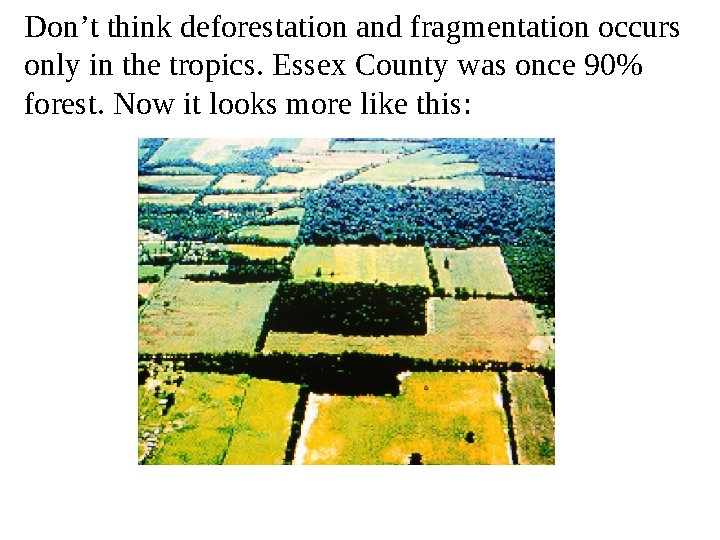
Don’t think deforestation and fragmentation occurs only in the tropics. Essex County was once 90% forest. Now it looks more like this:
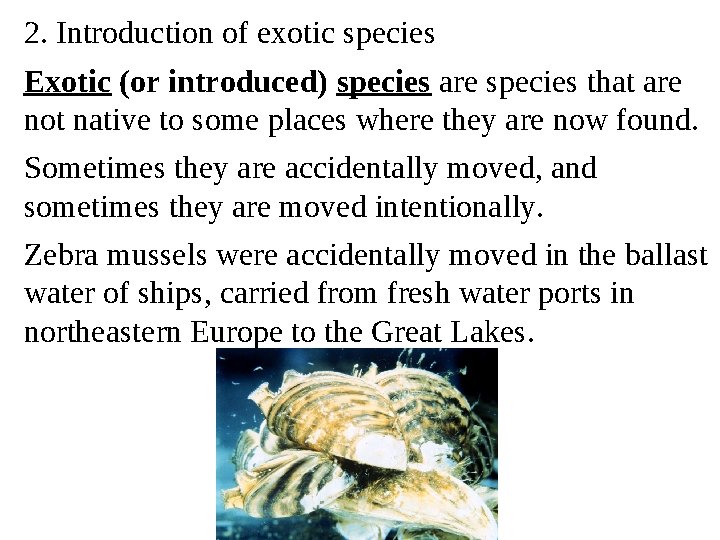
2. Introduction of exotic species Exotic (or introduced) species are species that are not native to some places where they are now found. Sometimes they are accidentally moved, and sometimes they are moved intentionally. Zebra mussels were accidentally moved in the ballast water of ships, carried from fresh water ports in northeastern Europe to the Great Lakes.
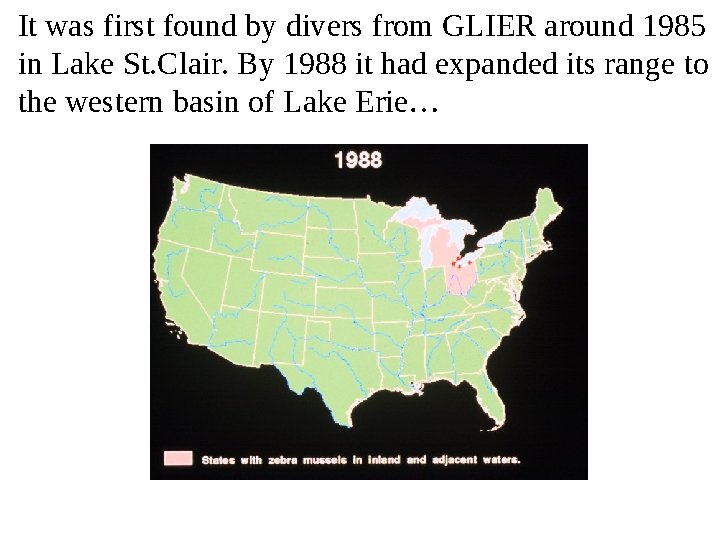
It was first found by divers from GLIER around 1985 in Lake St. Clair. By 1988 it had expanded its range to the western basin of Lake Erie…
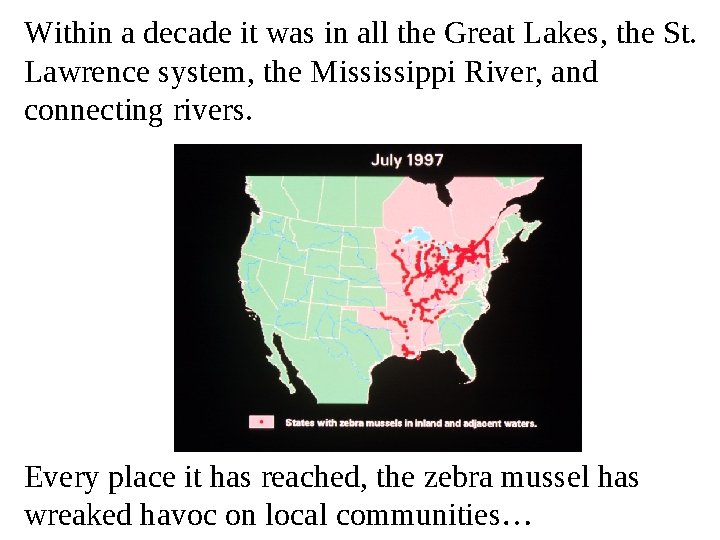
Within a decade it was in all the Great Lakes, the St. Lawrence system, the Mississippi River, and connecting rivers. Every place it has reached, the zebra mussel has wreaked havoc on local communities…
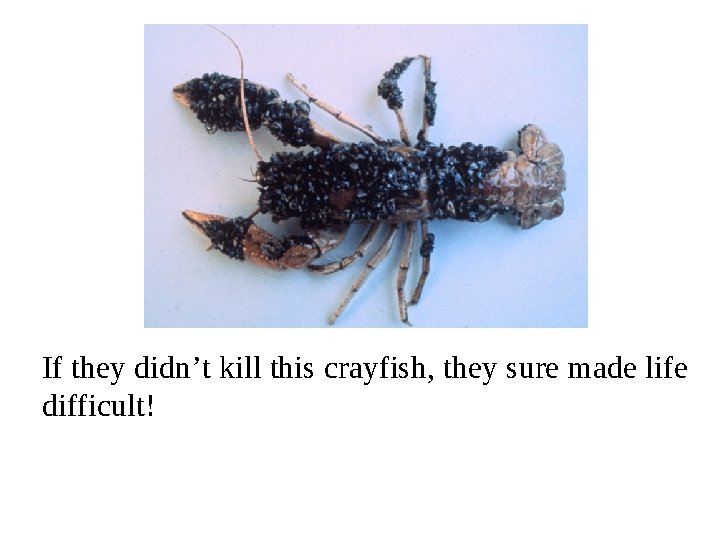
If they didn’t kill this crayfish, they sure made life difficult!
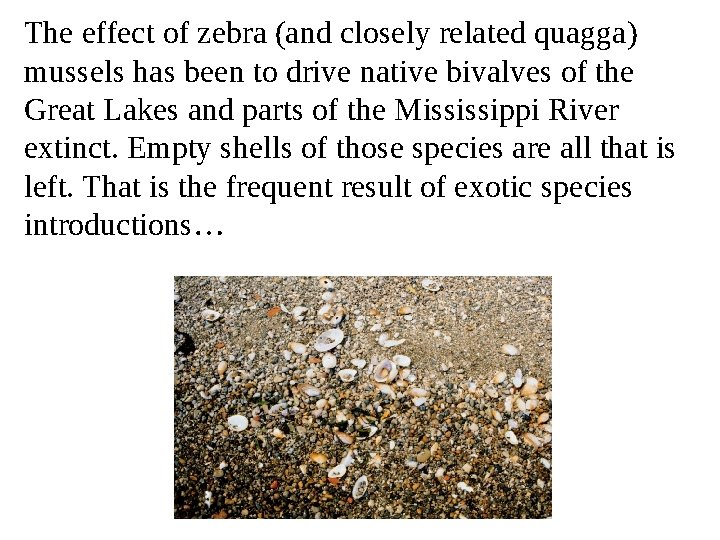
The effect of zebra (and closely related quagga) mussels has been to drive native bivalves of the Great Lakes and parts of the Mississippi River extinct. Empty shells of those species are all that is left. That is the frequent result of exotic species introductions…
The most devastating exotic species introduction (in terms of effect on biodiversity) was the intentional introduction of the Nile perch into Lake Victoria, one of the East African rift lakes. It was thought that the perch would increase the amount of protein that could be harvested to feed communities along the shore. Instead, as a predatory fish, it caused the extinction of about 200 species of small cichlid fish that had been an important protein source. That represents about ½ the number of cichlids that had been in the lake – one of the most impressive adaptive radiations that have been found.
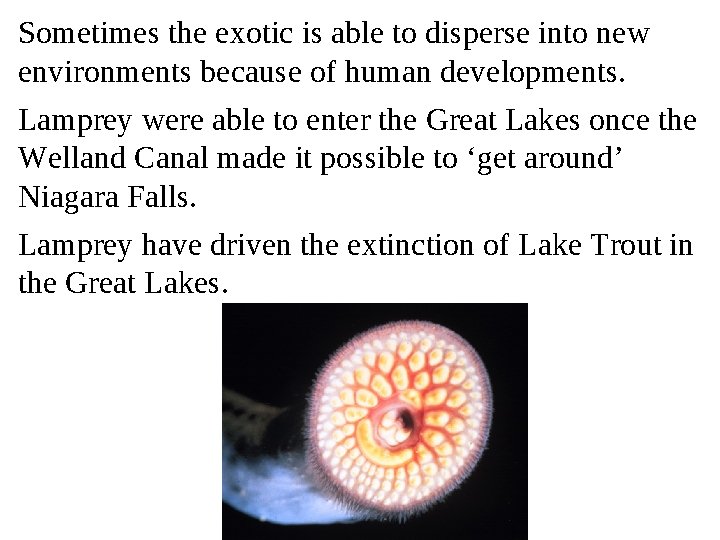
Sometimes the exotic is able to disperse into new environments because of human developments. Lamprey were able to enter the Great Lakes once the Welland Canal made it possible to ‘get around’ Niagara Falls. Lamprey have driven the extinction of Lake Trout in the Great Lakes.
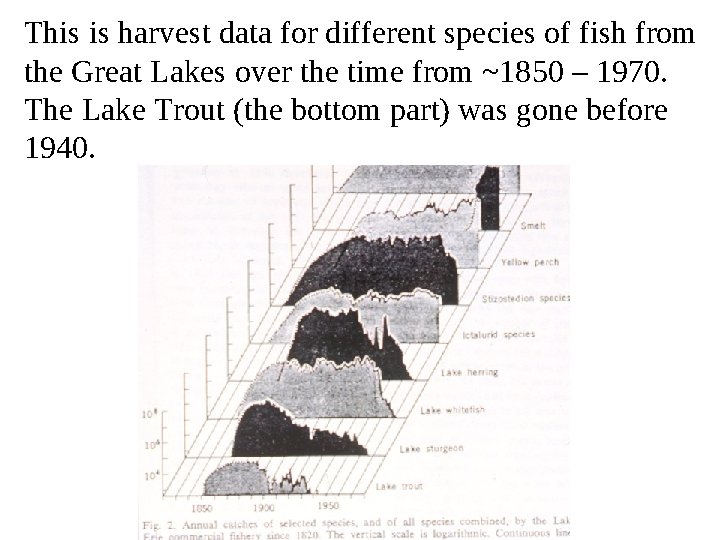
This is harvest data for different species of fish from the Great Lakes over the time from ~1850 – 1970. The Lake Trout (the bottom part) was gone before 1940.
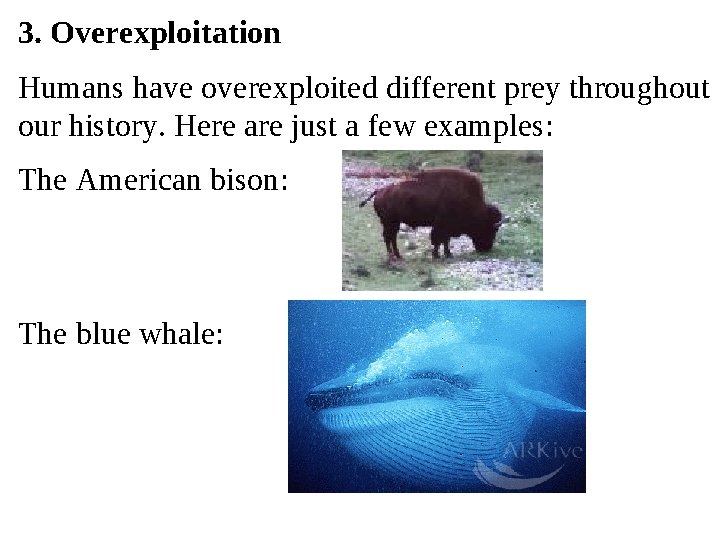
3. Overexploitation Humans have overexploited different prey throughout our history. Here are just a few examples: The American bison: The blue whale:
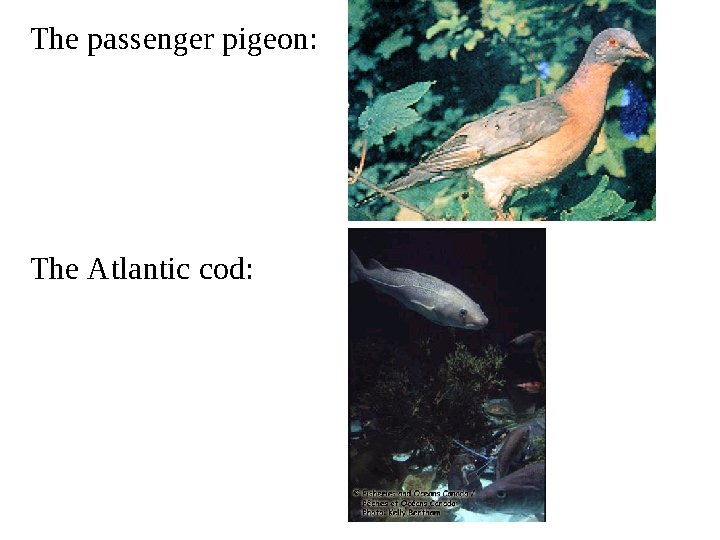
The passenger pigeon: The Atlantic cod:
4. Indirect effects Sometimes things that we do (or that happen naturally) have unexpected or unintended consequences. One of the most significant effects is the result of driftnet fishing in the oceans. Nets that are miles long are laid to catch tuna and other fish. However, these nets also trap turtles (fig. 38. 5 D), dolphins, harbor porpoises, seals, marine birds, and other species. All this bycatch dies in the nets before the nets are recovered. Many of the species are threatened or endangered.
When the population of a rare species decreases, one of the key biological consequences is the loss of genetic variation, and an increased likelihood of inbreeding. Thus, a rare species enters a terminal declining phase from which recovery is unlikely. We term this decline the extinction vortex.
Why is biodiversity important? 1. Diversity is believed to confer a level of stability on ecological communities. Think of a trophic web. As a web simplifies through species loss, remaining species become tightly tied to limited resources. Chance events that even temporarily remove a food source may lead to the extinction of the predator. 2. There may be currently unknown value to species or even genes they carry. Examples:
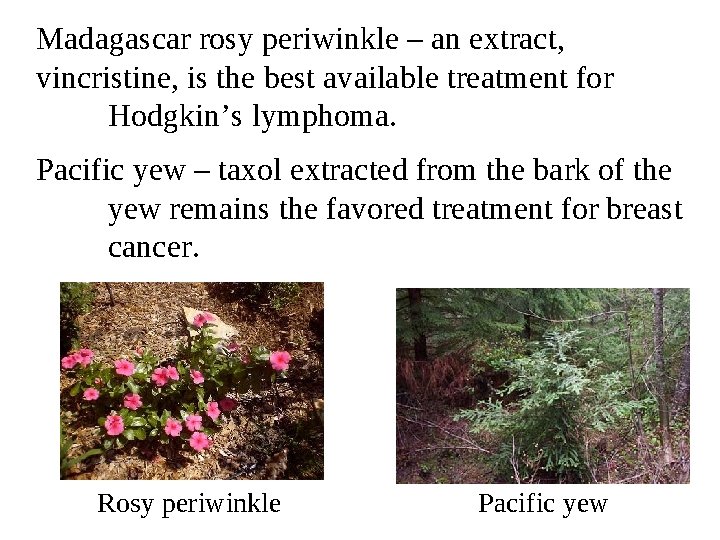
Madagascar rosy periwinkle – an extract, vincristine, is the best available treatment for Hodgkin’s lymphoma. Pacific yew – taxol extracted from the bark of the yew remains the favored treatment for breast cancer. Rosy periwinkle Pacific yew
One of the other important threats to species is the pollution we disperse into the environment in the form of heavy metals, pesticides, and industrial organic chemicals. Industrial organics are particularly dangerous to the species most likely to be rare and to have small populations – those at the top of the trophic pyramid. The problem is biomagnification. When each succeeding trophic level eats organisms from the next lower level, they metabolize proteins, fats and carbohydrates; organic pollutants are not metabolized and concentrate in fats (lipids) of the feeder.
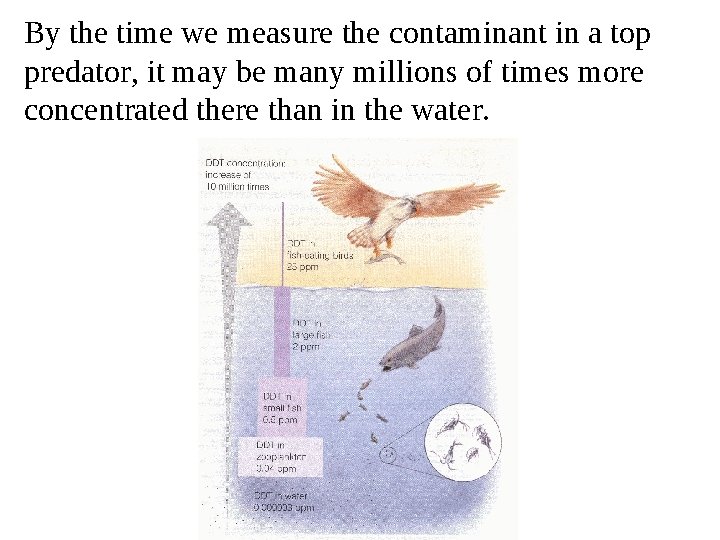
By the time we measure the contaminant in a top predator, it may be many millions of times more concentrated there than in the water.
Given our history of failure to protect species dwindling to extinction, have we learned, our we now trying to protect endangered species? Yes. CITES – Convention on International Trade of Endangered Species – trade of individuals of endangered species or their body parts is now prohibited. That should prevent trade of things like rhinoceros horns (used as an aphrodisiac and medicine) or elephant tusks (for ivory jewelry, etc. ). Poaching, however, still occurs.
SARA – the Species At Risk Act – is Canada’s endangered species legislation. It applies to endangered species on Federal lands, but by agreement with some provinces, also on provincial lands. Ontario has legislation that extends the protection onto private lands, as well. This act became law only within the last few years. Who decides which species are endangered? In Canada, the buck stops at the desk of the Minister of Environment. He gets “advice” from a group of experts from COSEWIC – the Committee On the Status of Endangered Wildlife in Canada.
ESA – the Endangered Species Act in the U. S. There, the Environmental Protection Agency makes the decision about whether a species is in need of protection. With all this protection, there have been successes in bringing species back from the brink…
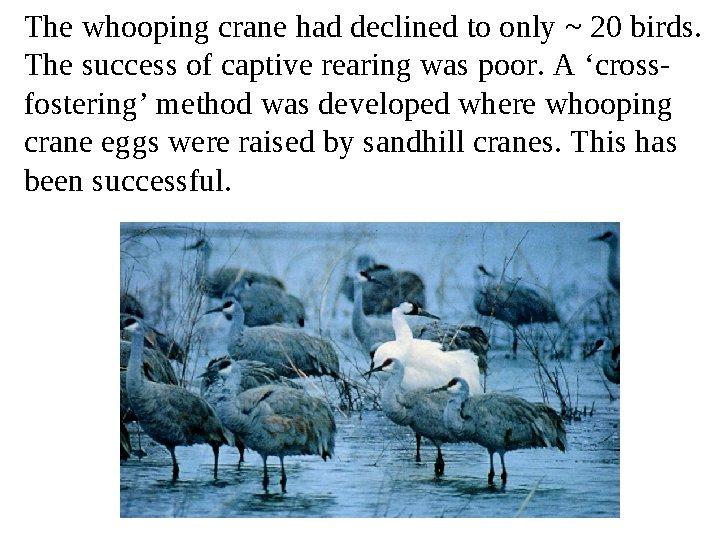
The whooping crane had declined to only ~ 20 birds. The success of captive rearing was poor. A ‘crossfostering’ method was developed where whooping crane eggs were raised by sandhill cranes. This has been successful.
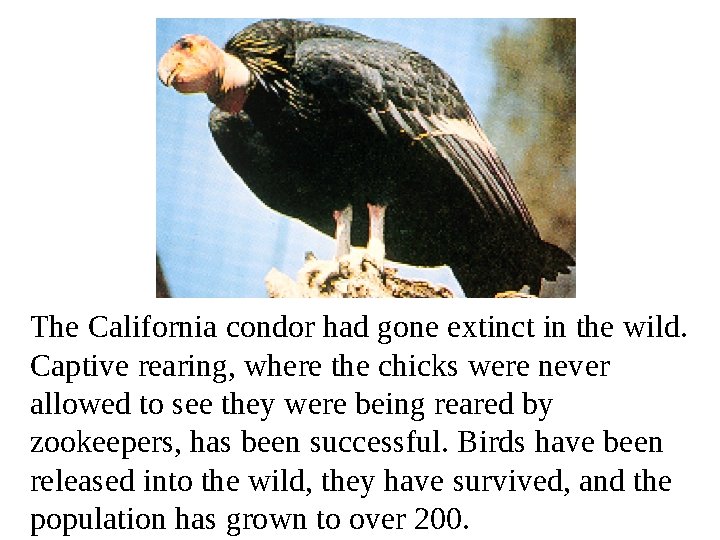
The California condor had gone extinct in the wild. Captive rearing, where the chicks were never allowed to see they were being reared by zookeepers, has been successful. Birds have been released into the wild, they have survived, and the population has grown to over 200.
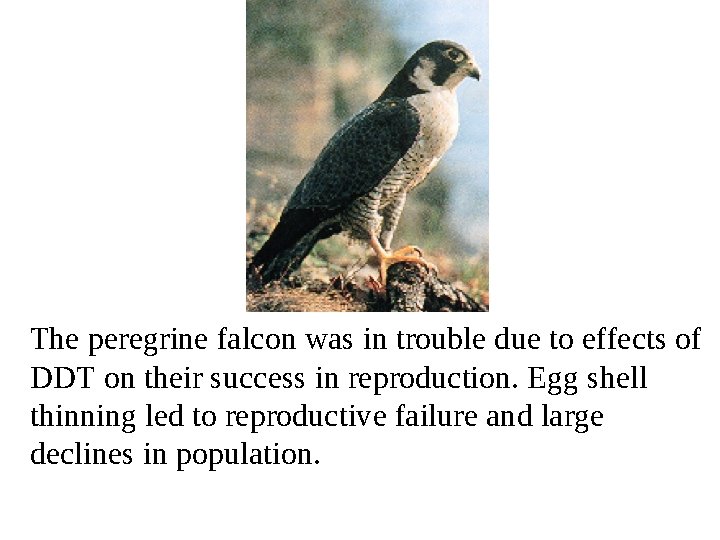
The peregrine falcon was in trouble due to effects of DDT on their success in reproduction. Egg shell thinning led to reproductive failure and large declines in population.
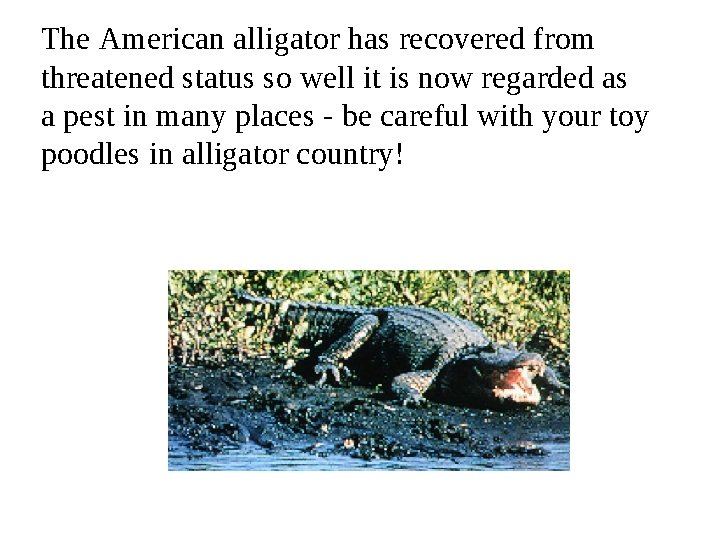
The American alligator has recovered from threatened status so well it is now regarded as a pest in many places - be careful with your toy poodles in alligator country!
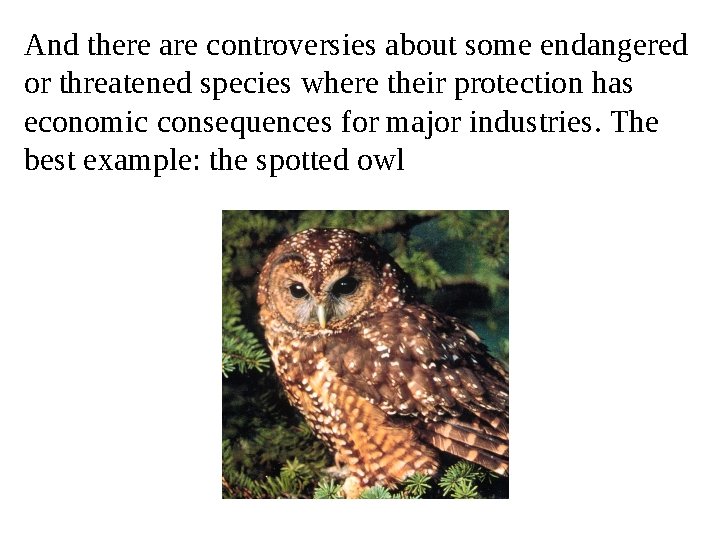
And there are controversies about some endangered or threatened species where their protection has economic consequences for major industries. The best example: the spotted owl
This owl lives only in old-growth forests of B. C. , Washington and Oregon where that old growth forest is extremely desirable to large lumber corporations. Protection for the spotted owl remains a legal and political football.
How do we assess what the future is for a species or a population potentially in danger? One key tool is PVA (Population Viability Analysis). It uses demographic tools and assessment of a species’ ecology to predict future trend in population size. The goal for protection is a less than 5% chance of extinction over the next 100 years.
The goals of conservation biology: 1. Obviously, the protection of biological diversity. 2. Given the need for development to support a growing human population, to design the processes according to the concept of sustainable develoopment.
- Slides: 32