
Consequences Unpacked Consequences Result Effect of Action Should

- Slides: 10
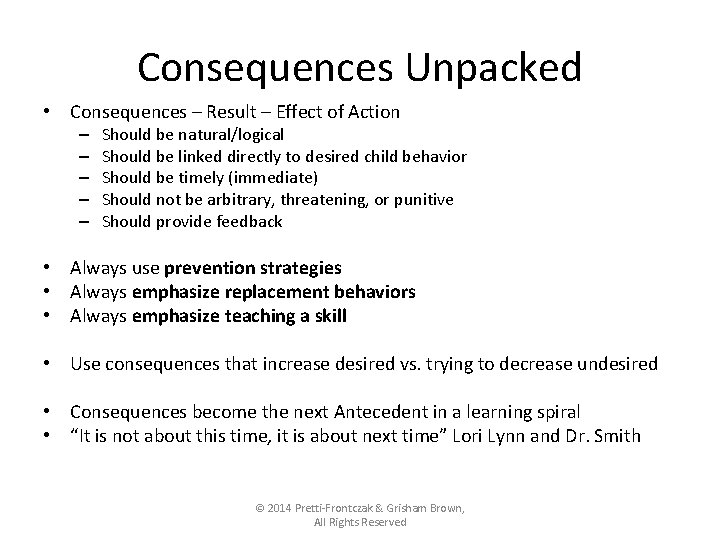
Consequences Unpacked • Consequences – Result – Effect of Action – – – Should be natural/logical Should be linked directly to desired child behavior Should be timely (immediate) Should not be arbitrary, threatening, or punitive Should provide feedback • Always use prevention strategies • Always emphasize replacement behaviors • Always emphasize teaching a skill • Use consequences that increase desired vs. trying to decrease undesired • Consequences become the next Antecedent in a learning spiral • “It is not about this time, it is about next time” Lori Lynn and Dr. Smith © 2014 Pretti-Frontczak & Grisham Brown, All Rights Reserved
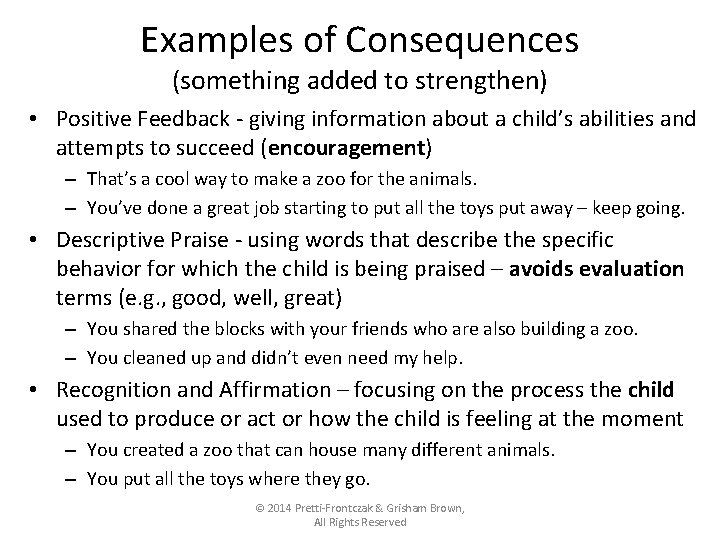
Examples of Consequences (something added to strengthen) • Positive Feedback - giving information about a child’s abilities and attempts to succeed (encouragement) – That’s a cool way to make a zoo for the animals. – You’ve done a great job starting to put all the toys put away – keep going. • Descriptive Praise - using words that describe the specific behavior for which the child is being praised – avoids evaluation terms (e. g. , good, well, great) – You shared the blocks with your friends who are also building a zoo. – You cleaned up and didn’t even need my help. • Recognition and Affirmation – focusing on the process the child used to produce or act or how the child is feeling at the moment – You created a zoo that can house many different animals. – You put all the toys where they go. © 2014 Pretti-Frontczak & Grisham Brown, All Rights Reserved
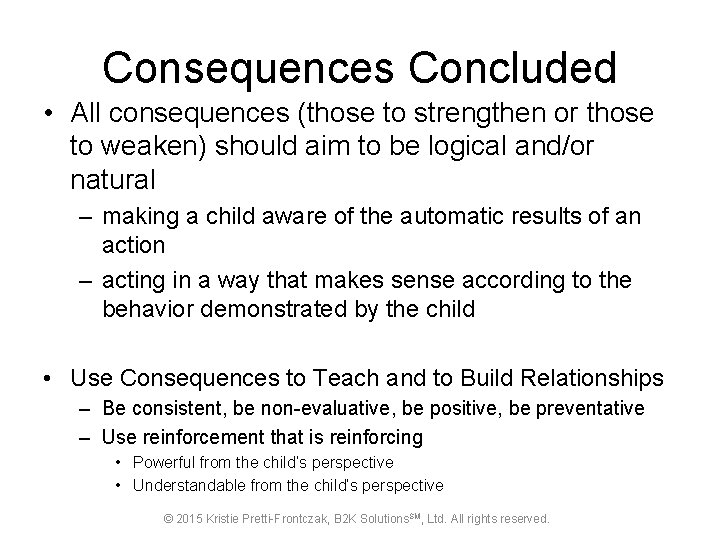
Consequences Concluded • All consequences (those to strengthen or those to weaken) should aim to be logical and/or natural – making a child aware of the automatic results of an action – acting in a way that makes sense according to the behavior demonstrated by the child • Use Consequences to Teach and to Build Relationships – Be consistent, be non-evaluative, be positive, be preventative – Use reinforcement that is reinforcing • Powerful from the child’s perspective • Understandable from the child’s perspective © 2015 Kristie Pretti-Frontczak, B 2 K Solutions. SM, Ltd. All rights reserved.
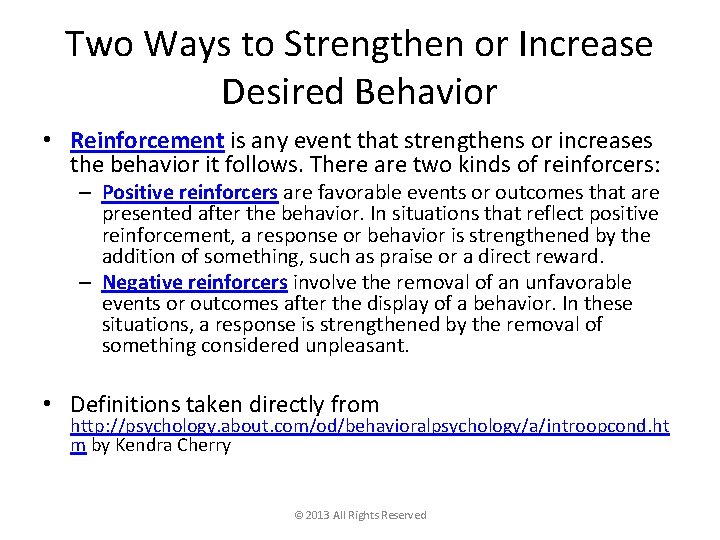
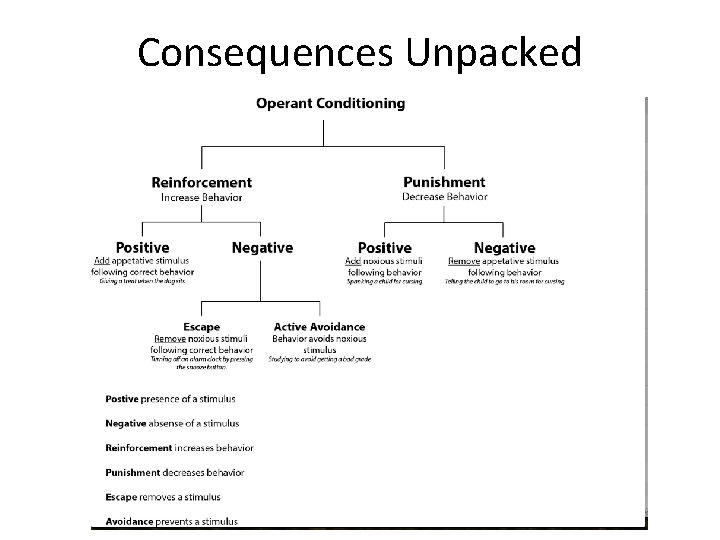
Two Ways to Strengthen or Increase Desired Behavior • Reinforcement is any event that strengthens or increases the behavior it follows. There are two kinds of reinforcers: – Positive reinforcers are favorable events or outcomes that are presented after the behavior. In situations that reflect positive reinforcement, a response or behavior is strengthened by the addition of something, such as praise or a direct reward. – Negative reinforcers involve the removal of an unfavorable events or outcomes after the display of a behavior. In these situations, a response is strengthened by the removal of something considered unpleasant. • Definitions taken directly from http: //psychology. about. com/od/behavioralpsychology/a/introopcond. ht m by Kendra Cherry © 2013 All Rights Reserved
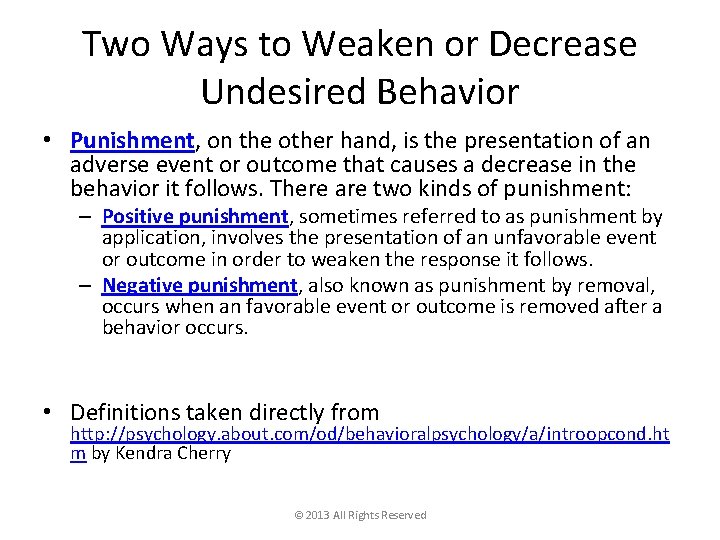
Two Ways to Weaken or Decrease Undesired Behavior • Punishment, on the other hand, is the presentation of an adverse event or outcome that causes a decrease in the behavior it follows. There are two kinds of punishment: – Positive punishment, sometimes referred to as punishment by application, involves the presentation of an unfavorable event or outcome in order to weaken the response it follows. – Negative punishment, also known as punishment by removal, occurs when an favorable event or outcome is removed after a behavior occurs. • Definitions taken directly from http: //psychology. about. com/od/behavioralpsychology/a/introopcond. ht m by Kendra Cherry © 2013 All Rights Reserved
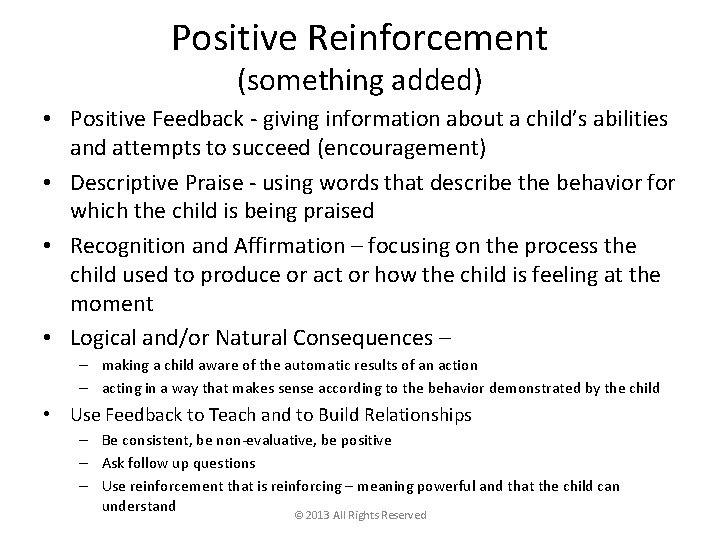
Positive Reinforcement (something added) • Positive Feedback - giving information about a child’s abilities and attempts to succeed (encouragement) • Descriptive Praise - using words that describe the behavior for which the child is being praised • Recognition and Affirmation – focusing on the process the child used to produce or act or how the child is feeling at the moment • Logical and/or Natural Consequences – – making a child aware of the automatic results of an action – acting in a way that makes sense according to the behavior demonstrated by the child • Use Feedback to Teach and to Build Relationships – Be consistent, be non-evaluative, be positive – Ask follow up questions – Use reinforcement that is reinforcing – meaning powerful and that the child can understand © 2013 All Rights Reserved
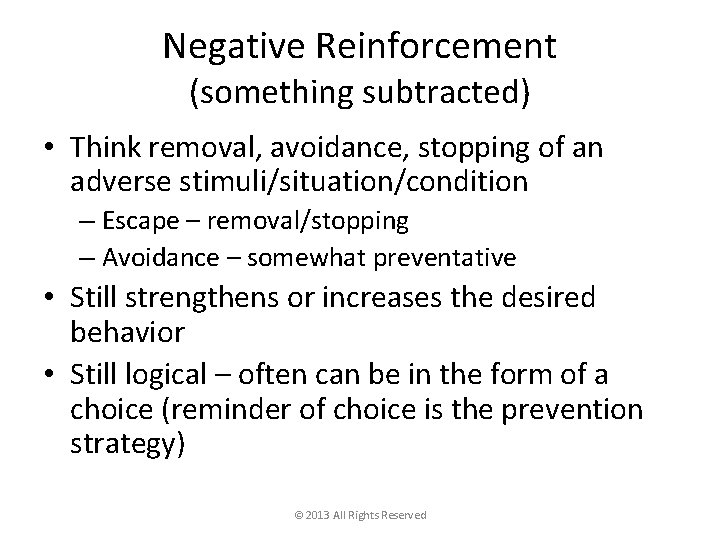
Negative Reinforcement (something subtracted) • Think removal, avoidance, stopping of an adverse stimuli/situation/condition – Escape – removal/stopping – Avoidance – somewhat preventative • Still strengthens or increases the desired behavior • Still logical – often can be in the form of a choice (reminder of choice is the prevention strategy) © 2013 All Rights Reserved
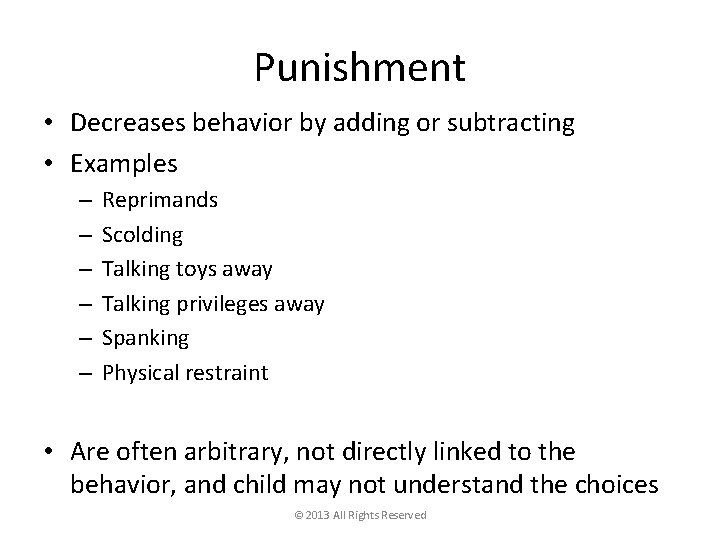
Punishment • Decreases behavior by adding or subtracting • Examples – – – Reprimands Scolding Talking toys away Talking privileges away Spanking Physical restraint • Are often arbitrary, not directly linked to the behavior, and child may not understand the choices © 2013 All Rights Reserved
Consequences Unpacked © 2013 All Rights Reserved
How we acquire learned behaviors – Learning not to get a sunburn Punishment – decrease times child gets a sunburn from playing outside Reinforce- increase time spent outside without getting a sunburn Child has fun with friends outside without getting a sunburn Negative (subtract) Escape by removing child from sun and allowing them to have fun and play in a covered area Avoid by putting on sunscreen before going outside Positive (add) Negative (subtract) Child gets painful blisters from sunburn Teacher sends child inside for getting a sunburn. Child is not allowed to play outside with friends © 2013 All Rights Reserved