
Consequences of European Exploration Causes of Exploration 3



- Slides: 21
Consequences of European Exploration
Causes of Exploration • 3 Gs • Technological advances (ship building, navigation, and cartography) • One more…
Causes of Exploration • Mercantilism - belief that there is a limited amount of wealth in the world. Whichever country had the most would be the “winner” – the richest.
Europe and the World After Columbus • What effect did overseas expansion have on the conquered societies, on enslaved Africans, and on world trade?
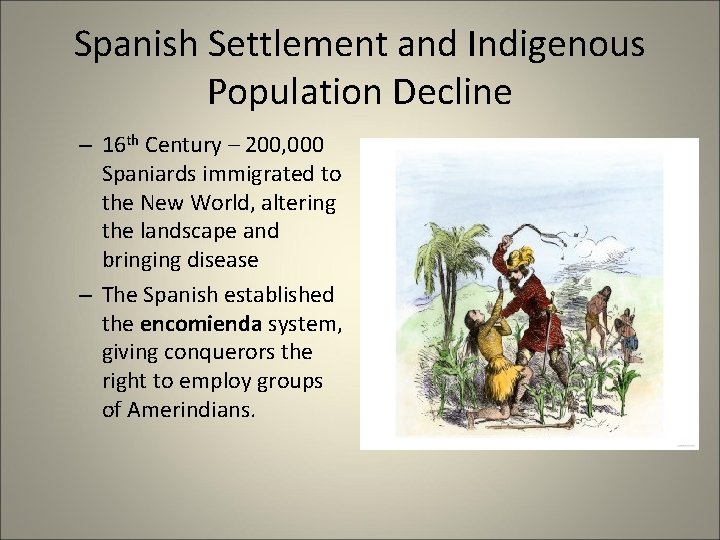
Spanish Settlement and Indigenous Population Decline – 16 th Century – 200, 000 Spaniards immigrated to the New World, altering the landscape and bringing disease – The Spanish established the encomienda system, giving conquerors the right to employ groups of Amerindians.
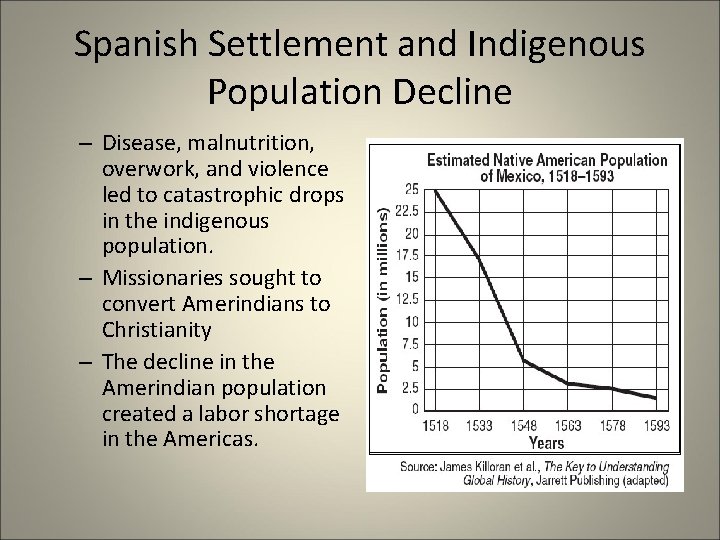
Spanish Settlement and Indigenous Population Decline – Disease, malnutrition, overwork, and violence led to catastrophic drops in the indigenous population. – Missionaries sought to convert Amerindians to Christianity – The decline in the Amerindian population created a labor shortage in the Americas.
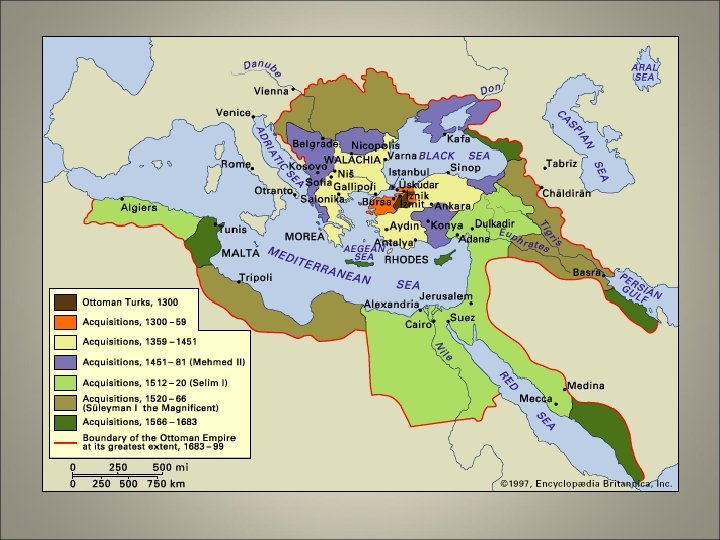
Sugar and Slavery – Before the 1400 s (15 th Century) all European slaves were White (aka Polish, and other Slavic peoples) – The Ottoman conquest of Constantinople cut off slaves from the Black Sea Region (1453) – With Portuguese voyages to West Africa and the occupation of the Canary and Madeira islands, slavery hooked up with sugar culture
Sugar and Slaves – Native Americans did not survive long under conditions of slavery and forced labor – The Spaniards brought in enslaved Africans as substitutes for the Native Americans – The Atlantic slave trade peaked in the 18 th Century (1700 s)
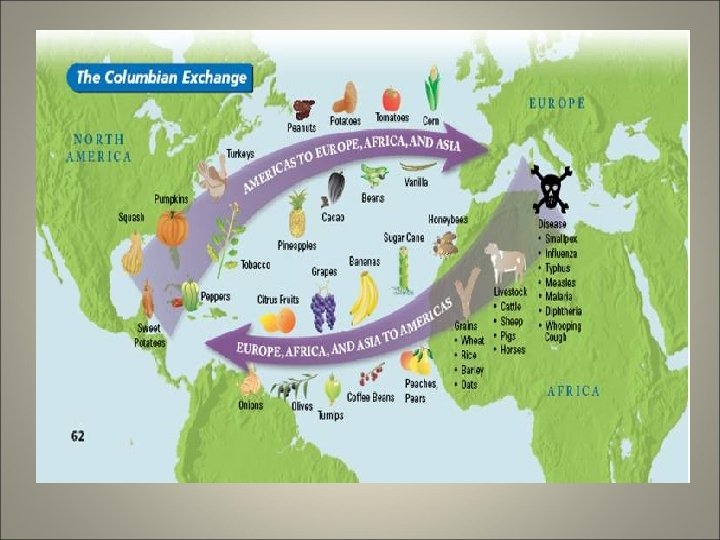
The Columbian Exchange – Biosocial changes to New World and Europe – Flora, fauna, and disease traveled in both directions across the Atlantic – New World foods (like potatoes) became Old World staples – Domestic animals (like horses) were brought to the new world – European diseases ravaged Amerindian populations – Sailors and settlers brought syphilis back with them to Europe
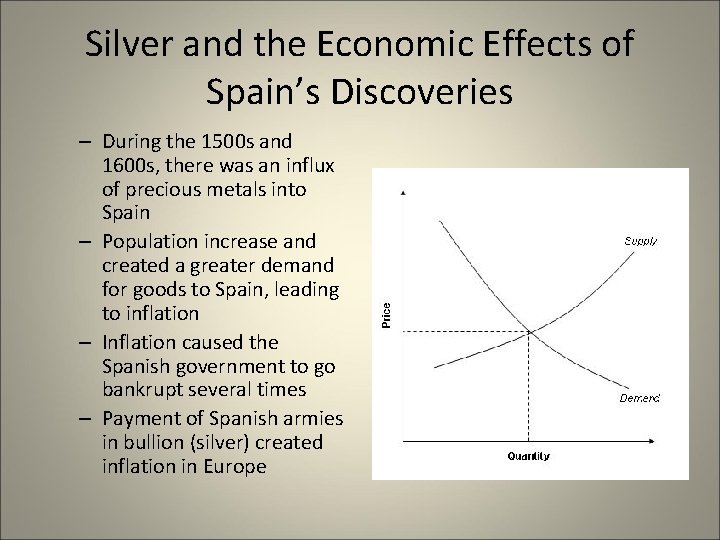
Silver and the Economic Effects of Spain’s Discoveries – During the 1500 s and 1600 s, there was an influx of precious metals into Spain – Population increase and created a greater demand for goods to Spain, leading to inflation – Inflation caused the Spanish government to go bankrupt several times – Payment of Spanish armies in bullion (silver) created inflation in Europe
How does inflation work? Demand Price INFLATION!
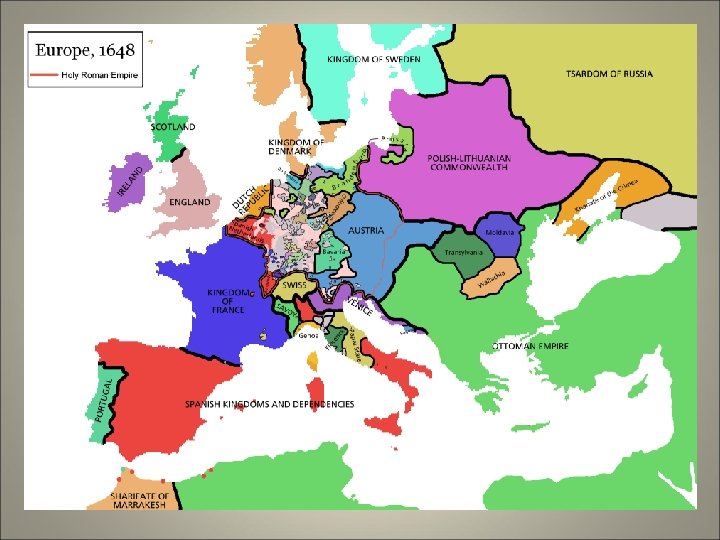
The Birth of the Global Economy – Three new commercial empires: Portugal, Spain, and the Dutch – 16 th century Portugal controlled the sea routes to India – Portuguese Brazil supplied most of Europe’s sugar – Spain had a land empire in the New World and a sea empire in the Pacific – Global commercial boom from 1570 -1630 – Dutch sea trade dominated in the later 17 th century
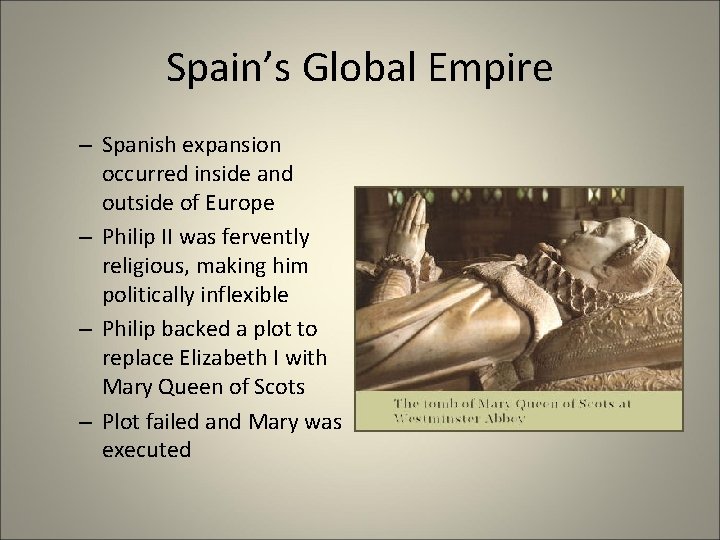
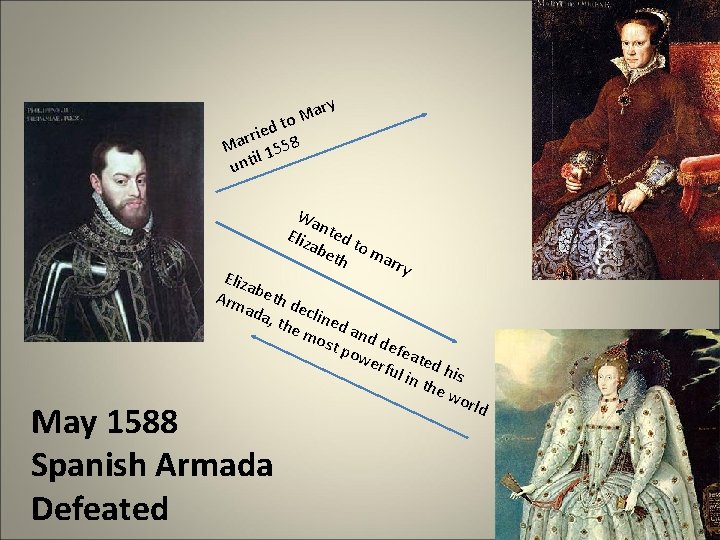
Spain’s Global Empire – Spanish expansion occurred inside and outside of Europe – Philip II was fervently religious, making him politically inflexible – Philip backed a plot to replace Elizabeth I with Mary Queen of Scots – Plot failed and Mary was executed
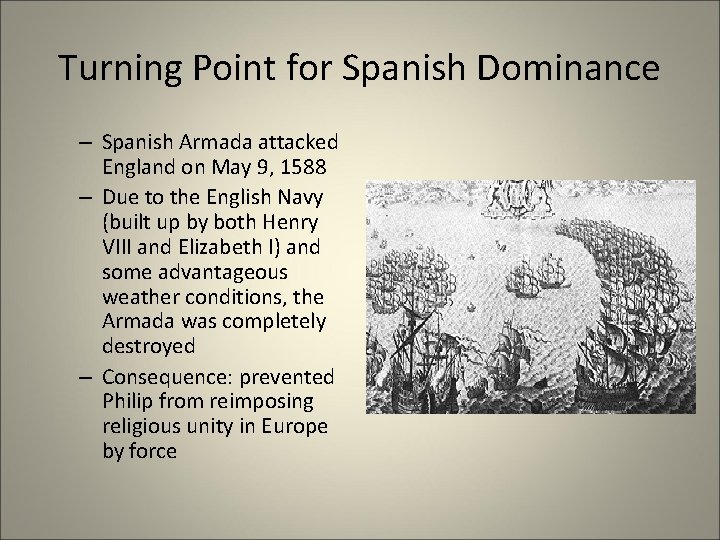
Turning Point for Spanish Dominance – Spanish Armada attacked England on May 9, 1588 – Due to the English Navy (built up by both Henry VIII and Elizabeth I) and some advantageous weather conditions, the Armada was completely destroyed – Consequence: prevented Philip from reimposing religious unity in Europe by force
y ar M o ed t i r r Ma 1558 il unt Wa Eliz nted abe to m th arr y Eliz a Arm beth d e ada , th clined em a ost nd de pow fea erfu ted h i l in the s wor ld May 1588 Spanish Armada Defeated
Changing Attitudes and Beliefs – New Ideas about Race • There was no particular connection between race and slavery in the ancient world • Europeans brought ideas about race with them to the New World • Medieval Christians and Arabs shared negative views of Blacks • Slavery in the New World contributed to the dissemination of more rigid notions of racial inferiority
Changing Attitudes and Beliefs • Michel de Montaigne and Cultural Curiosity – Montaigne (1533 -1592) a French nobleman, created the essay as a means of clarifying his own thoughts – Montaigne was a skeptic; he rejected the notion that any one culture was inherently superior to any other ?
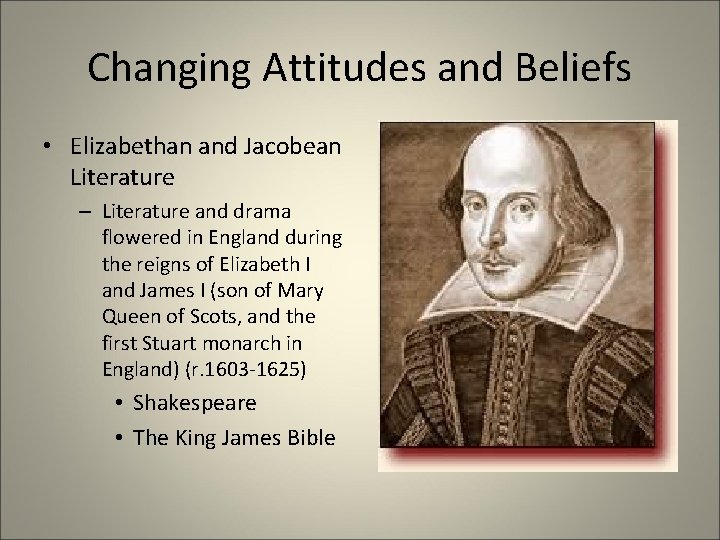
Changing Attitudes and Beliefs • Elizabethan and Jacobean Literature – Literature and drama flowered in England during the reigns of Elizabeth I and James I (son of Mary Queen of Scots, and the first Stuart monarch in England) (r. 1603 -1625) • Shakespeare • The King James Bible