
Consequences of cryomaintain signal loss on cold powering

- Slides: 12
Consequences of cryo-maintain signal loss on cold powering system V. Gahier (TE/CRG/OP) HL-LHC Cold powering failure modes working group (meeting #15) https: //indico. cern. ch/event/990112/ 12/20/2021 WP 6 a Safety WG – Pres 15 2
Agenda • Reminder of Cryo Maintain / Cryostart function in LHC • Reminder of DFX design • Applied example for DFX • Initial cryogenic operating conditions • Loss of CM signal by inadvertent closure of helium inlet to Cold Powering System • Conclusions and way forward 12/20/2021 WP 6 a Safety working group 3
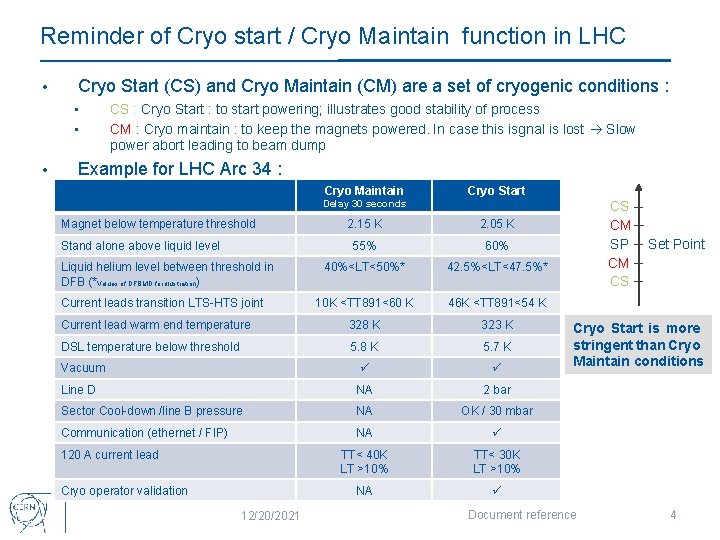
Reminder of Cryo start / Cryo Maintain function in LHC • Cryo Start (CS) and Cryo Maintain (CM) are a set of cryogenic conditions : • • • CS : Cryo Start : to start powering; illustrates good stability of process CM : Cryo maintain : to keep the magnets powered. In case this isgnal is lost Slow power abort leading to beam dump Example for LHC Arc 34 : Cryo Maintain Cryo Start Delay 30 seconds Magnet below temperature threshold 2. 15 K 2. 05 K 55% 60% 40%<LT<50%* 42. 5%<LT<47. 5%* 10 K <TT 891<60 K 46 K <TT 891<54 K Current lead warm end temperature 328 K 323 K DSL temperature below threshold 5. 8 K 5. 7 K Line D NA 2 bar Sector Cool-down /line B pressure NA OK / 30 mbar Communication (ethernet / FIP) NA TT< 40 K LT >10% TT< 30 K LT >10% NA Stand alone above liquid level Liquid helium level between threshold in DFB (*Values of DFBMD for illustration) Current leads transition LTS-HTS joint Vacuum 120 A current lead Cryo operator validation 12/20/2021 CS CM SP CM CS Set Point Cryo Start is more stringent than Cryo Maintain conditions Document reference 4
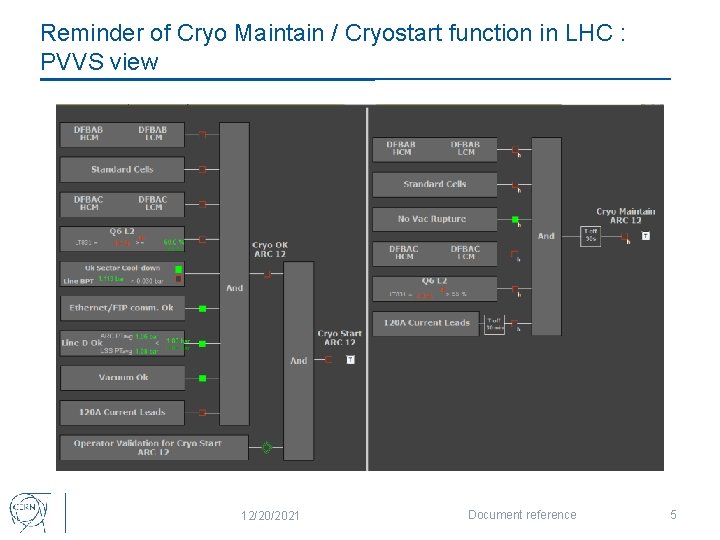
Reminder of Cryo Maintain / Cryostart function in LHC : PVVS view 12/20/2021 Document reference 5
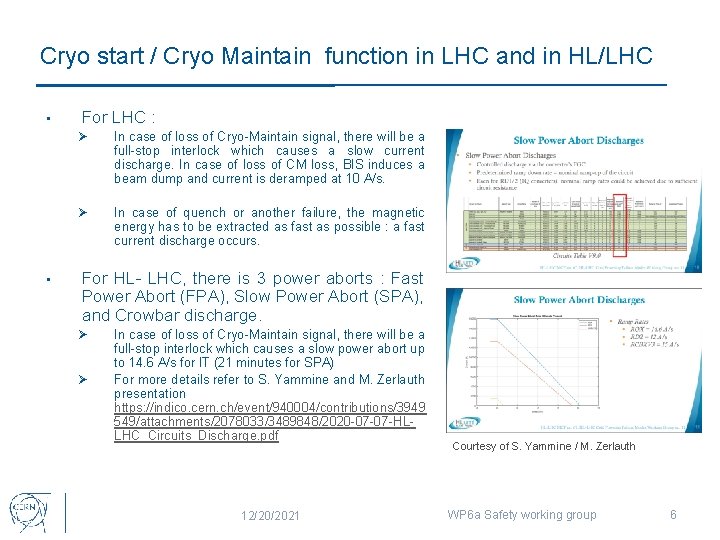
Cryo start / Cryo Maintain function in LHC and in HL/LHC • • For LHC : Ø In case of loss of Cryo-Maintain signal, there will be a full-stop interlock which causes a slow current discharge. In case of loss of CM loss, BIS induces a beam dump and current is deramped at 10 A/s. Ø In case of quench or another failure, the magnetic energy has to be extracted as fast as possible : a fast current discharge occurs. For HL- LHC, there is 3 power aborts : Fast Power Abort (FPA), Slow Power Abort (SPA), and Crowbar discharge. Ø Ø In case of loss of Cryo-Maintain signal, there will be a full-stop interlock which causes a slow power abort up to 14. 6 A/s for IT (21 minutes for SPA) For more details refer to S. Yammine and M. Zerlauth presentation https: //indico. cern. ch/event/940004/contributions/3949 549/attachments/2078033/3489848/2020 -07 -07 -HLLHC_Circuits_Discharge. pdf 12/20/2021 Courtesy of S. Yammine / M. Zerlauth WP 6 a Safety working group 6
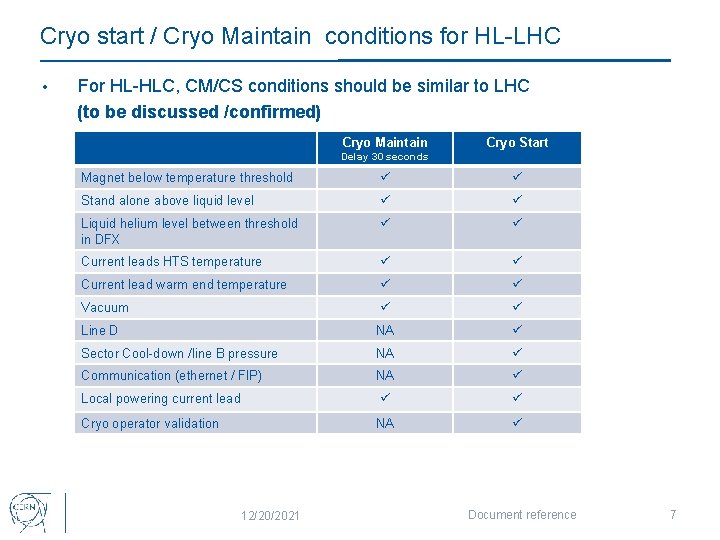
Cryo start / Cryo Maintain conditions for HL-LHC • For HL-HLC, CM/CS conditions should be similar to LHC (to be discussed /confirmed) Cryo Maintain Cryo Start Delay 30 seconds Magnet below temperature threshold Stand alone above liquid level Liquid helium level between threshold in DFX Current leads HTS temperature Current lead warm end temperature Vacuum Line D NA Sector Cool-down /line B pressure NA Communication (ethernet / FIP) NA Local powering current lead Cryo operator validation NA 12/20/2021 Document reference 7
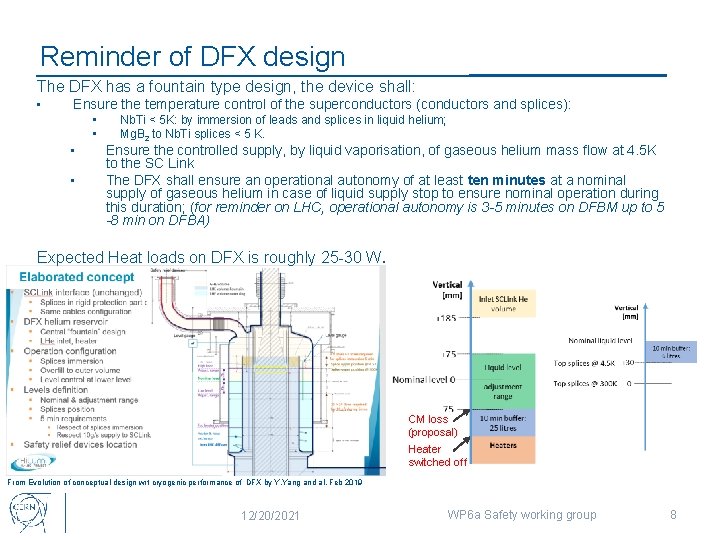
Reminder of DFX design The DFX has a fountain type design, the device shall: • Ensure the temperature control of the superconductors (conductors and splices): • • Nb. Ti < 5 K: by immersion of leads and splices in liquid helium; Mg. B 2 to Nb. Ti splices < 5 K. Ensure the controlled supply, by liquid vaporisation, of gaseous helium mass flow at 4. 5 K to the SC Link The DFX shall ensure an operational autonomy of at least ten minutes at a nominal supply of gaseous helium in case of liquid supply stop to ensure nominal operation during this duration; (for reminder on LHC, operational autonomy is 3 -5 minutes on DFBM up to 5 -8 min on DFBA) Expected Heat loads on DFX is roughly 25 -30 W. CM loss (proposal) Heater switched off From Evolution of conceptual design wrt cryogenic performance of DFX by Y. Yang and al. Feb 2019 12/20/2021 WP 6 a Safety working group 8
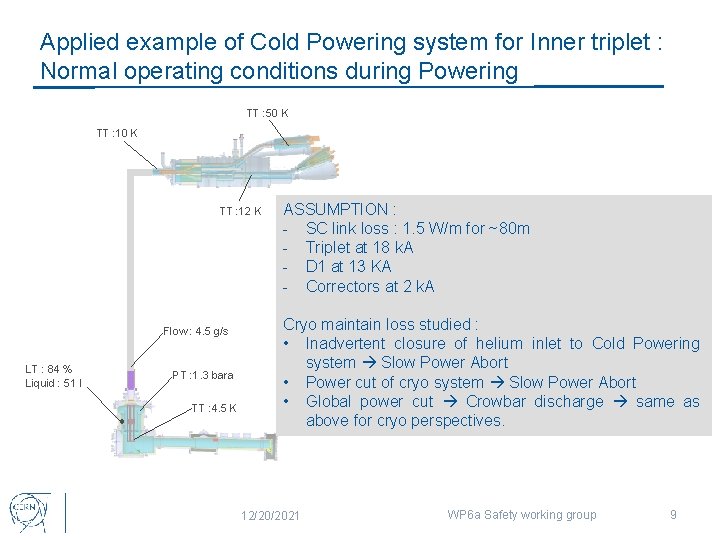
Applied example of Cold Powering system for Inner triplet : Normal operating conditions during Powering TT : 50 K TT : 12 K Flow : 4. 5 g/s LT : 84 % Liquid : 51 l PT : 1. 3 bara TT : 4. 5 K ASSUMPTION : - SC link loss : 1. 5 W/m for ~80 m - Triplet at 18 k. A - D 1 at 13 KA - Correctors at 2 k. A Cryo maintain loss studied : • Inadvertent closure of helium inlet to Cold Powering system Slow Power Abort • Power cut of cryo system Slow Power Abort • Global power cut Crowbar discharge same as above for cryo perspectives. 12/20/2021 WP 6 a Safety working group 9
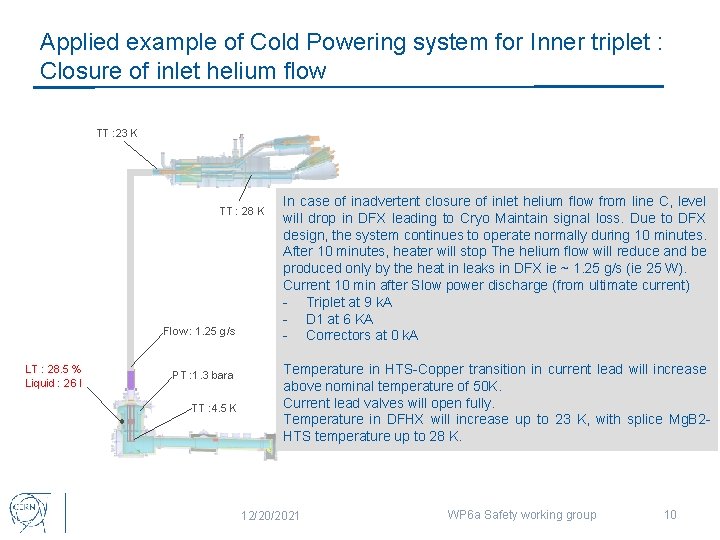
Applied example of Cold Powering system for Inner triplet : Closure of inlet helium flow TT : 23 K TT : 28 K Flow : 1. 25 g/s LT : 28. 5 % Liquid : 26 l PT : 1. 3 bara TT : 4. 5 K In case of inadvertent closure of inlet helium flow from line C, level will drop in DFX leading to Cryo Maintain signal loss. Due to DFX design, the system continues to operate normally during 10 minutes. After 10 minutes, heater will stop The helium flow will reduce and be produced only by the heat in leaks in DFX ie ~ 1. 25 g/s (ie 25 W). Current 10 min after Slow power discharge (from ultimate current) - Triplet at 9 k. A - D 1 at 6 KA - Correctors at 0 k. A Temperature in HTS-Copper transition in current lead will increase above nominal temperature of 50 K. Current lead valves will open fully. Temperature in DFHX will increase up to 23 K, with splice Mg. B 2 HTS temperature up to 28 K. 12/20/2021 WP 6 a Safety working group 10
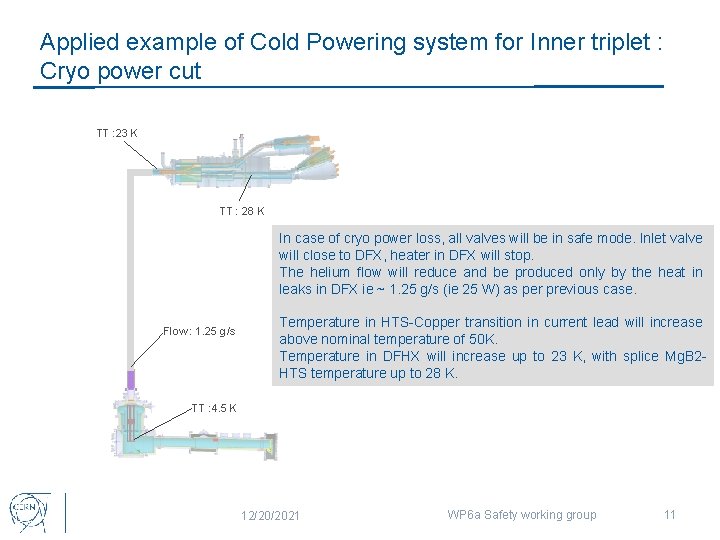
Applied example of Cold Powering system for Inner triplet : Cryo power cut TT : 23 K TT : 28 K In case of cryo power loss, all valves will be in safe mode. Inlet valve will close to DFX, heater in DFX will stop. The helium flow will reduce and be produced only by the heat in leaks in DFX ie ~ 1. 25 g/s (ie 25 W) as per previous case. Flow : 1. 25 g/s Temperature in HTS-Copper transition in current lead will increase above nominal temperature of 50 K. Temperature in DFHX will increase up to 23 K, with splice Mg. B 2 HTS temperature up to 28 K. TT : 4. 5 K 12/20/2021 WP 6 a Safety working group 11
Conclusion and Way Forward • Cryo maintain conditions for HL-LHC to be defined / agreed. • In case of inadvertent closure of helium inlet to DFX : • • • Loss of cryo maintain leading to SPA, Mg. B 2 -HTS splice temperature will raise up to 28 K, Temperature in HTS (in current lead) will raise to higher than 50 K. Electrical consequences to be assessed, Potential SPA ramp to be reviewed. 12/20/2021 WP 6 a Safety working group 12