
Consequence Analysis Dr AA Department of Chemical Engineering

- Slides: 23
Consequence Analysis Dr. AA Department of Chemical Engineering University Teknology Malaysia
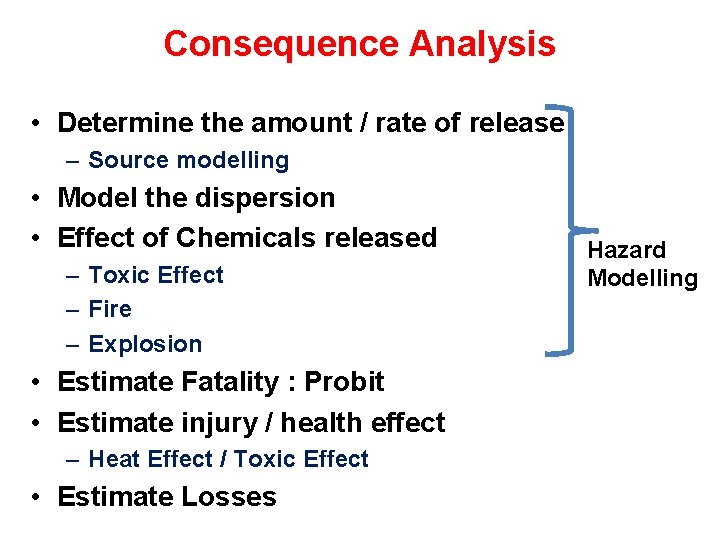
Consequence Analysis • Determine the amount / rate of release – Source modelling • Model the dispersion • Effect of Chemicals released – Toxic Effect – Fire – Explosion • Estimate Fatality : Probit • Estimate injury / health effect – Heat Effect / Toxic Effect • Estimate Losses Hazard Modelling
Estimation of Fatality (Probit Analysis)
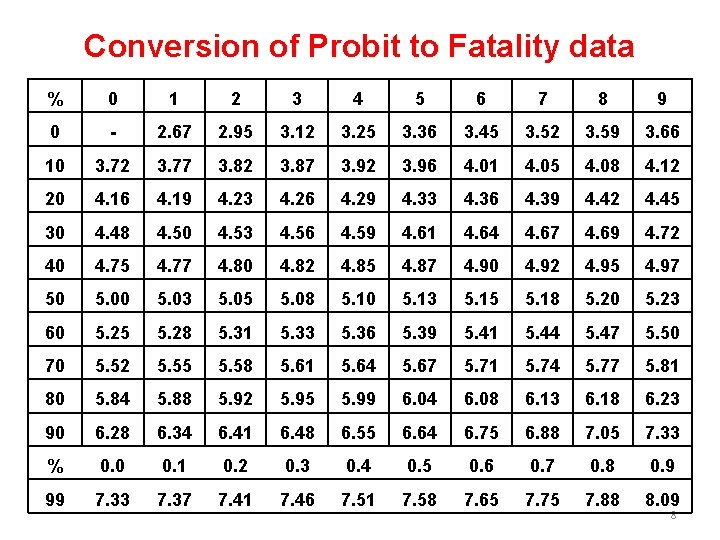
Estimation of Fatality: Probit Analysis • The dose level of the various hazard events against fatality can be conveniently determined using Probit Analysis. • It is a graphical and Look-up Table approach to determine probability of fatality 4
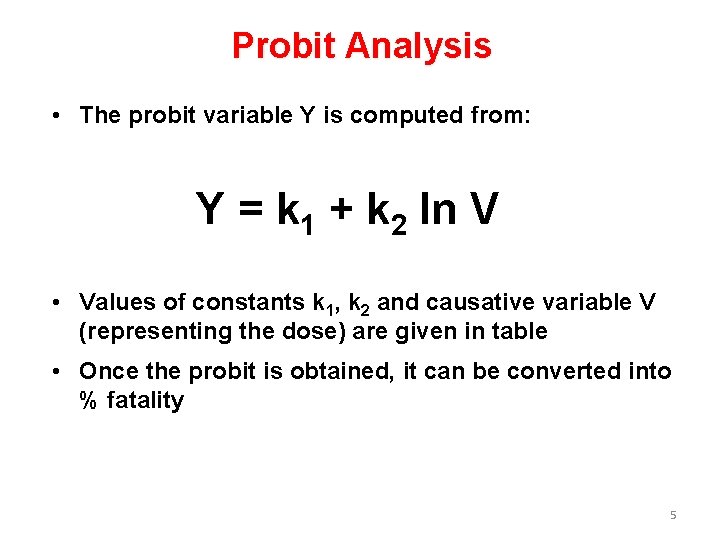
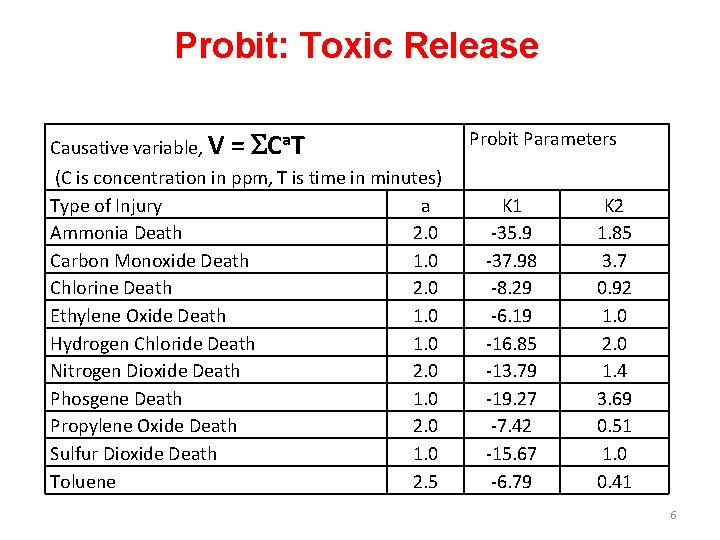
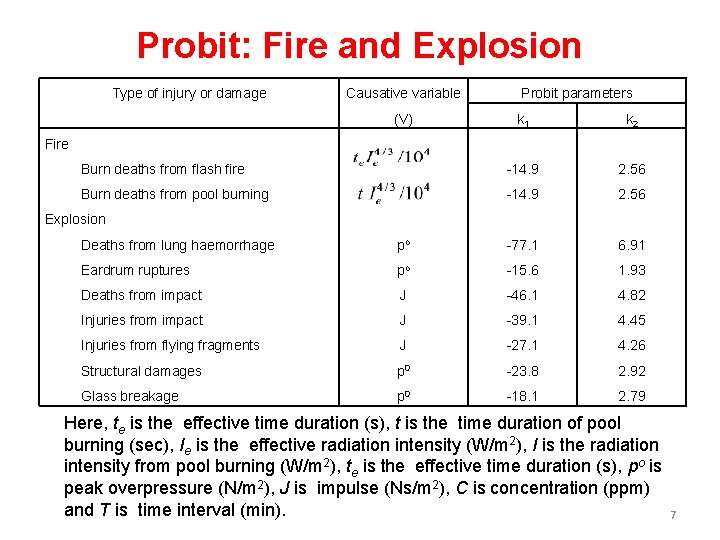
Probit Analysis • The probit variable Y is computed from: Y = k 1 + k 2 ln V • Values of constants k 1, k 2 and causative variable V (representing the dose) are given in table • Once the probit is obtained, it can be converted into % fatality 5
Probit: Toxic Release Causative variable, V = SCa. T (C is concentration in ppm, T is time in minutes) Type of Injury a Ammonia Death 2. 0 Carbon Monoxide Death 1. 0 Chlorine Death 2. 0 Ethylene Oxide Death 1. 0 Hydrogen Chloride Death 1. 0 Nitrogen Dioxide Death 2. 0 Phosgene Death 1. 0 Propylene Oxide Death 2. 0 Sulfur Dioxide Death 1. 0 Toluene 2. 5 Probit Parameters K 1 -35. 9 -37. 98 -8. 29 -6. 19 -16. 85 -13. 79 -19. 27 -7. 42 -15. 67 -6. 79 K 2 1. 85 3. 7 0. 92 1. 0 2. 0 1. 4 3. 69 0. 51 1. 0 0. 41 6
Probit: Fire and Explosion Type of injury or damage Causative variable Probit parameters k 1 k 2 Burn deaths from flash fire -14. 9 2. 56 Burn deaths from pool burning -14. 9 2. 56 (V) Fire Explosion Deaths from lung haemorrhage po -77. 1 6. 91 Eardrum ruptures po -15. 6 1. 93 Deaths from impact J -46. 1 4. 82 Injuries from impact J -39. 1 4. 45 Injuries from flying fragments J -27. 1 4. 26 Structural damages p 0 -23. 8 2. 92 Glass breakage p 0 -18. 1 2. 79 Here, te is the effective time duration (s), t is the time duration of pool burning (sec), Ie is the effective radiation intensity (W/m 2), I is the radiation intensity from pool burning (W/m 2), te is the effective time duration (s), po is peak overpressure (N/m 2), J is impulse (Ns/m 2), C is concentration (ppm) and T is time interval (min). 7
Conversion of Probit to Fatality data % 0 1 2 3 4 5 6 7 8 9 0 - 2. 67 2. 95 3. 12 3. 25 3. 36 3. 45 3. 52 3. 59 3. 66 10 3. 72 3. 77 3. 82 3. 87 3. 92 3. 96 4. 01 4. 05 4. 08 4. 12 20 4. 16 4. 19 4. 23 4. 26 4. 29 4. 33 4. 36 4. 39 4. 42 4. 45 30 4. 48 4. 50 4. 53 4. 56 4. 59 4. 61 4. 64 4. 67 4. 69 4. 72 40 4. 75 4. 77 4. 80 4. 82 4. 85 4. 87 4. 90 4. 92 4. 95 4. 97 50 5. 03 5. 05 5. 08 5. 10 5. 13 5. 15 5. 18 5. 20 5. 23 60 5. 25 5. 28 5. 31 5. 33 5. 36 5. 39 5. 41 5. 44 5. 47 5. 50 70 5. 52 5. 55 5. 58 5. 61 5. 64 5. 67 5. 71 5. 74 5. 77 5. 81 80 5. 84 5. 88 5. 92 5. 95 5. 99 6. 04 6. 08 6. 13 6. 18 6. 23 90 6. 28 6. 34 6. 41 6. 48 6. 55 6. 64 6. 75 6. 88 7. 05 7. 33 % 0. 0 0. 1 0. 2 0. 3 0. 4 0. 5 0. 6 0. 7 0. 8 0. 9 99 7. 33 7. 37 7. 41 7. 46 7. 51 7. 58 7. 65 7. 75 7. 88 8. 09 8
Heat Effect Criteria
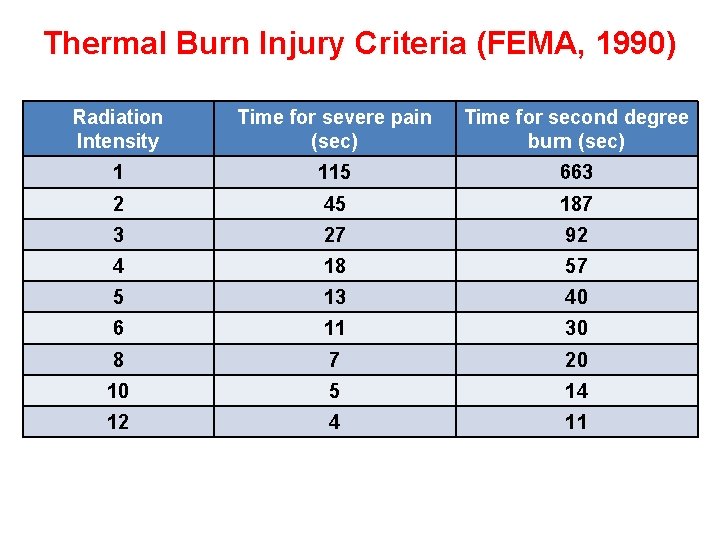
Thermal Burn Injury Criteria (FEMA, 1990) Radiation Intensity Time for severe pain (sec) Time for second degree burn (sec) 1 115 663 2 45 187 3 27 92 4 18 57 5 13 40 6 11 30 8 7 20 10 5 14 12 4 11
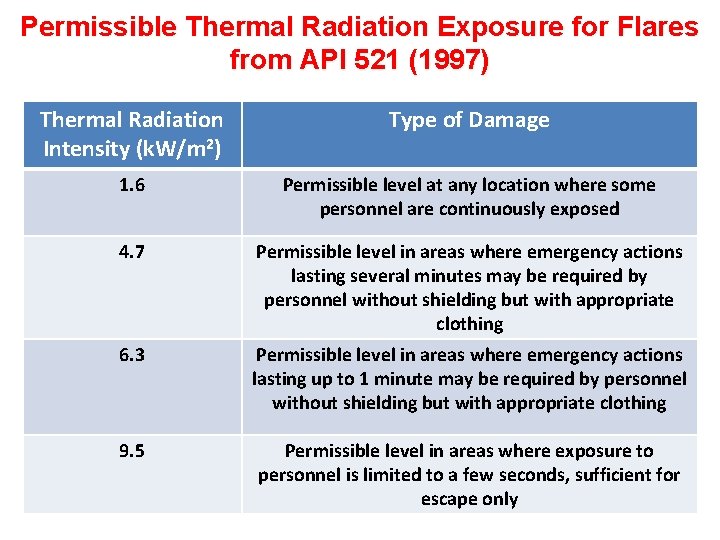
Permissible Thermal Radiation Exposure for Flares from API 521 (1997) Thermal Radiation Intensity (k. W/m 2) Type of Damage 1. 6 Permissible level at any location where some personnel are continuously exposed 4. 7 Permissible level in areas where emergency actions lasting several minutes may be required by personnel without shielding but with appropriate clothing 6. 3 Permissible level in areas where emergency actions lasting up to 1 minute may be required by personnel without shielding but with appropriate clothing 9. 5 Permissible level in areas where exposure to personnel is limited to a few seconds, sufficient for escape only
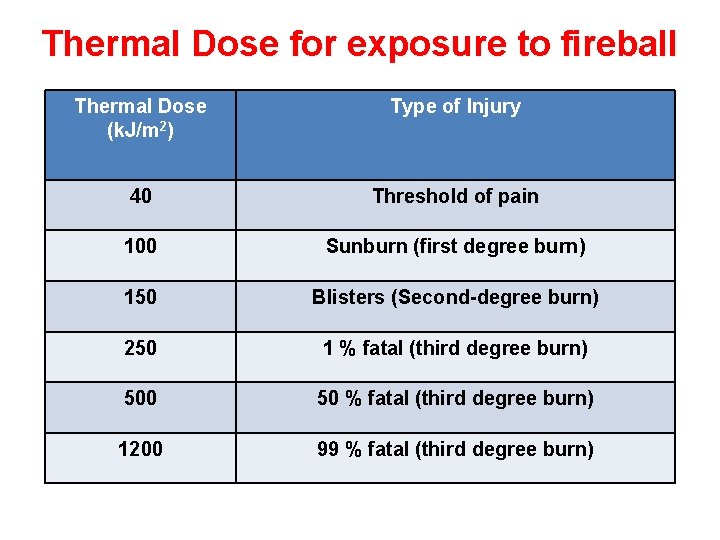
Thermal Dose for exposure to fireball Thermal Dose (k. J/m 2) Type of Injury 40 Threshold of pain 100 Sunburn (first degree burn) 150 Blisters (Second-degree burn) 250 1 % fatal (third degree burn) 500 50 % fatal (third degree burn) 1200 99 % fatal (third degree burn)
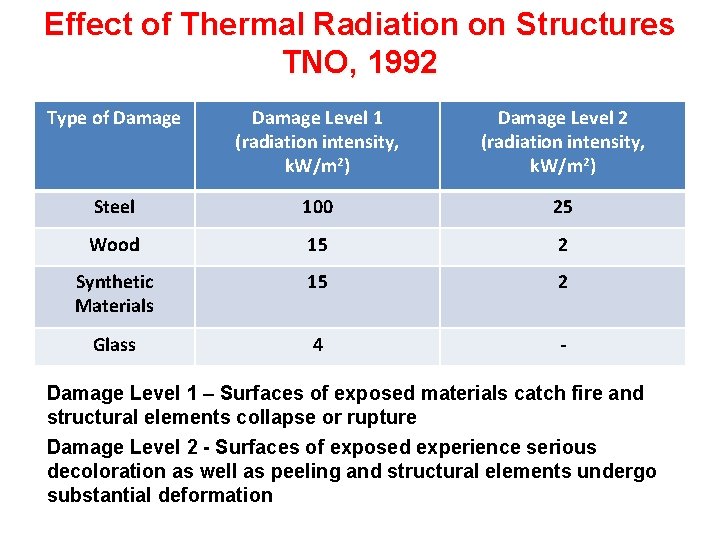
Effect of Thermal Radiation on Structures TNO, 1992 Type of Damage Level 1 (radiation intensity, k. W/m 2) Damage Level 2 (radiation intensity, k. W/m 2) Steel 100 25 Wood 15 2 Synthetic Materials 15 2 Glass 4 - Damage Level 1 – Surfaces of exposed materials catch fire and structural elements collapse or rupture Damage Level 2 - Surfaces of exposed experience serious decoloration as well as peeling and structural elements undergo substantial deformation
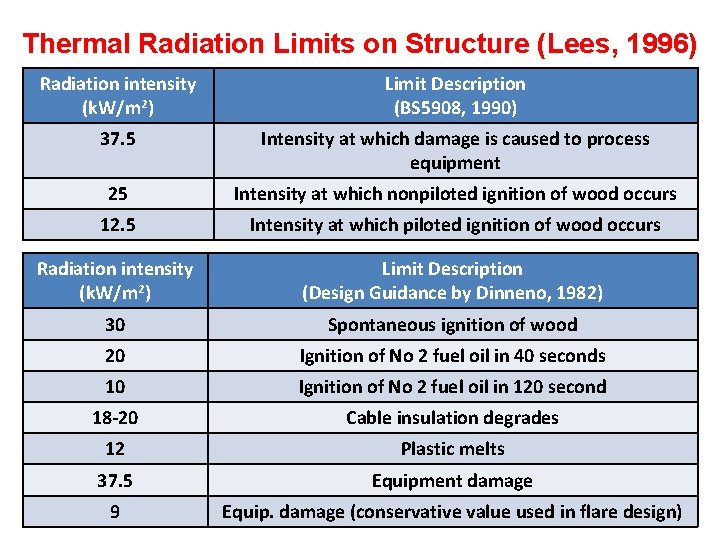
Thermal Radiation Limits on Structure (Lees, 1996) Radiation intensity (k. W/m 2) Limit Description (BS 5908, 1990) 37. 5 Intensity at which damage is caused to process equipment 25 Intensity at which nonpiloted ignition of wood occurs 12. 5 Intensity at which piloted ignition of wood occurs Radiation intensity (k. W/m 2) Limit Description (Design Guidance by Dinneno, 1982) 30 Spontaneous ignition of wood 20 Ignition of No 2 fuel oil in 40 seconds 10 Ignition of No 2 fuel oil in 120 second 18 -20 Cable insulation degrades 12 Plastic melts 37. 5 Equipment damage 9 Equip. damage (conservative value used in flare design)
Toxic Effect Criteria
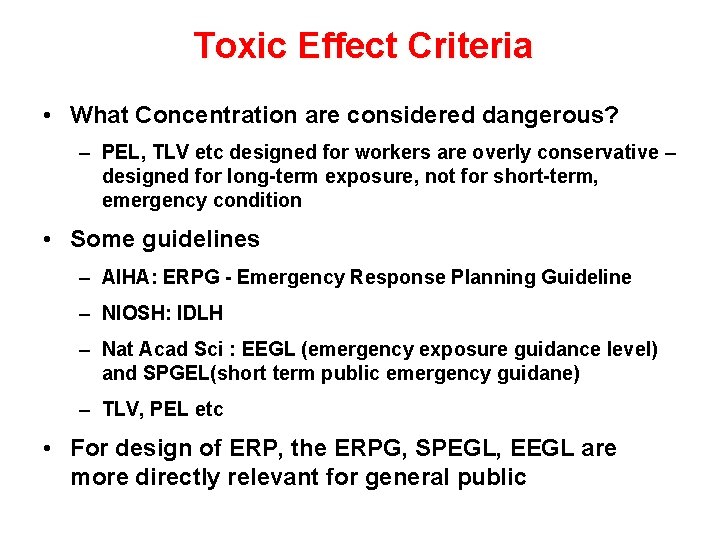
Toxic Effect Criteria • What Concentration are considered dangerous? – PEL, TLV etc designed for workers are overly conservative – designed for long-term exposure, not for short-term, emergency condition • Some guidelines – AIHA: ERPG - Emergency Response Planning Guideline – NIOSH: IDLH – Nat Acad Sci : EEGL (emergency exposure guidance level) and SPGEL(short term public emergency guidane) – TLV, PEL etc • For design of ERP, the ERPG, SPEGL, EEGL are more directly relevant for general public
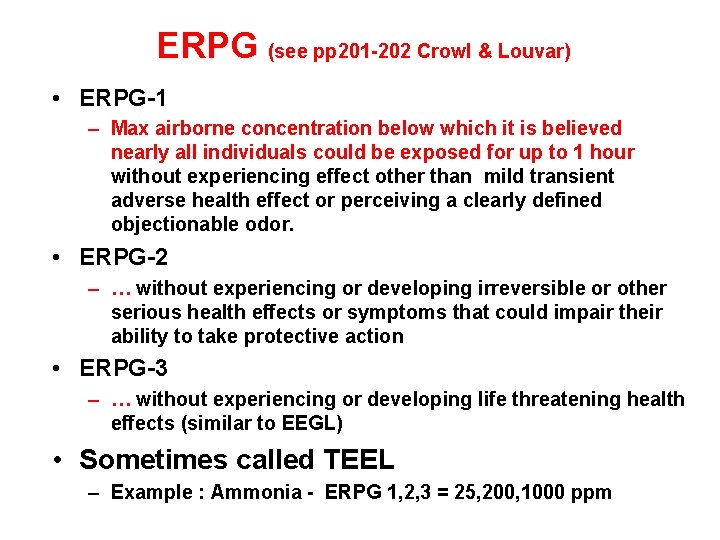
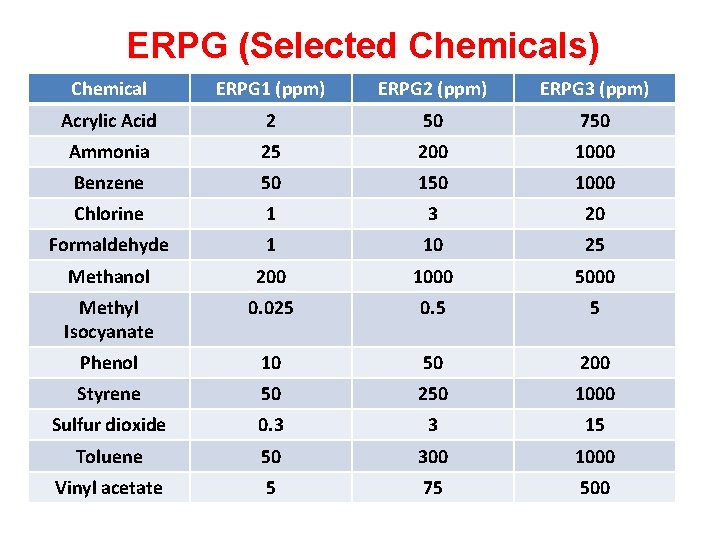
ERPG (see pp 201 -202 Crowl & Louvar) • ERPG-1 – Max airborne concentration below which it is believed nearly all individuals could be exposed for up to 1 hour without experiencing effect other than mild transient adverse health effect or perceiving a clearly defined objectionable odor. • ERPG-2 – … without experiencing or developing irreversible or other serious health effects or symptoms that could impair their ability to take protective action • ERPG-3 – … without experiencing or developing life threatening health effects (similar to EEGL) • Sometimes called TEEL – Example : Ammonia - ERPG 1, 2, 3 = 25, 200, 1000 ppm
ERPG (Selected Chemicals) Chemical ERPG 1 (ppm) ERPG 2 (ppm) ERPG 3 (ppm) Acrylic Acid 2 50 750 Ammonia 25 200 1000 Benzene 50 1000 Chlorine 1 3 20 Formaldehyde 1 10 25 Methanol 200 1000 5000 Methyl Isocyanate 0. 025 0. 5 5 Phenol 10 50 200 Styrene 50 250 1000 Sulfur dioxide 0. 3 3 15 Toluene 50 300 1000 Vinyl acetate 5 75 500
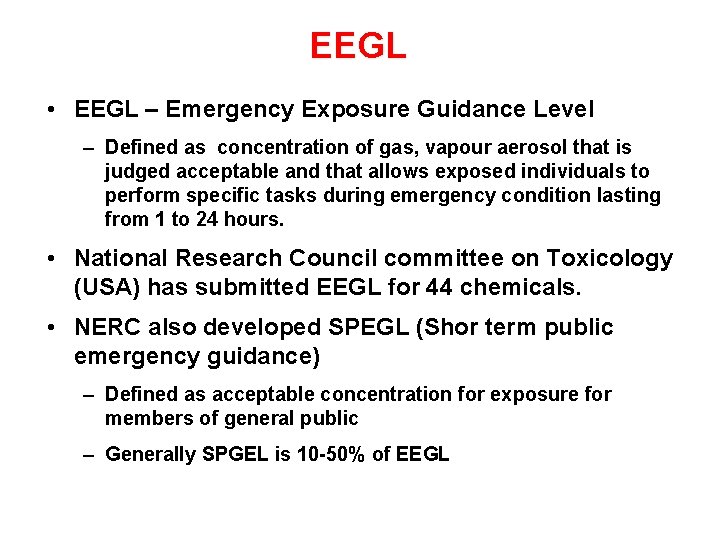
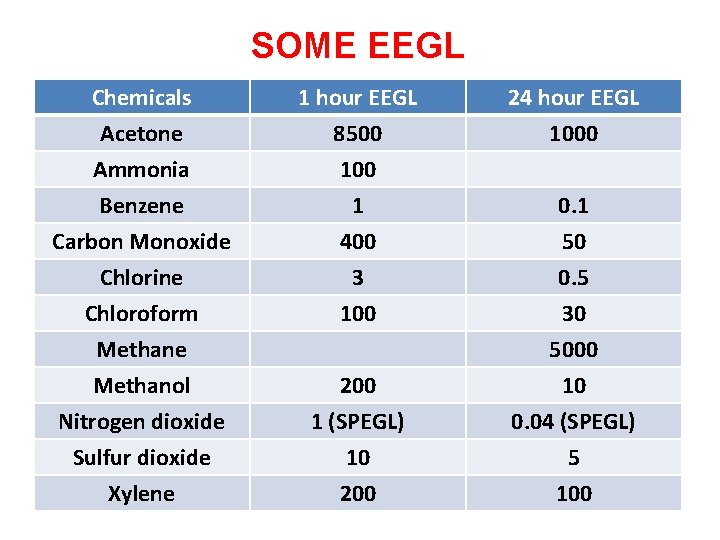
EEGL • EEGL – Emergency Exposure Guidance Level – Defined as concentration of gas, vapour aerosol that is judged acceptable and that allows exposed individuals to perform specific tasks during emergency condition lasting from 1 to 24 hours. • National Research Council committee on Toxicology (USA) has submitted EEGL for 44 chemicals. • NERC also developed SPEGL (Shor term public emergency guidance) – Defined as acceptable concentration for exposure for members of general public – Generally SPGEL is 10 -50% of EEGL
SOME EEGL Chemicals Acetone Ammonia Benzene 1 hour EEGL 8500 1 24 hour EEGL 1000 Carbon Monoxide Chlorine Chloroform Methane Methanol Nitrogen dioxide Sulfur dioxide Xylene 400 3 100 50 0. 5 30 5000 10 0. 04 (SPEGL) 5 100 200 1 (SPEGL) 10 200 0. 1
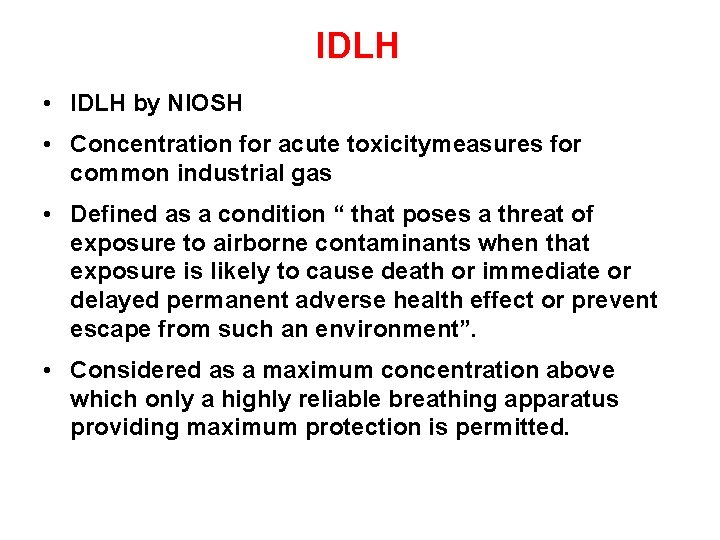
IDLH • IDLH by NIOSH • Concentration for acute toxicitymeasures for common industrial gas • Defined as a condition “ that poses a threat of exposure to airborne contaminants when that exposure is likely to cause death or immediate or delayed permanent adverse health effect or prevent escape from such an environment”. • Considered as a maximum concentration above which only a highly reliable breathing apparatus providing maximum protection is permitted.
Toxic End Point • EPA promulgamated a set of toxic end points to be used for air dispersion modeling for toxic gas releases as part of EPA RMP • Toxic end points follows (in order of preference) – ERPG-2 – LOC (level of concern) - the maximum concentration of an extremely hazardous substance in air that will not cause serious irreversible health effects in the general population when exposed to the substance for relatively short period.
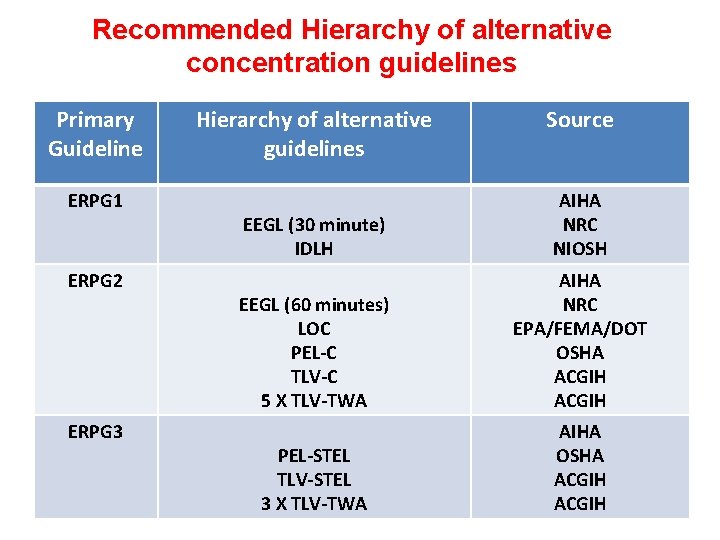
Recommended Hierarchy of alternative concentration guidelines Primary Guideline ERPG 1 ERPG 2 ERPG 3 Hierarchy of alternative guidelines Source EEGL (30 minute) IDLH AIHA NRC NIOSH EEGL (60 minutes) LOC PEL-C TLV-C 5 X TLV-TWA AIHA NRC EPA/FEMA/DOT OSHA ACGIH PEL-STEL TLV-STEL 3 X TLV-TWA AIHA OSHA ACGIH