
Consent Pathway for people with Capacity Issues All
- Slides: 1
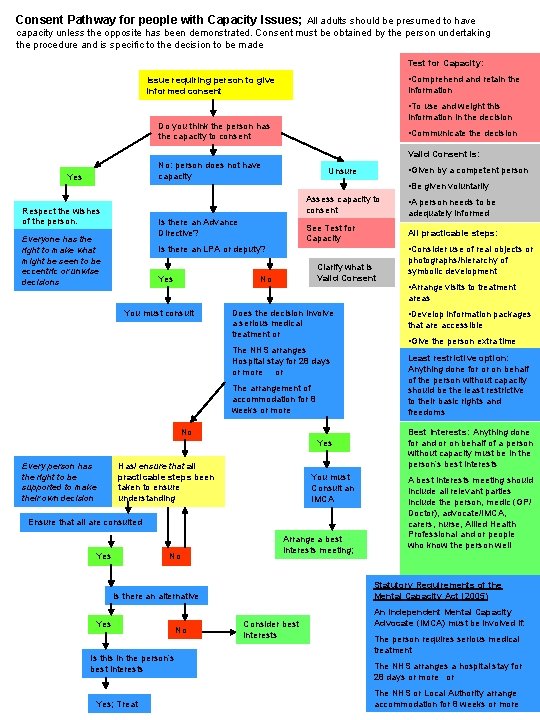
Consent Pathway for people with Capacity Issues; All adults should be presumed to have capacity unless the opposite has been demonstrated. Consent must be obtained by the person undertaking the procedure and is specific to the decision to be made Test for Capacity: • Comprehend and retain the Issue requiring person to give informed consent information • To use and weight this information in the decision Do you think the person has the capacity to consent • Communicate the decision Valid Consent is: No: person does not have capacity Yes Respect the wishes of the person. • Be given voluntarily Is there an Advance Directive? Everyone has the right to make what might be seen to be eccentric or unwise decisions • Given by a competent person Unsure Assess capacity to consent • A person needs to be See Test for Capacity All practicable steps: • Consider use of real objects or Is there an LPA or deputy? Yes adequately informed Clarify what is Valid Consent No photographs/hierarchy of symbolic development • Arrange visits to treatment areas You must consult Does the decision involve a serious medical treatment or The NHS arranges Hospital stay for 28 days or more or The arrangement of accommodation for 8 weeks or more No Yes Every person has the right to be supported to make their own decision Has/ ensure that all practicable steps been taken to ensure understanding You must Consult an IMCA Ensure that all are consulted Yes No Arrange a best interests meeting; Is this in the person’s best interests Yes; Treat No that are accessible • Give the person extra time Least restrictive option: Anything done for or on behalf of the person without capacity should be the least restrictive to their basic rights and freedoms Best Interests: Anything done for and or on behalf of a person without capacity must be in the person’s best interests A best interests meeting should include all relevant parties include the person, medic (GP/ Doctor), advocate/IMCA, carers, nurse, Allied Health Professional and or people who know the person well Statutory Requirements of the Mental Capacity Act (2005) Is there an alternative Yes • Develop information packages Consider best interests An Independent Mental Capacity Advocate (IMCA) must be involved if: The person requires serious medical treatment The NHS arranges a hospital stay for 28 days or more or The NHS or Local Authority arrange accommodation for 8 weeks or more