
Consensus FLP and Paxos COS 418 Distributed Systems
Consensus, FLP, and Paxos COS 418: Distributed Systems Lecture 10 Wyatt Lloyd
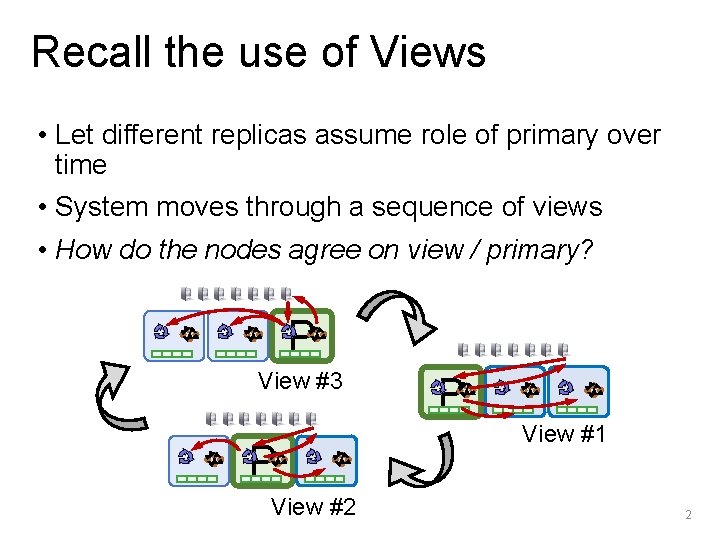
Recall the use of Views • Let different replicas assume role of primary over time • System moves through a sequence of views • How do the nodes agree on view / primary? P View #3 P View #2 P View #1 2
Consensus • Definition: 1. A general agreement about something 2. An idea or opinion that is shared by all the people in a group
Consensus Given a set of processors, each with an initial value: • Termination: All non-faulty processes eventually decide on a value • Agreement: All processes that decide do so on the same value • Validity: The value that has been decided must have proposed by some process
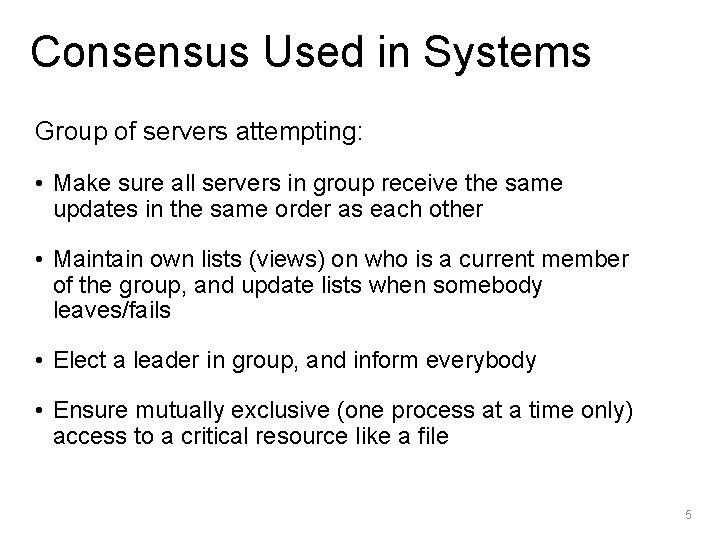
Consensus Used in Systems Group of servers attempting: • Make sure all servers in group receive the same updates in the same order as each other • Maintain own lists (views) on who is a current member of the group, and update lists when somebody leaves/fails • Elect a leader in group, and inform everybody • Ensure mutually exclusive (one process at a time only) access to a critical resource like a file 5
Can We Achieve Consensus?
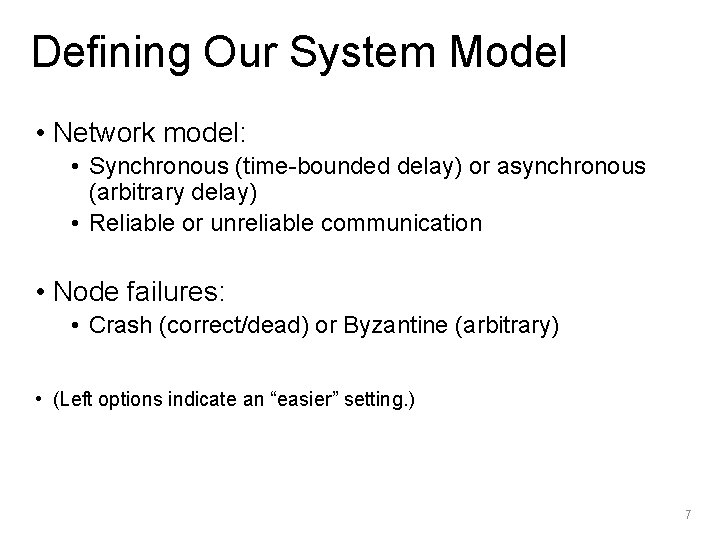
Defining Our System Model • Network model: • Synchronous (time-bounded delay) or asynchronous (arbitrary delay) • Reliable or unreliable communication • Node failures: • Crash (correct/dead) or Byzantine (arbitrary) • (Left options indicate an “easier” setting. ) 7
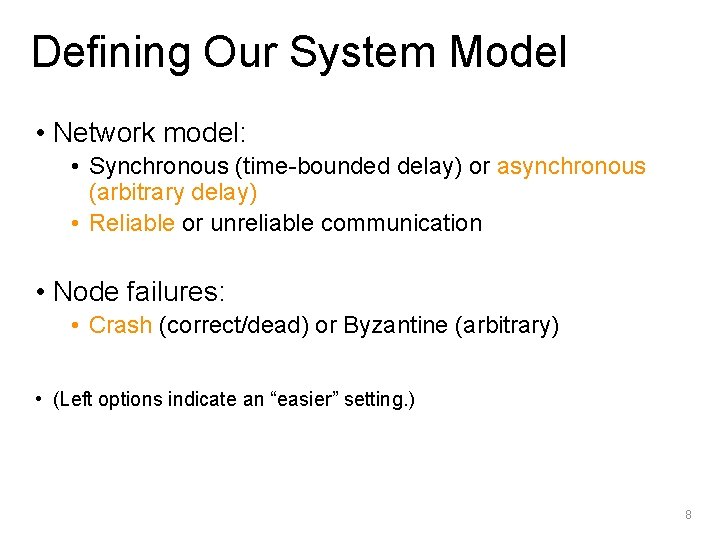
Defining Our System Model • Network model: • Synchronous (time-bounded delay) or asynchronous (arbitrary delay) • Reliable or unreliable communication • Node failures: • Crash (correct/dead) or Byzantine (arbitrary) • (Left options indicate an “easier” setting. ) 8
Consensus is Impossible
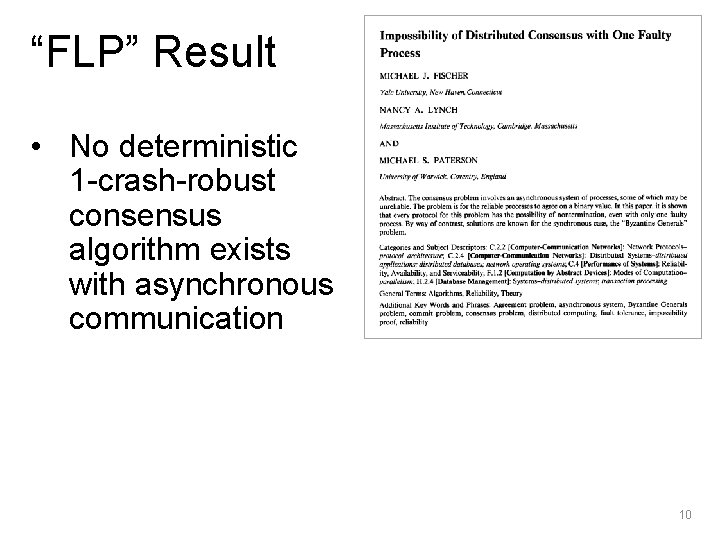
“FLP” Result • No deterministic 1 -crash-robust consensus algorithm exists with asynchronous communication 10
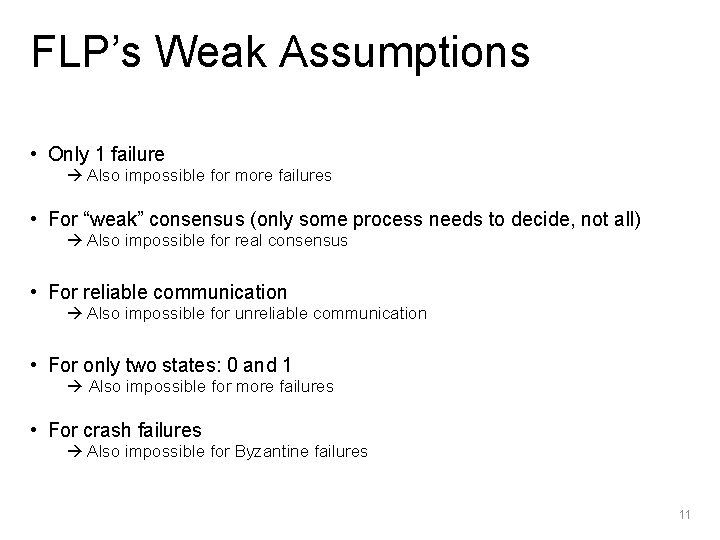
FLP’s Weak Assumptions • Only 1 failure Also impossible for more failures • For “weak” consensus (only some process needs to decide, not all) Also impossible for real consensus • For reliable communication Also impossible for unreliable communication • For only two states: 0 and 1 Also impossible for more failures • For crash failures Also impossible for Byzantine failures 11
FLP’s Strong Assumptions • Deterministic actions at each node • Asynchronous network communication • All “runs” must eventually achieve consensus
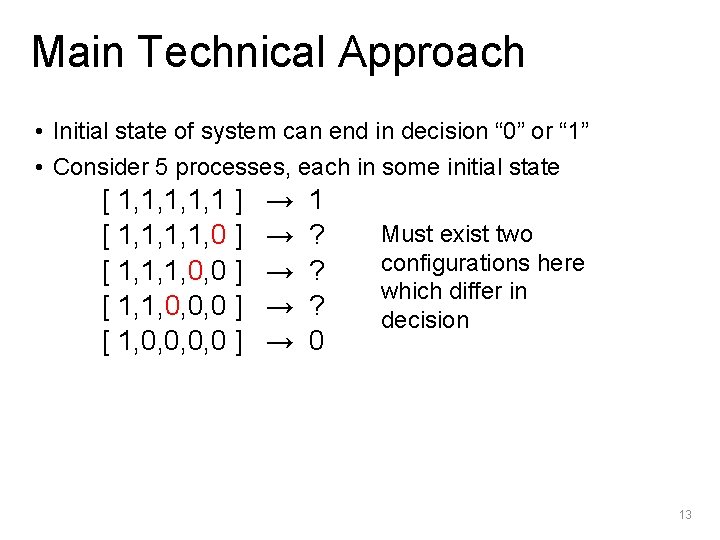
Main Technical Approach • Initial state of system can end in decision “ 0” or “ 1” • Consider 5 processes, each in some initial state [ 1, 1, 1 ] [ 1, 1, 0 ] [ 1, 1, 1, 0, 0 ] [ 1, 1, 0, 0, 0 ] [ 1, 0, 0 ] → → → 1 ? ? ? 0 Must exist two configurations here which differ in decision 13
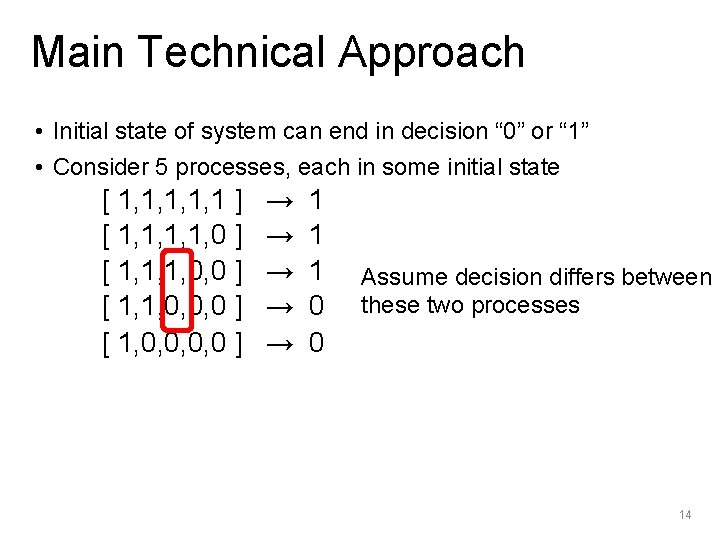
Main Technical Approach • Initial state of system can end in decision “ 0” or “ 1” • Consider 5 processes, each in some initial state [ 1, 1, 1 ] [ 1, 1, 0 ] [ 1, 1, 1, 0, 0 ] [ 1, 1, 0, 0, 0 ] [ 1, 0, 0 ] → → → 1 1 1 0 0 Assume decision differs between these two processes 14
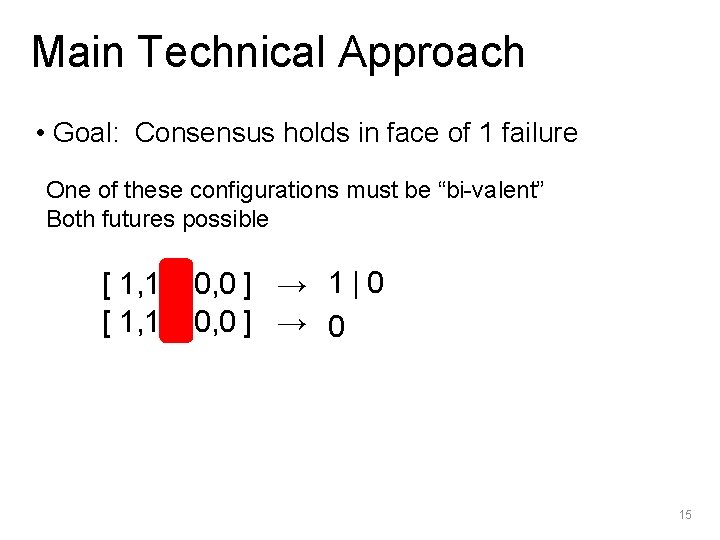
Main Technical Approach • Goal: Consensus holds in face of 1 failure One of these configurations must be “bi-valent” Both futures possible [ 1, 1, 0, 0, 0 ] → 1 | 0 [ 1, 1, 1, 0, 0 ] → 0 15
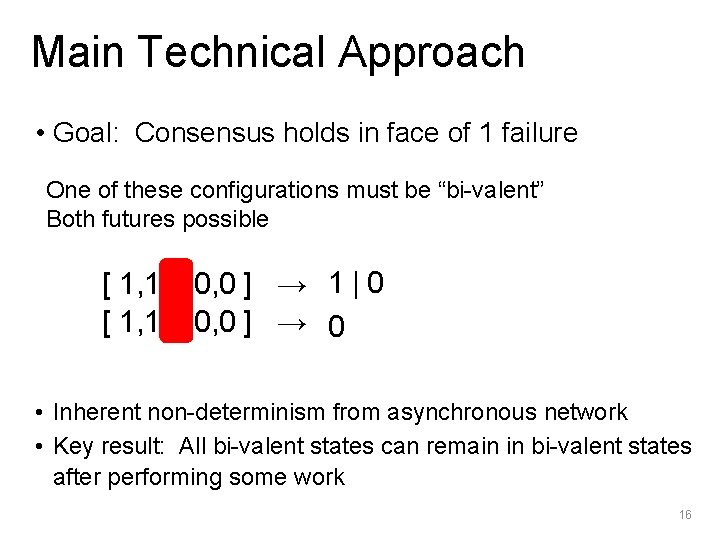
Main Technical Approach • Goal: Consensus holds in face of 1 failure One of these configurations must be “bi-valent” Both futures possible [ 1, 1, 0, 0, 0 ] → 1 | 0 [ 1, 1, 1, 0, 0 ] → 0 • Inherent non-determinism from asynchronous network • Key result: All bi-valent states can remain in bi-valent states after performing some work 16
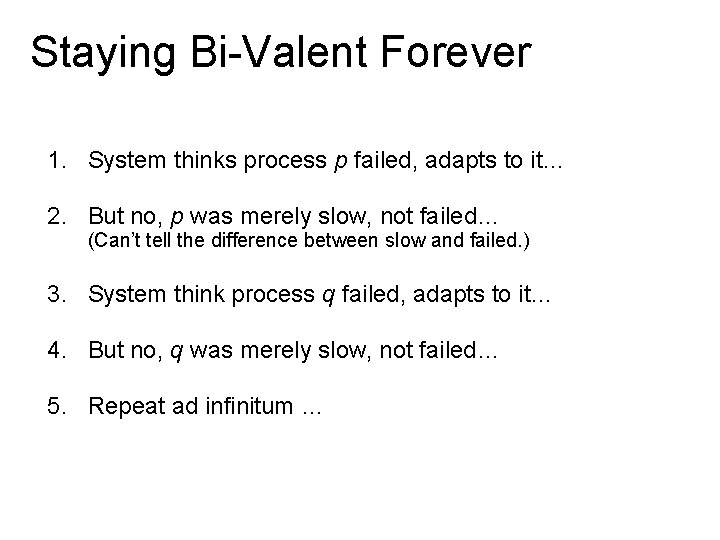
Staying Bi-Valent Forever 1. System thinks process p failed, adapts to it… 2. But no, p was merely slow, not failed… (Can’t tell the difference between slow and failed. ) 3. System think process q failed, adapts to it… 4. But no, q was merely slow, not failed… 5. Repeat ad infinitum …
Consensus is Impossible But, we achieve consensus all the time…
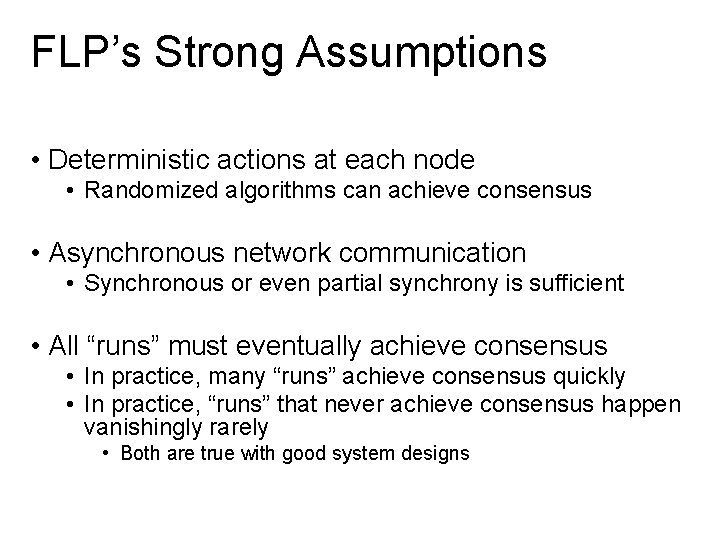
FLP’s Strong Assumptions • Deterministic actions at each node • Randomized algorithms can achieve consensus • Asynchronous network communication • Synchronous or even partial synchrony is sufficient • All “runs” must eventually achieve consensus • In practice, many “runs” achieve consensus quickly • In practice, “runs” that never achieve consensus happen vanishingly rarely • Both are true with good system designs
Consensus is Possible With Paxos!
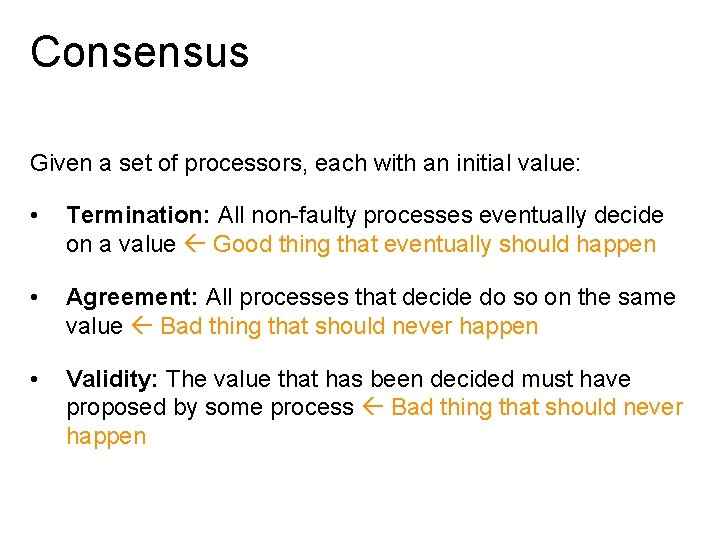
Consensus Given a set of processors, each with an initial value: • Termination: All non-faulty processes eventually decide on a value Good thing that eventually should happen • Agreement: All processes that decide do so on the same value Bad thing that should never happen • Validity: The value that has been decided must have proposed by some process Bad thing that should never happen
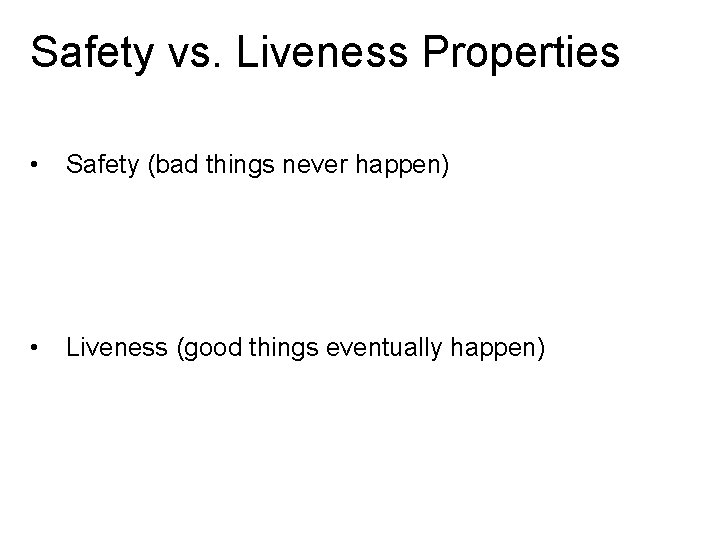
Safety vs. Liveness Properties • Safety (bad things never happen) • Liveness (good things eventually happen)
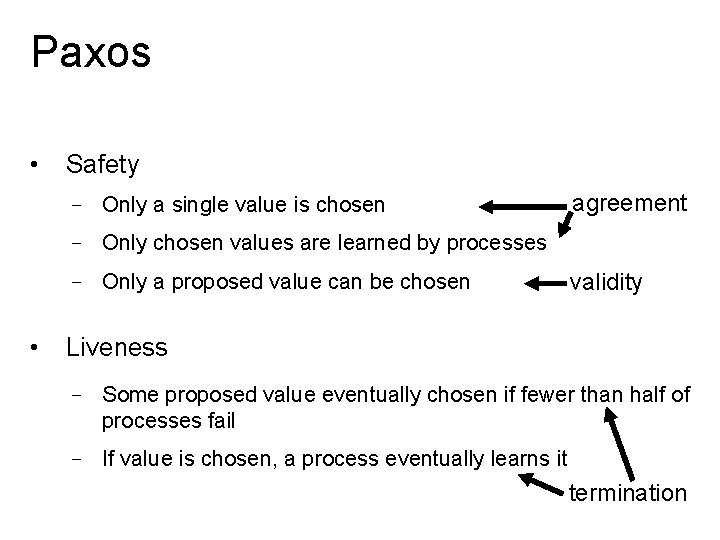
Paxos • Safety – Only a single value is chosen agreement – Only chosen values are learned by processes – Only a proposed value can be chosen • validity Liveness – Some proposed value eventually chosen if fewer than half of processes fail – If value is chosen, a process eventually learns it termination
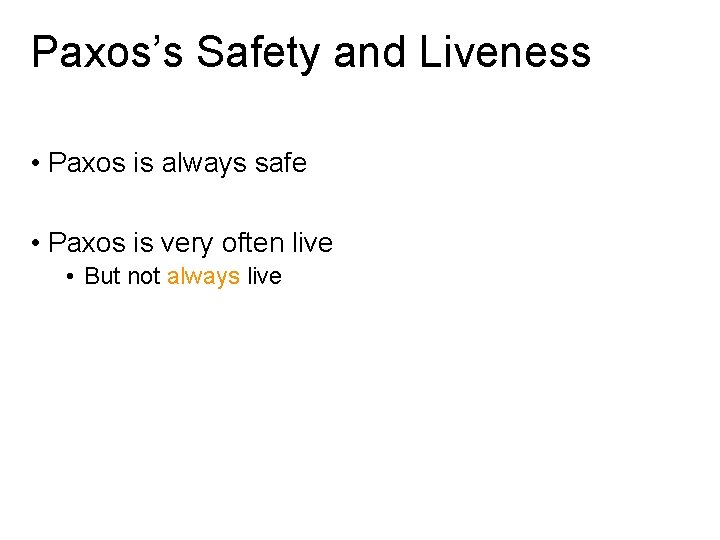
Paxos’s Safety and Liveness • Paxos is always safe • Paxos is very often live • But not always live
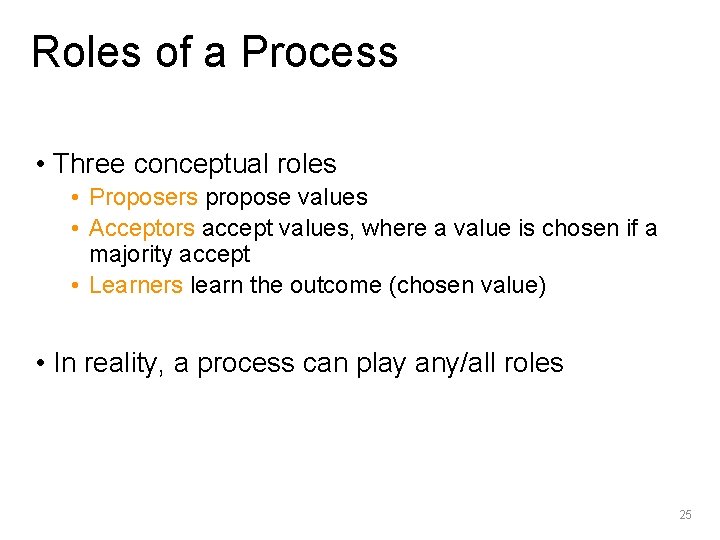
Roles of a Process • Three conceptual roles • Proposers propose values • Acceptors accept values, where a value is chosen if a majority accept • Learners learn the outcome (chosen value) • In reality, a process can play any/all roles 25
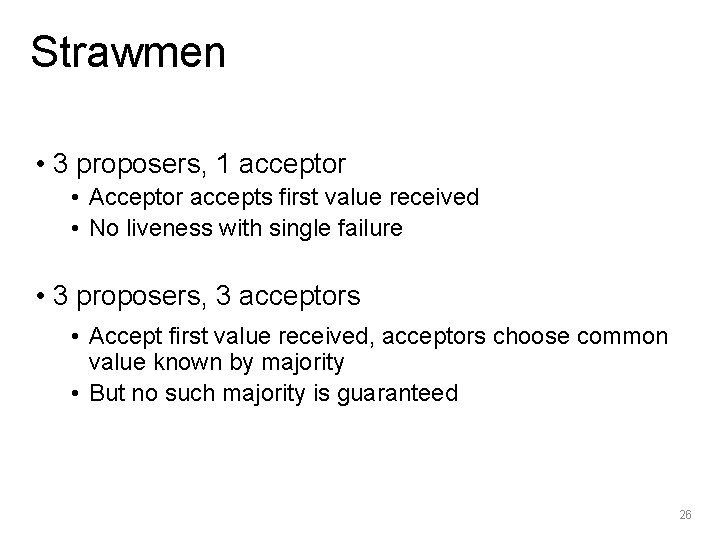
Strawmen • 3 proposers, 1 acceptor • Acceptor accepts first value received • No liveness with single failure • 3 proposers, 3 acceptors • Accept first value received, acceptors choose common value known by majority • But no such majority is guaranteed 26
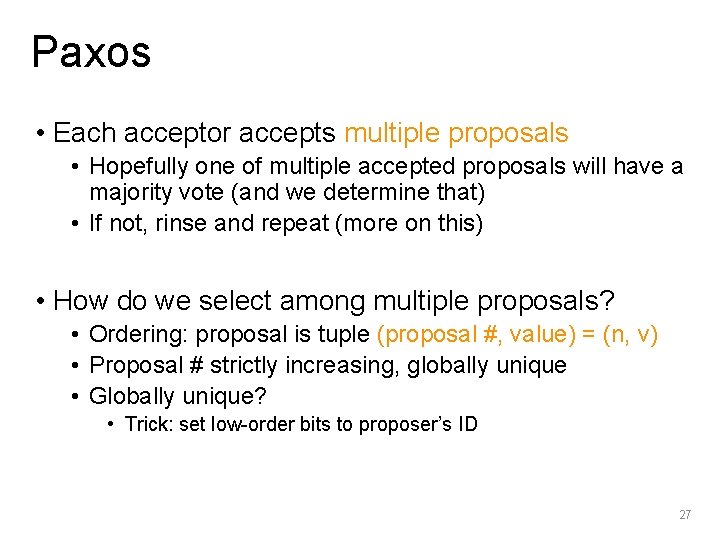
Paxos • Each acceptor accepts multiple proposals • Hopefully one of multiple accepted proposals will have a majority vote (and we determine that) • If not, rinse and repeat (more on this) • How do we select among multiple proposals? • Ordering: proposal is tuple (proposal #, value) = (n, v) • Proposal # strictly increasing, globally unique • Globally unique? • Trick: set low-order bits to proposer’s ID 27
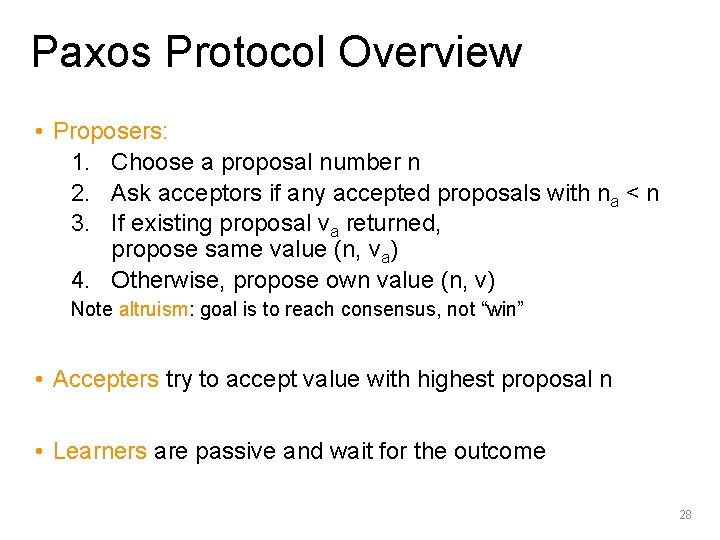
Paxos Protocol Overview • Proposers: 1. Choose a proposal number n 2. Ask acceptors if any accepted proposals with na < n 3. If existing proposal va returned, propose same value (n, va) 4. Otherwise, propose own value (n, v) Note altruism: goal is to reach consensus, not “win” • Accepters try to accept value with highest proposal n • Learners are passive and wait for the outcome 28
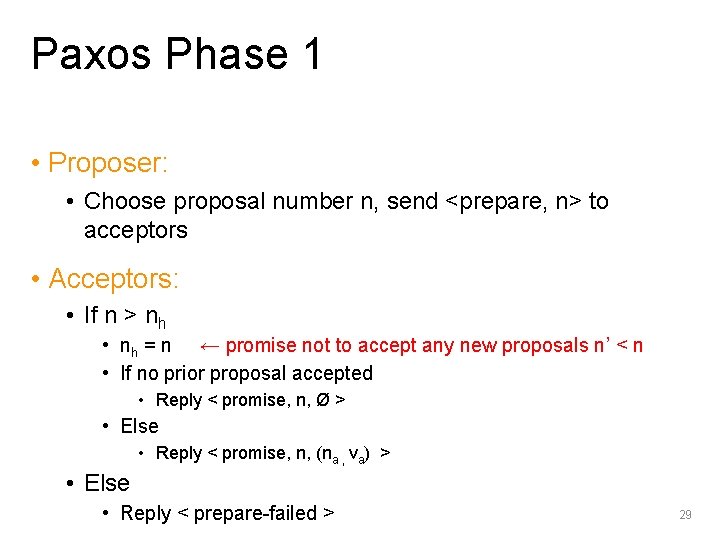
Paxos Phase 1 • Proposer: • Choose proposal number n, send <prepare, n> to acceptors • Acceptors: • If n > nh • nh = n ← promise not to accept any new proposals n’ < n • If no prior proposal accepted • Reply < promise, n, Ø > • Else • Reply < promise, n, (na , va) > • Else • Reply < prepare-failed > 29
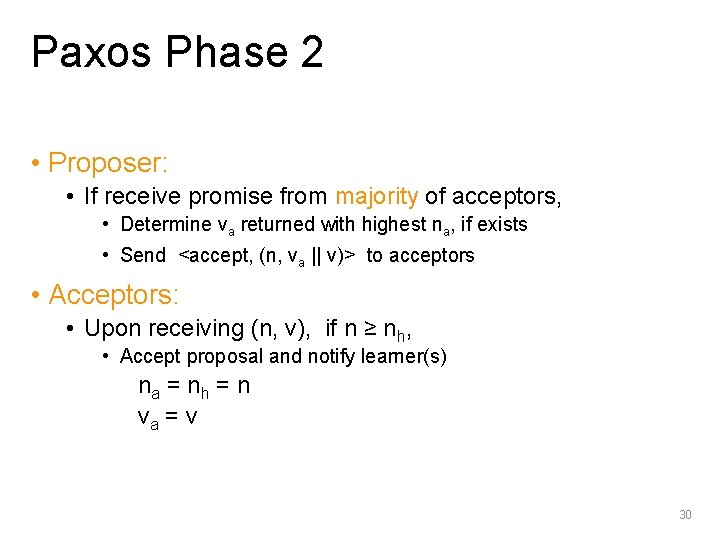
Paxos Phase 2 • Proposer: • If receive promise from majority of acceptors, • Determine va returned with highest na, if exists • Send <accept, (n, va || v)> to acceptors • Acceptors: • Upon receiving (n, v), if n ≥ nh, • Accept proposal and notify learner(s) na = n h = n va = v 30
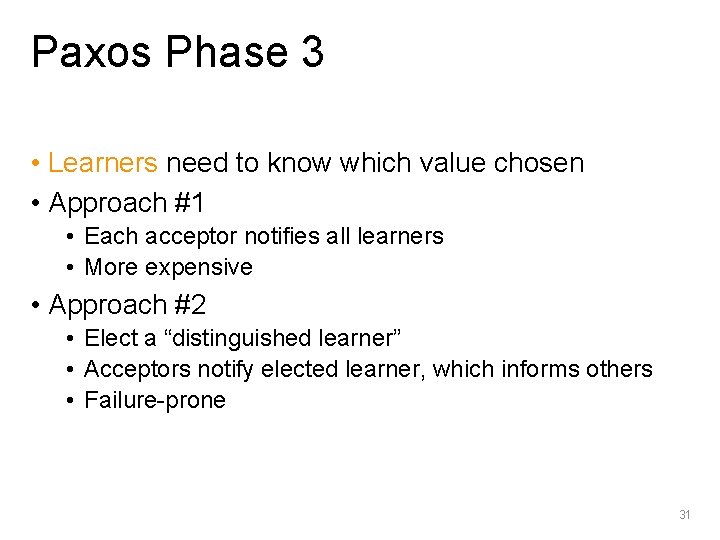
Paxos Phase 3 • Learners need to know which value chosen • Approach #1 • Each acceptor notifies all learners • More expensive • Approach #2 • Elect a “distinguished learner” • Acceptors notify elected learner, which informs others • Failure-prone 31
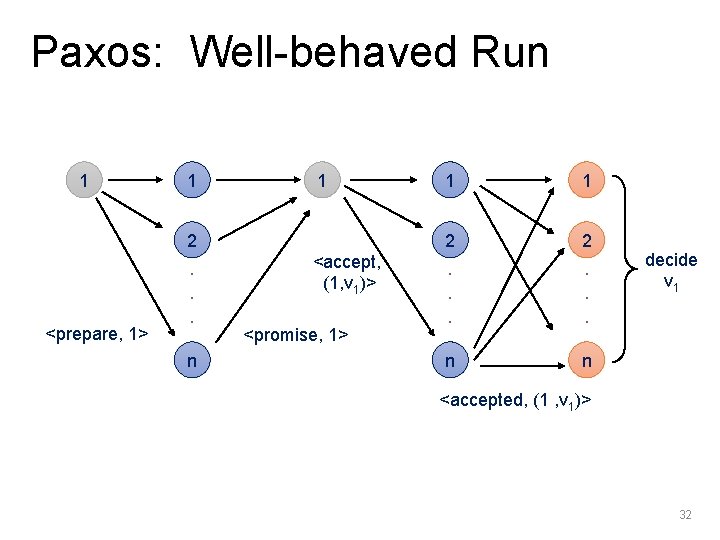
Paxos: Well-behaved Run 1 1 1 2 <prepare, 1> . . . n <accept, (1, v 1)> <promise, 1> 1 1 2 2 . . . n n decide v 1 <accepted, (1 , v 1)> 32
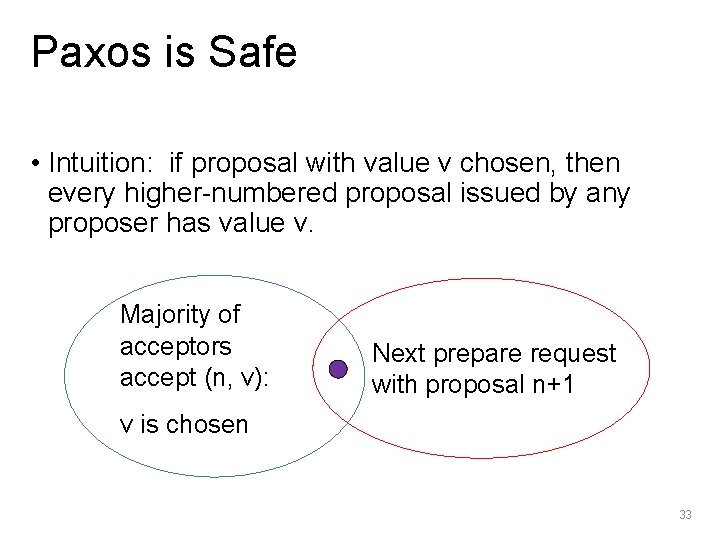
Paxos is Safe • Intuition: if proposal with value v chosen, then every higher-numbered proposal issued by any proposer has value v. Majority of acceptors accept (n, v): Next prepare request with proposal n+1 v is chosen 33
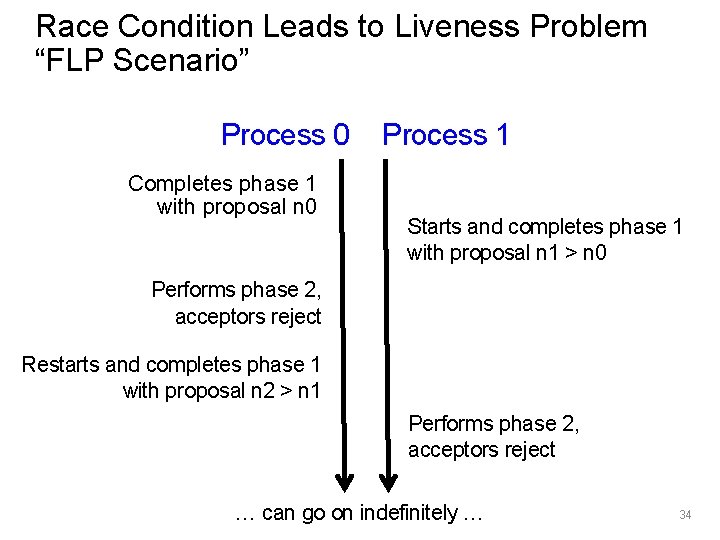
Race Condition Leads to Liveness Problem “FLP Scenario” Process 0 Completes phase 1 with proposal n 0 Process 1 Starts and completes phase 1 with proposal n 1 > n 0 Performs phase 2, acceptors reject Restarts and completes phase 1 with proposal n 2 > n 1 Performs phase 2, acceptors reject … can go on indefinitely … 34
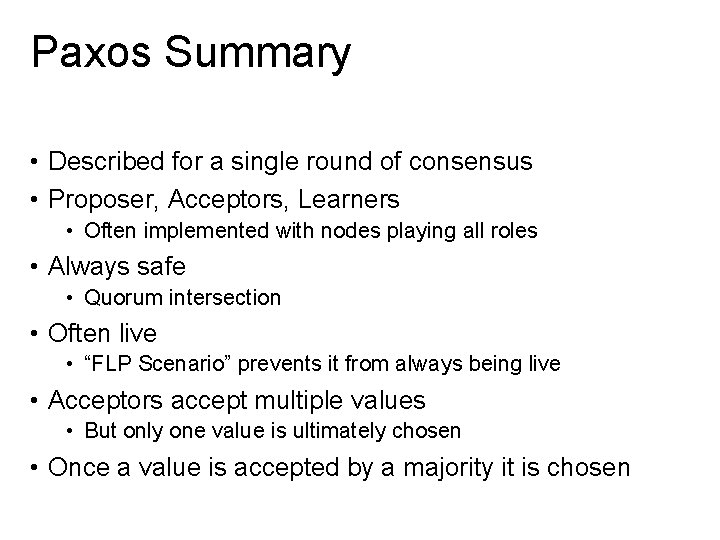
Paxos Summary • Described for a single round of consensus • Proposer, Acceptors, Learners • Often implemented with nodes playing all roles • Always safe • Quorum intersection • Often live • “FLP Scenario” prevents it from always being live • Acceptors accept multiple values • But only one value is ultimately chosen • Once a value is accepted by a majority it is chosen
Flavors of Paxos • Terminology is a mess • Paxos loosely, and confusingly defined… • We’ll stick with • Basic Paxos • Multi-Paxos
Flavors of Paxos: Basic Paxos • Run the full protocol each time • e. g. , for each slot in the command log • Takes 2 rounds until a value is chosen • “FLP Scenario” is dueling proposers
Flavors of Paxos: Multi-Paxos • Elect a leader and have them run the 2 nd phase directly • e. g. , for each slot in the command log • Leader election uses Basic Paxos • Takes 1 round until a value is chosen • Faster than Basic Paxos • “FLP Scenario” is dueling proposers during leader election • Rarer than Basic Paxos • Used extensively in practice!
Consensus Takeaways • Consensus: Terminating agreement on a valid proposal • Consensus is impossible to always achieve • FLP result • Consensus is possible to achieve in practice • With Multi-Paxos • Mostly happens in a single round to the nearest quorum • Sometimes takes a single round to a further quorum • Rarely takes multiple rounds to elect a new leader and for that node to get the request accepted • Runs exist where no new leader is ever elected

- Slides: 40