
Consensus Based Decision Making According to the Guide
Consensus Based Decision Making
According to the Guide to Florida Regional Service (GFSR), 2016, Consensus Based Decision Making is defined as: A cooperative process for making decisions in which everyone in the group consents to the decision of the group. o Not necessarily everyone’s first preference, but true consent. o Decisions should reflect the integrated will of the group as a whole. o Preserves the interest and integrity of all members. 2
A problem-solving orientation for people who wish to work together to determine solutions. o A process for working together to determine the best solution for the group, not, for determining whose ideas are best. o A reasoning process for finding solutions, not engaging in the “okey-doke”. This will not work unless everyone has respect for the process involved in constructive conflict 3
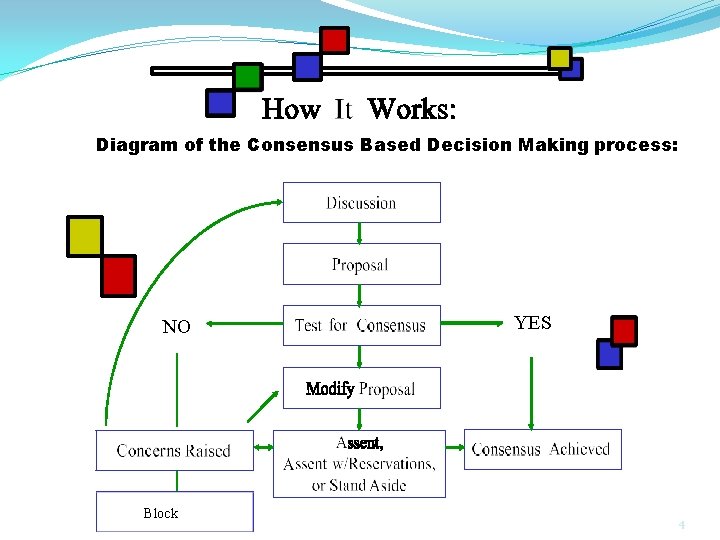
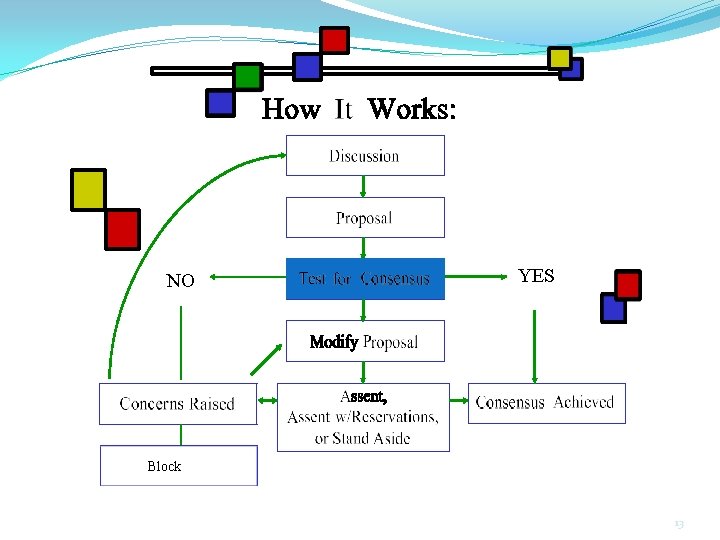
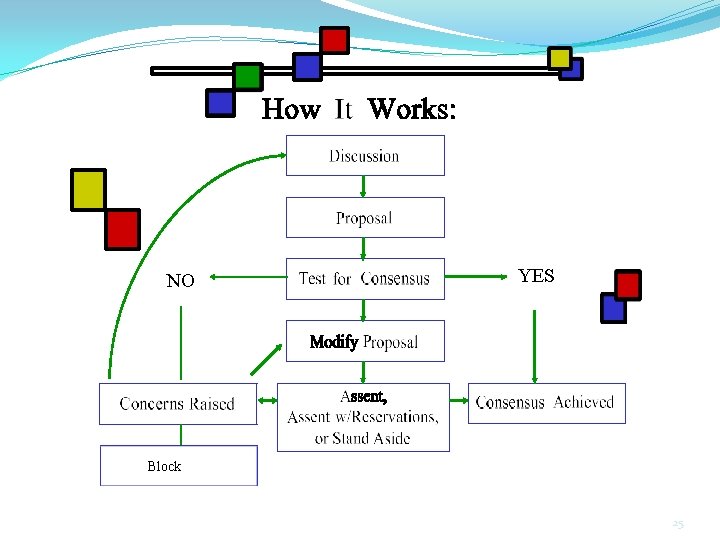
Diagram of the Consensus Based Decision Making process: ® NO Block YES 4
Consensus Based Decision Making requires: • Participation of Decision Makers (RCMs) • Patience • Open-mindedness • Trust • Faith • • • Good Will Honesty Respect Willingness Good Facilitation 5
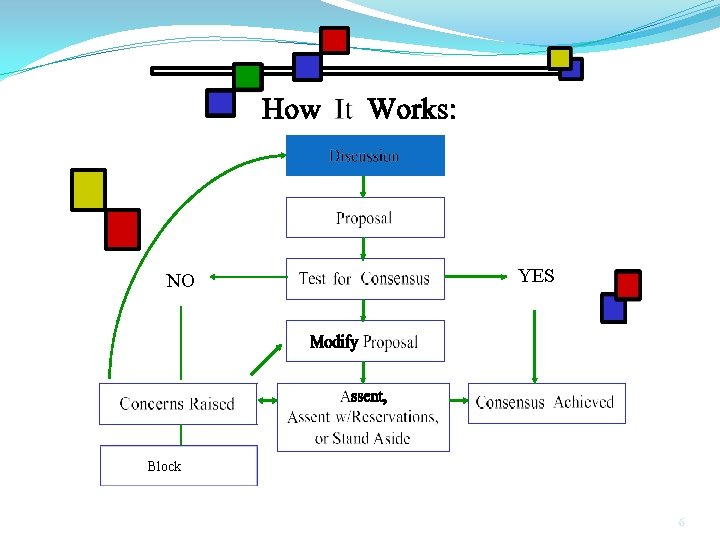
® NO YES Block 6
Discussion “The general direction of the group and potential proposals for action are often identified during the discussion. ” “Formation of a Proposal: Based on the discussion, a formal decision on the proposal is presented to the group. ” (Source: GFRS p. 12) 7
Discussion Once proposal is formed, it is presented to the group and open discussion of the subject takes place at the Guide to Florida Regional Service Meeting and the Regional Service Conference. It can also occur in your home groups or over coffee. The topic is discussed with the goal of identifying opinions and information related to the topic. 8
Discussion Guide to Florida Regional Service Meeting o Strongly suggest proposals be presented at this time for discussion. o New proposals and/or proposals currently being considered can be discussed. “The purpose of the Guide to Florida Regional Service Group is to consider (and discuss) all pending proposals (that impact the Florida Region and its member Areas)…” (Source: GFRS, pg. 30) 9
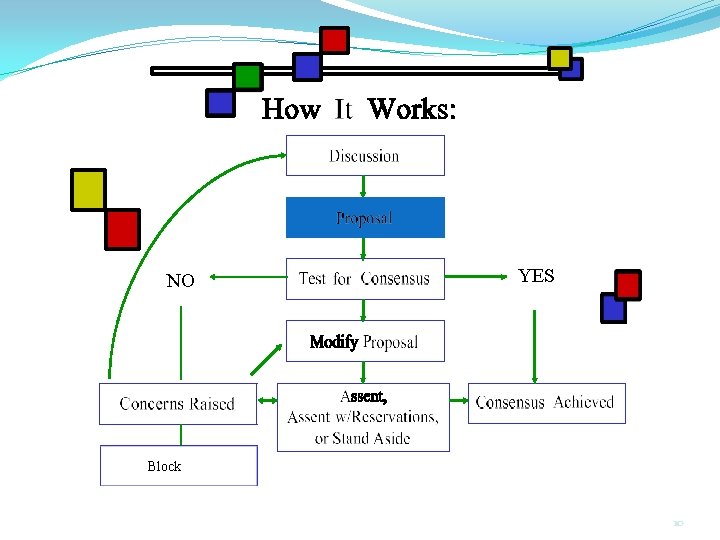
® NO YES Block 10
Proposal During the 2008 Service Structure Change the Florida Region suggest proposals contain: v Proposal: A description or statement of what is being proposed. v Rationale: Describe the reason for the proposal, what/whom it impacts, applicable benefits, timeline if any, etc. v Spiritual Impact: - A statement that describes the Steps, Traditions or Concepts. v Financial Impact: - Outline the cost and/or savings. v Changes to the Guide to Florida Regional Service: Does this require a change to the GFRS? If Yes, must list page number, original wording and revised wording. A copy of the proposal is to be given to the FRSC Secretary Team during the Regional Service Conference for publishing in the Regional Minutes. 11
Proposal During the Regional Service Conference New Business portion: o Proposal is introduced, and read to the RSC Body. o Test for Consensus is taken on the proposal as it is currently written. o This is a Yes or No poll to find degrees of support for the proposal. Results will lead the direction of the discussion. 12
® NO YES Block 13
Our goal is to reach a consensus on a given proposal. We measure support or opposition by: 1. Test for Consensus: Determines degree of support. RCMs vote Yes: They support the proposal. RCMs vote No: They have concerns with the proposal. 2. Call for Consensus: Each member of the group must actively state their agreement with the proposal or degrees of dissent… (Source: GFRS pg. 12) 14
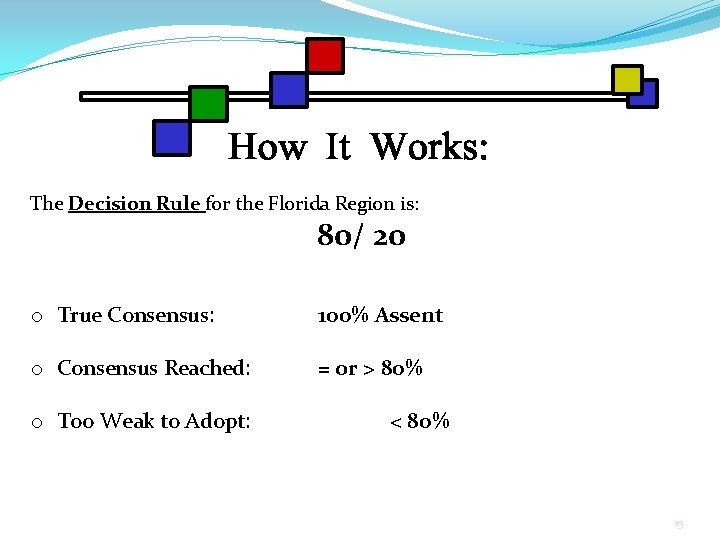
The Decision Rule for the Florida Region is: 80/ 20 o True Consensus: 100% Assent o Consensus Reached: = or > 80% o Too Weak to Adopt: < 80% 15
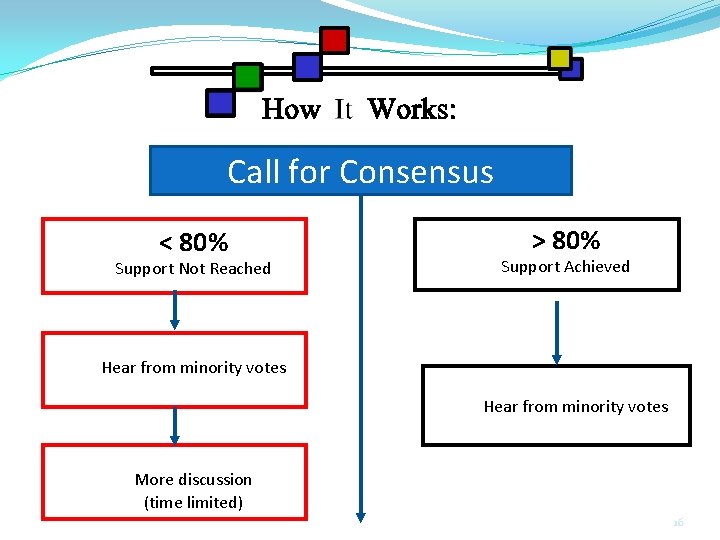
Call for Consensus < 80% Support Not Reached > 80% Support Achieved Hear from minority votes More discussion (time limited) 16
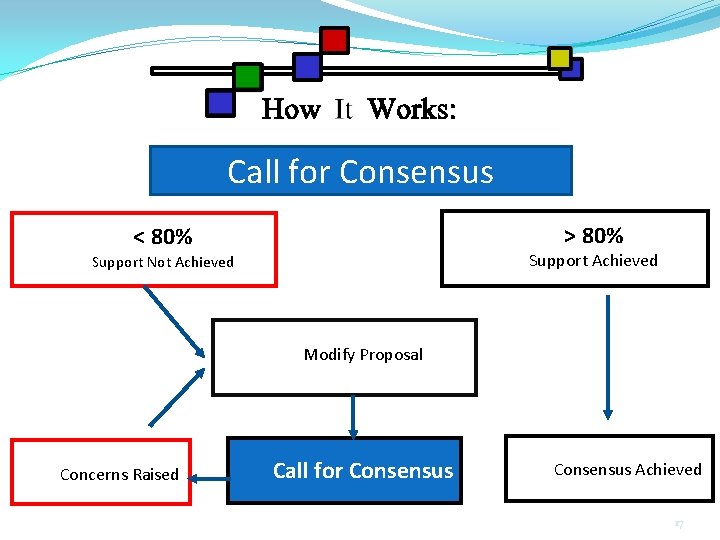
Call for Consensus > 80% < 80% Support Achieved Support Not Achieved Modify Proposal Concerns Raised Call for Consensus Achieved 17
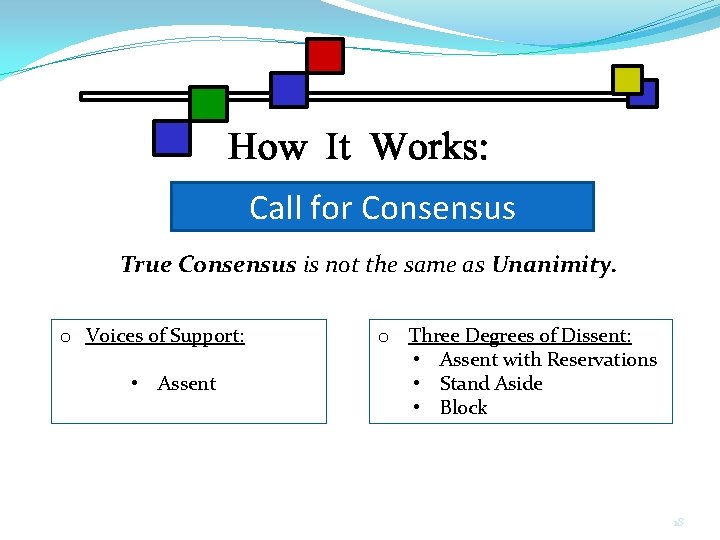
Call for Consensus True Consensus is not the same as Unanimity. o Voices of Support: • Assent o Three Degrees of Dissent: • Assent with Reservations • Stand Aside • Block 18
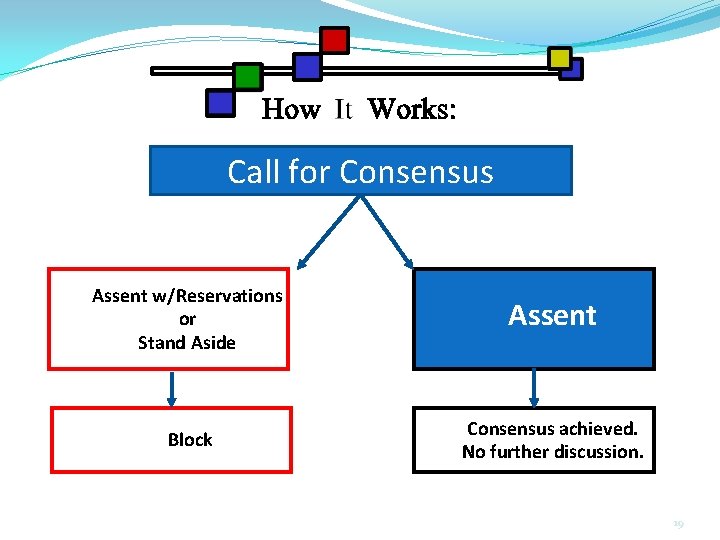
Call for Consensus Assent w/Reservations or Stand Aside Assent Block Consensus achieved. No further discussion. 19
Assent: This means that you support the proposal, all things considered. It does not mean that you are in agreement with every aspect, but that you have heard the discussion, had a chance to participate in the process of finalizing the proposal, and are prepared to support the proposal. Assent is signified by raising your Area’s table card and remaining silent. 20
There are three degrees of dissent o Assent with Reservations: I have some concerns that needs to be heard. o Stand Aside: I have concerns, but will not stop the group from moving forward. o Block: I have a serious issue with the proposal based on traditions or concepts and will not give my consent. 21
Three Degrees of Dissent Assent with Reservations: Group members are willing to let a proposal pass but desire to register their concerns. Assent with reservations is not materially different from the assent option, but is a way of giving addicts a place to stand so that there is no need to object more strongly. The assumption is that the reservations have been heard, and you are simply noting that you can support the proposal and continue to have reservations. 22
Three Degrees of Dissent Stand Aside: A stand aside may be registered by a group member who has a “serious personal disagreement” with a proposal but is willing to let the proposal pass. o Stand Asides do not halt a proposal. The concerns of group members standing aside are usually addressed by modifications to the proposal. o Those who feel they are incapable of adequately understanding or participating in the proposal should vote as Stand Asides. o If >20% of the groups present vote Stand Aside this will indicate a consensus too weak to adopt. Once Stand Asides are heard, another Call for Consensus is taken. 23
Three Degrees of Dissent Block: Should be an extreme rare step taken only when a participant honestly believes a Tradition or Concept is directly violated by this proposal or that some very fundamental moral position of the participant is violated. o The member who Blocks must be able to articulate which Traditions or Concepts are violated. o Once articulated, a Test for Consensus is taken to validate the Block. o Yes you support the Block or No you do not support the Block. =/> 80% Yes is needed to support the Block NOTE: It only requires 1 member to register a Block. 24
® NO YES Block 25
Questions? ? 26
- Slides: 26