
Consensus and Consistency When you cant agree to
- Slides: 46
Consensus and Consistency When you can’t agree to disagree
Consensus • Why do applications need consensus? • What does it mean to have consensus?
Consensus = consistency
Assumptions • • • Processes can choose values Run at arbitrary speeds Can fail/restart at any time No adversarial model (not Byzantine) Messages can be duplicated or lost, and take arbitrarily long to arrive (but not forever)
How do we do this? • General stages – New value produced at a process – New value(s) shared among processes – Eventually all processes agree on a new value • Roles – Proposer (of new value) – Learner – Acceptor
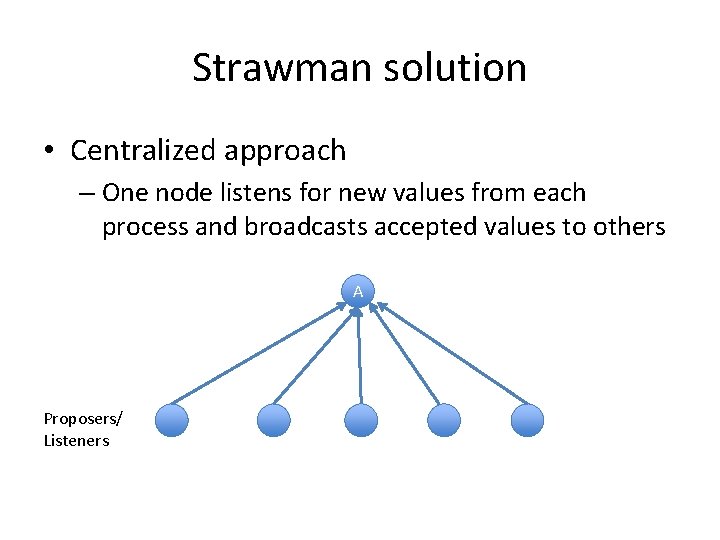
Strawman solution • Centralized approach – One node listens for new values from each process and broadcasts accepted values to others A Proposers/ Listeners
Problems with this • Single point of failure
Ok, so we need a group • Multiple acceptors – New problem: consensus among acceptors • Solution – If enough acceptors agree, then we’re set – Majority is enough (for accepting only one value) • Why? – Only works for one value at a time
Which value to accept? • P 1: Accept the first proposal you hear – Ensures progress even if there is only one proposal • What if there are multiple proposals? – P 2: Assign numbers to proposals, pick highestnumbered value (n) chosen by majority of acceptors – In fact, every proposal accepted with number > n must have value v
But wait… • What if new process wakes up with new value and higher number? – P 1 says you have to accept it, but that violates P 2 • Need to make sure proposers know about accepted proposals – What about future accepted proposals? – Extract a promise not to accept
Proposing: Two phases • Phase 1: Prepare – Ask for a promise not to accept a proposal with number greater than n – If acceptors haven’t seen a proposal with number > n, they make a promise not to accept one • Phase 2: Accept – Proposer proposes accept for v, where v is value of highest number proposal, or anything if no proposal – Acceptor accepts if it hasn’t accepted proposal with number greater than n
Learning • All acceptors notify all learners – Scalability problem • Use super-learner to disseminate – Fault tolerance • Use group of super-learners • Values may be chosen w/o any learners learning – Lazy update at next chosen proposal
Liveness • Consider this – P proposes n • promise made – Q proposes n+1 • promise made to q, promise to p invalid – P proposes n+2 • promise made to p, promise to q invalid –… • Use distinguished proposer – Only one to issue proposals
Paxos in action • Pick leader • Leader learns all previous chosen values • Leader proposes new value(s) • Failure get in the way – Leader may fail between actions – Even if some values are accepted out of order
Problems with Paxos • Difficult to understand how to use it in a practical setting, or how it ensures invariants – Single-decree abstraction (one value decision) is hard to map to online system – Multi-Paxos (series of transactions) is even harder to fully grasp in terms of guarantees
Problems with Paxos • Multi-Paxos not fully specified – Many have struggled to fill in blanks – Few are published (Chubby is an exception) • Single decree not a great abstraction for practical systems – We need something for reconciling a sequence of transactions efficiently • P 2 P model not great fit for used scenarios – Leaders can substantially optimize the algorithm
Raft: Making Paxos easier? • Stronger leaders – Only leader propagates state changes • Randomized timers for leader election – Simplifies conflict resolution • Joint consensus – Availability during configuration changes (Subsequent slides from Raft people) https: //raft. github. io/
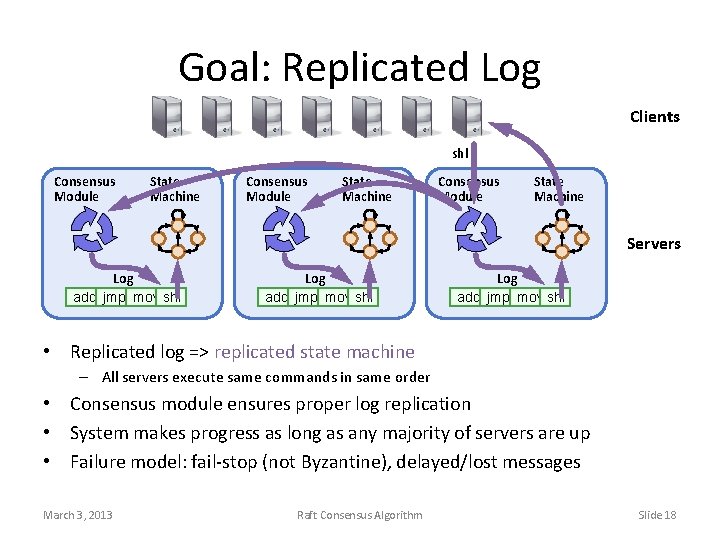
Goal: Replicated Log Clients shl Consensus Module State Machine Servers Log add jmp mov shl • Replicated log => replicated state machine – All servers execute same commands in same order • Consensus module ensures proper log replication • System makes progress as long as any majority of servers are up • Failure model: fail-stop (not Byzantine), delayed/lost messages March 3, 2013 Raft Consensus Algorithm Slide 18
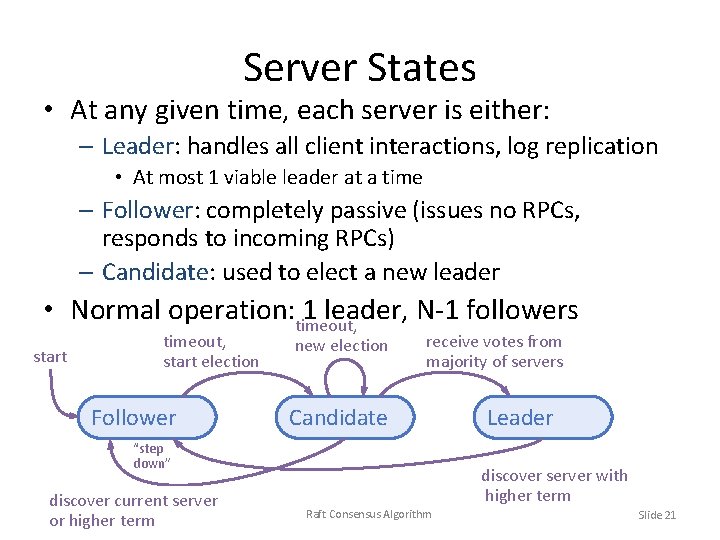
Server States • At any given time, each server is either: – Leader: handles all client interactions, log replication • At most 1 viable leader at a time – Follower: completely passive (issues no RPCs, responds to incoming RPCs) – Candidate: used to elect a new leader • Normal operation: timeout, 1 leader, N-1 followers timeout, start election start Follower new election receive votes from majority of servers Candidate “step down” discover current server or higher term March 3, 2013 Leader discover server with higher term Raft Consensus Algorithm Slide 21
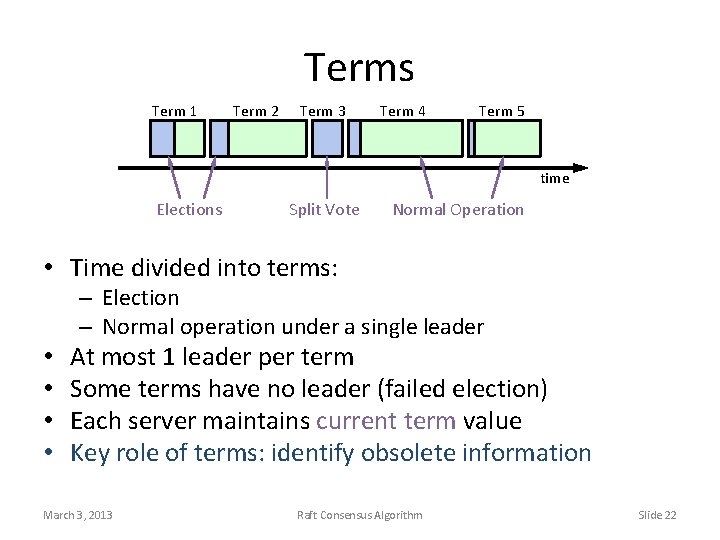
Terms Term 1 Term 2 Term 3 Term 4 Term 5 time Elections Split Vote Normal Operation • Time divided into terms: • • – Election – Normal operation under a single leader At most 1 leader per term Some terms have no leader (failed election) Each server maintains current term value Key role of terms: identify obsolete information March 3, 2013 Raft Consensus Algorithm Slide 22
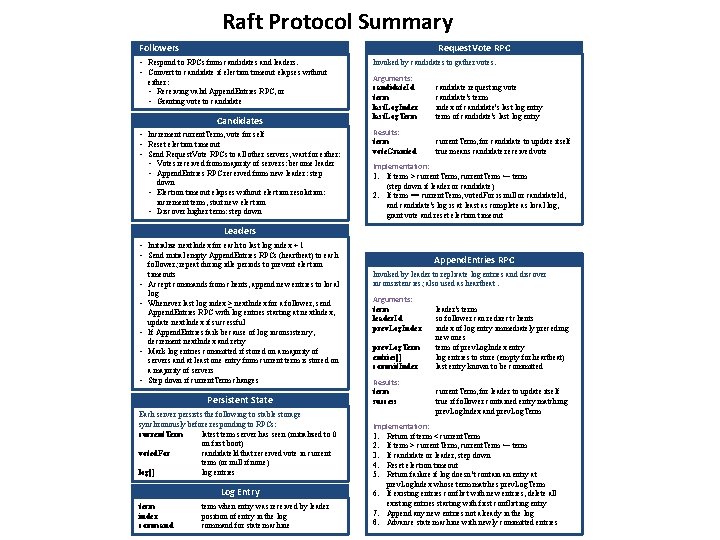
Raft Protocol Summary Followers Request. Vote RPC • Respond to RPCs from candidates and leaders. • Convert to candidate if election timeout elapses without either: • Receiving valid Append. Entries RPC, or • Granting vote to candidate Candidates • Increment current. Term, vote for self • Reset election timeout • Send Request. Vote RPCs to all other servers, wait for either: • Votes received from majority of servers: become leader • Append. Entries RPC received from new leader: step down • Election timeout elapses without election resolution: increment term, start new election • Discover higher term: step down Invoked by candidates to gather votes. Arguments: candidate. Id term last. Log. Index last. Log. Term candidate requesting vote candidate's term index of candidate's last log entry term of candidate's last log entry Results: term vote. Granted current. Term, for candidate to update itself true means candidate received vote Implementation: 1. If term > current. Term, current. Term ← term (step down if leader or candidate) 2. If term == current. Term, voted. For is null or candidate. Id, and candidate's log is at least as complete as local log, grant vote and reset election timeout Leaders • Initialize next. Index for each to last log index + 1 • Send initial empty Append. Entries RPCs (heartbeat) to each • • • follower; repeat during idle periods to prevent election timeouts Accept commands from clients, append new entries to local log Whenever last log index ≥ next. Index for a follower, send Append. Entries RPC with log entries starting at next. Index, update next. Index if successful If Append. Entries fails because of log inconsistency, decrement next. Index and retry Mark log entries committed if stored on a majority of servers and at least one entry from current term is stored on a majority of servers Step down if current. Term changes Persistent State Each server persists the following to stable storage synchronously before responding to RPCs: current. Term latest term server has seen (initialized to 0 on first boot) voted. For candidate. Id that received vote in current term (or null if none) log[] log entries March 3, 2013 term index command Append. Entries RPC Invoked by leader to replicate log entries and discover inconsistencies; also used as heartbeat. Arguments: term leader. Id prev. Log. Index prev. Log. Term entries[] commit. Index Results: term success leader's term so follower can redirect clients index of log entry immediately preceding new ones term of prev. Log. Index entry log entries to store (empty for heartbeat) last entry known to be committed current. Term, for leader to update itself true if follower contained entry matching prev. Log. Index and prev. Log. Term Implementation: 1. Return if term < current. Term 2. If term > current. Term, current. Term ← term 3. If candidate or leader, step down 4. Reset election timeout 5. Return failure if log doesn’t contain an entry at prev. Log. Index whose term matches prev. Log. Term Log Entry 6. If existing entries conflict with new entries, delete all existing entries starting with first conflicting entry term when entry was received by leader Append any new entries not already in the log position of entry in the log Raft Consensus 7. Algorithm 8. Advance state machine with newly committed entries command for state machine Slide 23
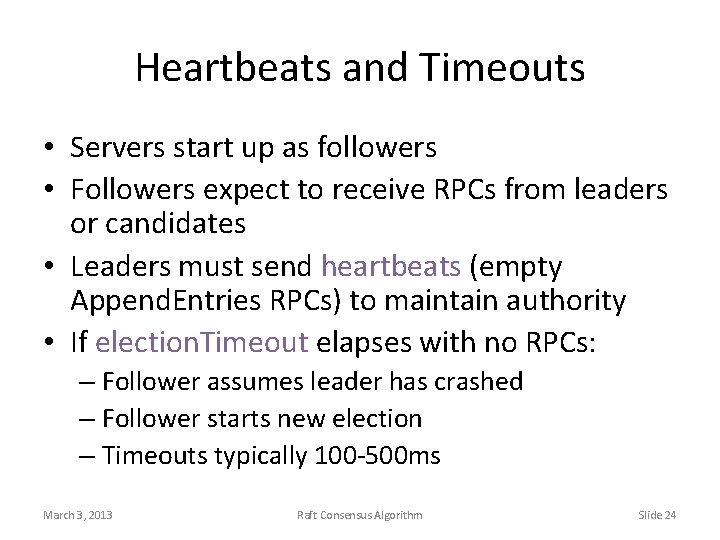
Heartbeats and Timeouts • Servers start up as followers • Followers expect to receive RPCs from leaders or candidates • Leaders must send heartbeats (empty Append. Entries RPCs) to maintain authority • If election. Timeout elapses with no RPCs: – Follower assumes leader has crashed – Follower starts new election – Timeouts typically 100 -500 ms March 3, 2013 Raft Consensus Algorithm Slide 24
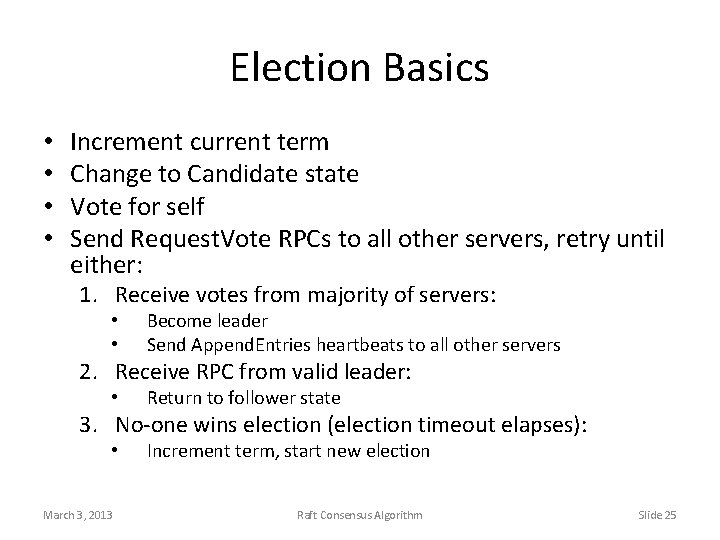
Election Basics • • Increment current term Change to Candidate state Vote for self Send Request. Vote RPCs to all other servers, retry until either: 1. Receive votes from majority of servers: • • Become leader Send Append. Entries heartbeats to all other servers 2. Receive RPC from valid leader: • Return to follower state 3. No-one wins election (election timeout elapses): • March 3, 2013 Increment term, start new election Raft Consensus Algorithm Slide 25
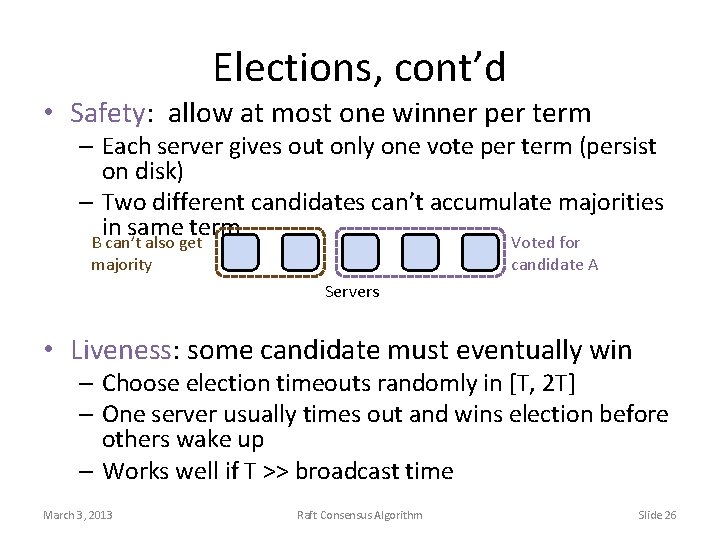
Elections, cont’d • Safety: allow at most one winner per term – Each server gives out only one vote per term (persist on disk) – Two different candidates can’t accumulate majorities in same term B can’t also get Voted for majority candidate A Servers • Liveness: some candidate must eventually win – Choose election timeouts randomly in [T, 2 T] – One server usually times out and wins election before others wake up – Works well if T >> broadcast time March 3, 2013 Raft Consensus Algorithm Slide 26
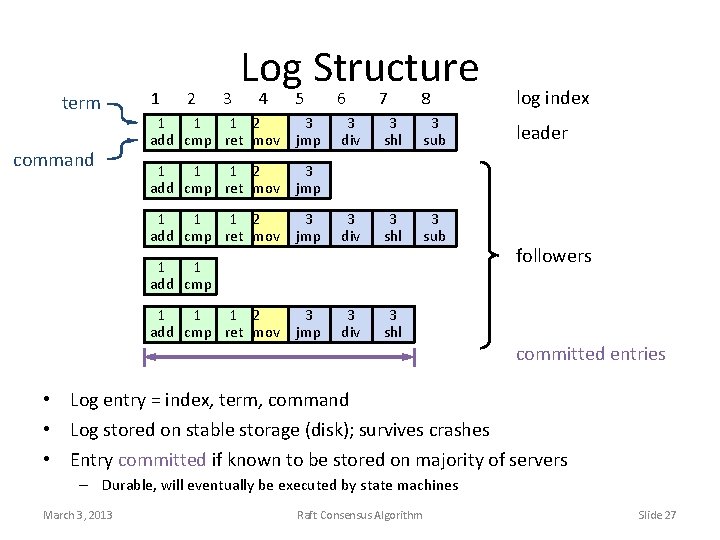
term command Log Structure 5 6 7 8 log index 1 1 1 2 add cmp ret mov 3 jmp 3 div 3 shl 3 sub leader 1 1 1 2 add cmp ret mov 3 jmp 3 div 3 shl 3 sub 3 jmp 3 div 3 shl 1 2 3 4 1 1 add cmp 1 1 1 2 add cmp ret mov followers committed entries • Log entry = index, term, command • Log stored on stable storage (disk); survives crashes • Entry committed if known to be stored on majority of servers – Durable, will eventually be executed by state machines March 3, 2013 Raft Consensus Algorithm Slide 27
• • Normal Operation Client sends command to leader Leader appends command to its log Leader sends Append. Entries RPCs to followers Once new entry committed: – Leader passes command to its state machine, returns result to client – Leader notifies followers of committed entries in subsequent Append. Entries RPCs – Followers pass committed commands to their state machines • Crashed/slow followers? – Leader retries RPCs until they succeed • Performance is optimal in common case: – One successful RPC to any majority of servers March 3, 2013 Raft Consensus Algorithm Slide 28
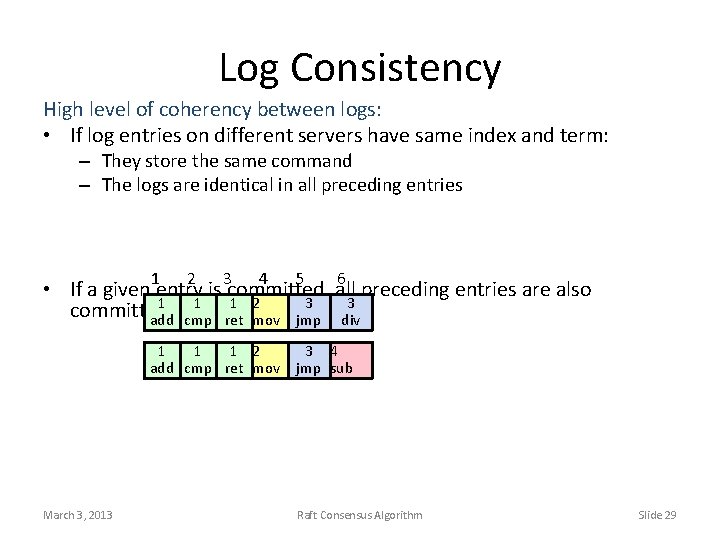
Log Consistency High level of coherency between logs: • If log entries on different servers have same index and term: – They store the same command – The logs are identical in all preceding entries 1 2 3 4 5 6 • If a given entry is committed, all preceding entries are also 1 1 1 2 3 3 committed add cmp ret mov jmp div 1 1 1 2 add cmp ret mov March 3, 2013 3 4 jmp sub Raft Consensus Algorithm Slide 29
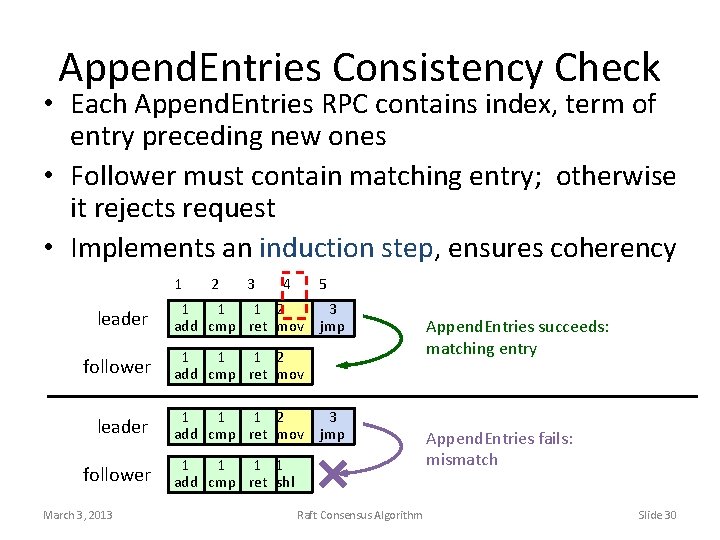
Append. Entries Consistency Check • Each Append. Entries RPC contains index, term of entry preceding new ones • Follower must contain matching entry; otherwise it rejects request • Implements an induction step, ensures coherency 1 2 3 4 5 leader 1 1 1 2 add cmp ret mov follower 1 1 1 2 add cmp ret mov leader 1 1 1 2 add cmp ret mov follower March 3, 2013 3 jmp 1 1 add cmp ret shl Raft Consensus Algorithm Append. Entries succeeds: matching entry Append. Entries fails: mismatch Slide 30
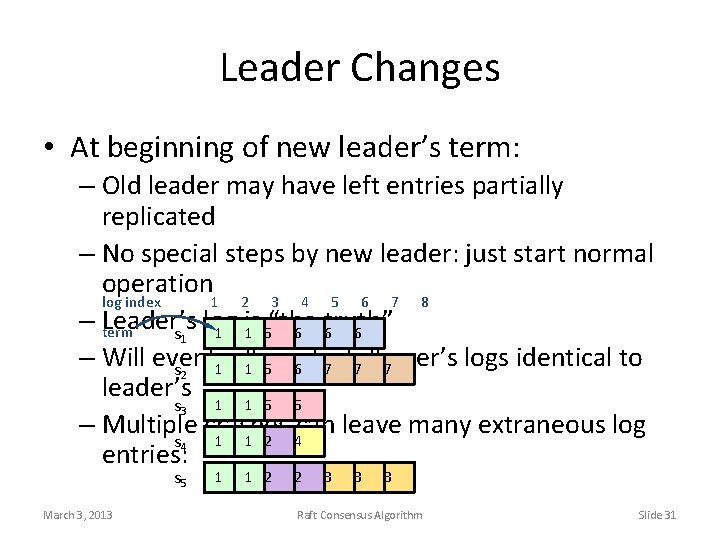
Leader Changes • At beginning of new leader’s term: – Old leader may have left entries partially replicated – No special steps by new leader: just start normal operation 1 2 3 4 5 6 7 8 log index – Leader’s log is “the truth” term 1 1 5 6 6 6 s 1 – Will eventually logs identical to 1 1 5 make 6 7 follower’s 7 7 s 2 leader’s 1 1 5 5 s 3 – Multiple crashes can leave many extraneous log 1 1 2 4 s 4 entries: s 5 March 3, 2013 1 1 2 2 3 3 3 Raft Consensus Algorithm Slide 31
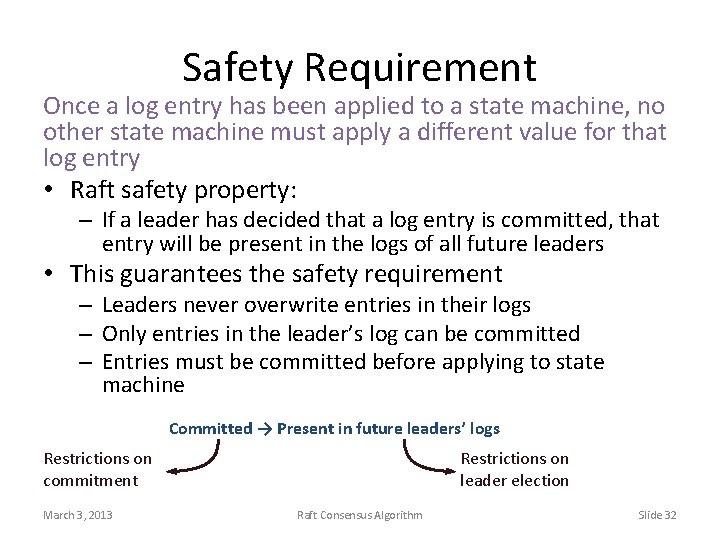
Safety Requirement Once a log entry has been applied to a state machine, no other state machine must apply a different value for that log entry • Raft safety property: – If a leader has decided that a log entry is committed, that entry will be present in the logs of all future leaders • This guarantees the safety requirement – Leaders never overwrite entries in their logs – Only entries in the leader’s log can be committed – Entries must be committed before applying to state machine Committed → Present in future leaders’ logs Restrictions on commitment March 3, 2013 Restrictions on leader election Raft Consensus Algorithm Slide 32
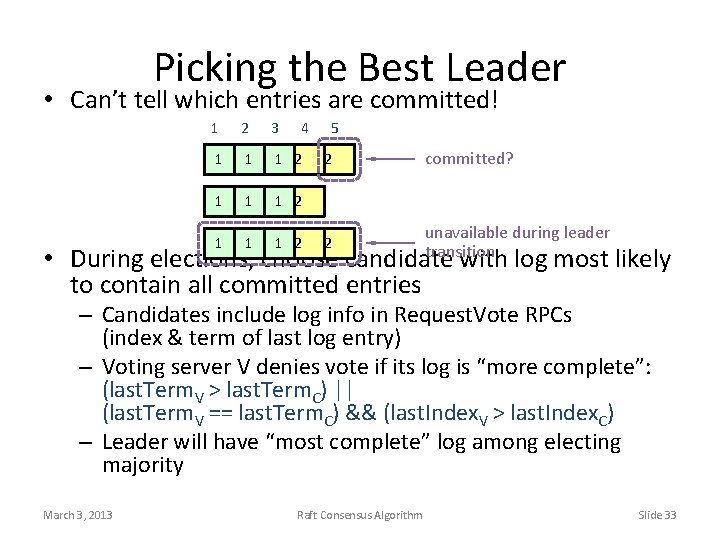
Picking the Best Leader • Can’t tell which entries are committed! 1 2 3 4 1 1 1 2 5 2 committed? 2 unavailable during leader transition • During elections, choose candidate with log most likely to contain all committed entries – Candidates include log info in Request. Vote RPCs (index & term of last log entry) – Voting server V denies vote if its log is “more complete”: (last. Term. V > last. Term. C) || (last. Term. V == last. Term. C) && (last. Index. V > last. Index. C) – Leader will have “most complete” log among electing majority March 3, 2013 Raft Consensus Algorithm Slide 33
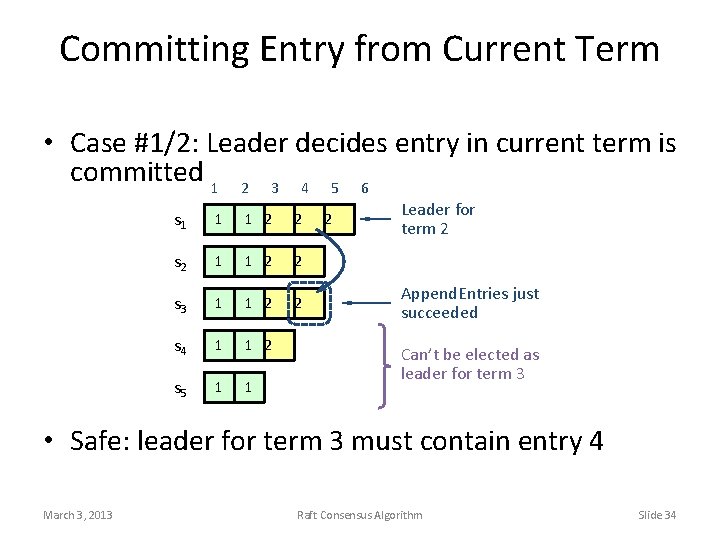
Committing Entry from Current Term • Case #1/2: Leader decides entry in current term is committed 1 2 3 4 5 6 s 1 1 1 2 2 s 2 1 1 2 2 s 3 1 1 2 2 s 4 1 1 2 s 5 1 1 2 Leader for term 2 Append. Entries just succeeded Can’t be elected as leader for term 3 • Safe: leader for term 3 must contain entry 4 March 3, 2013 Raft Consensus Algorithm Slide 34
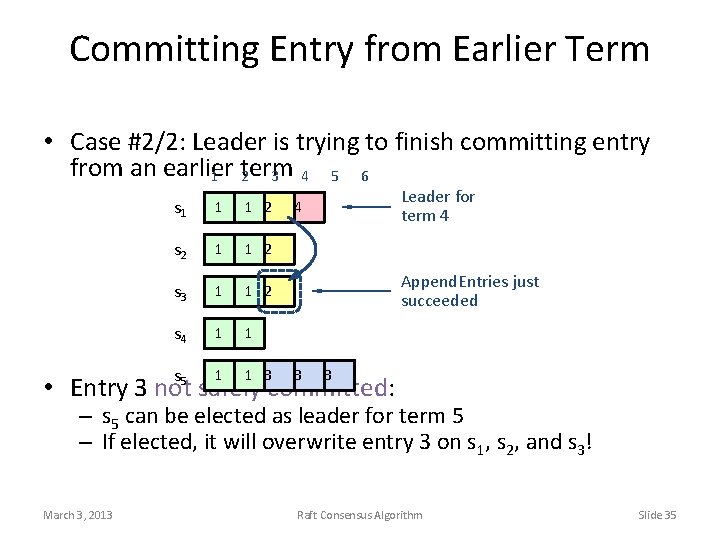
Committing Entry from Earlier Term • Case #2/2: Leader is trying to finish committing entry from an earlier 1 term 2 3 4 5 6 s 1 1 1 2 s 2 1 1 2 s 3 1 1 2 s 4 1 1 s 5 1 1 3 Leader for term 4 4 Append. Entries just succeeded 3 3 • Entry 3 not safely committed: – s 5 can be elected as leader for term 5 – If elected, it will overwrite entry 3 on s 1, s 2, and s 3! March 3, 2013 Raft Consensus Algorithm Slide 35
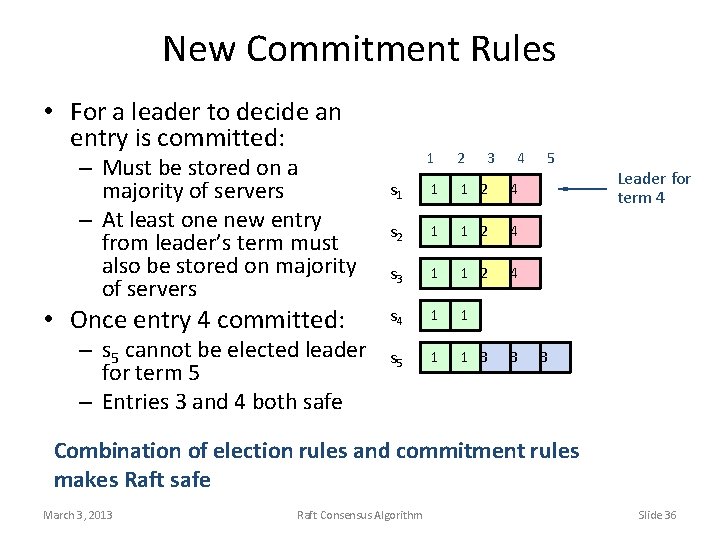
New Commitment Rules • For a leader to decide an entry is committed: – Must be stored on a majority of servers – At least one new entry from leader’s term must also be stored on majority of servers • Once entry 4 committed: – s 5 cannot be elected leader for term 5 – Entries 3 and 4 both safe 1 2 3 4 s 1 1 1 2 4 s 2 1 1 2 4 s 3 1 1 2 4 s 4 1 1 s 5 1 1 3 3 5 Leader for term 4 3 Combination of election rules and commitment rules makes Raft safe March 3, 2013 Raft Consensus Algorithm Slide 36
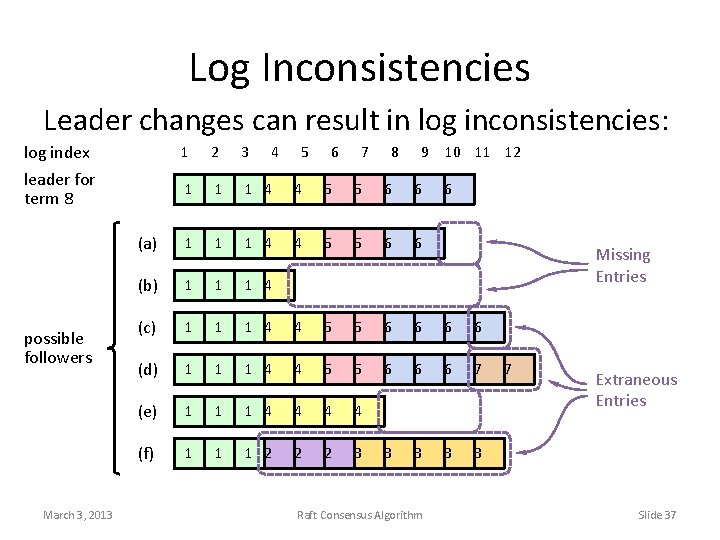
Log Inconsistencies Leader changes can result in log inconsistencies: log index leader for term 8 possible followers March 3, 2013 1 2 3 4 5 6 7 8 9 10 11 12 1 1 1 4 4 5 5 6 6 (a) 1 1 1 4 4 5 5 6 6 (b) 1 1 1 4 (c) 1 1 1 4 4 5 5 6 6 (d) 1 1 1 4 4 5 5 6 6 6 7 (e) 1 1 1 4 4 (f) 1 1 1 2 2 2 3 3 3 Raft Consensus Algorithm 6 Missing Entries 7 Extraneous Entries Slide 37
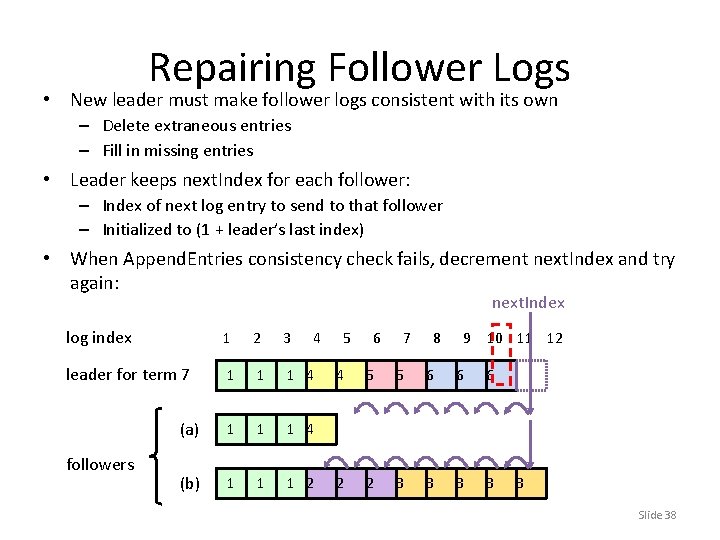
Repairing Follower Logs • New leader must make follower logs consistent with its own – Delete extraneous entries – Fill in missing entries • Leader keeps next. Index for each follower: – Index of next log entry to send to that follower – Initialized to (1 + leader’s last index) • When Append. Entries consistency check fails, decrement next. Index and try again: next. Index log index 1 2 3 leader for term 7 1 1 1 4 (a) 1 1 1 4 (b) 1 1 1 2 followers March 3, 2013 4 5 6 7 8 9 10 11 12 4 5 5 6 6 6 2 2 3 3 Raft Consensus Algorithm 3 Slide 38
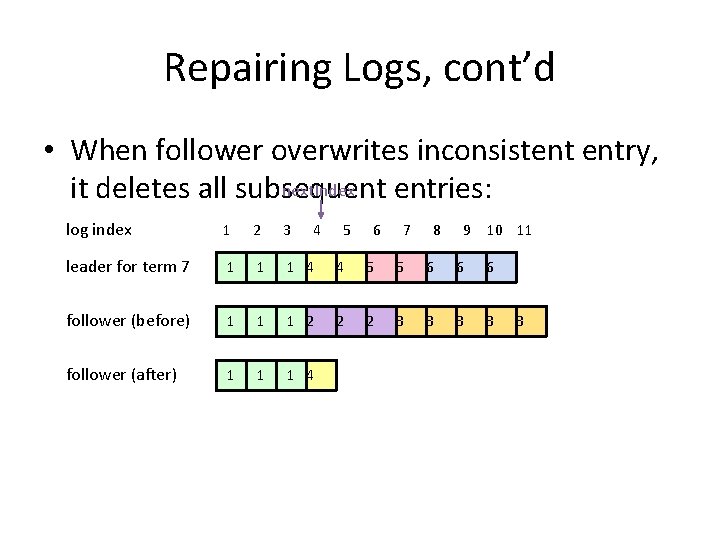
Repairing Logs, cont’d • When follower overwrites inconsistent entry, next. Index it deletes all subsequent entries: log index 1 2 3 leader for term 7 1 1 1 4 4 5 5 6 6 6 follower (before) 1 1 1 2 2 2 3 3 follower (after) 1 1 1 4 March 3, 2013 4 5 6 7 Raft Consensus Algorithm 8 9 10 11 3 Slide 39
Neutralizing Old Leaders • Deposed leader may not be dead: – Temporarily disconnected from network – Other servers elect a new leader – Old leader becomes reconnected, attempts to commit log entries • Terms used to detect stale leaders (and candidates) – Every RPC contains term of sender – If sender’s term is older, RPC is rejected, sender reverts to follower and updates its term – If receiver’s term is older, it reverts to follower, updates its term, then processes RPC normally • Election updates terms of majority of servers – Deposed server cannot commit new log entries March 3, 2013 Raft Consensus Algorithm Slide 40
Client Protocol • Send commands to leader – If leader unknown, contact any server – If contacted server not leader, it will redirect to leader • Leader does not respond until command has been logged, committed, and executed by leader’s state machine • If request times out (e. g. , leader crash): – Client reissues command to some other server – Eventually redirected to new leader – Retry request with new leader March 3, 2013 Raft Consensus Algorithm Slide 41
Client Protocol, cont’d • What if leader crashes after executing command, but before responding? – Must not execute command twice • Solution: client embeds a unique id in each command – Server includes id in log entry – Before accepting command, leader checks its log for entry with that id – If id found in log, ignore new command, return response from old command • Result: exactly-once semantics as long as client doesn’t crash March 3, 2013 Raft Consensus Algorithm Slide 42
Configuration Changes • System configuration: – ID, address for each server – Determines what constitutes a majority • Consensus mechanism must support changes in the configuration: – Replace failed machine – Change degree of replication March 3, 2013 Raft Consensus Algorithm Slide 43
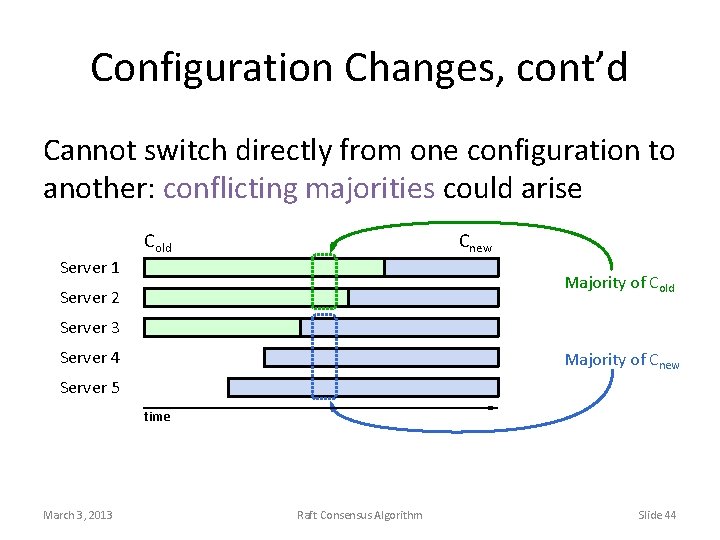
Configuration Changes, cont’d Cannot switch directly from one configuration to another: conflicting majorities could arise Cold Cnew Server 1 Majority of Cold Server 2 Server 3 Server 4 Majority of Cnew Server 5 time March 3, 2013 Raft Consensus Algorithm Slide 44
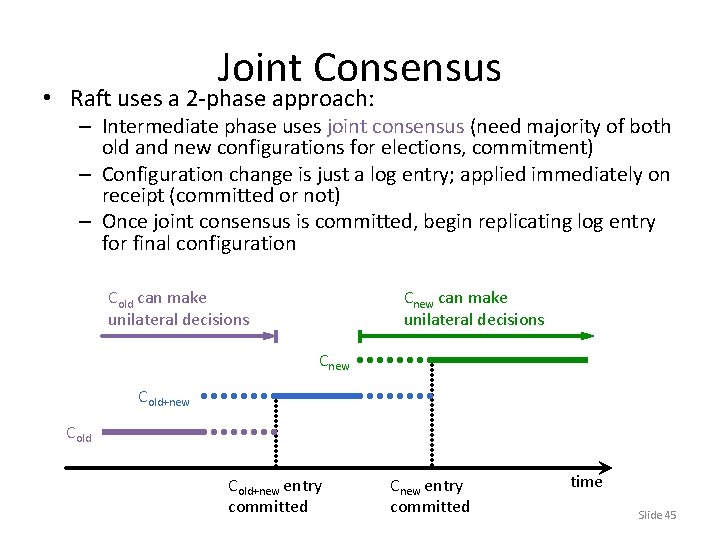
Joint Consensus • Raft uses a 2 -phase approach: – Intermediate phase uses joint consensus (need majority of both old and new configurations for elections, commitment) – Configuration change is just a log entry; applied immediately on receipt (committed or not) – Once joint consensus is committed, begin replicating log entry for final configuration Cold can make unilateral decisions Cnew Cold+new Cold March 3, 2013 Cold+new entry Cnew entry committed Raft Consensus Algorithm time Slide 45
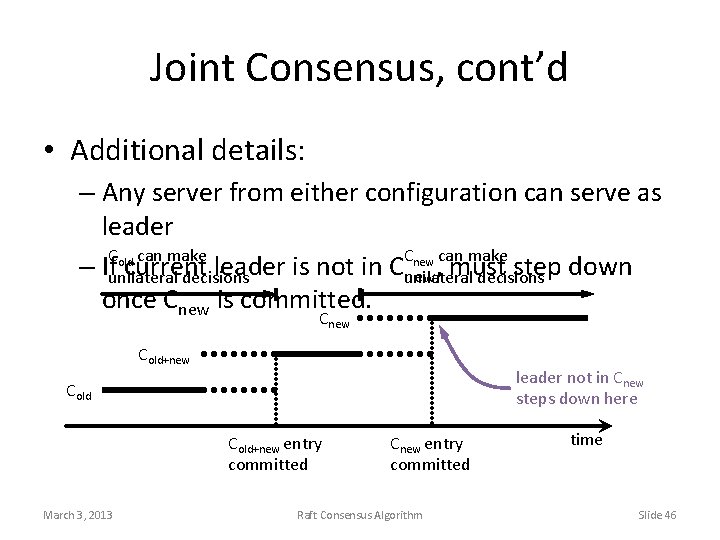
Joint Consensus, cont’d • Additional details: – Any server from either configuration can serve as leader Cnew can make old can make – If. Cunilateral current leader is not in C step down new, must decisions unilateral decisions once Cnew is committed. Cnew Cold+new leader not in Cnew steps down here Cold+new entry committed March 3, 2013 Cnew entry committed Raft Consensus Algorithm time Slide 46
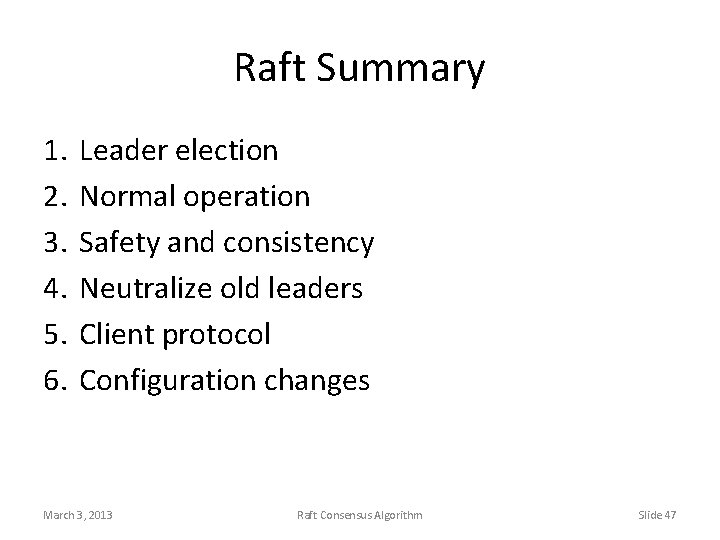
Raft Summary 1. 2. 3. 4. 5. 6. Leader election Normal operation Safety and consistency Neutralize old leaders Client protocol Configuration changes March 3, 2013 Raft Consensus Algorithm Slide 47
For Thursday • Ready Chubby paper – Shows example of trying to implement Paxos • Read faulty process paper – The plot thickens with Byzantine failures