
Conseil Europen pour les Langues European Language Council

- Slides: 42
Conseil Européen pour les Langues European Language Council of Europe Policy Forum Global Approaches to Plurilingual Education Strasbourg, 28 -29 June 2004 1
Conseil Européen pour les Langues European Language Council Education for plurilingualism in practice Higher education: THE CEL/ELC EXPERIENCE Wolfgang Mackiewicz CEL/ELC President Freie Universität Berlin (DE) 2
Conseil Européen pour les Langues European Language Council The CEL/ELC is an international association under Belgian law MEMBERS Some 160 higher education institutions and organisations specialising in languages 3
Conseil Européen pour les Langues European Language Council PRINCIPAL AIM To promote a quantitative and qualitative improvement in the knowledge of all the languages and cultures of the European Union and of other languages and cultures and this from the point of view of higher education 4
Conseil Européen pour les Langues European Language Council PRINCIPAL TYPE OF ACTIVITY EUROPEAN CO-OPERATION PROJECTS Ø Ø Ø policy development of proposals for * curriculum innovation * innovative teaching / learning methods * quality enhancement materials and curriculum development projects (for example, DIALANG) 5
Conseil Européen pour les Langues European Language Council A PRIORITY SINCE THE DAYS OF SIGMA Policy development in regard to language learning among both specialist and non -specialist students and this in terms of concrete measures proposed 6
Conseil Européen pour les Langues European Language Council POINT NO. ONE YOU CAN‘T HAVE INNOVATIVE PRACTICE WITHOUT INNOVATIVE POLICIES 7
Conseil Européen pour les Langues European Language Council Education for plurilingualism Seven milestones in policy development (1994 -2004) Milestone One SIGMA Scientific Committee on Languages (1994 -1995) Many of the recommendations currently being implemented were developed back then. 8
Conseil Européen pour les Langues European Language Council Milestone Two Thematic Network Project in the Area of Languages, Sub-project 8: Language studies for students of other disciplines (1996 -1999) Milestone Three Project for the exploitation and dissemination of the results of the TNP, notably the Brussels Dissemination Conference (09/00) 9
Conseil Européen pour les Langues European Language Council Claude Truchot, Rapporteur général of the Conference – a clarion call for the development of university language policies Milestone Four CEL/ELC Task Force on European Language Policy (01/2000 -06/2001) 10
Conseil Européen pour les Langues European Language Council Þpreparation of reference document Universities and language policy in Europe Ø Objectives: cf. promotion of plurilingual competence Ø Methods: cf. decompartmentelization of languages; plurilingual education Ø Strategies: cf. pilot project for development and implementation of language policy 11
Conseil Européen pour les Langues European Language Council Milestone Five Berlin EYL 2001 Conference - 500 participants: Ø experts from across Europe Ø representatives of national / regional governments Ø important organisations (ACA, EAIE, EUA, and UNICA) Ø university leaders Ø representatives of European institutions and of the Council of Europe 12
Conseil Européen pour les Langues European Language Council THE BERLIN DECLARATION Language Studies in Higher Education: A Key Contribution to European Integration KEY SENTENCES Multilingual competence, high levels of communicative competence in a number of languages, and language learning ability are 13
Conseil Européen pour les Langues European Language Council becoming essential aspects of a European graduate‘s employability, citizenship and personal development. Universities must provide students, regardless of their field of specialisation, with opportunities for improving their knowledge in languages, for learning new languages, and for becoming more independent in their language learning. 14
Conseil Européen pour les Langues European Language Council Measures proposed – universities to Ø offer all undergraduates the opportunity to take a number of credits in languages Ø create environments for independent learning Ø encourage co-operative learning (speakers of different languages) Ø offer as many languages as possible (LWULT languages) 15
Conseil Européen pour les Langues European Language Council Ø offer (portions of) degree programmes in other languages Ø provide linguistic and intercultural preparation and support for mobility Ø promote their own languages ***** Ø higher education language learning / teaching should be aimed at development of multilingual profile 16
Conseil Européen pour les Langues European Language Council Ø instruments to be used: DIALANG & ELP Degree courses in modern languages Ø intensive foundation courses for ab-initio languages Ø language majors to be encouraged to study another European language alongside their major language 17
Conseil Européen pour les Langues European Language Council Berlin Declaration called on universities to develop and implement their own specific and coherent language policies reflecting Ø the European dimension Ø the specific needs of the non-academic environments Ø institutional priorities and strengths 18
Conseil Européen pour les Langues European Language Council POINT NO. TWO YOU CANNOT HAVE INNOVATIVE PRACTICE ON A LARGE SCALE UNLESS YOU INVOLVE UNIVERSITY LEADERS 19
Conseil Européen pour les Langues European Language Council Milestone Six European University Language Policy Interest Group (2001 -2003) Vice presidents / vice rectors and experts from nine universities from cross Europe, meeting regularly to report on new developments, notably in the context of Bologna 20
Conseil Européen pour les Langues European Language Council Milestone Seven ENLU – European Network for the Promotion of Language Learning Among all Undergraduates (12/2003 -12/2005) Þfrom description and analysis of status quo (+/-) to breakthrough 21
Conseil Européen pour les Langues European Language Council POINT NO. THREE IT CERTAINLY HELPS IF YOU CAN INFLUENCE POLICY DEVELOPMENT AT EUROPEAN AND NATIONAL LEVEL 22
Conseil Européen pour les Langues European Language Council EU level Ø sections on higher education in the Commission‘s Consultation Document (2002) and Action Plan (2003) on Promoting Language Learning and Linguistic Diversity Bologna Ø the Berlin Communiqué of September 2003 Various national developments (DE, DK …) 23
Conseil Européen pour les Langues European Language Council Universities across Europe, notably CEL/ELC member institutions Þdevelopment and implementation of language policies Ø implementation of Bologna Ø part of a general Europeanization / internationalization effort 24
Conseil Européen pour les Langues European Language Council CASE STUDY THE FREIE UNIVERSITÄT BERLIN 1. new bachelor courses and offerings Ø a number Academic Senate resolutions prepared by the vice president in charge of education who at the time was a member of the European University Language Policy Interest Group – resolutions which together amount to a kind of university lang. policy 25
Conseil Européen pour les Langues European Language Council 2. contract between the language centre and the präsidium (2004 -2005) Ø implementation of the CEFR, notably of the proficiency scales learner autonomy, in all language courses and offerings Ø creation of an independent language learning centre 26
Conseil Européen pour les Langues European Language Council NEW BACHELOR STUDY COURSES • 180 credits • 1 credit = 30 hours student work • bachelor courses = single subject courses consisting of a core subject of 90 or 110 credits + (an) imported module package(s) Ø a strand outside the subject area(s): general preparation for employability – obligatory internship + choice of other options 27
Conseil Européen pour les Langues European Language Council I. Language provision as part of the general preparation for employability strand General considerations Ø students have to achieve a competence level relevant to employability Ø in more widely taught languages, this level has to be higher than in LWULT languages 28
Conseil Européen pour les Langues European Language Council Ø special incentives for languages regarded as particuarly relevant: entry level at zero or A 2 Ø students can only study ONE language Ø English not to be offered Ø however: all students have to do one module in their core subject in another language, normally in English 29
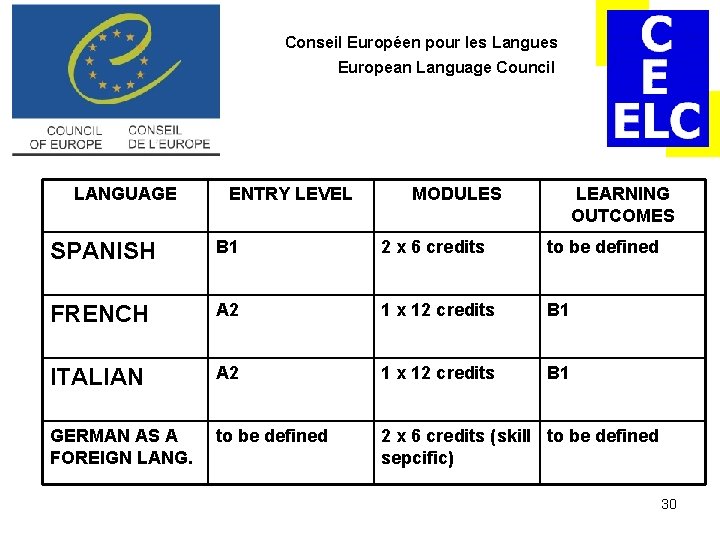
Conseil Européen pour les Langues European Language Council LANGUAGE ENTRY LEVEL MODULES LEARNING OUTCOMES SPANISH B 1 2 x 6 credits to be defined FRENCH A 2 1 x 12 credits B 1 ITALIAN A 2 1 x 12 credits B 1 GERMAN AS A FOREIGN LANG. to be defined 2 x 6 credits (skill to be defined sepcific) 30
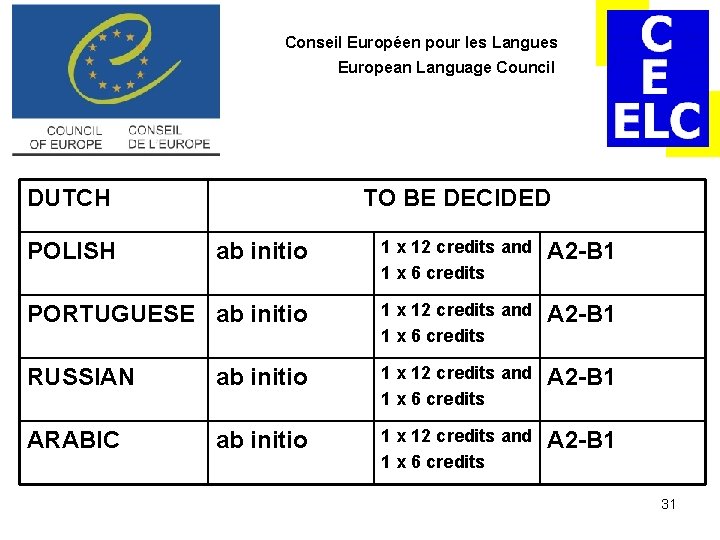
Conseil Européen pour les Langues European Language Council DUTCH TO BE DECIDED ab initio 1 x 12 credits and 1 x 6 credits A 2 -B 1 PORTUGUESE ab initio 1 x 12 credits and 1 x 6 credits A 2 -B 1 RUSSIAN ab initio 1 x 12 credits and 1 x 6 credits A 2 -B 1 ARABIC ab initio 1 x 12 credits and 1 x 6 credits A 2 -B 1 POLISH 31
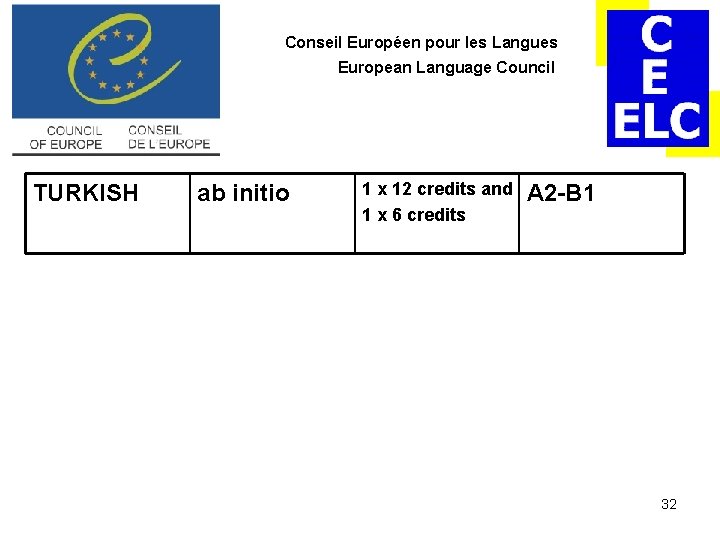
Conseil Européen pour les Langues European Language Council TURKISH ab initio 1 x 12 credits and 1 x 6 credits A 2 -B 1 32
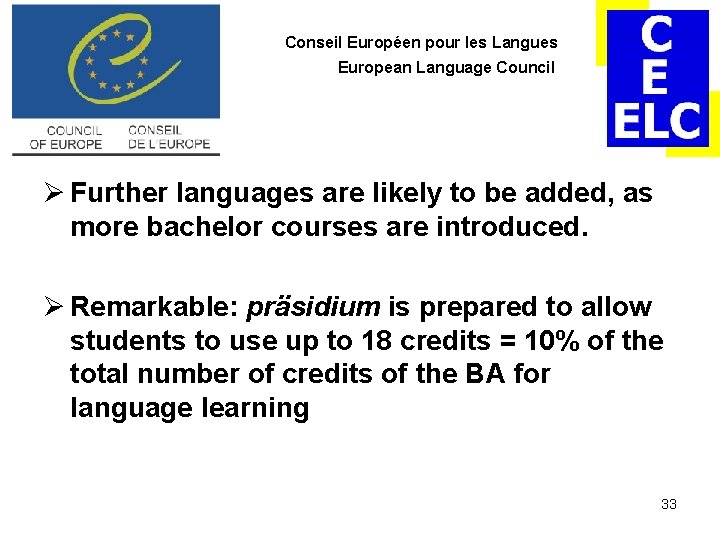
Conseil Européen pour les Langues European Language Council Ø Further languages are likely to be added, as more bachelor courses are introduced. Ø Remarkable: präsidium is prepared to allow students to use up to 18 credits = 10% of the total number of credits of the BA for language learning 33
Conseil Européen pour les Langues European Language Council NB Spanish Ø by far the most popular language Ø co-operation with the Instituto Cervantes: 4 modules designed to take students from zero to B 1 [costs: ½ IC, ¼ students, ¼ FUB] 34
Conseil Européen pour les Langues European Language Council II. Packages of modules in modern languages complementing 90 - and 110 -credit core subjects Ø NOT for English; not yet (? ) for French Ø initially for Dutch, Italian, Portuguese and Spanish Ø further languages represented at FUB to be phased in at a later stage 35
Conseil Européen pour les Langues European Language Council Example One: 30 credit in ES, IT, PT Ø 24 credits (= 4 modules) language study (zero -> B 1) Ø 6 credits civilization Example Two: 60 credits in ES, IT, PT Ø 42 credits (= 7 modules) language study (zero -> B 2. 2 -C 1. 1) Ø 18 credits linguistics, literature, civilization 36
Conseil Européen pour les Langues European Language Council III. New approaches to language study in modern languages degree courses Ø a break with philological tradition Ø in order to achieve relevant proficiency levels (-> domains, text types), language study in core courses starts at B 1 (ES, FR, IT) or C 1 (EN) 37
Conseil Européen pour les Langues European Language Council Ø in non-school languages: turbo courses of 30 credits each, preceding study proper IV. Independent learning and co-operative learning IV. 1 In combination with taught courses 38
Conseil Européen pour les Langues European Language Council Ø calculation of credits in accordance with the time students are estimated to need on average to get from entry level to exit level (learning outcomes) Ø normally: a 6 -credit module = 4 x 15 contact hours = 60 taught hours + 120 hours independent and co-operative learning - a major challenge for teachers and students 39
Conseil Européen pour les Langues European Language Council Ø introduction of ELP across the board Ø work in progress: modules are currently being developed IV. 2 Independent learning not linked to courses Ø independent language learning centre to be fully operational by the end of 2005 Ø at present: highly successful tandem system 40
Conseil Européen pour les Langues European Language Council Almost ten years after SIGMA, I have to say these are early days - and exciting times. FUB and other CEL/ELC member institutions are only beginning to respond to the plurilingual / multilingual challenge Ø ) in future, credits for independent / cooperative learning ? 41
Conseil Européen pour les Langues European Language Council THANK YOU ! http: //www. fu-berlin. de/elc/ 42