
Consciousness and Thought WrapUp Talk David Chalmers The
- Slides: 37
Consciousness and Thought: Wrap-Up Talk David Chalmers
The Critique of Pure Thought David Chalmers
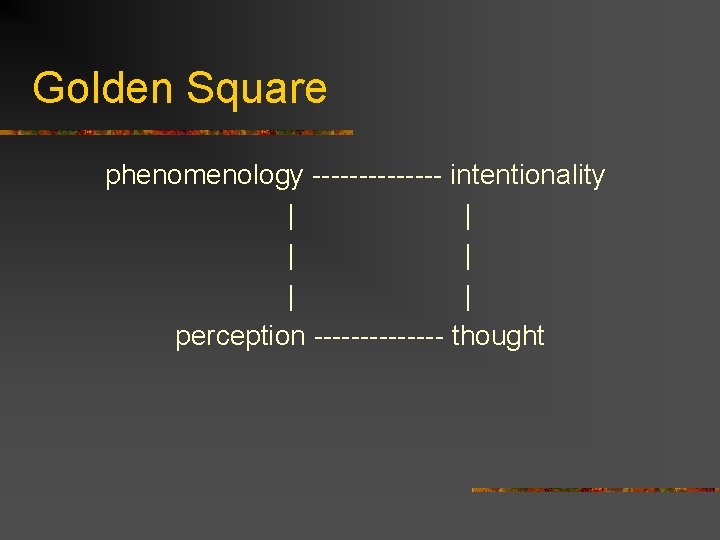
Golden Square phenomenology ------- intentionality | | | perception ------- thought
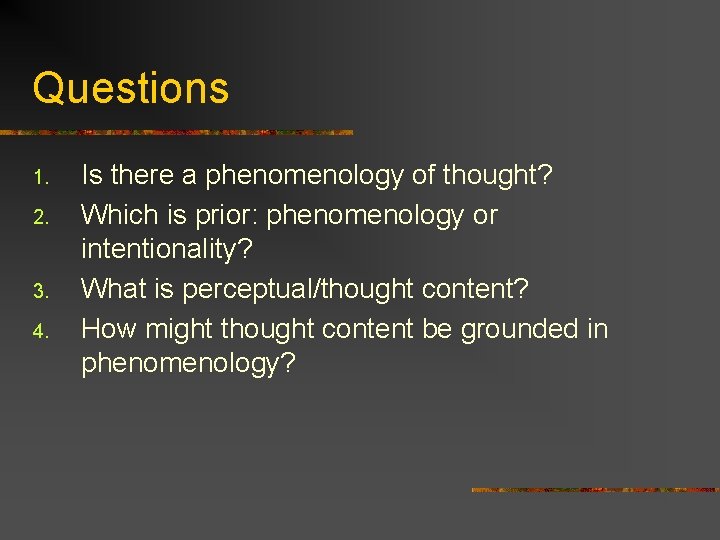
Questions 1. 2. 3. 4. Is there a phenomenology of thought? Which is prior: phenomenology or intentionality? What is perceptual/thought content? How might thought content be grounded in phenomenology?
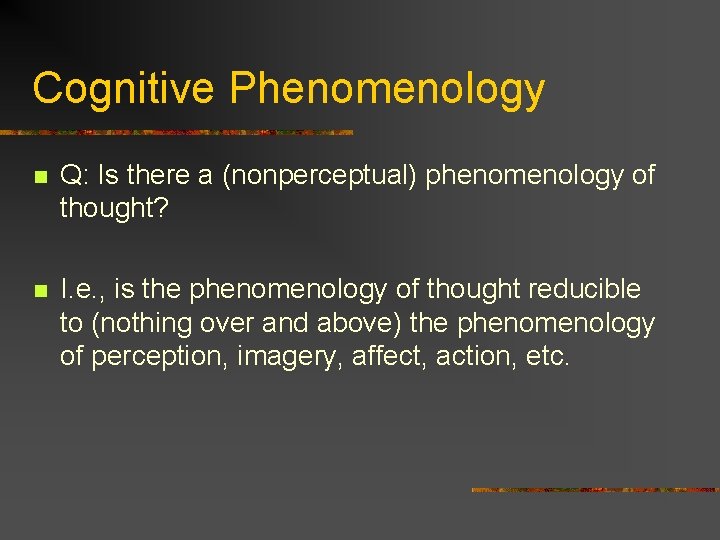
Cognitive Phenomenology n Q: Is there a (nonperceptual) phenomenology of thought? n I. e. , is the phenomenology of thought reducible to (nothing over and above) the phenomenology of perception, imagery, affect, action, etc.
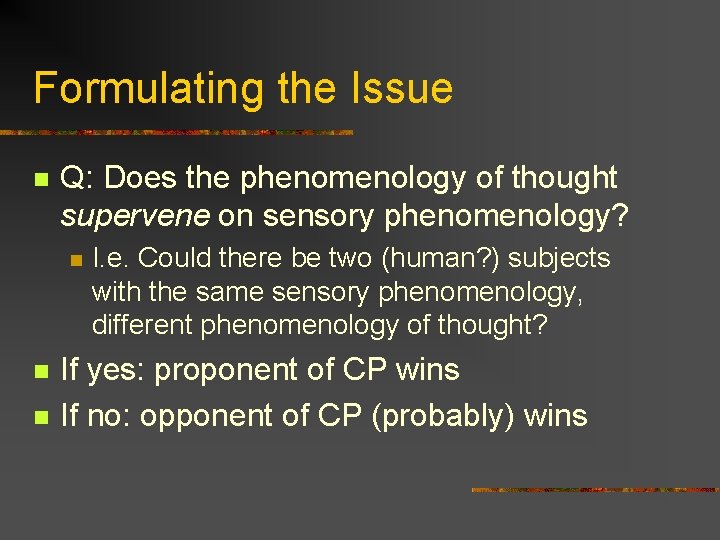
Formulating the Issue n Q: Does the phenomenology of thought supervene on sensory phenomenology? n n n I. e. Could there be two (human? ) subjects with the same sensory phenomenology, different phenomenology of thought? If yes: proponent of CP wins If no: opponent of CP (probably) wins
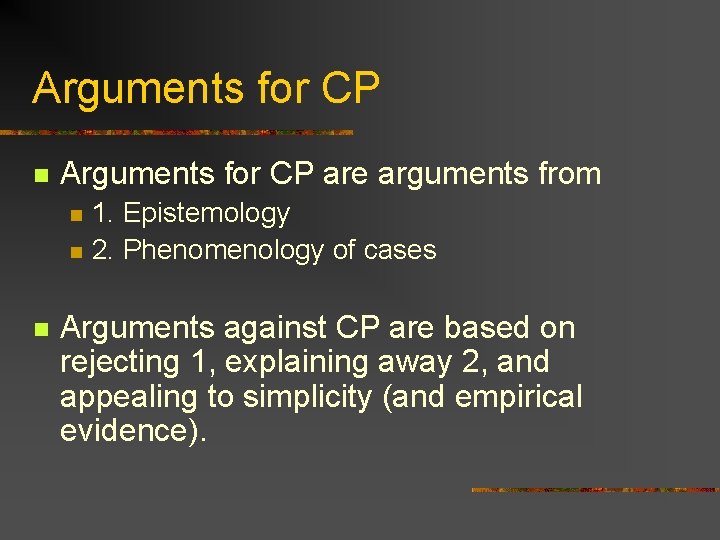
Arguments for CP n Arguments for CP are arguments from n n n 1. Epistemology 2. Phenomenology of cases Arguments against CP are based on rejecting 1, explaining away 2, and appealing to simplicity (and empirical evidence).
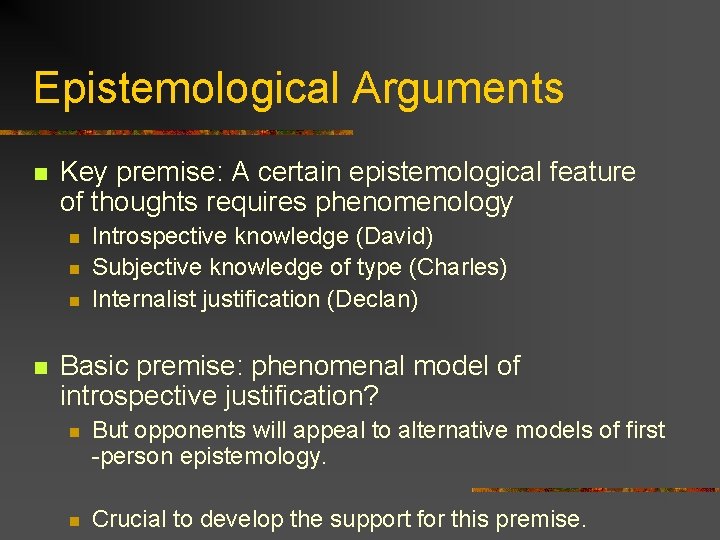
Epistemological Arguments n Key premise: A certain epistemological feature of thoughts requires phenomenology n n Introspective knowledge (David) Subjective knowledge of type (Charles) Internalist justification (Declan) Basic premise: phenomenal model of introspective justification? n But opponents will appeal to alternative models of first -person epistemology. n Crucial to develop the support for this premise.
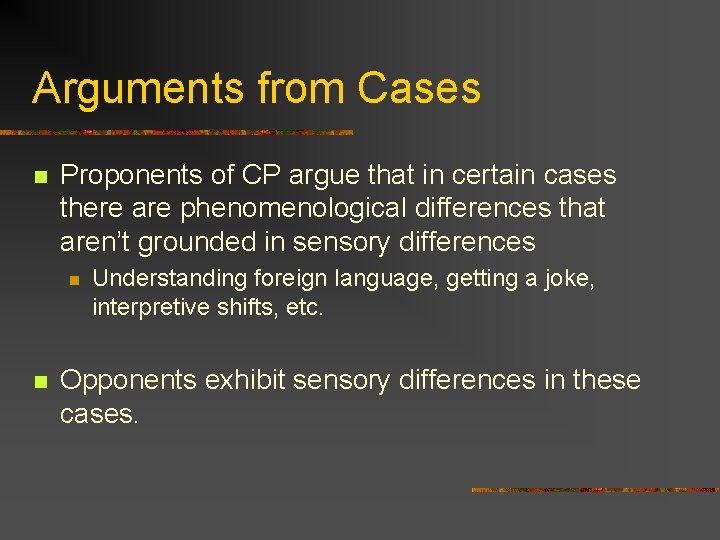
Arguments from Cases n Proponents of CP argue that in certain cases there are phenomenological differences that aren’t grounded in sensory differences n n Understanding foreign language, getting a joke, interpretive shifts, etc. Opponents exhibit sensory differences in these cases.
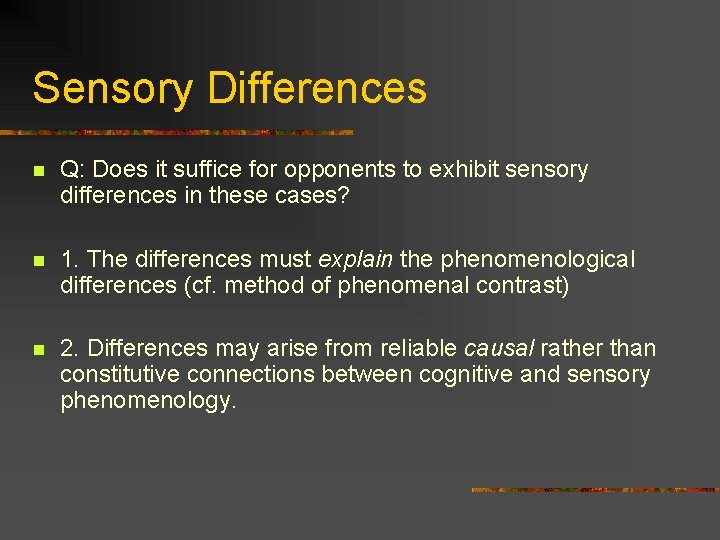
Sensory Differences n Q: Does it suffice for opponents to exhibit sensory differences in these cases? n 1. The differences must explain the phenomenological differences (cf. method of phenomenal contrast) n 2. Differences may arise from reliable causal rather than constitutive connections between cognitive and sensory phenomenology.
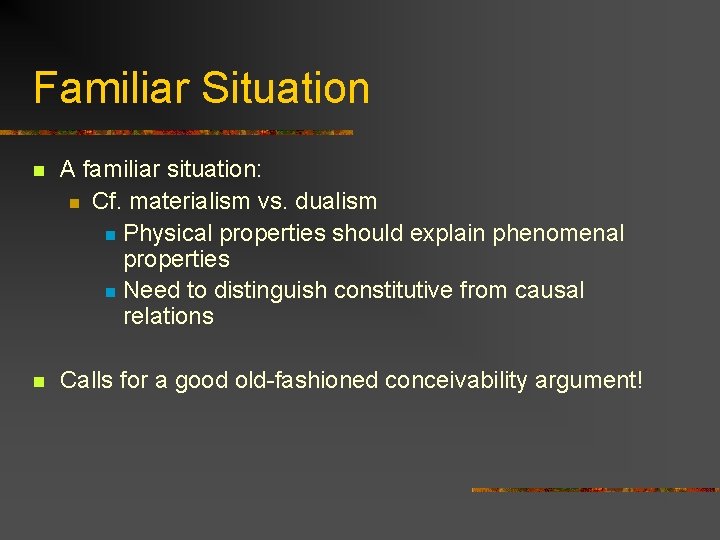
Familiar Situation n A familiar situation: n Cf. materialism vs. dualism n Physical properties should explain phenomenal properties n Need to distinguish constitutive from causal relations n Calls for a good old-fashioned conceivability argument!
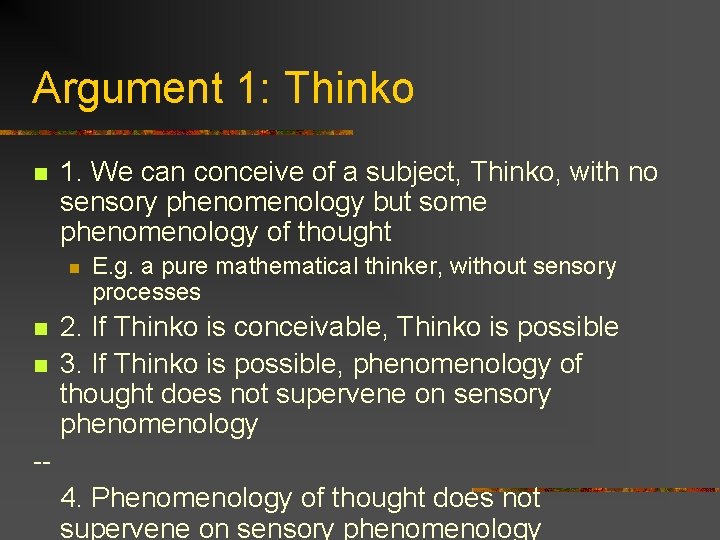
Argument 1: Thinko n 1. We can conceive of a subject, Thinko, with no sensory phenomenology but some phenomenology of thought n n n E. g. a pure mathematical thinker, without sensory processes 2. If Thinko is conceivable, Thinko is possible 3. If Thinko is possible, phenomenology of thought does not supervene on sensory phenomenology -4. Phenomenology of thought does not supervene on sensory phenomenology
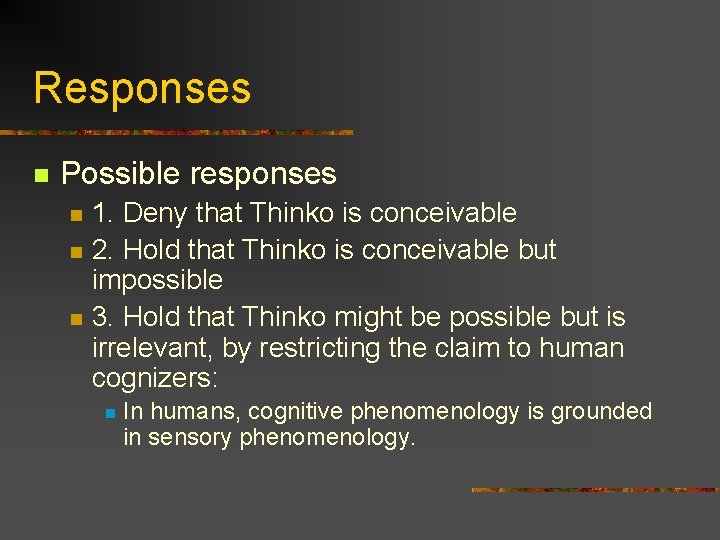
Responses n Possible responses n n n 1. Deny that Thinko is conceivable 2. Hold that Thinko is conceivable but impossible 3. Hold that Thinko might be possible but is irrelevant, by restricting the claim to human cognizers: n In humans, cognitive phenomenology is grounded in sensory phenomenology.
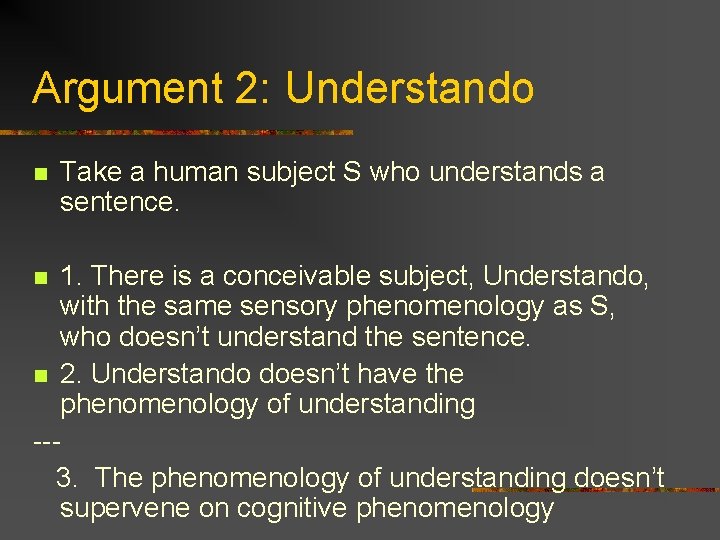
Argument 2: Understando n Take a human subject S who understands a sentence. 1. There is a conceivable subject, Understando, with the same sensory phenomenology as S, who doesn’t understand the sentence. n 2. Understando doesn’t have the phenomenology of understanding --3. The phenomenology of understanding doesn’t supervene on cognitive phenomenology n
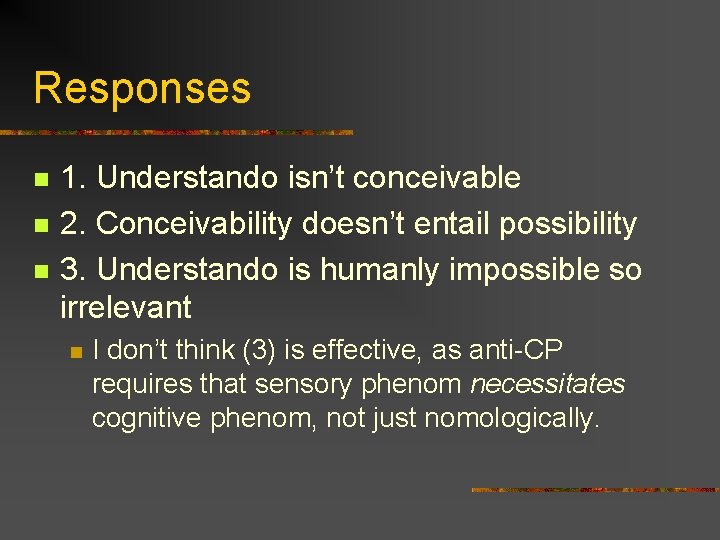
Responses n n n 1. Understando isn’t conceivable 2. Conceivability doesn’t entail possibility 3. Understando is humanly impossible so irrelevant n I don’t think (3) is effective, as anti-CP requires that sensory phenom necessitates cognitive phenom, not just nomologically.
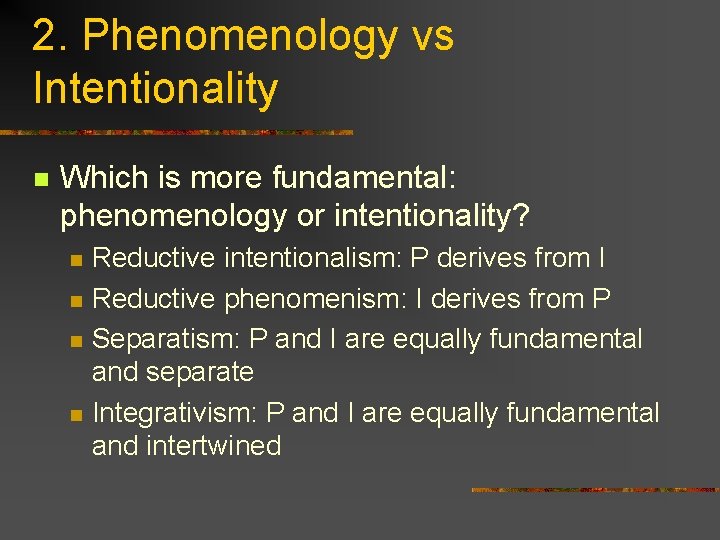
2. Phenomenology vs Intentionality n Which is more fundamental: phenomenology or intentionality? n n Reductive intentionalism: P derives from I Reductive phenomenism: I derives from P Separatism: P and I are equally fundamental and separate Integrativism: P and I are equally fundamental and intertwined
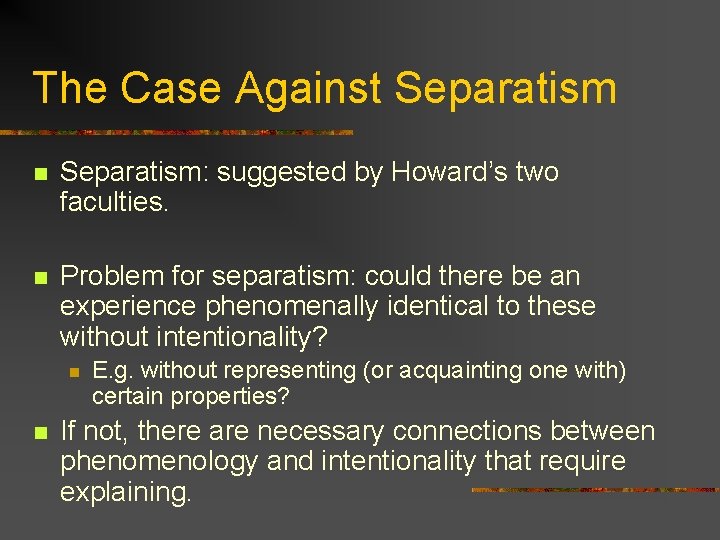
The Case Against Separatism n Separatism: suggested by Howard’s two faculties. n Problem for separatism: could there be an experience phenomenally identical to these without intentionality? n n E. g. without representing (or acquainting one with) certain properties? If not, there are necessary connections between phenomenology and intentionality that require explaining.
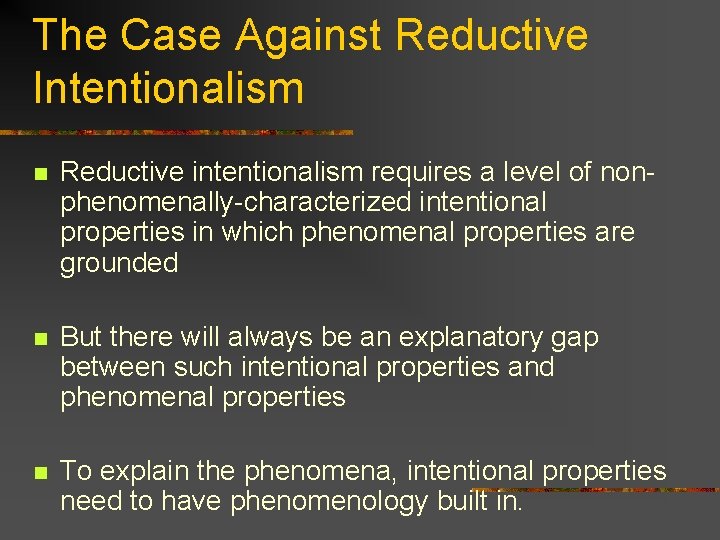
The Case Against Reductive Intentionalism n Reductive intentionalism requires a level of nonphenomenally-characterized intentional properties in which phenomenal properties are grounded n But there will always be an explanatory gap between such intentional properties and phenomenal properties n To explain the phenomena, intentional properties need to have phenomenology built in.
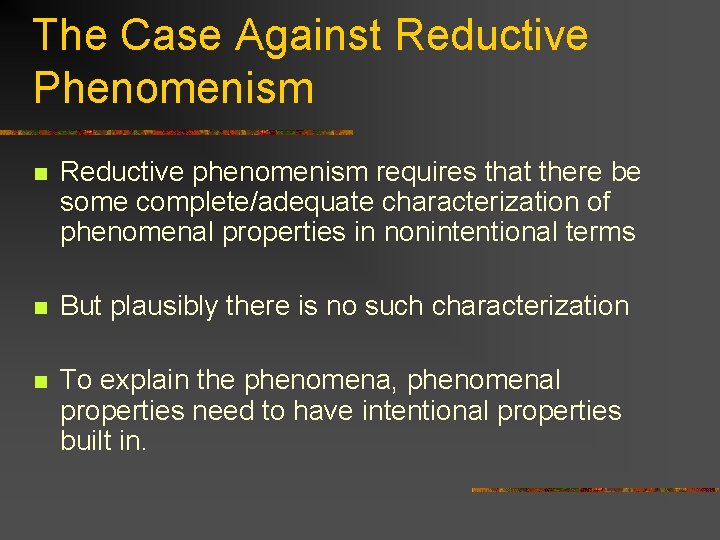
The Case Against Reductive Phenomenism n Reductive phenomenism requires that there be some complete/adequate characterization of phenomenal properties in nonintentional terms n But plausibly there is no such characterization n To explain the phenomena, phenomenal properties need to have intentional properties built in.
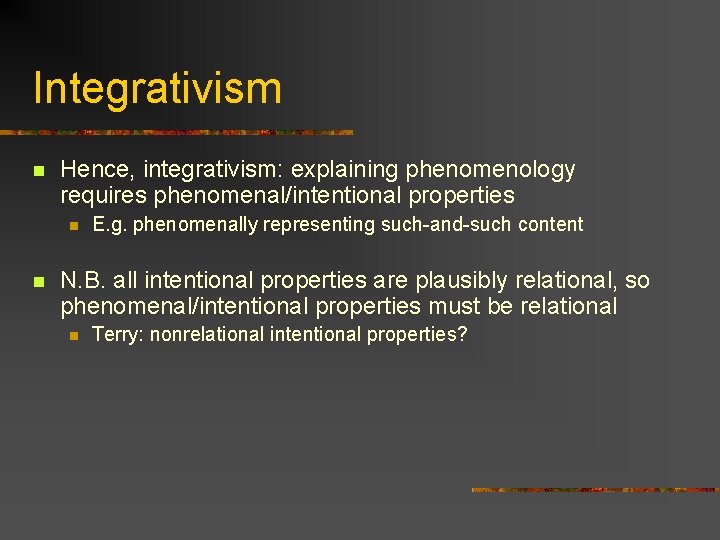
Integrativism n Hence, integrativism: explaining phenomenology requires phenomenal/intentional properties n n E. g. phenomenally representing such-and-such content N. B. all intentional properties are plausibly relational, so phenomenal/intentional properties must be relational n Terry: nonrelational intentional properties?
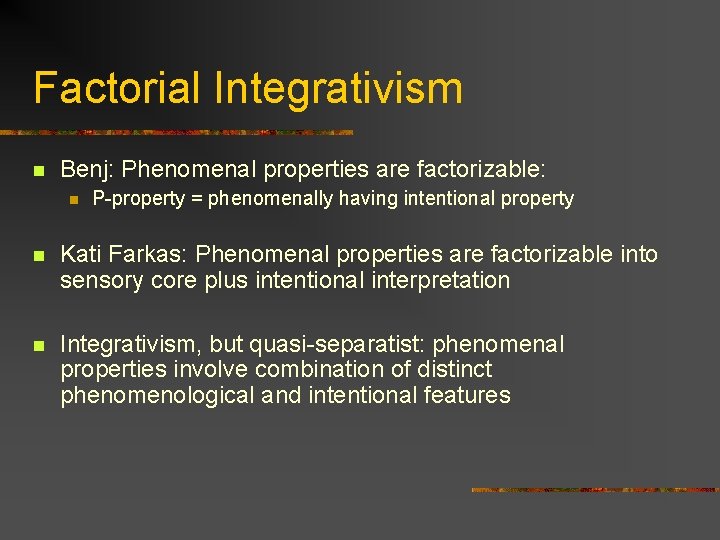
Factorial Integrativism n Benj: Phenomenal properties are factorizable: n P-property = phenomenally having intentional property n Kati Farkas: Phenomenal properties are factorizable into sensory core plus intentional interpretation n Integrativism, but quasi-separatist: phenomenal properties involve combination of distinct phenomenological and intentional features
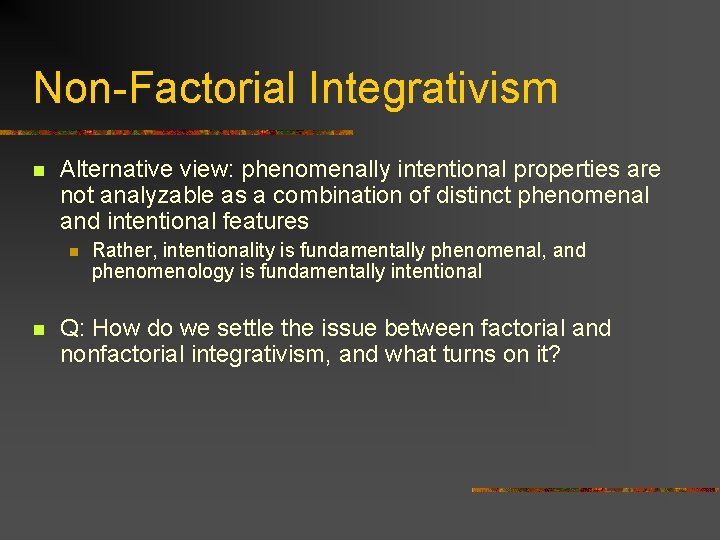
Non-Factorial Integrativism n Alternative view: phenomenally intentional properties are not analyzable as a combination of distinct phenomenal and intentional features n n Rather, intentionality is fundamentally phenomenal, and phenomenology is fundamentally intentional Q: How do we settle the issue between factorial and nonfactorial integrativism, and what turns on it?
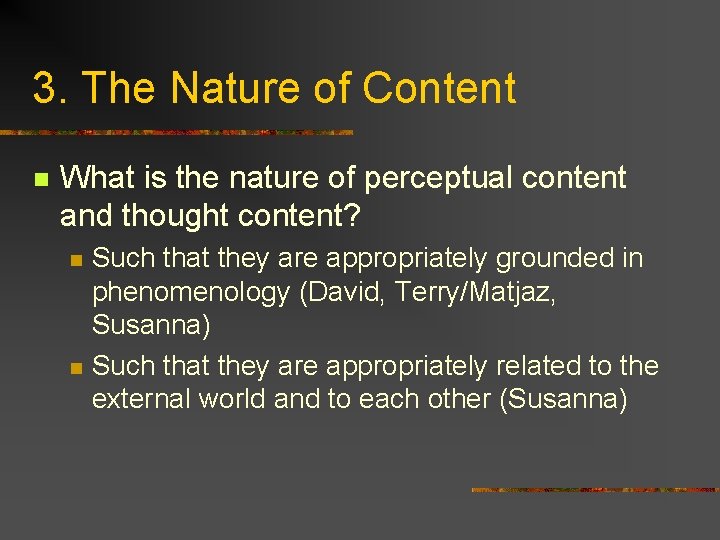
3. The Nature of Content n What is the nature of perceptual content and thought content? n n Such that they are appropriately grounded in phenomenology (David, Terry/Matjaz, Susanna) Such that they are appropriately related to the external world and to each other (Susanna)
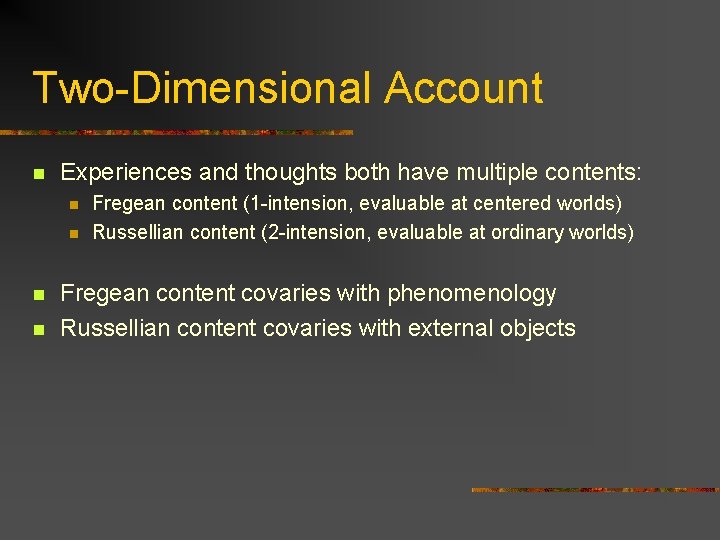
Two-Dimensional Account n Experiences and thoughts both have multiple contents: n n Fregean content (1 -intension, evaluable at centered worlds) Russellian content (2 -intension, evaluable at ordinary worlds) Fregean content covaries with phenomenology Russellian content covaries with external objects
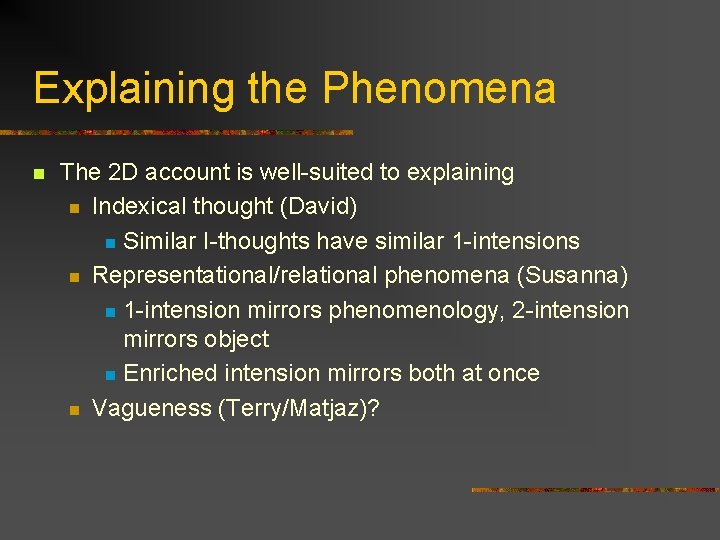
Explaining the Phenomena n The 2 D account is well-suited to explaining n Indexical thought (David) n Similar I-thoughts have similar 1 -intensions n Representational/relational phenomena (Susanna) n 1 -intension mirrors phenomenology, 2 -intension mirrors object n Enriched intension mirrors both at once n Vagueness (Terry/Matjaz)?
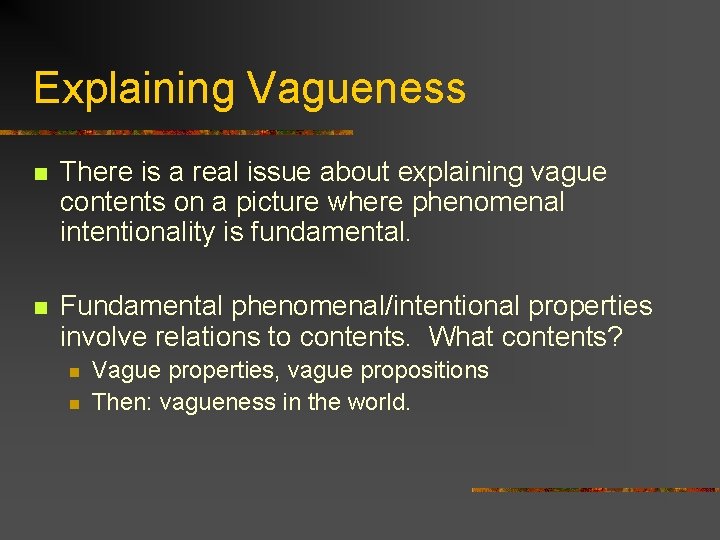
Explaining Vagueness n There is a real issue about explaining vague contents on a picture where phenomenal intentionality is fundamental. n Fundamental phenomenal/intentional properties involve relations to contents. What contents? n n Vague properties, vague propositions Then: vagueness in the world.
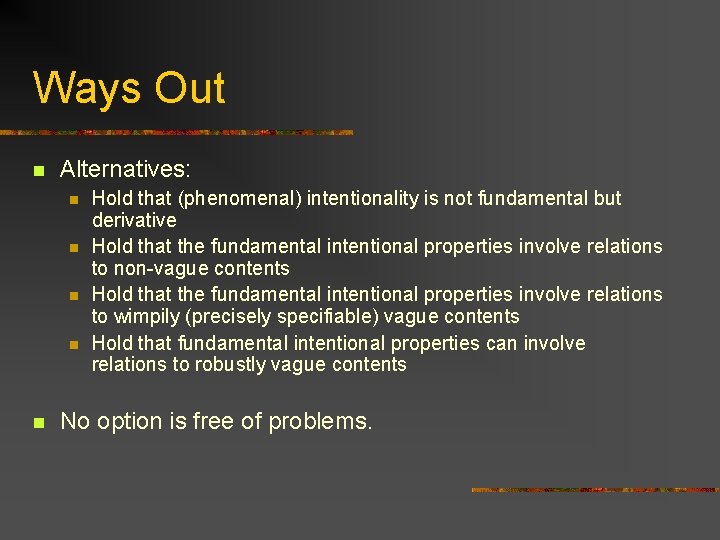
Ways Out n Alternatives: n n n Hold that (phenomenal) intentionality is not fundamental but derivative Hold that the fundamental intentional properties involve relations to non-vague contents Hold that the fundamental intentional properties involve relations to wimpily (precisely specifiable) vague contents Hold that fundamental intentional properties can involve relations to robustly vague contents No option is free of problems.
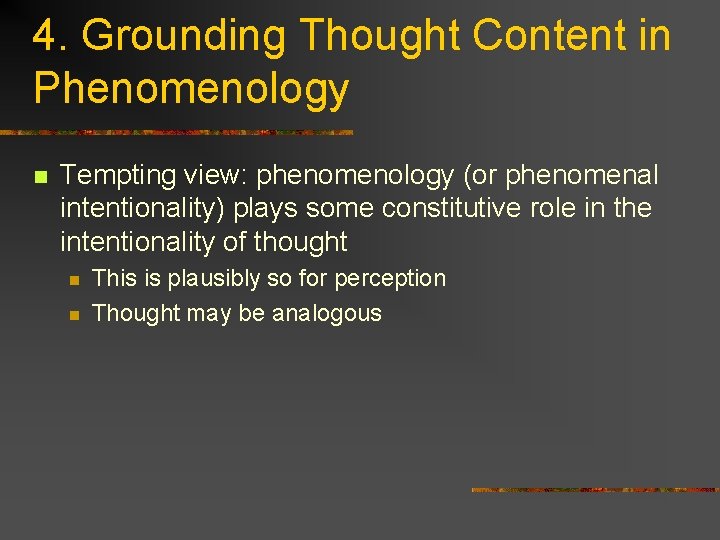
4. Grounding Thought Content in Phenomenology n Tempting view: phenomenology (or phenomenal intentionality) plays some constitutive role in the intentionality of thought n n This is plausibly so for perception Thought may be analogous
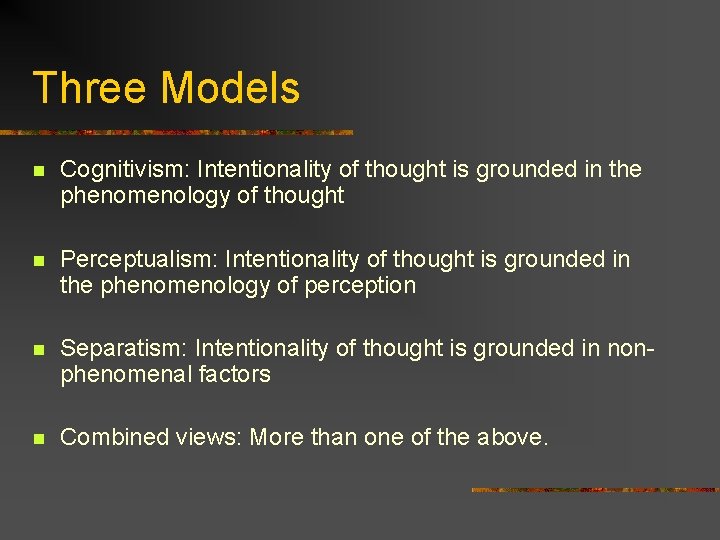
Three Models n Cognitivism: Intentionality of thought is grounded in the phenomenology of thought n Perceptualism: Intentionality of thought is grounded in the phenomenology of perception n Separatism: Intentionality of thought is grounded in nonphenomenal factors n Combined views: More than one of the above.
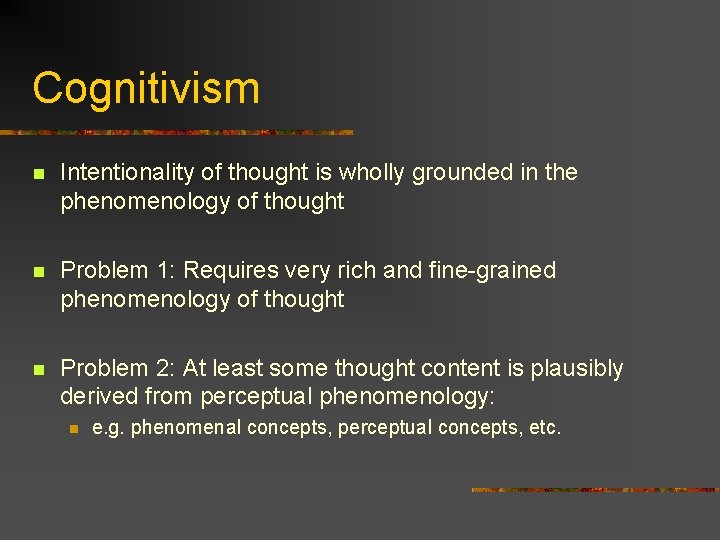
Cognitivism n Intentionality of thought is wholly grounded in the phenomenology of thought n Problem 1: Requires very rich and fine-grained phenomenology of thought n Problem 2: At least some thought content is plausibly derived from perceptual phenomenology: n e. g. phenomenal concepts, perceptual concepts, etc.
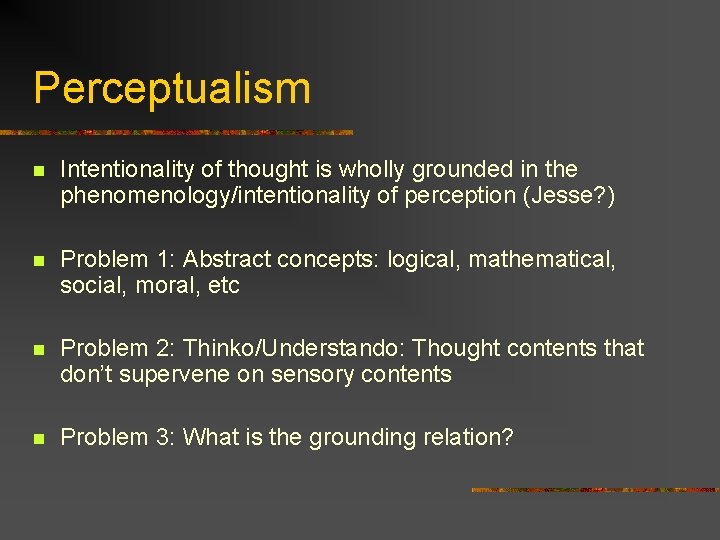
Perceptualism n Intentionality of thought is wholly grounded in the phenomenology/intentionality of perception (Jesse? ) n Problem 1: Abstract concepts: logical, mathematical, social, moral, etc n Problem 2: Thinko/Understando: Thought contents that don’t supervene on sensory contents n Problem 3: What is the grounding relation?
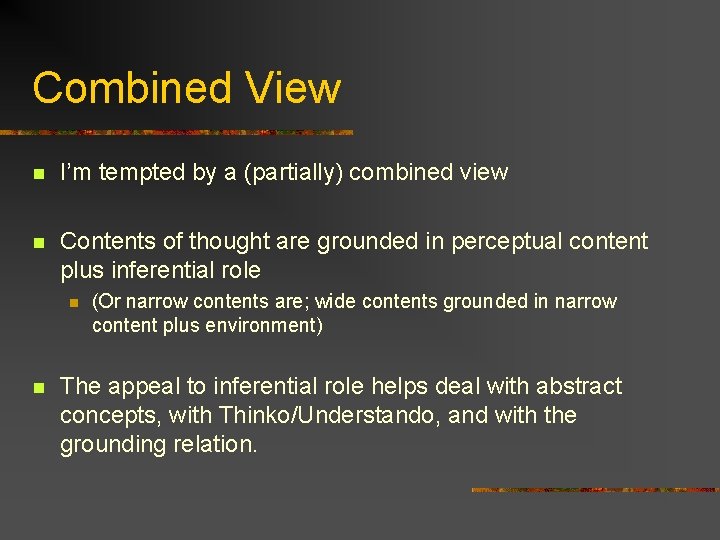
Combined View n I’m tempted by a (partially) combined view n Contents of thought are grounded in perceptual content plus inferential role n n (Or narrow contents are; wide contents grounded in narrow content plus environment) The appeal to inferential role helps deal with abstract concepts, with Thinko/Understando, and with the grounding relation.
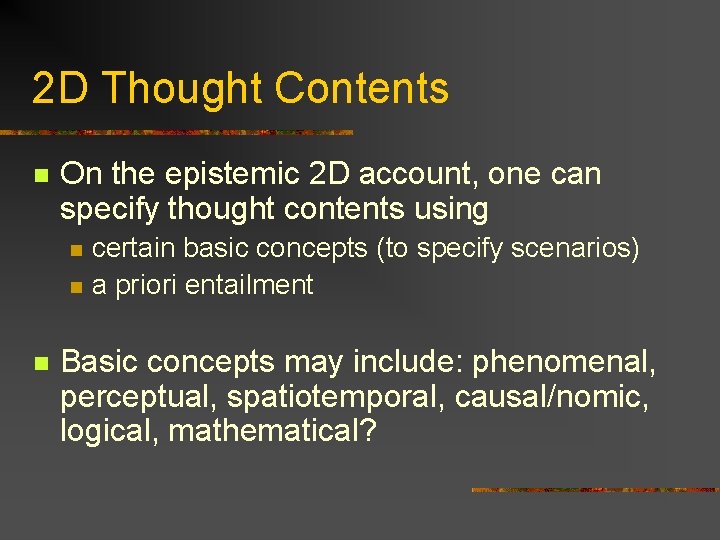
2 D Thought Contents n On the epistemic 2 D account, one can specify thought contents using n n n certain basic concepts (to specify scenarios) a priori entailment Basic concepts may include: phenomenal, perceptual, spatiotemporal, causal/nomic, logical, mathematical?
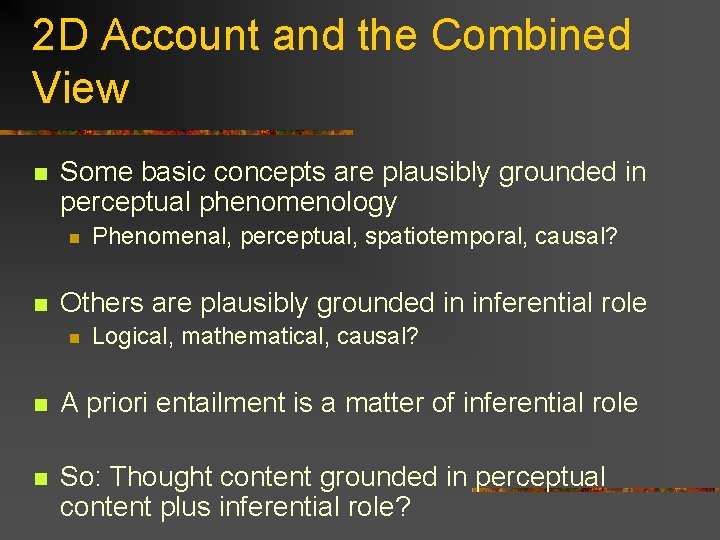
2 D Account and the Combined View n Some basic concepts are plausibly grounded in perceptual phenomenology n n Phenomenal, perceptual, spatiotemporal, causal? Others are plausibly grounded in inferential role n Logical, mathematical, causal? n A priori entailment is a matter of inferential role n So: Thought content grounded in perceptual content plus inferential role?
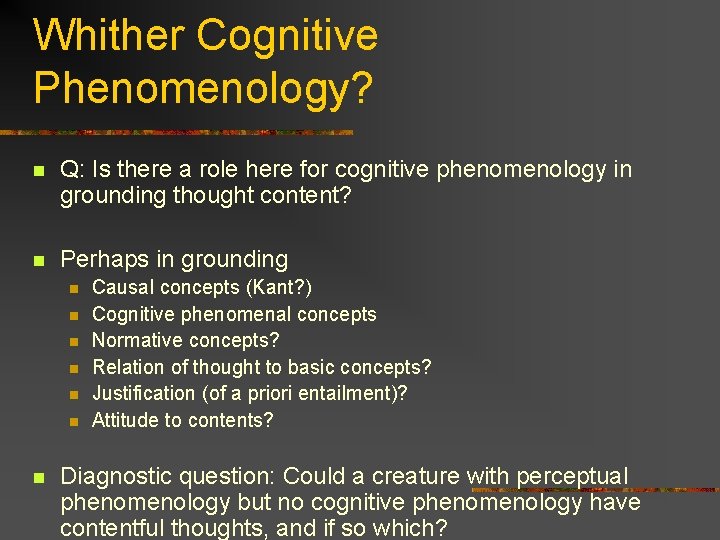
Whither Cognitive Phenomenology? n Q: Is there a role here for cognitive phenomenology in grounding thought content? n Perhaps in grounding n n n n Causal concepts (Kant? ) Cognitive phenomenal concepts Normative concepts? Relation of thought to basic concepts? Justification (of a priori entailment)? Attitude to contents? Diagnostic question: Could a creature with perceptual phenomenology but no cognitive phenomenology have contentful thoughts, and if so which?
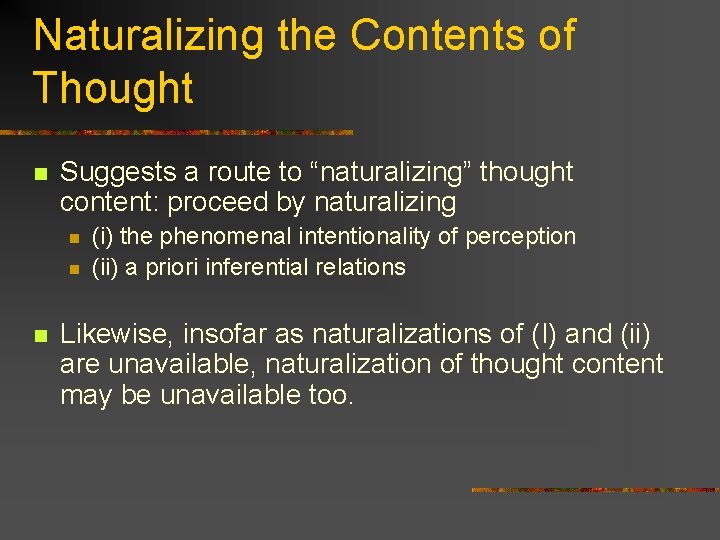
Naturalizing the Contents of Thought n Suggests a route to “naturalizing” thought content: proceed by naturalizing n n n (i) the phenomenal intentionality of perception (ii) a priori inferential relations Likewise, insofar as naturalizations of (I) and (ii) are unavailable, naturalization of thought content may be unavailable too.
Concluding Critique n The road to (an understanding of) thought may well proceed through (an understanding of) consciousness