
Conscience A help to moral decision making Define
- Slides: 5
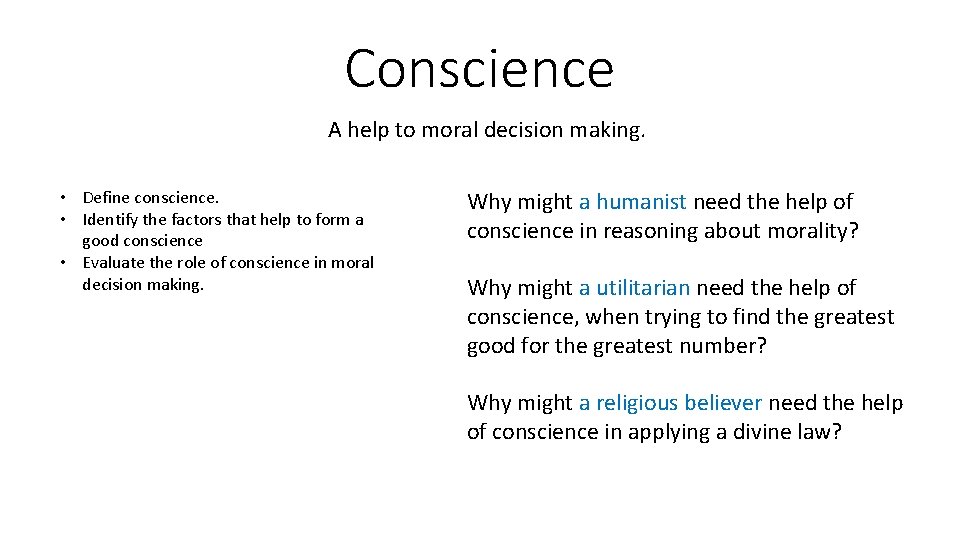
Conscience A help to moral decision making. • Define conscience. • Identify the factors that help to form a good conscience • Evaluate the role of conscience in moral decision making. Why might a humanist need the help of conscience in reasoning about morality? Why might a utilitarian need the help of conscience, when trying to find the greatest good for the greatest number? Why might a religious believer need the help of conscience in applying a divine law?
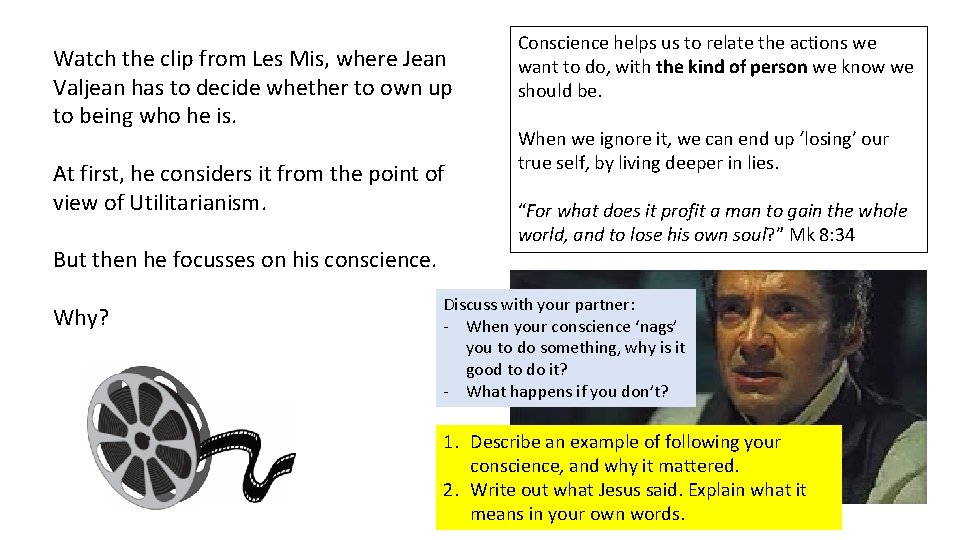
Watch the clip from Les Mis, where Jean Valjean has to decide whether to own up to being who he is. At first, he considers it from the point of view of Utilitarianism. But then he focusses on his conscience. Why? Conscience helps us to relate the actions we want to do, with the kind of person we know we should be. When we ignore it, we can end up ‘losing’ our true self, by living deeper in lies. “For what does it profit a man to gain the whole world, and to lose his own soul? ” Mk 8: 34 Discuss with your partner: - When your conscience ‘nags’ you to do something, why is it good to do it? - What happens if you don’t? 1. Describe an example of following your conscience, and why it mattered. 2. Write out what Jesus said. Explain what it means in your own words.
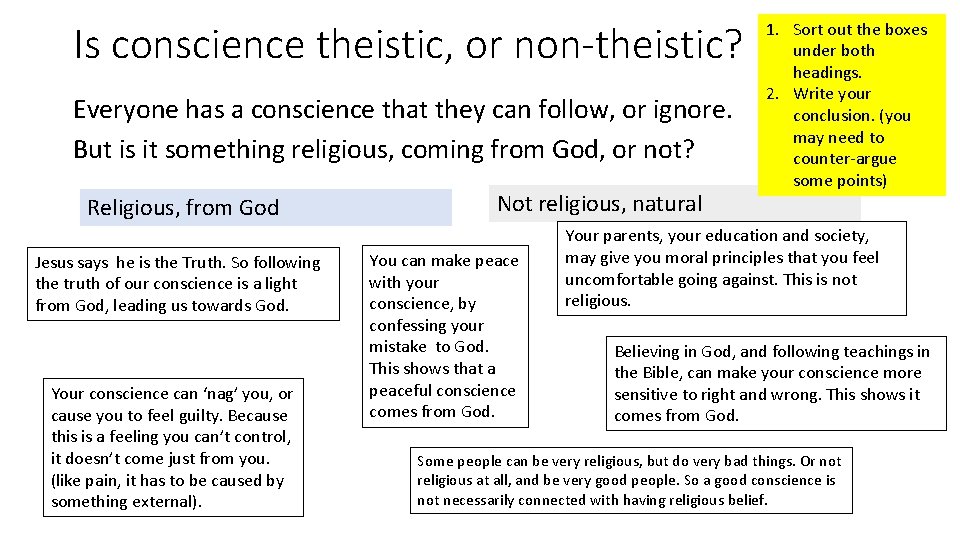
Is conscience theistic, or non-theistic? Everyone has a conscience that they can follow, or ignore. But is it something religious, coming from God, or not? Religious, from God Jesus says he is the Truth. So following the truth of our conscience is a light from God, leading us towards God. Your conscience can ‘nag’ you, or cause you to feel guilty. Because this is a feeling you can’t control, it doesn’t come just from you. (like pain, it has to be caused by something external). Not religious, natural You can make peace with your conscience, by confessing your mistake to God. This shows that a peaceful conscience comes from God. 1. Sort out the boxes under both headings. 2. Write your conclusion. (you may need to counter-argue some points) Your parents, your education and society, may give you moral principles that you feel uncomfortable going against. This is not religious. Believing in God, and following teachings in the Bible, can make your conscience more sensitive to right and wrong. This shows it comes from God. Some people can be very religious, but do very bad things. Or not religious at all, and be very good people. So a good conscience is not necessarily connected with having religious belief.
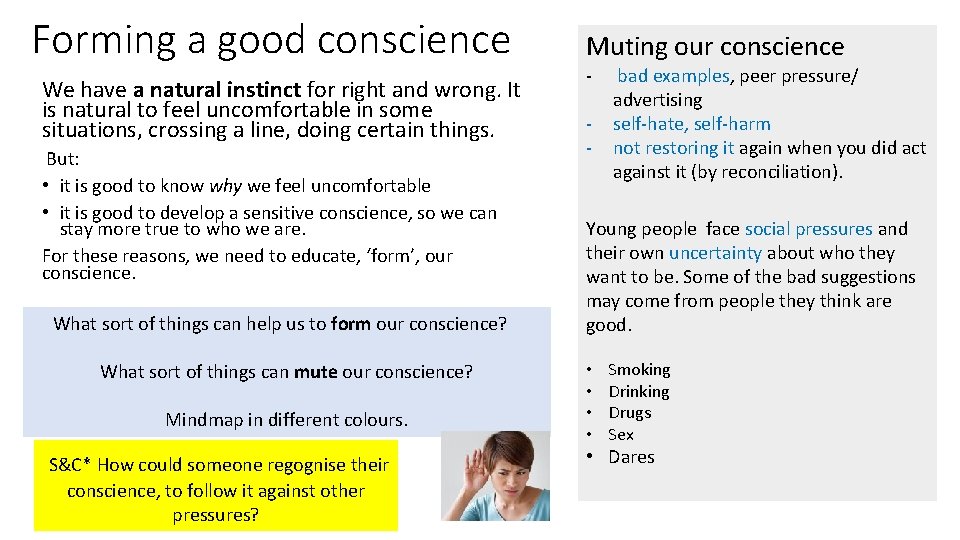
Forming a good conscience We have a natural instinct for right and wrong. It is natural to feel uncomfortable in some situations, crossing a line, doing certain things. But: • it is good to know why we feel uncomfortable • it is good to develop a sensitive conscience, so we can stay more true to who we are. For these reasons, we need to educate, ‘form’, our conscience. What sort of things can help us to form our conscience? What sort of things can mute our conscience? Mindmap in different colours. S&C* How could someone regognise their conscience, to follow it against other pressures? Muting our conscience - bad examples, peer pressure/ advertising self-hate, self-harm not restoring it again when you did act against it (by reconciliation). Young people face social pressures and their own uncertainty about who they want to be. Some of the bad suggestions may come from people they think are good. • • Smoking Drinking Drugs Sex • Dares
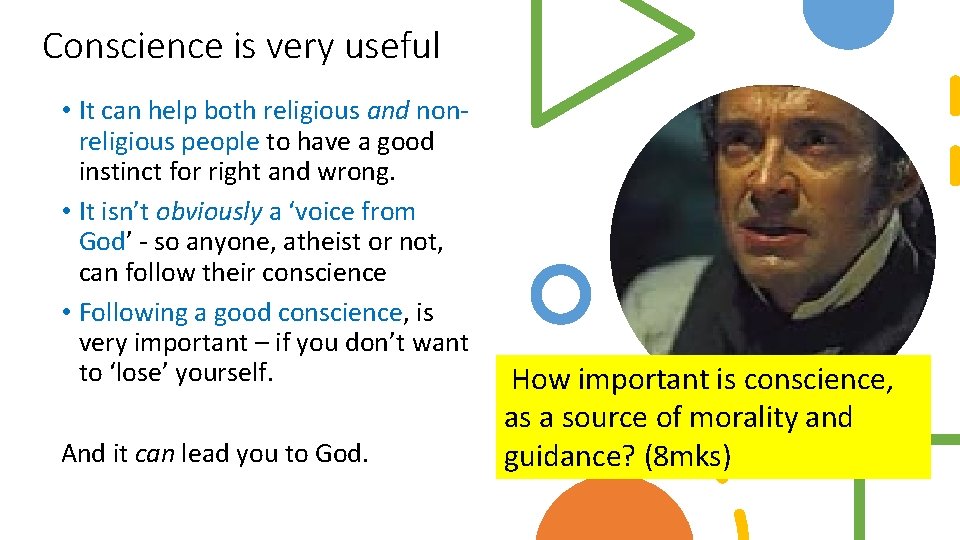
Conscience is very useful • It can help both religious and nonreligious people to have a good instinct for right and wrong. • It isn’t obviously a ‘voice from God’ - so anyone, atheist or not, can follow their conscience • Following a good conscience, is very important – if you don’t want to ‘lose’ yourself. And it can lead you to God. How important is conscience, as a source of morality and guidance? (8 mks)