
CONOPS TO DOCTRINE Shaping the Force From Idea
![Specific Current Tasks - NWDC (CONOPS vs Concepts) “Recommend you [NWDC] split the OPNAV](https://slidetodoc.com/presentation_image_h2/b0728ff88f9503480f70ce331ec537cc/image-13.jpg "Specific Current Tasks - NWDC (CONOPS vs Concepts) “Recommend you [NWDC] split the OPNAV")
- Slides: 36
CONOPS TO DOCTRINE: Shaping the Force From Idea Through Implementation Fleet CONOPS Guidance Brief UNCLASSIFIED United States Fleet Forces October 12, 2006 Operational Readiness, Effectiveness, Primacy 1
Fleet CONOPS Guidance • • Background Target Audience CONOPS Tasks CONOPS Development Process • CONOPS Format • Lessons Learned • Briefing Guidance United States Fleet Forces These are the principal areas that will be addressed by this brief. (For all slides, one click will hide the explanation, roll-back/page back to view again) Operational Readiness, Effectiveness, Primacy 2
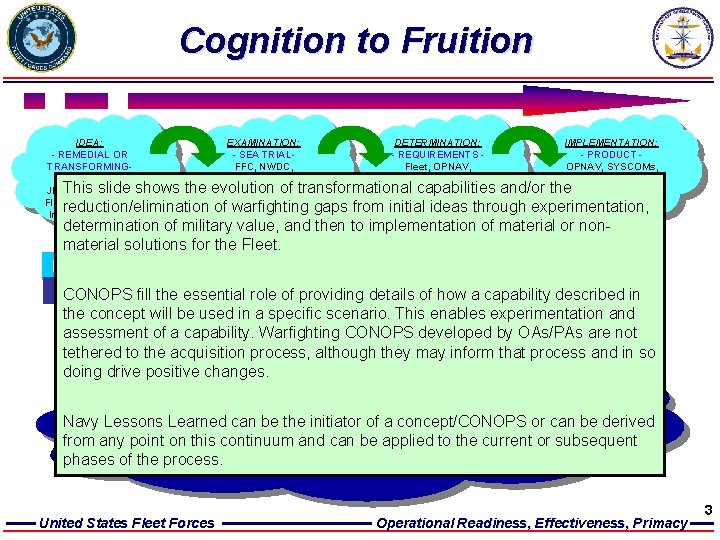
Cognition to Fruition IDEA: - REMEDIAL OR TRANSFORMINGLeadership, JFCOM, Agencies, Fleet, Think Tanks, Industry, WCOEs EXAMINATION: - SEA TRIALFFC, NWDC, Operational Agents, Fleet Collaborative Teams, STESG DETERMINATION: - REQUIREMENTS Fleet, OPNAV, Do. N/Do. D Leadership IMPLEMENTATION: - PRODUCT OPNAV, SYSCOMs, PEOs, Fleet, NWDC, OPTEVFOR This slide shows the evolution of transformational capabilities and/or the reduction/elimination of warfighting gaps from initial ideas through experimentation, determination of military value, and then to implementation of material or nonmaterial solutions for the Fleet. Assessment NCDP DTOT IOC FOC Development Experimentation Concept CONOPS TACMEMO TTP described Doctrine CONOPS fill the essential role of providing details of how a capability in the concept will be used in a specific scenario. This enables experimentation and assessment of a capability. Warfighting CONOPS developed by OAs/PAs are not tethered to the acquisition process, although they may inform that process and in so doing drive positive changes. Exercises Visions TOP LESSONS OPLANS/CONPLANS Navy Lessons Learned can. Strategies be the initiator of a concept/CONOPS or can be derived DOWN LEARNED from any point on this continuum and can be applied to the current or subsequent NSP GUIDANCE QDR Real-World Ops phases of the process. NOC United States Fleet Forces Operational Readiness, Effectiveness, Primacy 3
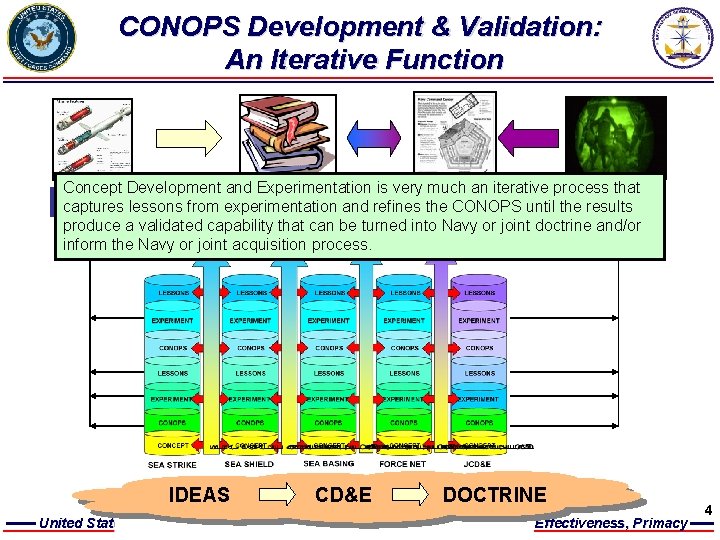
CONOPS Development & Validation: An Iterative Function Concept Development and Experimentation is very much an iterative process that DOCTRINE JOINT NCDP lessons from. NAVY captures experimentation and refines the CONOPS until the JCIDS results produce a validated capability that can be turned. DOCTRINE into Navy or joint doctrine and/or inform the Navy or joint acquisition process. IDEAS United States Fleet Forces CD&E DOCTRINE Operational Readiness, Effectiveness, Primacy 4
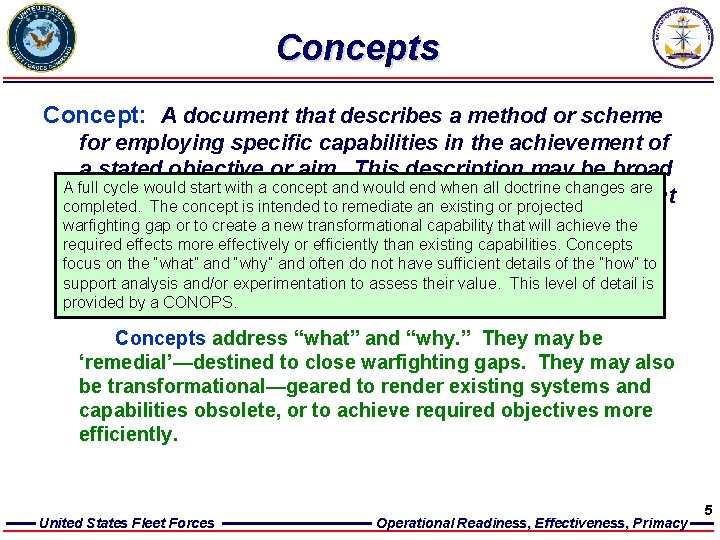
Concepts Concept: A document that describes a method or scheme for employing specific capabilities in the achievement of a stated objective or aim. This description may be broad A full cycle would start with a concept and would end when all doctrine changes are or narrow. It may range from describing the employment completed. The concept is intended to remediate an existing or projected of capabilities in the terms andthat at will theachieve highest warfighting gap or to create a newbroadest transformational capability the required effects more effectivelythe or efficiently than existing Concepts levels to specifying employment ofcapabilities. a particular focus on the “what” and “why” and often do not have sufficient details of the “how” to technology system or the to application of a. This particular support analysis and/or experimentation assess their value. level of detail is provided by a CONOPS. training system. Concepts address “what” and “why. ” They may be ‘remedial’—destined to close warfighting gaps. They may also be transformational—geared to render existing systems and capabilities obsolete, or to achieve required objectives more efficiently. United States Fleet Forces Operational Readiness, Effectiveness, Primacy 5
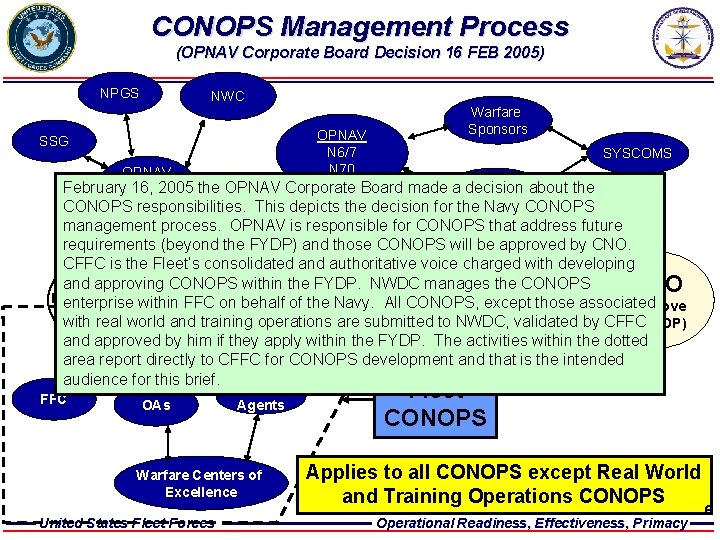
CONOPS Management Process (OPNAV Corporate Board Decision 16 FEB 2005) NPGS NWC OPNAV N 6/7 N 70 SSG Warfare Sponsors SYSCOMS OPNAV Platform about the February 16, N 3/52005 the OPNAV Corporate Board made a decision Sponsors CONOPS N 81 responsibilities. This depicts the decision for the Navy CONOPS management process. OPNAV is responsible for CONOPS that address future requirements (beyond the FYDP) and those CONOPS will be approved by CNO. CFFC is the Fleet’s consolidated and authoritative voice charged with developing CFFC NWDC and approving CONOPS within Validate the FYDP. NWDC manages the CONOPS CNO Develop and Coordinate OPNAV N 3/N 5 enterprise within FFC on behalf of the Navy. All CONOPS, except those associated Approve CONOPS Staff Review and Approve (< FYDP) with real world and training operations are submitted to NWDC, validated by CFFC (> FYDP) Maintain Database Recommendation and approved by him if they apply within the FYDP. The activities within the dotted area report directly to CFFC for CONOPS development and that is the intended audience for this brief. FFC OAs Platform Agents Warfare Centers of Excellence United States Fleet Forces Fleet CONOPS Applies to all CONOPS except Real World and Training Operations CONOPS Operational Readiness, Effectiveness, Primacy 6
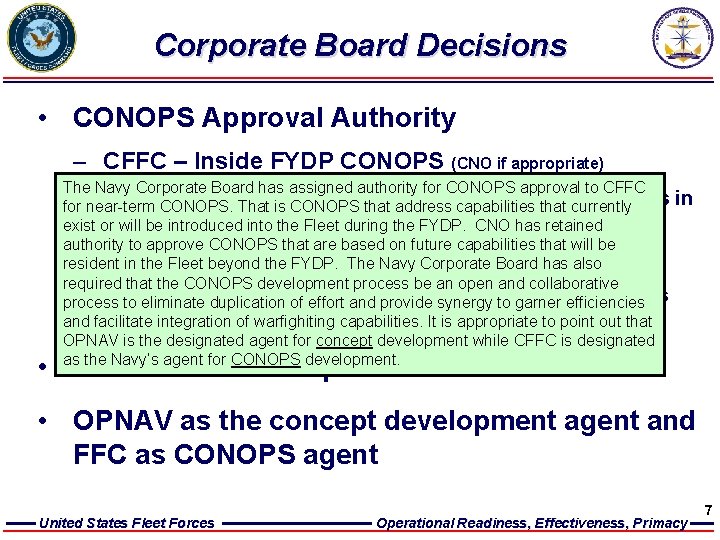
Corporate Board Decisions • CONOPS Approval Authority – CFFC – Inside FYDP CONOPS (CNO if appropriate) The Navy Corporate Board has assigned authority for CONOPS approval to CFFC ü Near-Term Operating CONOPS that address for near-term CONOPS. That is CONOPS that address capabilities thatcapabilities currently fleet today or Fleet that during will IOC within. CNO thehas FYDP exist or willthe be introduced into the FYDP. retained authority to approve CONOPS that are based on future capabilities that will be – CNO Outside CONOPS resident in the– Fleet beyond the. FYDP. The Navy Corporate Board has also required that the CONOPS development process be an open and collaborative üto Far-Term CONOPS that describe new/future process eliminate duplication of effort and provide synergy to garnercapabilities efficiencies beyond theof FYDP and facilitate integration warfighiting capabilities. It is appropriate to point out that OPNAV is the designated agent for concept development while CFFC is designated as the Navy’s agent for CONOPS development. in • Process must be open and collaborative • OPNAV as the concept development agent and FFC as CONOPS agent United States Fleet Forces Operational Readiness, Effectiveness, Primacy 7
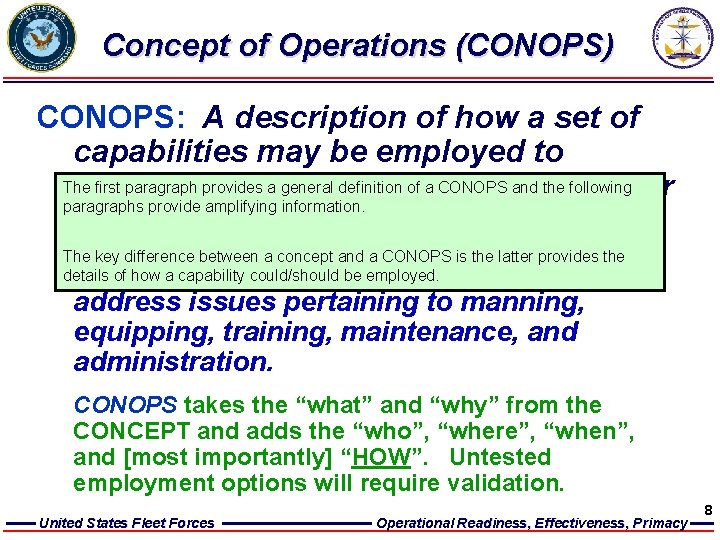
Concept of Operations (CONOPS) CONOPS: A description of how a set of capabilities may be employed to The first paragraph desired provides a general definition of a CONOPS and the following achieve objectives or particular paragraphs provide amplifying information. end state for a specific scenario The key difference between a concept and a CONOPS is the latter provides the details of how a capability could/should be employed. A CONOPS can, and may be expected to, address issues pertaining to manning, equipping, training, maintenance, and administration. CONOPS takes the “what” and “why” from the CONCEPT and adds the “who”, “where”, “when”, and [most importantly] “HOW”. Untested employment options will require validation. United States Fleet Forces Operational Readiness, Effectiveness, Primacy 8
What is a Fleet CONOPS? Fleet Concept of Operations (CONOPS) should be innovative about employmenthow optionsthe based on changing ACONOPS written document specifying Fleet will operating and fiscal environments, while retaining proven past employment options employ current or capabilities that will IOC that remain valid in thecapabilities changing environment. New/revised employment options where the Fleet has sufficient knowledge andand experience to be comfortable that thethe within the FYDP to effectively efficiently perform employment will work as stated, will not require validation, and doctrine will be missions assigned by thechanges. COCOM to theofnaval forces. revised to document the employment Employment capabilities not in the Fleet today and new thatby have not been tested, may require validation. Fleet CONOPS areoptions used warfighting operators and CONOPS are living documents that will be revised when new capabilities are added planners, andwhen inform programs record of the to future FYDPs, validation results requireof a change, or when Fleet’s operators determine new and improved ways to employ the capabilities. intent and needs. United States Fleet Forces Operational Readiness, Effectiveness, Primacy 9
Target Audience • Fleet Warfighting CONOPS – Those that will employ/operate the capability (conduct The target audience for CONOPS may be large and diverse. It reaches from a the mission) ship/aircraft crew to those who make the final decision on whether the capability will be employed. It informs those in supported and supporting roles, from manning and – Those that supportwiththe capability training providers to integration other systems and forces (joint / coalition). The focus of a Fleet warfighting CONOPS must be on those listed in the first bullet. – audience Thosefor that will integrate their capabilities withisthe The a Platform CONOPS (those assigned to the TYCOMs) the same as above but with focus on bullets 2 and 5. capability in the CONOPS – Decision makers/planners within the capability chain-ofcommand – Those who are responsible for the delivery of the capability to the Fleet or may work on enhancements United States Fleet Forces Operational Readiness, Effectiveness, Primacy 10
Specific Current Tasks - NWDC • “THIS MESSAGE AMPLIFIES REF A [COMFLTFORCOM 201424 Z AUG 04] BY ESTABLISHING NWDC AN NAVY-WIDE CONOPS COORDINATOR. ITS PROVISIONS ARE APPLICABLE TO ALL NAVY COMMANDS AND AGENCIES THAT DRAFT, REVIEW, APPROVE, AND USE CONOPSS TO INFORM THE OPNAV DECISIONMAKING PROCESSES OR DOCTRINE DEVELOPMENT. ” This COMMAND slide and the. CURRENTLY following two MAINTAINING slides list the specific tasking for the Navy Warfare • “ANY OR PRODUCING A CONOPS Development. OTHER Command (NWDC) from CNO, CFFCOF and. MILITARY FFC DCOM. NWDC is WILL DOCUMENT, THAN IN DIRECT SUPPORT OPERATIONS INFORM NWDC OF THEIRCONOPS EFFORTS. . . : tasked as the Navy-wide coordinator and leader of the CONOPS – experimentation – doctrine enterprise. This tasking NWDC’s • “NWDC WILL MAINTAIN A CURRENT STATUS OFrecognizes ALL CONOPS AND POST participation and visibility in the NWDC concept. WILL development and experimentation efforts of APPROVED/DRAFT CONOPS. COORDINATE FLEET INPUTS/REVIEWS WITH APPROPRIATE AND FLEET/TYCOMS FOR FLTFORCOM. JFCOM and the other. FLEET services as a. NUMBERED unique resource for Navy CONOPS NWDC MAY ALSO INCLUDE OTHER SERVICE, COMBINED, development. is tasked to look across the. JOINT, breadth depth of. INTER-AGENCY, CONOPS AND INDUSTRYNWDC CONOPS IN THEIR REPOSITORY WHENand SUCH PRODUCTS WOULD in development to deliver new Fleet capabilities. NWDC will perform the integration SUPPORT RELATED NAVY EFFORTS. ” role across ALL CONOPS. • “NWDC WILL HOST THE NAVY CONOPS REPOSITORY IN THE SEA TRIAL INFORMATION MANAGEMENT SYSTEM (STIMS) DATABASE (HTTP: /WWW. NWDC. NAVY. SMIL. MIL/STIMS/SEARCH/CONOPS DOCUMENTS. ASP). ” • “NWDC IN COORDINATION WITH FLTFORCOM AND OPNAV WILL RELEASE ADDITIONAL CONOPS GUIDANCE ARTICULATING THE APPROVAL PROCESS AND AUTHORITY, FORMAT, AND STANDARDIZED DEFINITIONS TO SUPPORT ENTERPRISE-WIDE MANAGEMENT. ” CNO 151950 Z OCT 04 United States Fleet Forces Operational Readiness, Effectiveness, Primacy 11
Specific Current Tasks - NWDC • “NWDC, as leader of the CONOPS-experimentationdoctrine enterprise, is uniquely positioned to capitalize upon related Service and joint efforts, experimentation results, and lessons learned. NWDC manages Fleet CONOPS generation for CFFC, who approves CONOPS for execution in the FYDP and recommends approval to CNO for those beyond the FYDP. ” • “NWDC: In shepherding these initiatives, ensure that the …. CONOPS leverage, and are aligned with existing work, and that their content reflects the cognitive breadth and depth required to deliver new Fleet capabilities. ” CFFC 171946 Z MAR 05 United States Fleet Forces Operational Readiness, Effectiveness, Primacy 12
Specific Current Tasks - NWDC (CONOPS vs Concepts) “Recommend you [NWDC] split the OPNAV liaison function into two separate functions -- CONOPS and concepts. You have Fleet lead for both, but I want to emphasize the difference between Concepts and CONOPS. For concepts (typically beyond the FYDP), OPNAV should have lead and should engage the Fleet enterprise through NWDC. For a CONOPS within the FYDP, Fleet should lead and leverage OPNAV through NWDC” “It is also worth reiterating that the PAs have considerable expertise to bring to the table (both for platform-centric matters but also in warfare) and I would expect it to be a rare CONOPS that arrives at FFC without clear PA involvement. ” VADM Cosgriff email to RADM Kelly 7 Dec 2005 United States Fleet Forces Operational Readiness, Effectiveness, Primacy 13
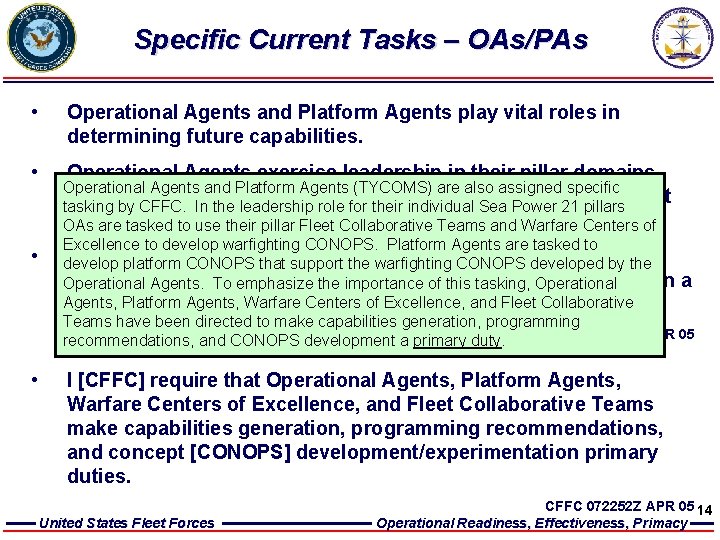
Specific Current Tasks – OAs/PAs • Operational Agents and Platform Agents play vital roles in determining future capabilities. • Operational Agents exercise leadership in their pillar domains Operational Agents and Platform Agents (TYCOMS) are also assigned specific and will develop fleet warfighting CONOPS using affiliated Fleet tasking by CFFC. In the leadership role for their individual Sea Power 21 pillars Collaborative Teams. OAs are tasked to use their pillar Fleet Collaborative Teams and Warfare Centers of • • Excellence to develop warfighting CONOPS. Platform Agents are tasked to Platform Agents are that best ablethe to warfighting address CONOPS platform and system develop platform CONOPS support developed by the capabilities and. Tocan expectthetoimportance produceofplatform Operational Agents. emphasize this tasking, CONOPS Operationalwithin a Agents, Platform. CONOPS Agents, Warfare Centers ofby Excellence, warfighting developed an OA. and Fleet Collaborative Teams have been directed to make capabilities generation, programming CFFC 171946 Z MAR 05 recommendations, and CONOPS development a primary duty. I [CFFC] require that Operational Agents, Platform Agents, Warfare Centers of Excellence, and Fleet Collaborative Teams make capabilities generation, programming recommendations, and concept [CONOPS] development/experimentation primary duties. United States Fleet Forces CFFC 072252 Z APR 05 14 Operational Readiness, Effectiveness, Primacy
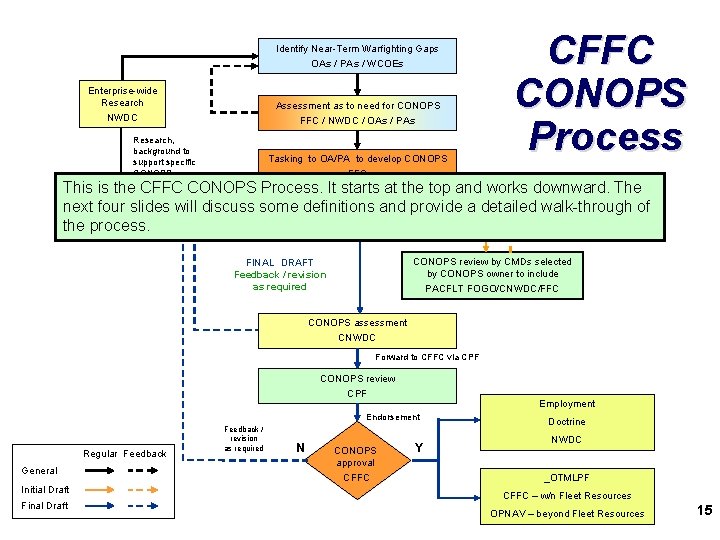
Identify Near-Term Warfighting Gaps OAs / PAs / WCOEs Enterprise-wide Research Assessment as to need for CONOPS FFC / NWDC / OAs / PAs NWDC Research, background to support specific CONOPS development Tasking to OA/PA to develop CONOPS FFC CONOPS Process This is the CFFC CONOPS Process. It starts at the top and works downward. The INITIAL DRAFT next four slides will discuss some definitions and provide a detailed walk-through of CONOPS development Feedback / revision as required OAs / PAs the process. CONOPS review by CMDs selected by CONOPS owner to include FINAL DRAFT Feedback / revision as required PACFLT FOGO/CNWDC/FFC CONOPS assessment CNWDC Forward to CFFC via CPF CONOPS review CPF Employment Endorsement Regular Feedback General Initial Draft Final Draft Feedback / revision as required N CONOPS approval CFFC Y Doctrine NWDC _OTMLPF CFFC – w/n Fleet Resources OPNAV – beyond Fleet Resources 15
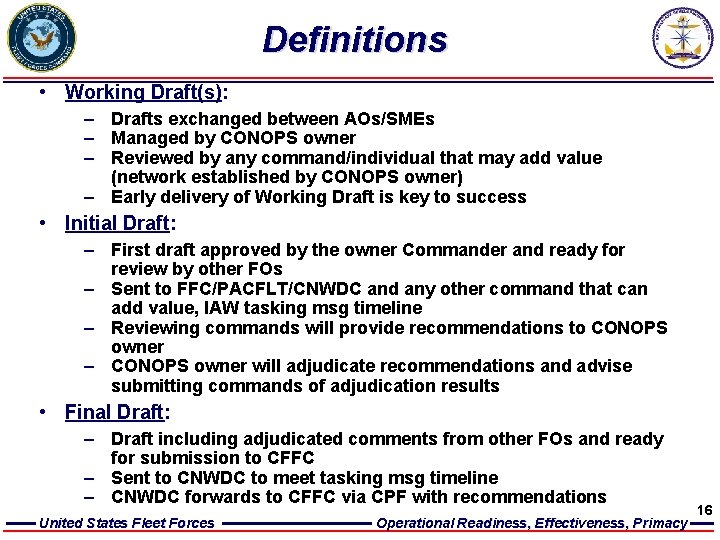
Definitions • Working Draft(s): – Drafts exchanged between AOs/SMEs – Managed by CONOPS owner – Reviewed by any command/individual that may add value (network established by CONOPS owner) – Early delivery of Working Draft is key to success • Initial Draft: – First draft approved by the owner Commander and ready for review by other FOs – Sent to FFC/PACFLT/CNWDC and any other command that can add value, IAW tasking msg timeline – Reviewing commands will provide recommendations to CONOPS owner – CONOPS owner will adjudicate recommendations and advise submitting commands of adjudication results • Final Draft: – Draft including adjudicated comments from other FOs and ready for submission to CFFC – Sent to CNWDC to meet tasking msg timeline – CNWDC forwards to CFFC via CPF with recommendations United States Fleet Forces Operational Readiness, Effectiveness, Primacy 16
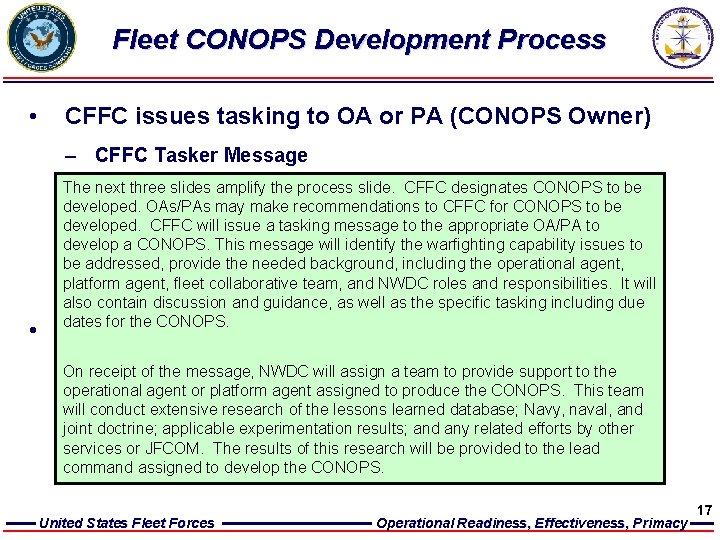
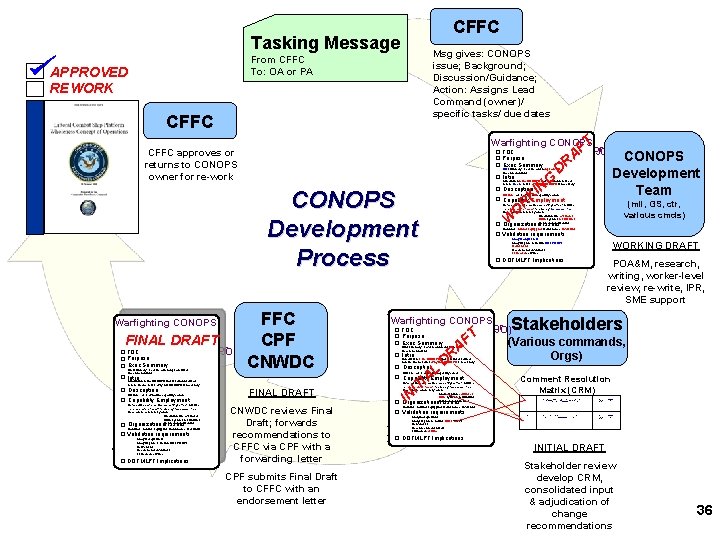
Fleet CONOPS Development Process • CFFC issues tasking to OA or PA (CONOPS Owner) – CFFC Tasker Message • three Issue The next slides amplify the process slide. CFFC designates CONOPS to be developed. OAs/PAs may make recommendations to CFFC for CONOPS to be • Background - OA/PA/FCT/NWDC broad developed. CFFC will issue a tasking message to the appropriate OA/PA to roles/responsibilities develop CONOPS. This -message will identify the warfighting capability issues to • a. Discussion Guidance be addressed, provide the needed background, including the operational agent, • agent, Action Assigns team, the Lead Command owner) platform fleet-collaborative and NWDC roles and(CONOPS responsibilities. It will and specific tasks with due dates also contain discussion and guidance, as well as the specific tasking including due • dates for the CONOPS. NWDC assigns a team to support OA/PA tasked – Provide assistance as requested by CONOPS Owner On receipt of the message, NWDC will assign a team to provide support to the operational agent or platform agent assigned to produce the CONOPS. This team – Assistance may include research subject-related lessons will conduct extensive research of the lessons learned database; Navy, naval, and doctrine, experimentation results andefforts related joint learned, doctrine; applicable experimentation results; and any related by other joint/other services or JFCOM. Services’ The resultswork of this research will be provided to the lead command assigned to develop the CONOPS. United States Fleet Forces Operational Readiness, Effectiveness, Primacy 17
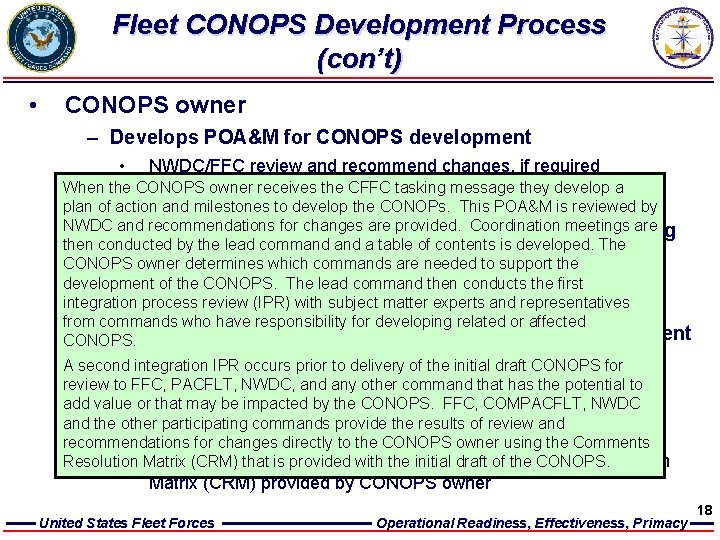
Fleet CONOPS Development Process (con’t) • CONOPS owner – Develops POA&M for CONOPS development • NWDC/FFC review and recommend changes, if required When the CONOPS owner receives the CFFC tasking message they develop a – Determines which commands will support plan of action and milestones to develop the CONOPs. This POA&M is reviewed by NWDC and recommendations for changes are provided. Coordination are – Conducts coordination meeting with SMEs frommeetings supporting then conducted by the lead command a table of contents is developed. The commands as required CONOPS owner determines which commands are needed to support the development of the CONOPS. lead command then conducts the first • Develops Table of. The Contents, Outline, assigns responsibilities to integration process review (IPR) with subject matter experts and representatives supporting commands from commands who have responsibility for developing related or affected – Conducts IPRs as required to manage CONOPS development CONOPS. – Delivers Initial Draftprior to FFC/PACFLT/NWDC other A second integration IPR occurs to delivery of the initial draftand CONOPS for review commands to FFC, PACFLT, NWDC, anyvalue other command that has the potential that mayand add - or be impacted by - theto add value or that may be impacted by the CONOPS. FFC, COMPACFLT, NWDC document and the other participating commands provide the results of review and • Receiving commands and provide recommendations for changes directlyreview/comment to the CONOPS owner using the Comments recommendations to CONOPS owner Resolution Matrix (CRM) that is provided with the initial using draft of. Comment the CONOPS. Matrix (CRM) provided by CONOPS owner United States Fleet Forces Operational Readiness, Effectiveness, Primacy 18
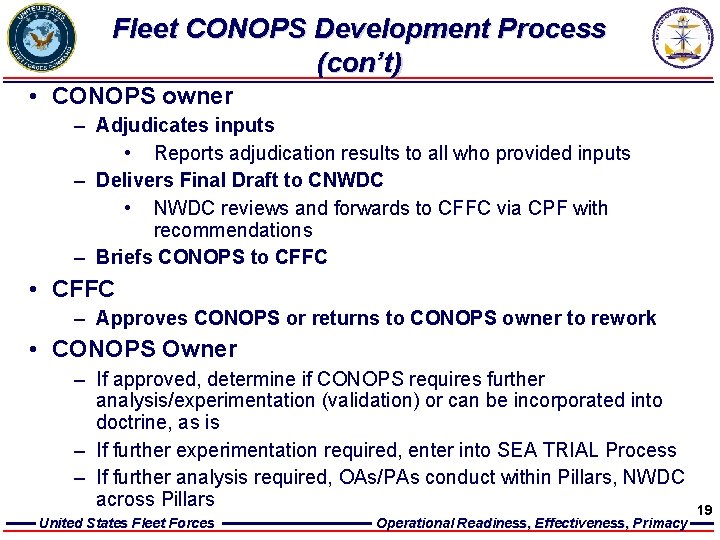
Fleet CONOPS Development Process (con’t) • CONOPS owner – Adjudicates inputs • Reports adjudication results to all who provided inputs – Delivers Final Draft to CNWDC • NWDC reviews and forwards to CFFC via CPF with recommendations – Briefs CONOPS to CFFC • CFFC – Approves CONOPS or returns to CONOPS owner to rework • CONOPS Owner – If approved, determine if CONOPS requires further analysis/experimentation (validation) or can be incorporated into doctrine, as is – If further experimentation required, enter into SEA TRIAL Process – If further analysis required, OAs/PAs conduct within Pillars, NWDC across Pillars United States Fleet Forces Operational Readiness, Effectiveness, Primacy 19
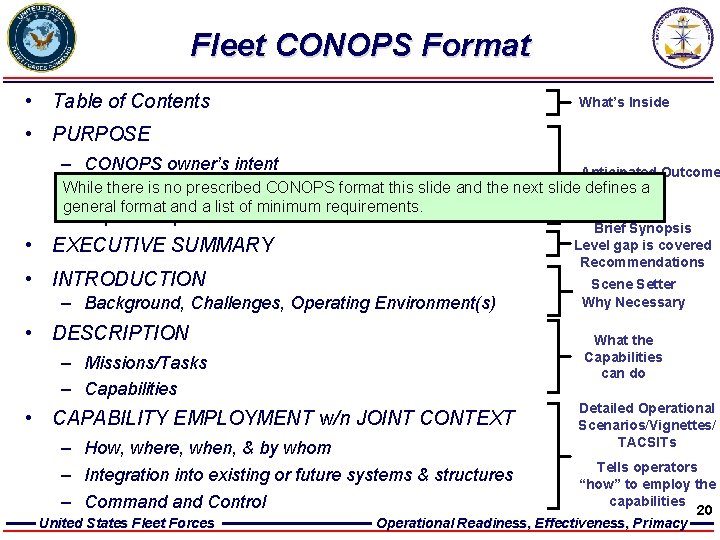
Fleet CONOPS Format • Table of Contents What’s Inside • PURPOSE – CONOPS owner’s intent Anticipated Outcome there is nogaps prescribed CONOPS format this slide and the next slide defines a –While Warfighting addressed general format and a list of minimum requirements. – Expected operational outcomes/end state/results Brief Synopsis Level gap is covered Recommendations • EXECUTIVE SUMMARY • INTRODUCTION – Background, Challenges, Operating Environment(s) • DESCRIPTION What the Capabilities can do – Missions/Tasks – Capabilities • CAPABILITY EMPLOYMENT w/n JOINT CONTEXT – How, where, when, & by whom – Integration into existing or future systems & structures – Command Control United States Fleet Forces Scene Setter Why Necessary Detailed Operational Scenarios/Vignettes/ TACSITs Tells operators “how” to employ the capabilities 20 Operational Readiness, Effectiveness, Primacy
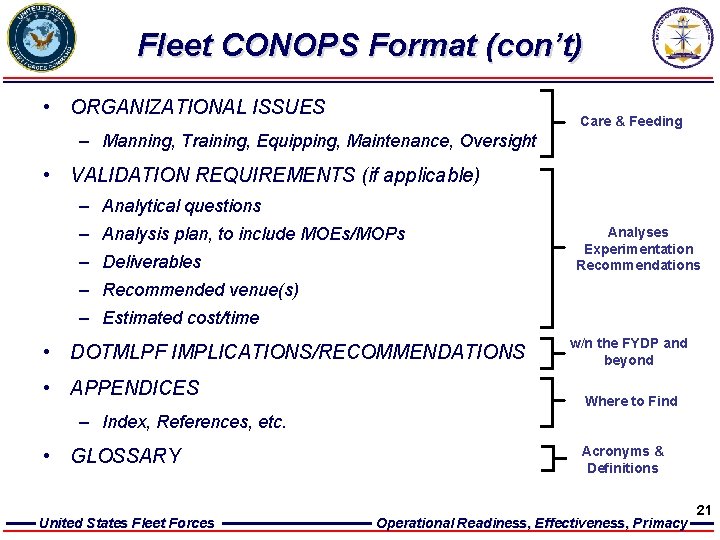
Fleet CONOPS Format (con’t) • ORGANIZATIONAL ISSUES Care & Feeding – Manning, Training, Equipping, Maintenance, Oversight • VALIDATION REQUIREMENTS (if applicable) – Analytical questions – Analysis plan, to include MOEs/MOPs – Deliverables Analyses Experimentation Recommendations – Recommended venue(s) – Estimated cost/time • DOTMLPF IMPLICATIONS/RECOMMENDATIONS • APPENDICES w/n the FYDP and beyond Where to Find – Index, References, etc. • GLOSSARY United States Fleet Forces Acronyms & Definitions Operational Readiness, Effectiveness, Primacy 21
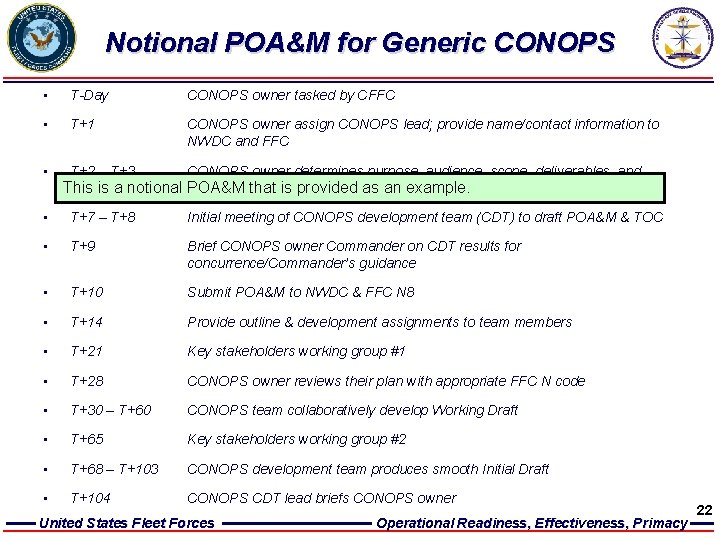
Notional POA&M for Generic CONOPS • T-Day CONOPS owner tasked by CFFC • T+1 CONOPS owner assign CONOPS lead; provide name/contact information to NWDC and FFC • T+2 – T+3 CONOPS owner determines purpose, audience, scope, deliverables, and commands This is a notional participating POA&M that is provided as an example. • T+7 – T+8 Initial meeting of CONOPS development team (CDT) to draft POA&M & TOC • T+9 Brief CONOPS owner Commander on CDT results for concurrence/Commander’s guidance • T+10 Submit POA&M to NWDC & FFC N 8 • T+14 Provide outline & development assignments to team members • T+21 Key stakeholders working group #1 • T+28 CONOPS owner reviews their plan with appropriate FFC N code • T+30 – T+60 CONOPS team collaboratively develop Working Draft • T+65 Key stakeholders working group #2 • T+68 – T+103 CONOPS development team produces smooth Initial Draft • T+104 CONOPS CDT lead briefs CONOPS owner United States Fleet Forces Operational Readiness, Effectiveness, Primacy 22
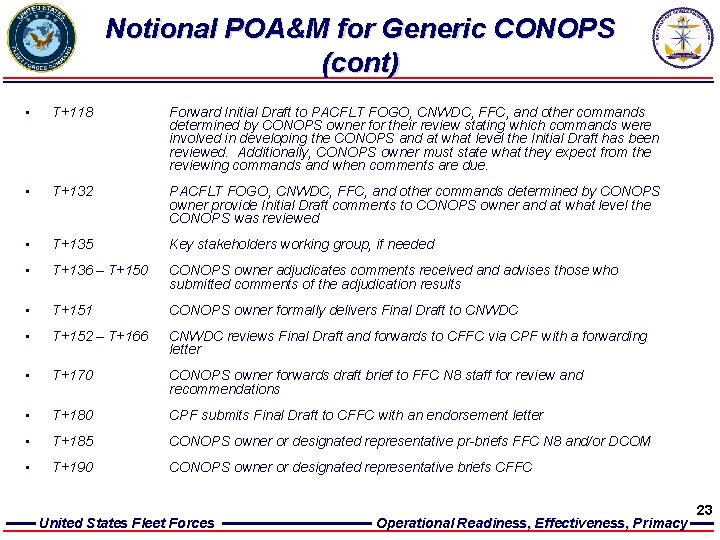
Notional POA&M for Generic CONOPS (cont) • T+118 Forward Initial Draft to PACFLT FOGO, CNWDC, FFC, and other commands determined by CONOPS owner for their review stating which commands were involved in developing the CONOPS and at what level the Initial Draft has been reviewed. Additionally, CONOPS owner must state what they expect from the reviewing commands and when comments are due. • T+132 PACFLT FOGO, CNWDC, FFC, and other commands determined by CONOPS owner provide Initial Draft comments to CONOPS owner and at what level the CONOPS was reviewed • T+135 Key stakeholders working group, if needed • T+136 – T+150 CONOPS owner adjudicates comments received and advises those who submitted comments of the adjudication results • T+151 CONOPS owner formally delivers Final Draft to CNWDC • T+152 – T+166 CNWDC reviews Final Draft and forwards to CFFC via CPF with a forwarding letter • T+170 CONOPS owner forwards draft brief to FFC N 8 staff for review and recommendations • T+180 CPF submits Final Draft to CFFC with an endorsement letter • T+185 CONOPS owner or designated representative pr-briefs FFC N 8 and/or DCOM • T+190 CONOPS owner or designated representative briefs CFFC United States Fleet Forces Operational Readiness, Effectiveness, Primacy 23
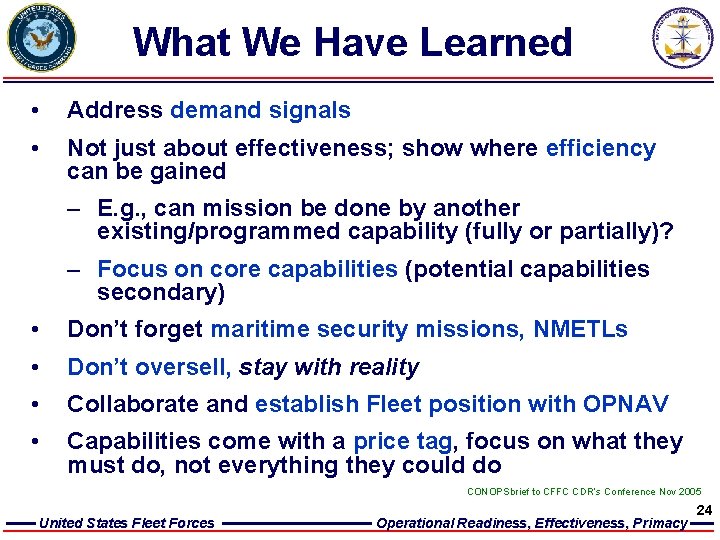
What We Have Learned • Address demand signals • Not just about effectiveness; show where efficiency can be gained – E. g. , can mission be done by another existing/programmed capability (fully or partially)? – Focus on core capabilities (potential capabilities secondary) • Don’t forget maritime security missions, NMETLs • Don’t oversell, stay with reality • Collaborate and establish Fleet position with OPNAV • Capabilities come with a price tag, focus on what they must do, not everything they could do CONOPSbrief to CFFC CDR’s Conference Nov 2005 United States Fleet Forces Operational Readiness, Effectiveness, Primacy 24
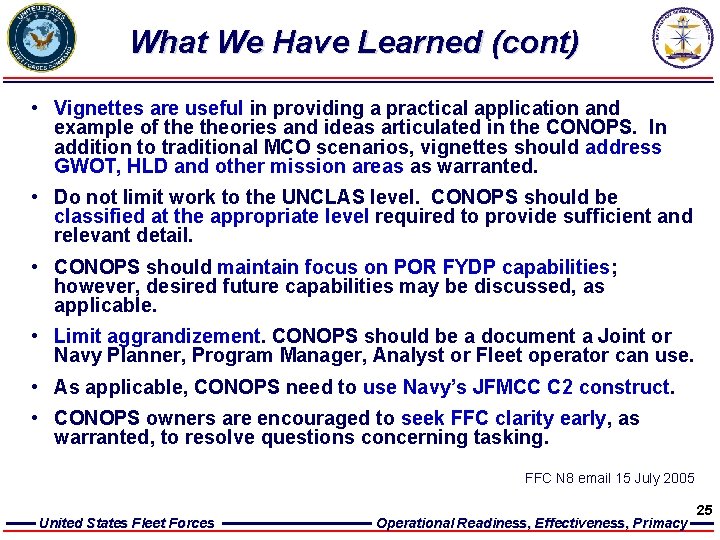
What We Have Learned (cont) • Vignettes are useful in providing a practical application and example of theories and ideas articulated in the CONOPS. In addition to traditional MCO scenarios, vignettes should address GWOT, HLD and other mission areas as warranted. • Do not limit work to the UNCLAS level. CONOPS should be classified at the appropriate level required to provide sufficient and relevant detail. • CONOPS should maintain focus on POR FYDP capabilities; however, desired future capabilities may be discussed, as applicable. • Limit aggrandizement. CONOPS should be a document a Joint or Navy Planner, Program Manager, Analyst or Fleet operator can use. • As applicable, CONOPS need to use Navy’s JFMCC C 2 construct. • CONOPS owners are encouraged to seek FFC clarity early, as warranted, to resolve questions concerning tasking. FFC N 8 email 15 July 2005 United States Fleet Forces Operational Readiness, Effectiveness, Primacy 25
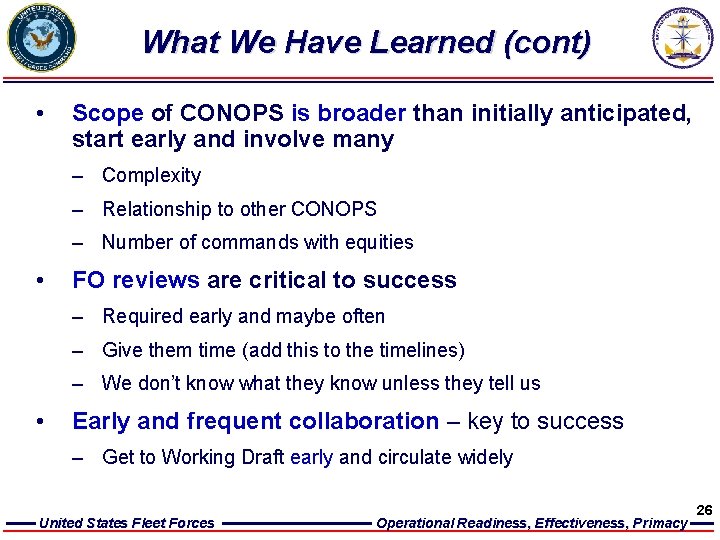
What We Have Learned (cont) • Scope of CONOPS is broader than initially anticipated, start early and involve many – Complexity – Relationship to other CONOPS – Number of commands with equities • FO reviews are critical to success – Required early and maybe often – Give them time (add this to the timelines) – We don’t know what they know unless they tell us • Early and frequent collaboration – key to success – Get to Working Draft early and circulate widely United States Fleet Forces Operational Readiness, Effectiveness, Primacy 26
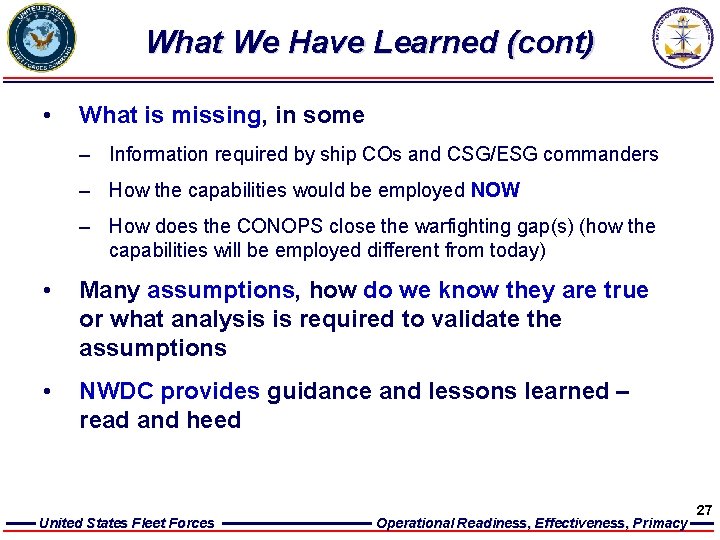
What We Have Learned (cont) • What is missing, in some – Information required by ship COs and CSG/ESG commanders – How the capabilities would be employed NOW – How does the CONOPS close the warfighting gap(s) (how the capabilities will be employed different from today) • Many assumptions, how do we know they are true or what analysis is required to validate the assumptions • NWDC provides guidance and lessons learned – read and heed United States Fleet Forces Operational Readiness, Effectiveness, Primacy 27
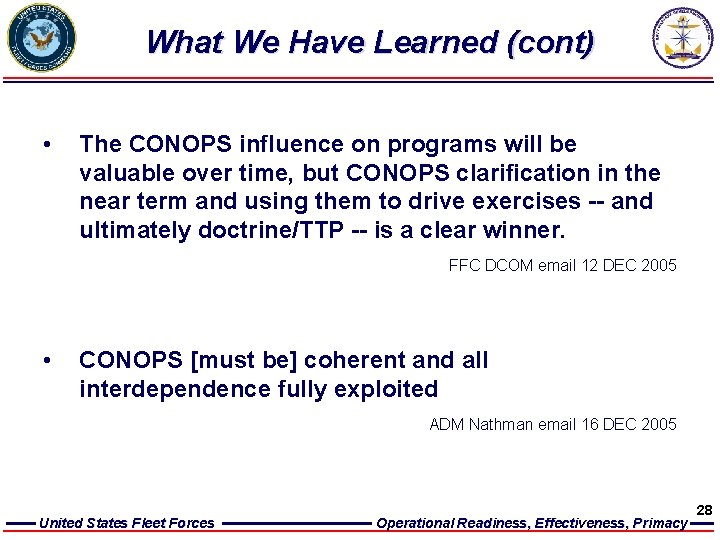
What We Have Learned (cont) • The CONOPS influence on programs will be valuable over time, but CONOPS clarification in the near term and using them to drive exercises -- and ultimately doctrine/TTP -- is a clear winner. FFC DCOM email 12 DEC 2005 • CONOPS [must be] coherent and all interdependence fully exploited ADM Nathman email 16 DEC 2005 United States Fleet Forces Operational Readiness, Effectiveness, Primacy 28
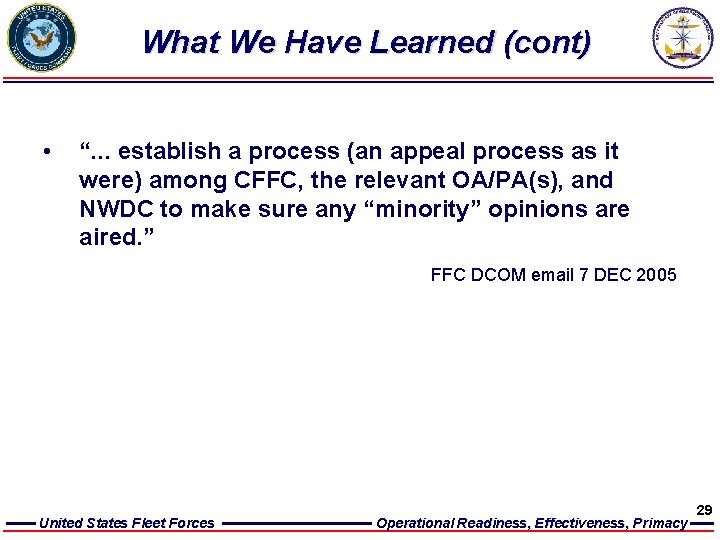
What We Have Learned (cont) • “. . . establish a process (an appeal process as it were) among CFFC, the relevant OA/PA(s), and NWDC to make sure any “minority” opinions are aired. ” FFC DCOM email 7 DEC 2005 United States Fleet Forces Operational Readiness, Effectiveness, Primacy 29
What We Have Learned (cont) Admirals, The purpose of this email is to pass on some general observations about ongoing CONOPs development efforts, to ensure we continue to produce the product ADM Nathman has directed. Key points/issues follow: • FFC directed CONOPs need to focus on “how” to employ capabilities we have today, or will have in quantity during the FYDP, much more than on future capabilities/platforms. Future capabilities should be captured in Concepts/Vision Statements--not FFC's lane. Often, this means the CONOP we write today will only be able to discuss a very limited initial capability--that's the key--to focus only on that limited capability and how we will really use it, vice how we might use the full capability in the future. We have seen good examples of this near term focus contained in portions of the SSGN, GWOT OFFENSIVE, LCS PLATFORM WHOLENESS, and SSBN ESCORT CONOPs. Some are blends--GLOBAL ASW is a good example, of things we can do today, and other areas where we really have very limited/no capability now or delivering in real numbers in the FYDP. • The primary audience for these CONOPs will be fleet operators. If the CONOP doesn't plainly tell them how to do business today, it is missing the mark. Additionally, these CONOPs will be a key resource for Navy/naval/joint planners to help them make the right employment decisions for these systems, and or capabilities. So, the CONOP should be as close to doctrinal in nature as possible--clear, "plain speak" guidance. In a number of areas, doctrine will already exist that covers most of what we can do. Our CONOPs should capture that briefly, and then add what we expect will be real in the FYDP. Continued on next slide United States Fleet Forces FFC DCOM email 22 April 2006 Operational Readiness, Effectiveness, Primacy 30
What We Have Learned (cont) • All platforms/systems/capabilities have some degree of risk/vulnerability, and some areas where they don't work very well. Talking about what we can't do, again in a straightforward manner, is just as important as talking about what we can. So, in the MARITIME BALLISTIC MISSILE DEFENSE CONOP (for example), we need to spell out the real problem of limited ships and interceptors today (and through the FYDP), and then do the hard thinking on how we can maximize the benefit from these limited assets, vice talking in overly broad terms about what we hope the future will enable us to accomplish with a much larger force. Better to do this hard thinking now, than have our folks on point trying to figure out how best to apply what we have in hand. • Many of the CONOPS we are seeing are too long--the important messages are buried under several pages of "front piece". Again, read your entries like you are headed to a fight, and looking for key info to help you win that fight. We need these pubs to hang together, but too many devote too much space to unneeded grand vision, hiding the real kernels of wisdom. • If the CONOP owner believes additional analysis/validation of capabilities is required before a portion of the guidance in the CONOP becomes doctrine, that should be stated clearly. That way, our folks will know these are our best thoughts, but can use them with the proper caution. I fully appreciate the magnitude of the effort being expended by you and your staffs to make these things work--we are making real progress. This email is intended to help keep us focused. Where it applies, take FORAC and let's continue to improve this important process. FFC DCOM email 22 April 2006 United States Fleet Forces Operational Readiness, Effectiveness, Primacy 31
What We Have Learned (cont) “. . . getting input directly from the forward operational commanders is critical to building a fleet-wide body of work that is relevant to today's challenges and informative of tomorrow's capabilities. . collaboration under the leadership of the respective Operational and/or Platform Agents (with the essential central -- and expanding -- role of NWDC) is key to tapping the broadest range of warfighting expertise in this effort. ” FFC DCOM email 11 August 2006 United States Fleet Forces Operational Readiness, Effectiveness, Primacy 32
Briefing Guidance (most important) • CFFC expects a CONOPS brief to articulate how the capabilities should be employed and not be an “ADMIN”, “bibliography” or “process” brief (i. e. don’t explain how to build an engine, but show him how use the engine). • Include a C 2 slide upfront to show your CONOPS will be executed. • Briefing the vignette(s) may be the best way to show capability employment and the “how” of the CONOPS. The vignettes can describe both peacetime (presence deployment) and/or wartime or MCO employment. • The brief should be pithy. Move slides with more detail to back-up. • Then, a pre-brief with FFC N 8 and/or DCOM is invaluable. They are in a position to identify hot spots and pitfalls. Approved by FFC DCOM 7 AUG 2006 United States Fleet Forces Operational Readiness, Effectiveness, Primacy 33
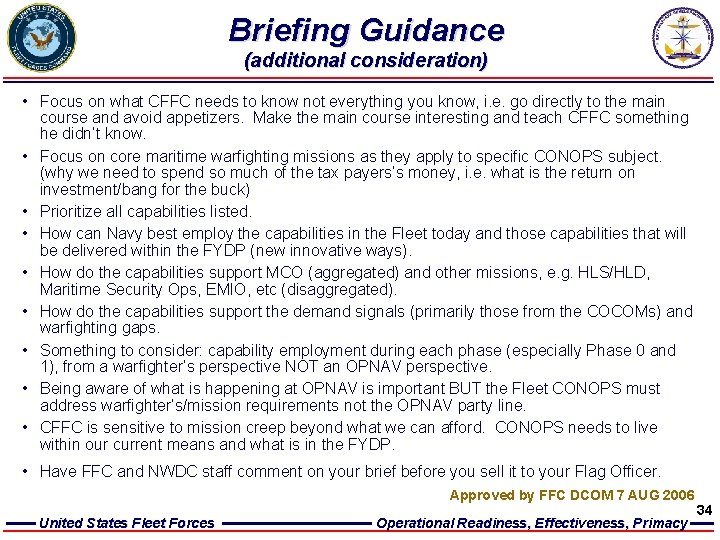
Briefing Guidance (additional consideration) • Focus on what CFFC needs to know not everything you know, i. e. go directly to the main course and avoid appetizers. Make the main course interesting and teach CFFC something he didn’t know. • Focus on core maritime warfighting missions as they apply to specific CONOPS subject. (why we need to spend so much of the tax payers’s money, i. e. what is the return on investment/bang for the buck) • Prioritize all capabilities listed. • How can Navy best employ the capabilities in the Fleet today and those capabilities that will be delivered within the FYDP (new innovative ways). • How do the capabilities support MCO (aggregated) and other missions, e. g. HLS/HLD, Maritime Security Ops, EMIO, etc (disaggregated). • How do the capabilities support the demand signals (primarily those from the COCOMs) and warfighting gaps. • Something to consider: capability employment during each phase (especially Phase 0 and 1), from a warfighter’s perspective NOT an OPNAV perspective. • Being aware of what is happening at OPNAV is important BUT the Fleet CONOPS must address warfighter’s/mission requirements not the OPNAV party line. • CFFC is sensitive to mission creep beyond what we can afford. CONOPS needs to live within our current means and what is in the FYDP. • Have FFC and NWDC staff comment on your brief before you sell it to your Flag Officer. Approved by FFC DCOM 7 AUG 2006 United States Fleet Forces Operational Readiness, Effectiveness, Primacy 34
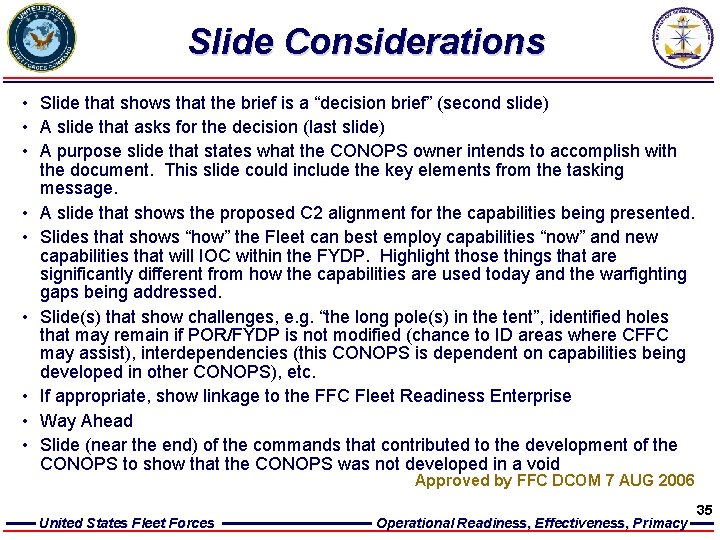
Slide Considerations • Slide that shows that the brief is a “decision brief” (second slide) • A slide that asks for the decision (last slide) • A purpose slide that states what the CONOPS owner intends to accomplish with the document. This slide could include the key elements from the tasking message. • A slide that shows the proposed C 2 alignment for the capabilities being presented. • Slides that shows “how” the Fleet can best employ capabilities “now” and new capabilities that will IOC within the FYDP. Highlight those things that are significantly different from how the capabilities are used today and the warfighting gaps being addressed. • Slide(s) that show challenges, e. g. “the long pole(s) in the tent”, identified holes that may remain if POR/FYDP is not modified (chance to ID areas where CFFC may assist), interdependencies (this CONOPS is dependent on capabilities being developed in other CONOPS), etc. • If appropriate, show linkage to the FFC Fleet Readiness Enterprise • Way Ahead • Slide (near the end) of the commands that contributed to the development of the CONOPS to show that the CONOPS was not developed in a void Approved by FFC DCOM 7 AUG 2006 United States Fleet Forces Operational Readiness, Effectiveness, Primacy 35
CFFC Tasking Message Msg gives: CONOPS issue; Background; Discussion/Guidance; Action: Assigns Lead Command (owner)/ specific tasks/ due dates From CFFC To: OA or PA APPROVED REWORK CFFC JFCOM CONOPS JCD&E T Warfighting Capstone Concept F for q TOC Operations Joint (CCJO) Purpose CFFC approves or returns to CONOPS owner for re-work q q JFCOMDRAFT JCD&E FINAL Capstone Concept for q TOC Operations Joint (CCJO) q q Purpose Exec Summary Brief summary. Level to which gaps are filled. Joint Recommendations Principles Attributes & Introduction to the CONOPS that is being described FFC CPF CNWDC herein. Scene setter, Why this CONOPS is necessary Operating q Joint Description Mission. Tasks. What the capability can do Concepts q Employment q Capability Functional Detailed Operational Scenarios/Vignettes/TACSITs Tells operators “how” to employ the capabilities. How, where, when, & by whom Integration into existing or future systems & structures Command Control Concepts q Organizational Issues Manning, Training, Equipping, Maintenance, Oversight q Validation requirements questions q Full-Analytical Analysis plan, to include MOEs/MOPs Deliverables Spectrum Recommended venue(s) Dominance Estimated cost/time q DOTMLPF Implications IN herein. Scene setter, Why this CONOPS is necessary Operating q Joint Description Mission. Tasks. What the capability can do Concepts q Employment q Capability Functional Detailed Operational Scenarios/Vignettes/TACSITs CONOPS Development Process Warfighting CONOPS G A R D Exec Summary Brief summary. Level to which gaps are filled. Joint Recommendations Principles Attributes & Introduction to the CONOPS that is being described FINAL DRAFT CNWDC reviews Final Draft; forwards recommendations to CFFC via CPF with a forwarding letter CPF submits Final Draft to CFFC with an endorsement letter K R O Concepts W Issues q Organizational CONOPS Development Team (mil, GS, ctr, various cmds) Tells operators “how” to employ the capabilities. How, where, when, & by whom Integration into existing or future systems & structures Command Control Manning, Training, Equipping, Maintenance, Oversight q Validation requirements Analytical questions q Full-Analysis plan, to include MOEs/MOPs Deliverables Spectrum Recommended venue(s) Dominance Estimated cost/time q DOTMLPF Implications WORKING DRAFT POA&M, research, writing, worker-level review, re-write, IPR, SME support JFCOM CONOPS JCD&E Warfighting Capstone Concept for q TOC Operations Joint (CCJO) Purpose q q FT A Exec Summary Brief summary. Level to which gaps are filled. Joint Recommendations Principles & Attributes Introduction to the CONOPS that is being described R D herein. Scene setter, Why this CONOPS is necessary L Operating q Joint Description Mission. Tasks. What the capability can do q Concepts Capability Employment q Functional Detailed Operational Scenarios/Vignettes/TACSITs IA IT Tells operators “how” to employ the capabilities. How, where, when, & by whom Integration into existing or future systems & structures Command Control IN Concepts q Organizational Issues Stakeholders (Various commands, Orgs) Comment Resolution Matrix (CRM) 1 General Comment: Suggest more significant revision still necessary to provide best finalized CONOP. [Latest]Powerpoint brief 10 Mar 06 looks more robust and more comprehensive than white paper CONOPS which is under-done by comparison. Recommended in CONOPS 101. (And as directed by CFFC). 2 Multiple staffing errors exist within a paper that does not seem to fully reflect the powerpoint presentation, nor NWDC CONOPS 101 format or requisite content. Recommended in CONOPS 101. (And as directed by CFFC). Manning, Training, Equipping, Maintenance, Oversight q Validation requirements questions q Full-Analytical Analysis plan, to include MOEs/MOPs Deliverables Spectrum Recommended venue(s) Dominance Estimated cost/time q DOTMLPF Implications INITIAL DRAFT Stakeholder review develop CRM, consolidated input & adjudication of change recommendations 36