
Connectivity Session Overview Welcome Introductions Background Connectivity Considerations
Connectivity
Session Overview • • Welcome & Introductions Background Connectivity Considerations & Recommendations Exemplar Rapid Fire Presentations Brainstorming Activity Broadband/Wireless Capacity Activity Policies & Initiatives Reflection & Wrap-Up
Purpose of the Workshop Provide participants, typically school and district leaders, with the opportunity to gain knowledge and resources to develop and enhance their infrastructure to support digital learning.
Objectives • Learn more about connectivity options for networks, Wi -Fi, and devices from colleagues and experts • Hear from colleagues on best practices for implementation • Collaborate with colleagues on key questions related to connectivity implementation • Acquire resources to support infrastructure planning and implementation • Develop and maintain relationships with other district and state leaders
I’m Here and I’m In Share your name and title and in 1 short sentence why they are attending the meeting Ask participants to say: “I’m here and I’m in”
Overview • Comprehensive infrastructure provides all students and teachers with the resources they need anytime, anywhere • Infrastructure includes broadband connectivity, hardware, software, and administrative tools • Infrastructure also includes people, processes, learning resources, policies, and sustainable models for improvement
Overview • Enables schools to expand learning options • Empowers students to – Create content – Participate in virtual courses – Collaborate with experts or other students remotely
Overview Quick Facts • Cisco predicts that global internet traffic will be over 50, 000 Gbps by 2019, more than triple the current traffic rate. • Education Networks of America (ENA), based on its experience delivering connectivity to over 5, 500 schools and libraries, continues to observe and projects into the future an internet growth rate of 65% per year. • Education. Super. Highway predicts that the typical school district will need to triple its bandwidth in the next three years. • Co. SN’s Infrastructure Survey states that 39% of districts report projected growth in the next 18 months between 50% and 499%.
Attaining Broadband District-Wide
Discussion Questions • Share one thing that is similar about your school/district and the featured video. • How has your state/district worked with business and non-profit partners to increase broadband access and speed? • Do your students lack robust broadband access at home?
Connectivity Considerations 2017 National Education Technology Plan identifies the essential components necessary to support learning • Ubiquitous connectivity • Powerful learning devices • High-quality digital learning content • Responsible Use Policies (RUPs). Building Technology Infrastructure for Learning Guide • Understanding types of available connectivity • Four paths for connecting districts and schools • Cost drivers and funding sources to consider • Special considerations for rural areas
Connectivity Consideration Bandwidth capacity determines which digital instructional materials and educational applications students and educators can effectively leverage in the classroom
Connectivity Implementation of – High-capacity and widely available broadband networks – Utilization of wireless networks
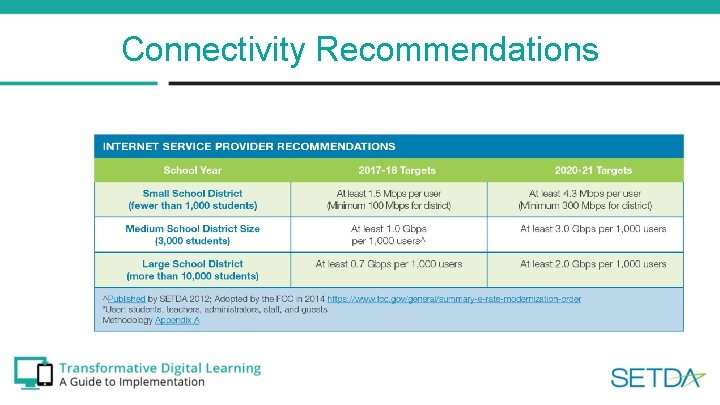
Connectivity Recommendations
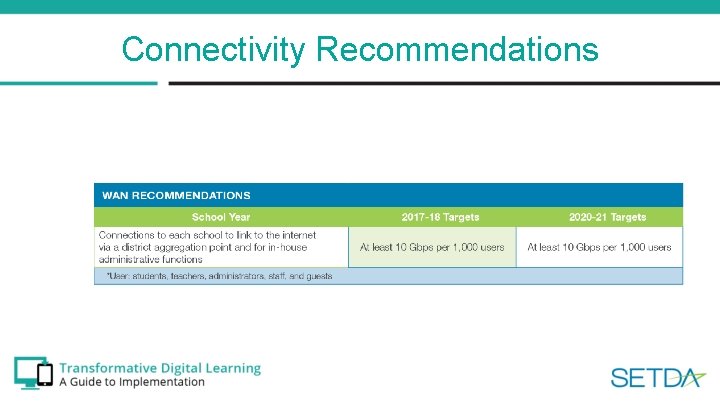
Connectivity Recommendations
Exemplar Rapid Fire Presentations • Add presenter name, district/school Discussion Questions • How is your school/district similar to the exemplar? • Are there practices shared that your school/district can implement right away? • What are some of your challenges?
Brainstorming Activity • What do you think of when you hear the word “connectivity”? • Where does your district/school have wireless hotspots? • What types of devices do your teachers and students use?
Broadband/Wireless Capacity Activity • • How Is your district/school building capacity to support an evolving infrastructure for learning in the digital age? Is the broadband infrastructure sufficient for simultaneous access for most users? How is wireless connectivity supporting connectivity? Is wireless available on campus in all learning spaces? Does your network have adequate security and levels of access? Does your school/district have adequate internet access to fully utilize digital instructional materials and resources (i. e. , speed, reliability)? Do your students and teachers have access to devices at school and outside of school?
Policies & Initiatives • Does your state have policies/guidelines for broadband connectivity? • Are there local policies/practices that can be updated to support equitable connectivity for all learners? • Which stakeholders and influencers need to be involved in the conversations?
Reflection & Wrap-Up Audience Challenge What can you do when you return to your position to help move the marker forward? • Create a calendar appointment to remind yourself • Mail a postcard to yourself • Invite your colleagues to discuss the issues
Wrap Up • Think about what tools and resources you can use to: – Maintain relationships – Encourage collaboration – Identify opportunities for on-going professional learning and workshops.
Thank You! Learn more at: Transforming Digital Learning: Toolkit to Support Educators and Stakeholders
- Slides: 22