
Connectivity of Marine Protected Areas in SouthWestern Indian
- Slides: 15
Connectivity of Marine Protected Areas in South-Western Indian Ocean: Using population genetics of reef fish to contribute to the design of MPAs network - Delphine MUTHS & Jérôme BOURJEA -
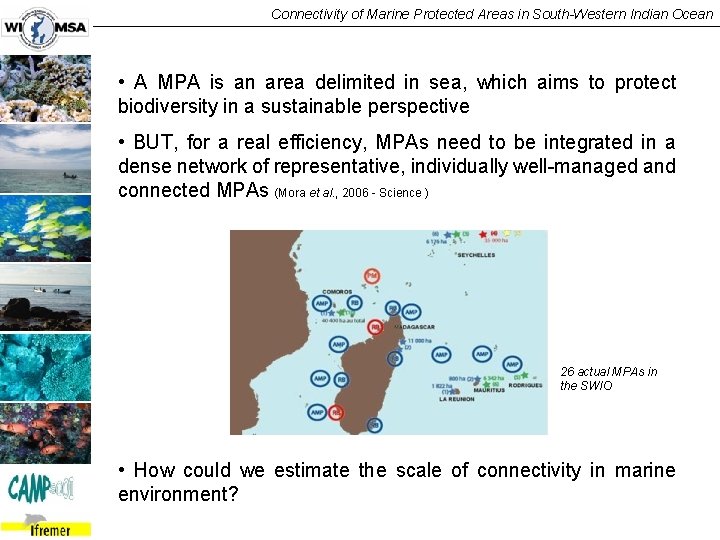
Connectivity of Marine Protected Areas in South-Western Indian Ocean • A MPA is an area delimited in sea, which aims to protect biodiversity in a sustainable perspective • BUT, for a real efficiency, MPAs need to be integrated in a dense network of representative, individually well-managed and connected MPAs (Mora et al. , 2006 - Science ) 26 actual MPAs in the SWIO • How could we estimate the scale of connectivity in marine environment?
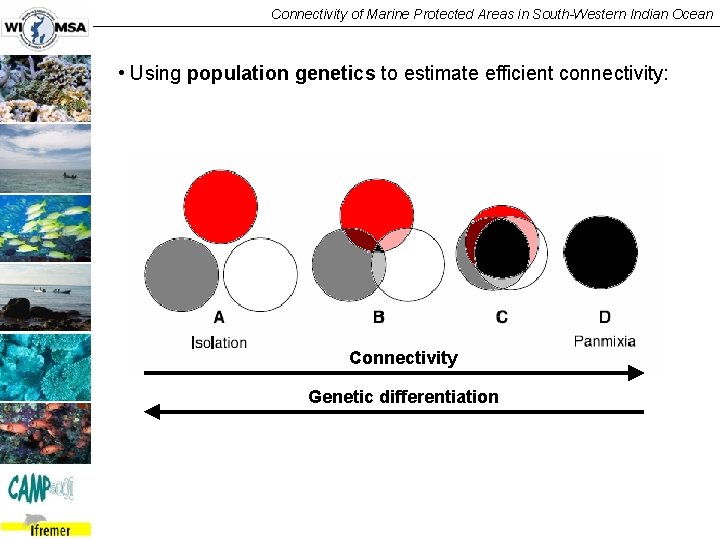
Connectivity of Marine Protected Areas in South-Western Indian Ocean • Using population genetics to estimate efficient connectivity: Connectivity Genetic differentiation
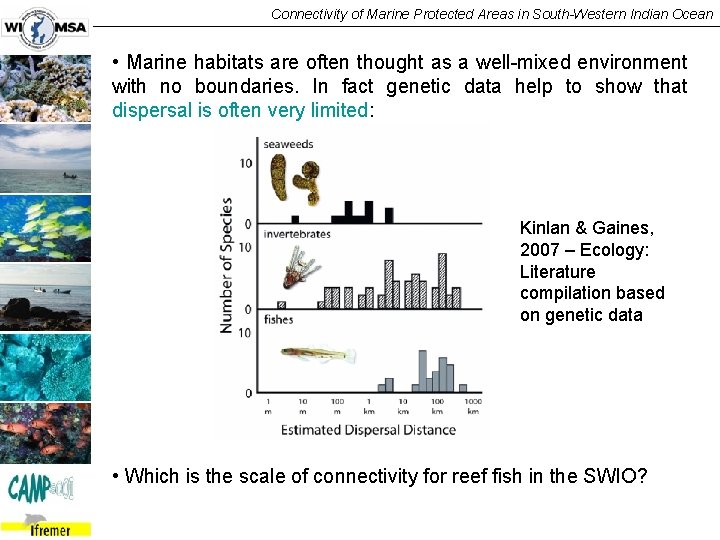
Connectivity of Marine Protected Areas in South-Western Indian Ocean • Marine habitats are often thought as a well-mixed environment with no boundaries. In fact genetic data help to show that dispersal is often very limited: Kinlan & Gaines, 2007 – Ecology: Literature compilation based on genetic data • Which is the scale of connectivity for reef fish in the SWIO?
Connectivity of Marine Protected Areas in South-Western Indian Ocean Strategy of our project CAMP: 1/ Elaborate a regional strategy of sampling and use population genetics methodology 2/ Better understand actual exchanges between populations and help to localize the most isolated areas 3/ Precise colonisation history of the SWIO 4/ Contribute to the design of the most efficient MPAs network in the SWIO
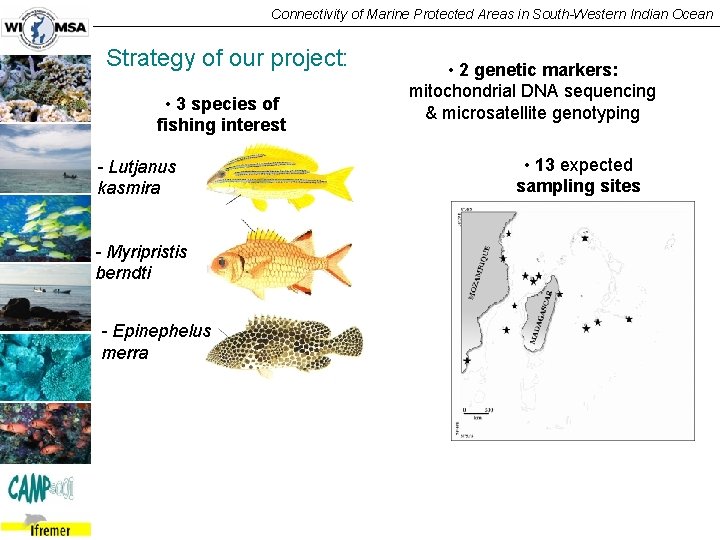
Connectivity of Marine Protected Areas in South-Western Indian Ocean Strategy of our project: • 3 species of fishing interest - Lutjanus kasmira - Myripristis berndti - Epinephelus merra • 2 genetic markers: mitochondrial DNA sequencing & microsatellite genotyping • 13 expected sampling sites
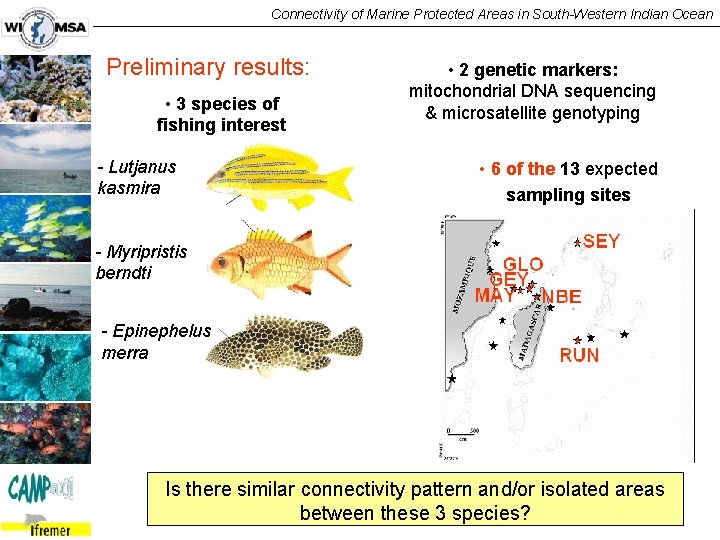
Connectivity of Marine Protected Areas in South-Western Indian Ocean Preliminary results: • 3 species of fishing interest - Lutjanus kasmira • 2 genetic markers: mitochondrial DNA sequencing & microsatellite genotyping 13 13 expected • 6 of • the expected sampling sites - Myripristis berndti - Epinephelus merra Is there similar connectivity pattern and/or isolated areas between these 3 species?
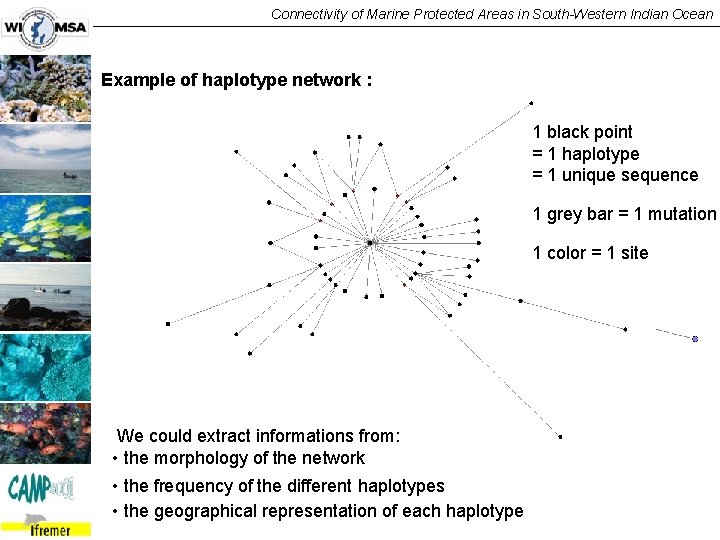
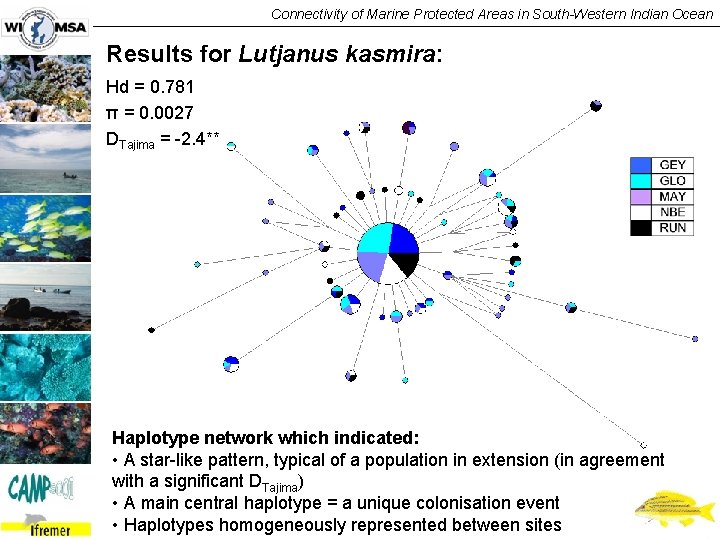
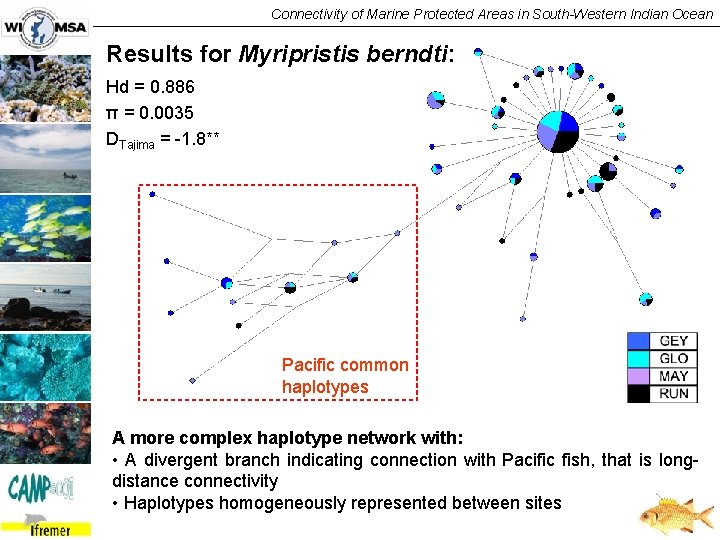
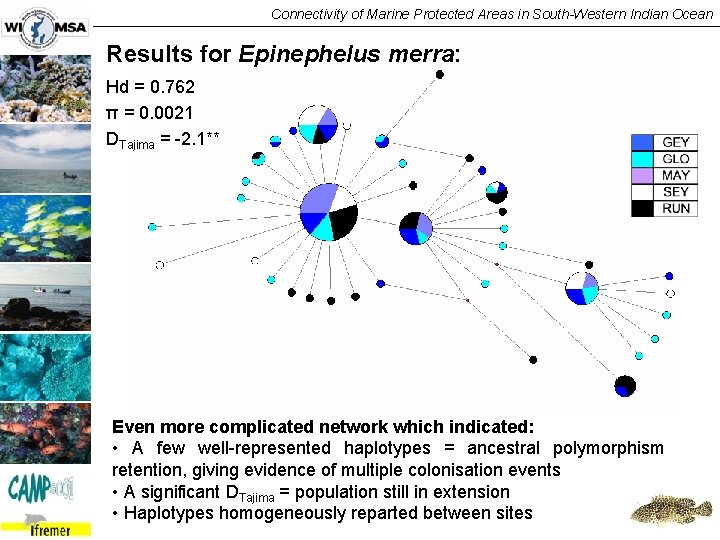
Connectivity of Marine Protected Areas in South-Western Indian Ocean Example of haplotype network : 1 black point = 1 haplotype = 1 unique sequence 1 grey bar = 1 mutation 1 color = 1 site We could extract informations from: • the morphology of the network • the frequency of the different haplotypes • the geographical representation of each haplotype
Connectivity of Marine Protected Areas in South-Western Indian Ocean Results for Lutjanus kasmira: Hd = 0. 781 π = 0. 0027 DTajima = -2. 4** Haplotype network which indicated: • A star-like pattern, typical of a population in extension (in agreement with a significant DTajima) • A main central haplotype = a unique colonisation event • Haplotypes homogeneously represented between sites
Connectivity of Marine Protected Areas in South-Western Indian Ocean Results for Myripristis berndti: Hd = 0. 886 π = 0. 0035 DTajima = -1. 8** Pacific common haplotypes A more complex haplotype network with: • A divergent branch indicating connection with Pacific fish, that is longdistance connectivity • Haplotypes homogeneously represented between sites
Connectivity of Marine Protected Areas in South-Western Indian Ocean Results for Epinephelus merra: Hd = 0. 762 π = 0. 0021 DTajima = -2. 1** Even more complicated network which indicated: • A few well-represented haplotypes = ancestral polymorphism retention, giving evidence of multiple colonisation events • A significant DTajima = population still in extension • Haplotypes homogeneously reparted between sites
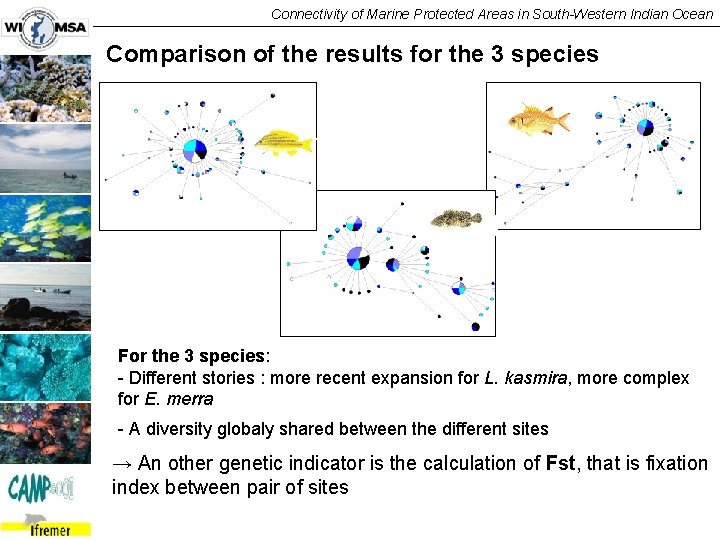
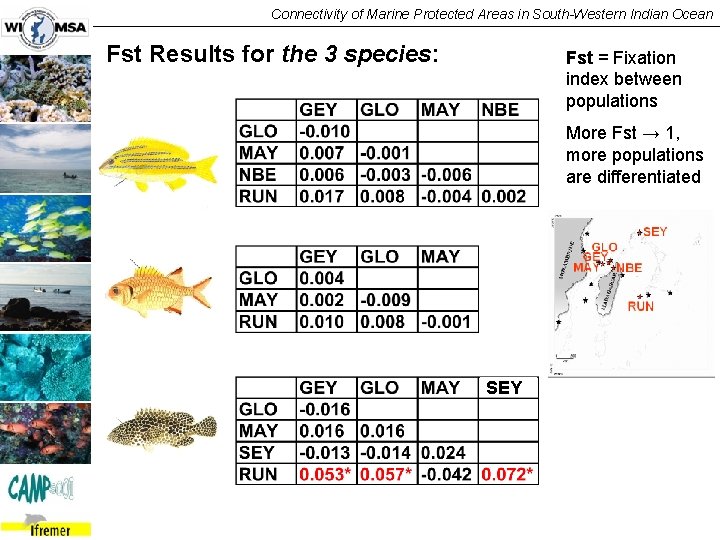
Connectivity of Marine Protected Areas in South-Western Indian Ocean Comparison of the results for the 3 species For the 3 species: - Different stories : more recent expansion for L. kasmira, more complex for E. merra - A diversity globaly shared between the different sites → An other genetic indicator is the calculation of Fst, that is fixation index between pair of sites
Connectivity of Marine Protected Areas in South-Western Indian Ocean Fst Results for the 3 species: Fst = Fixation index between populations More Fst → 1, more populations are differentiated SEY
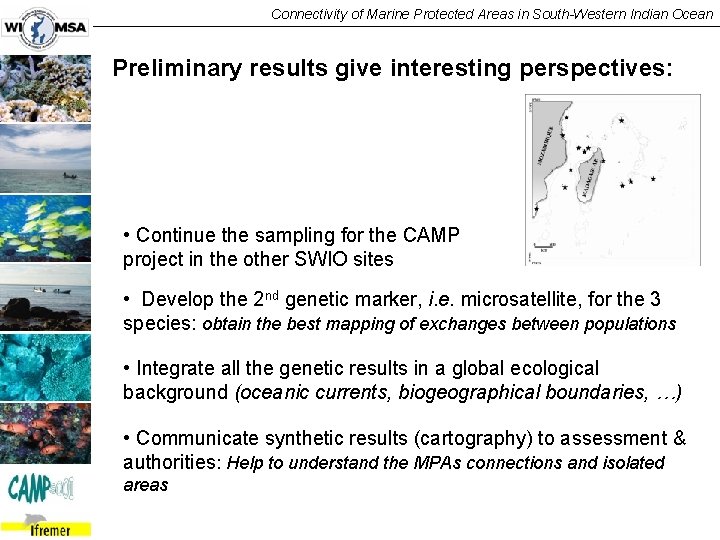
Connectivity of Marine Protected Areas in South-Western Indian Ocean Preliminary results give interesting perspectives: • Continue the sampling for the CAMP project in the other SWIO sites • Develop the 2 nd genetic marker, i. e. microsatellite, for the 3 species: obtain the best mapping of exchanges between populations • Integrate all the genetic results in a global ecological background (oceanic currents, biogeographical boundaries, …) • Communicate synthetic results (cartography) to assessment & authorities: Help to understand the MPAs connections and isolated areas
Connectivity of Marine Protected Areas in South-Western Indian Ocean Many thanks to: - people who help us for fish sampling, - to our main partners: • Réserve Naturelle Marine de La Réunion – France • Marine Park of Mohéli – Comoros • Seychelles Fishing Authority – Seychelles • SA Institute of Aquatic Biology – South Africa • Mauritius Oceanographic Institute – Mauritius (in progress) - to our financial supports: • WIOMSA (MASMA Grant) • POCT-OI (Europe, France, La Réunion) • TCO - Thanks for your