
Connectives A guide to the different types Adding
- Slides: 9
Connectives A guide to the different types. . .
Adding Connectives: These are used when you want to add ideas together that agree with each other or are about the same thing. No: I like cheese. I like sausages. Yes: I like cheese, I also like sausages. and also as well as moreover too
Sequencing Connectives next then first, second, third… finally meanwhile eventually after before These are used when you want to list ideas in a certain order. No: I cut the cheese. I cooked sausages. Yes: I cut cheese, finally I cooked the sausages.
Emphasising Connectives These are used when you want to stress a point as being very important. above all in particular especially significantly indeed notably No: I like cheese. I really like cheddar. Yes: I like cheese, in particular, cheddar.
Comparing Connectives equally in the same way similarly likewise as with like These are used when you want to compare ideas that are similar or the same as each other. No: I like cheese. I like sausages. Yes: I like cheese, equally I like sausages.
Cause and Effect Connectives These are used when you want the second part of your sentence to help explain the first part. The second part happens as a result of the first. because so therefore thus consequently No: I like cheese. I ate the cheese. Yes: I like cheese, therefore I ate the cheese!
Qualifying Connectives however although except if as long as These are used when the first idea in your sentence relies on the second part happening. No: I’ll cut the cheese. You get the knife. Yes: I’ll cut cheese, as long as you get the knife.
Illustrating Connectives These are used when you want to give an example to back up the first part of your sentence. for example such as for instance as revealed by in the case of No: I like cheese. I like cheddar and Red Leicester. Yes: I like cheese, such as Cheddar and Red Leicester!
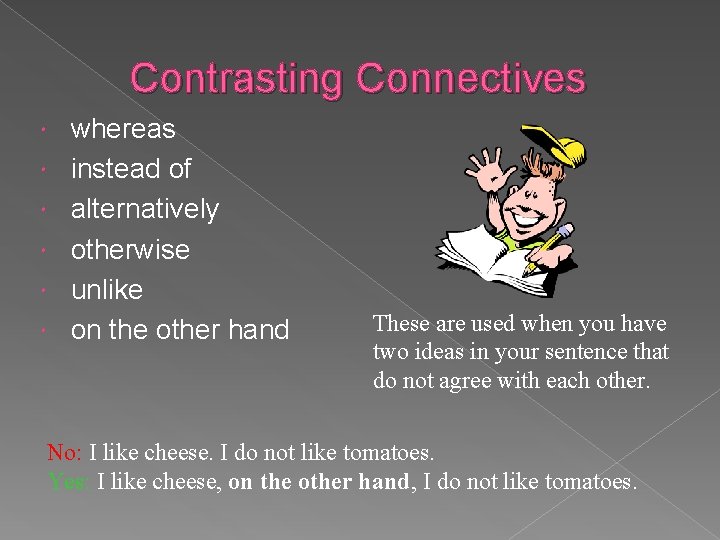
Contrasting Connectives whereas instead of alternatively otherwise unlike on the other hand These are used when you have two ideas in your sentence that do not agree with each other. No: I like cheese. I do not like tomatoes. Yes: I like cheese, on the other hand, I do not like tomatoes.