
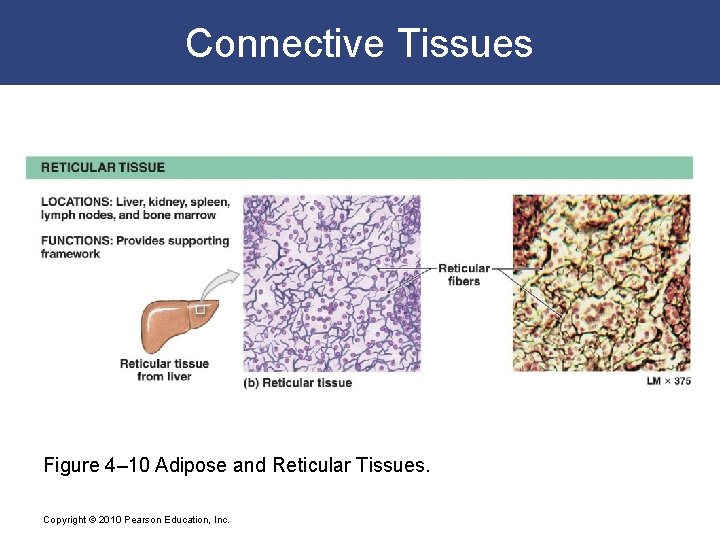
Connective Tissues Figure 4 10 Adipose and Reticular
- Slides: 57
Connective Tissues Figure 4– 10 Adipose and Reticular Tissues. Copyright © 2010 Pearson Education, Inc.
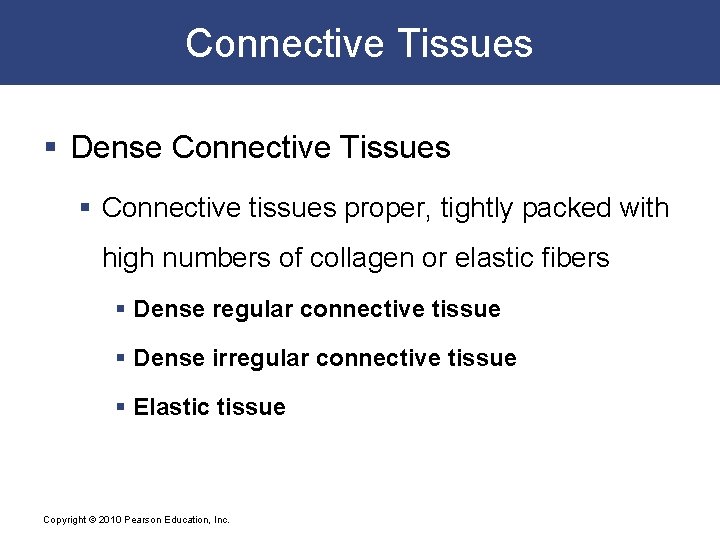
Connective Tissues § Dense Connective Tissues § Connective tissues proper, tightly packed with high numbers of collagen or elastic fibers § Dense regular connective tissue § Dense irregular connective tissue § Elastic tissue Copyright © 2010 Pearson Education, Inc.
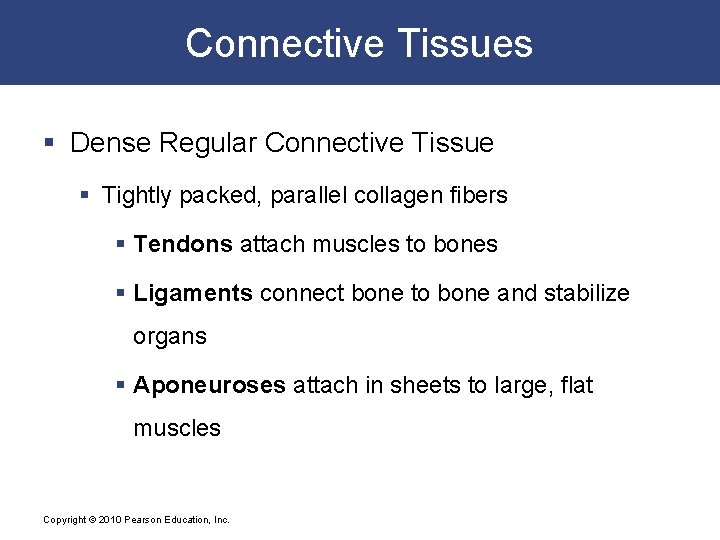
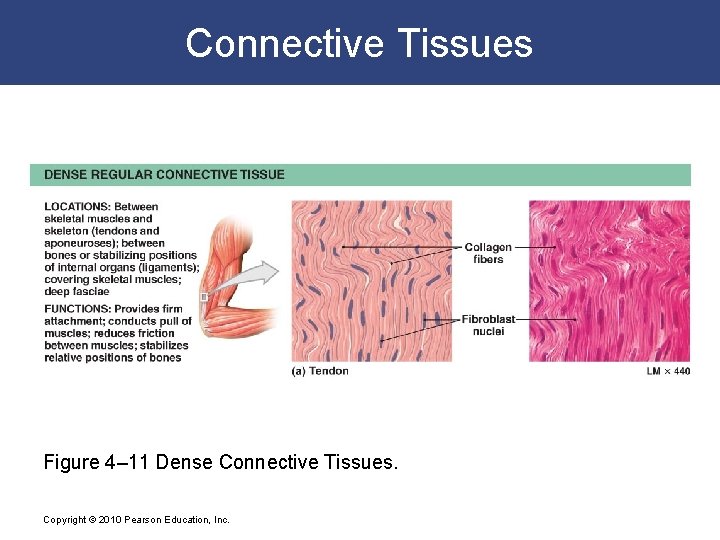
Connective Tissues § Dense Regular Connective Tissue § Tightly packed, parallel collagen fibers § Tendons attach muscles to bones § Ligaments connect bone to bone and stabilize organs § Aponeuroses attach in sheets to large, flat muscles Copyright © 2010 Pearson Education, Inc.
Connective Tissues Figure 4– 11 Dense Connective Tissues. Copyright © 2010 Pearson Education, Inc.
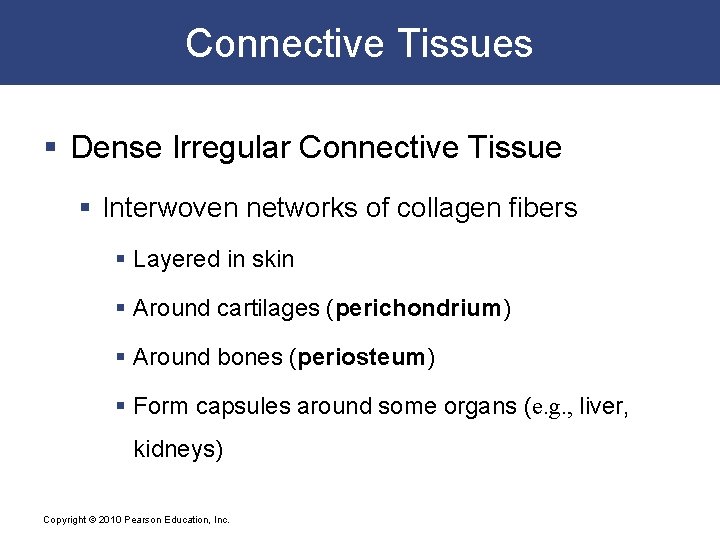
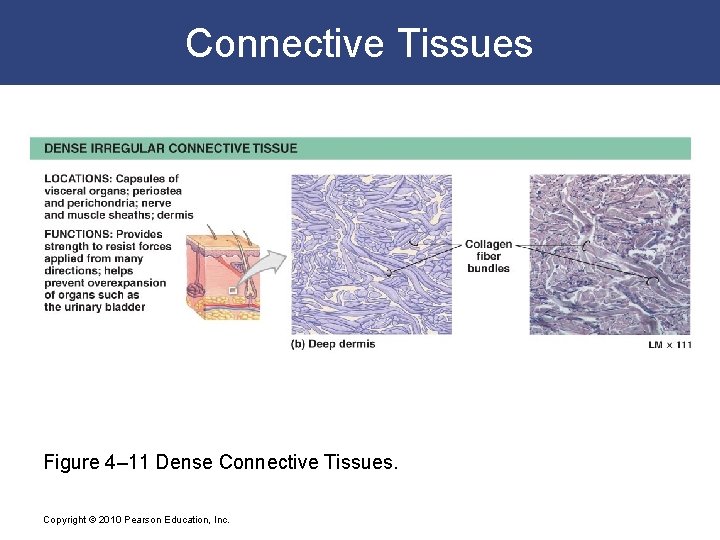
Connective Tissues § Dense Irregular Connective Tissue § Interwoven networks of collagen fibers § Layered in skin § Around cartilages (perichondrium) § Around bones (periosteum) § Form capsules around some organs (e. g. , liver, kidneys) Copyright © 2010 Pearson Education, Inc.
Connective Tissues Figure 4– 11 Dense Connective Tissues. Copyright © 2010 Pearson Education, Inc.
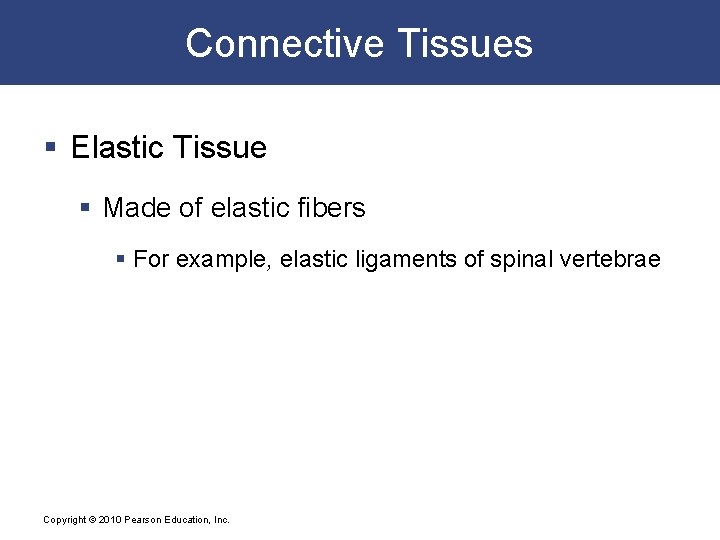
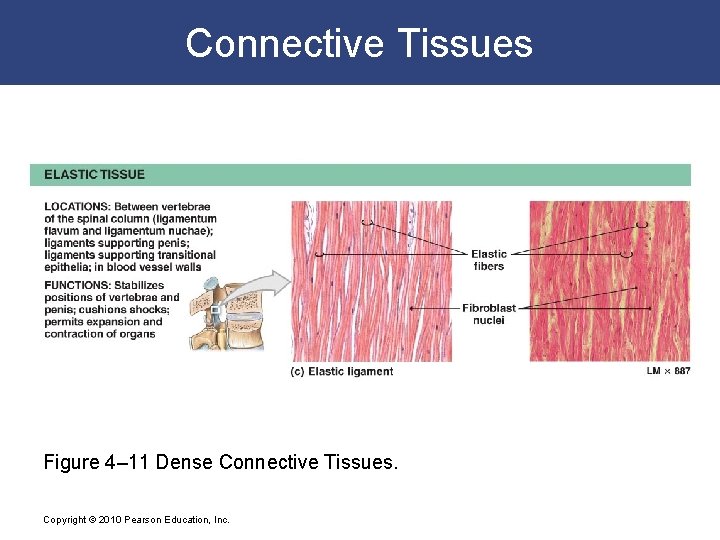
Connective Tissues § Elastic Tissue § Made of elastic fibers § For example, elastic ligaments of spinal vertebrae Copyright © 2010 Pearson Education, Inc.
Connective Tissues Figure 4– 11 Dense Connective Tissues. Copyright © 2010 Pearson Education, Inc.
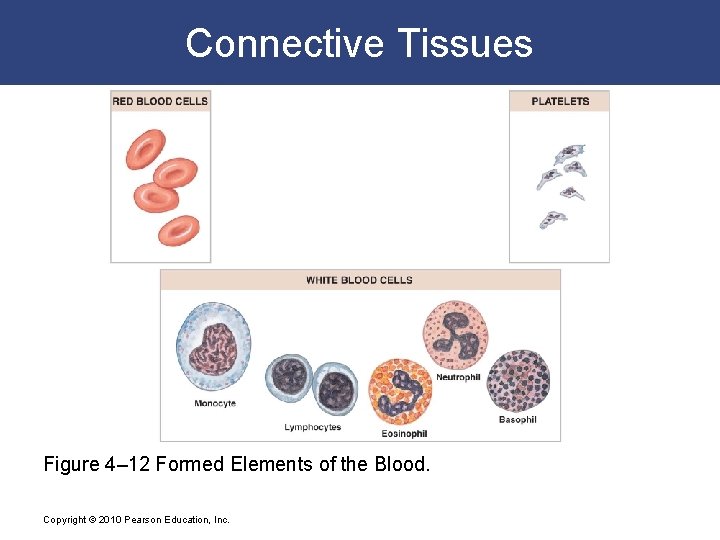
Connective Tissues § Fluid Connective Tissues § Blood and lymph § Watery matrix of dissolved proteins § Carry specific cell types (formed elements) § Formed elements of blood – red blood cells (erythrocytes) – white blood cells (leukocytes) – platelets Copyright © 2010 Pearson Education, Inc.
Connective Tissues § Fluid Elements of Fluid Connective Tissues § Extracellular § Plasma § Interstitial fluid § Lymph Copyright © 2010 Pearson Education, Inc.
Connective Tissues Figure 4– 12 Formed Elements of the Blood. Copyright © 2010 Pearson Education, Inc.
Connective Tissues § Lymph § Extracellular fluid § Collected from interstitial space § Monitored by immune system § Transported by lymphoid (lymphatic) system § Returned to venous system Copyright © 2010 Pearson Education, Inc.
Connective Tissues § Fluid Tissue Transport Systems § Cardiovascular system (blood) § Arteries § Capillaries § Veins § Lymphoid (lymphatic) system (lymph) § Lymphatic vessels Copyright © 2010 Pearson Education, Inc.
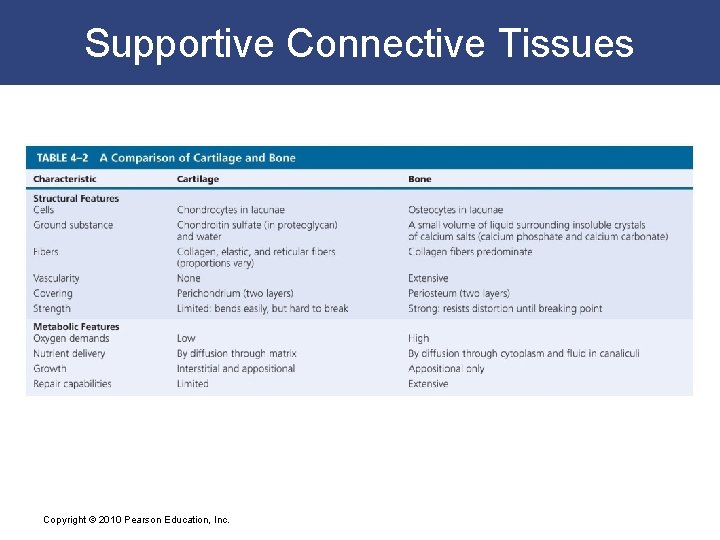
Supportive Connective Tissues § Support soft tissues and body weight § Cartilage § Gel-type ground substance § For shock absorption and protection § Bone § Calcified (made rigid by calcium salts, minerals) § For weight support Copyright © 2010 Pearson Education, Inc.
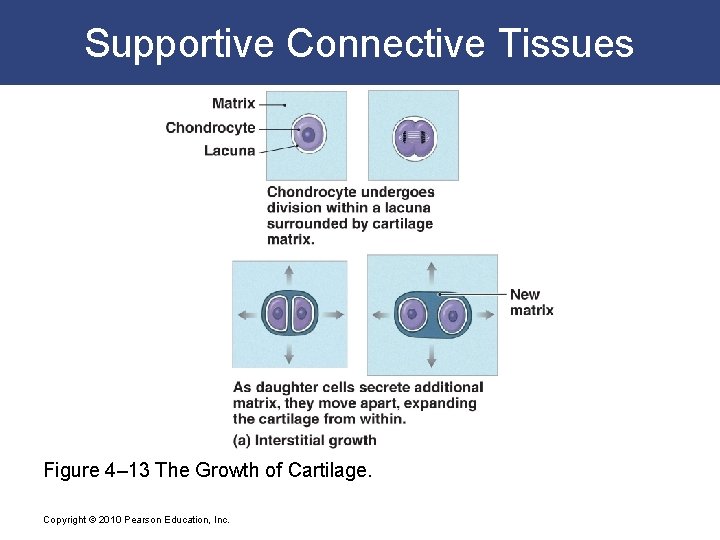
Supportive Connective Tissues § Cartilage Matrix § Proteoglycans derived from chondroitin sulfates § Ground substance proteins § Chondrocytes (cartilage cells) surrounded by lacunae (chambers) Copyright © 2010 Pearson Education, Inc.
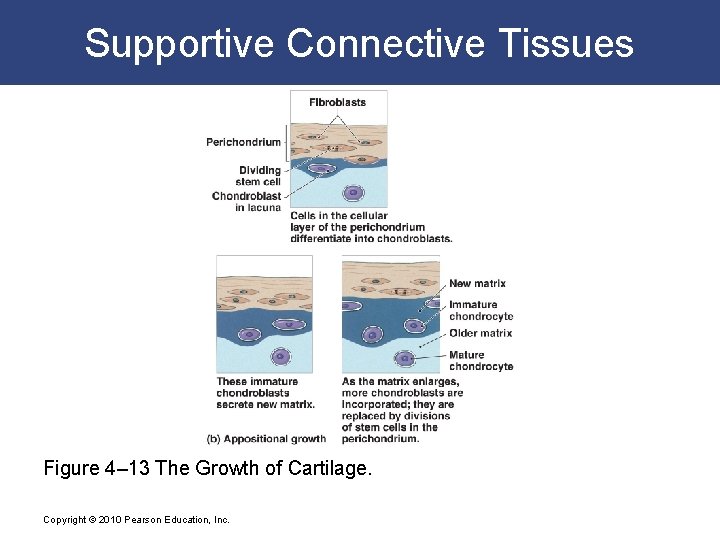
Supportive Connective Tissues § Cartilage Structure § No blood vessels: § Chondrocytes produce antiangiogenesis factor § Perichondrium: § Outer, fibrous layer (for strength) § Inner, cellular layer (for growth and maintenance) Copyright © 2010 Pearson Education, Inc.
Supportive Connective Tissues Figure 4– 13 The Growth of Cartilage. Copyright © 2010 Pearson Education, Inc.
Supportive Connective Tissues Figure 4– 13 The Growth of Cartilage. Copyright © 2010 Pearson Education, Inc.
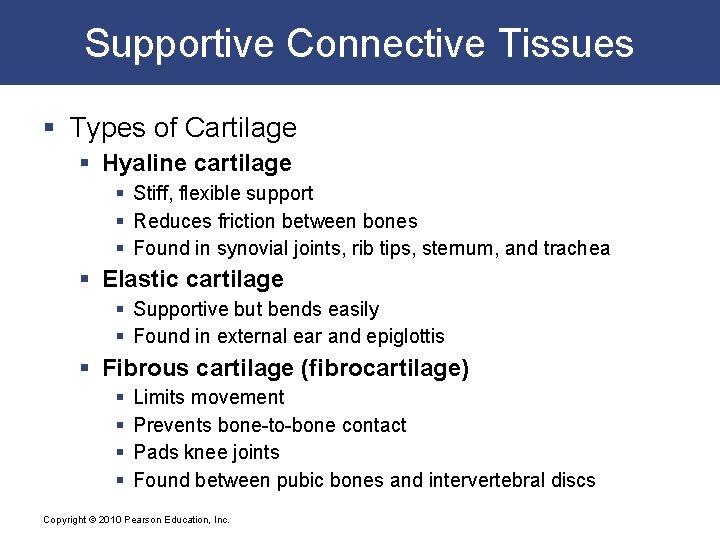
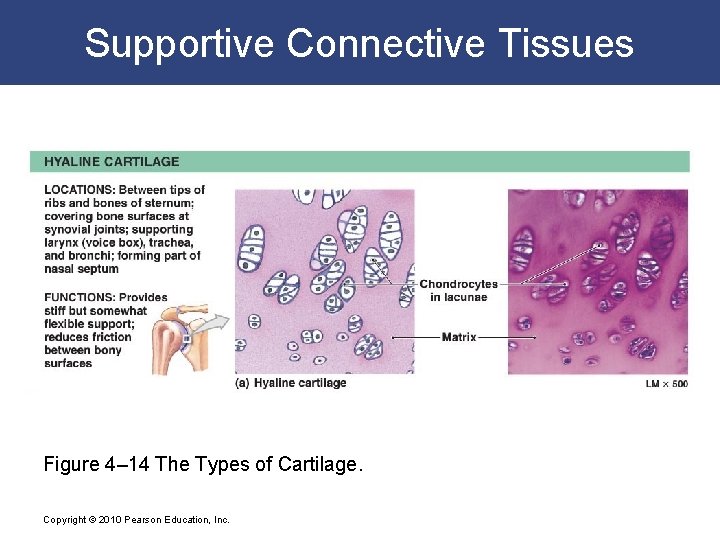
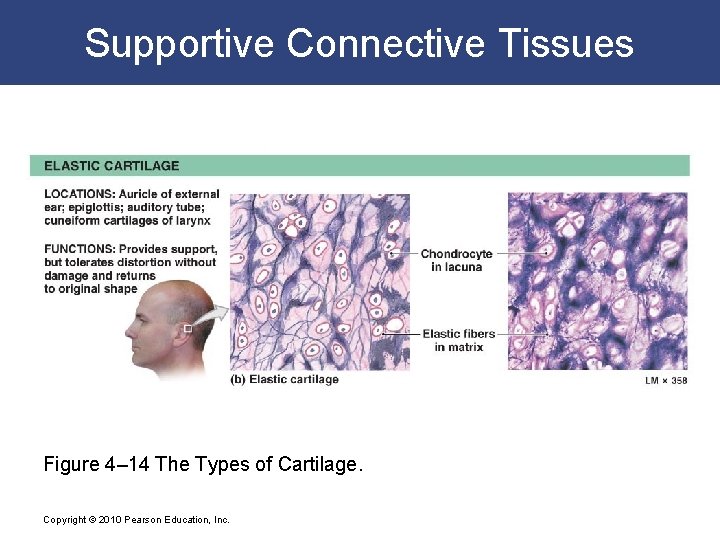
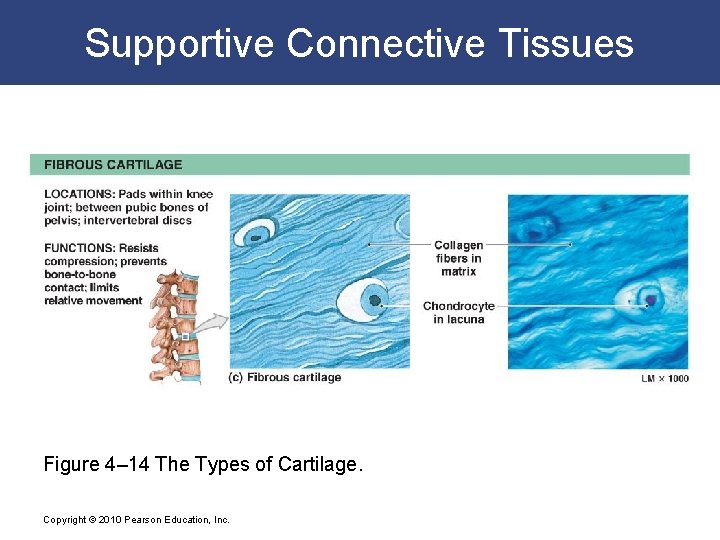
Supportive Connective Tissues § Types of Cartilage § Hyaline cartilage § Stiff, flexible support § Reduces friction between bones § Found in synovial joints, rib tips, sternum, and trachea § Elastic cartilage § Supportive but bends easily § Found in external ear and epiglottis § Fibrous cartilage (fibrocartilage) § § Limits movement Prevents bone-to-bone contact Pads knee joints Found between pubic bones and intervertebral discs Copyright © 2010 Pearson Education, Inc.
Supportive Connective Tissues Figure 4– 14 The Types of Cartilage. Copyright © 2010 Pearson Education, Inc.
Supportive Connective Tissues Figure 4– 14 The Types of Cartilage. Copyright © 2010 Pearson Education, Inc.
Supportive Connective Tissues Figure 4– 14 The Types of Cartilage. Copyright © 2010 Pearson Education, Inc.
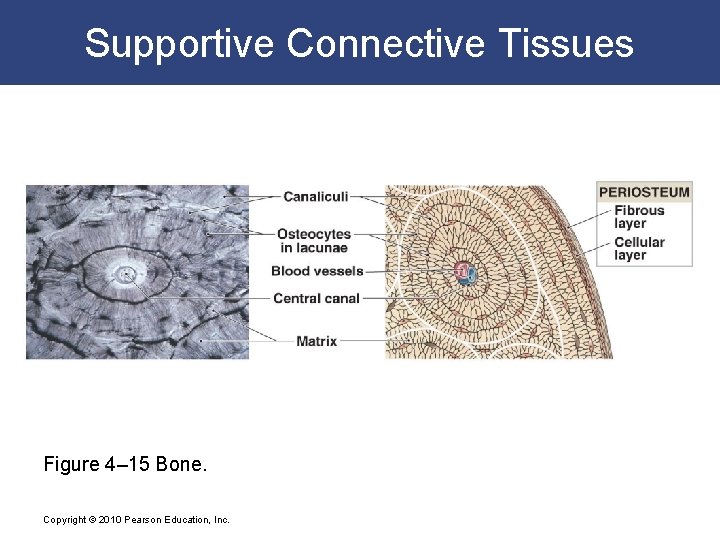
Supportive Connective Tissues § Bone or osseous tissue § Strong (calcified: calcium salt deposits) § Resists shattering (flexible collagen fibers) § Bone cells or osteocytes § Arranged around central canals within matrix § Small channels through matrix (canaliculi) access blood supply § Periosteum § Covers bone surfaces § Fibrous layer § Cellular layer Copyright © 2010 Pearson Education, Inc.
Supportive Connective Tissues Figure 4– 15 Bone. Copyright © 2010 Pearson Education, Inc.
Supportive Connective Tissues Copyright © 2010 Pearson Education, Inc.
Membranes § Are physical barriers § That line or cover portions of the body § Consist of § An epithelium § Supported by connective tissues Copyright © 2010 Pearson Education, Inc.
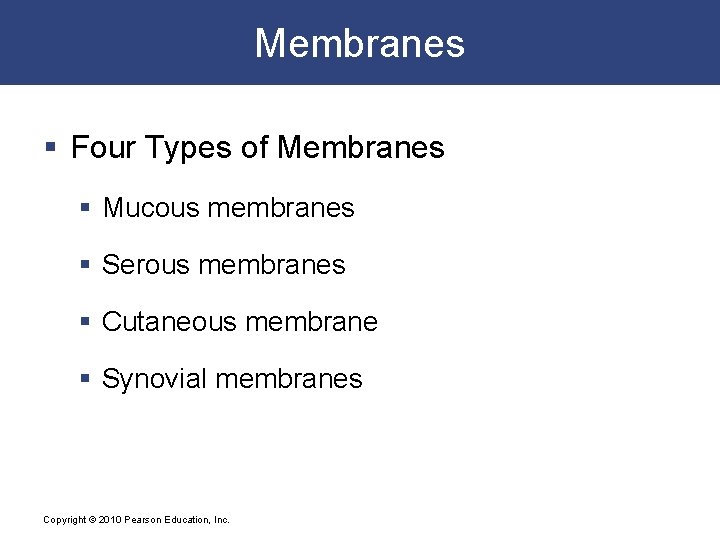
Membranes § Four Types of Membranes § Mucous membranes § Serous membranes § Cutaneous membrane § Synovial membranes Copyright © 2010 Pearson Education, Inc.
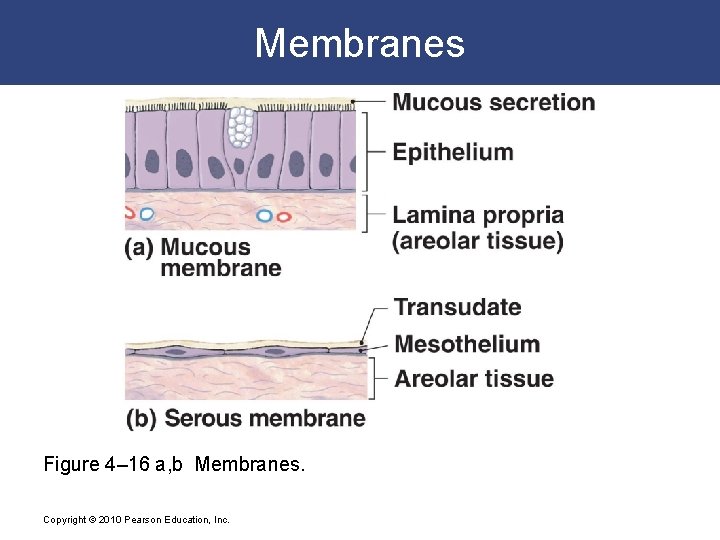
Membranes § Mucous membranes (mucosae) § Line passageways that have external connections § In digestive, respiratory, urinary, and reproductive tracts § Epithelial surfaces must be moist § To reduce friction § To facilitate absorption and excretion § Lamina propria § Is areolar tissue Copyright © 2010 Pearson Education, Inc.
Membranes § Serous Membranes § Line cavities not open to the outside § Are thin but strong § Have fluid transudate to reduce friction § Have a parietal portion covering the cavity § Have a visceral portion (serosa) covering the organs Copyright © 2010 Pearson Education, Inc.
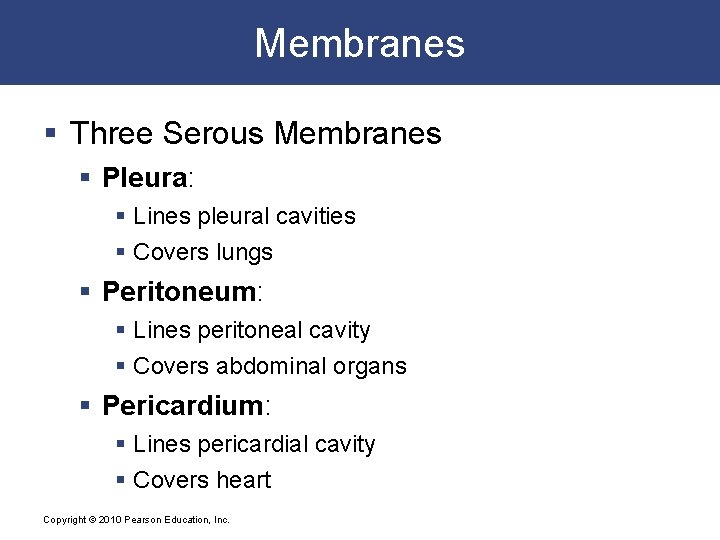
Membranes § Three Serous Membranes § Pleura: § Lines pleural cavities § Covers lungs § Peritoneum: § Lines peritoneal cavity § Covers abdominal organs § Pericardium: § Lines pericardial cavity § Covers heart Copyright © 2010 Pearson Education, Inc.
Membranes Figure 4– 16 a, b Membranes. Copyright © 2010 Pearson Education, Inc.
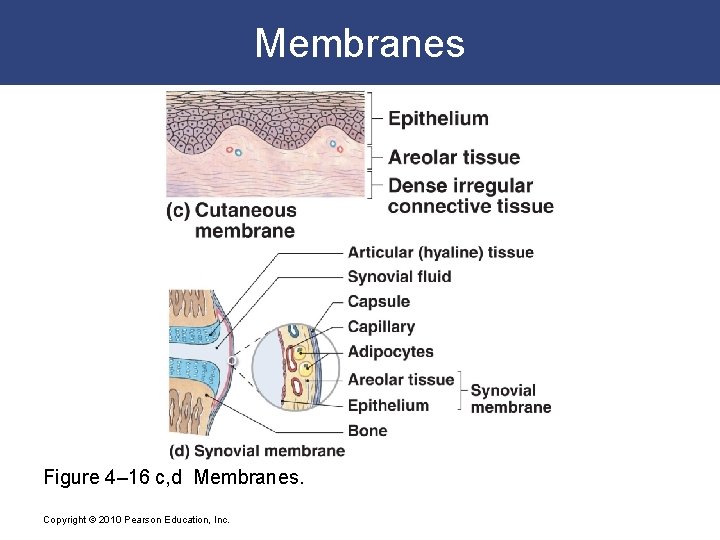
Membranes § Cutaneous membrane § Is skin, surface of the body § Thick, waterproof, and dry § Synovial membranes § Line moving, articulating joint cavities § Produce synovial fluid (lubricant) § Protect the ends of bones § Lack a true epithelium Copyright © 2010 Pearson Education, Inc.
Membranes Figure 4– 16 c, d Membranes. Copyright © 2010 Pearson Education, Inc.
Internal Framework of the Body § Connective tissues § Provide strength and stability § Maintain positions of internal organs § Provide routes for blood vessels, lymphatic vessels, and nerves § Fasciae § Singular form is fascia § The body’s framework of connective tissue § Layers and wrappings that support or surround organs Copyright © 2010 Pearson Education, Inc.
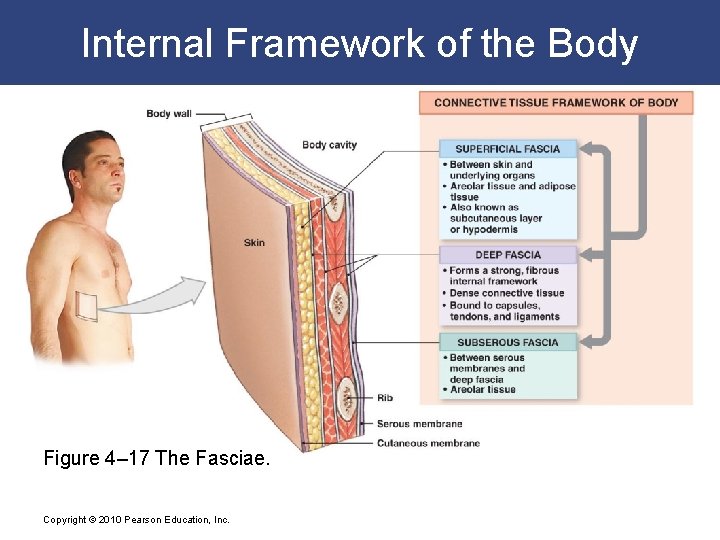
Internal Framework of the Body § Three Types of Fasciae § Superficial fascia § Deep fascia § Subserous fascia Copyright © 2010 Pearson Education, Inc.
Internal Framework of the Body Figure 4– 17 The Fasciae. Copyright © 2010 Pearson Education, Inc.
Muscle Tissue § Specialized for contraction § Produces all body movement § Three types of muscle tissue § Skeletal muscle § Large body muscles responsible for movement § Cardiac muscle § Found only in the heart § Smooth muscle § Found in walls of hollow, contracting organs (blood vessels; urinary bladder; respiratory, digestive, and reproductive tracts) Copyright © 2010 Pearson Education, Inc.
Muscle Tissue § Classification of Muscle Cells § Striated (muscle cells with a banded appearance) § Nonstriated (not banded; smooth) § Muscle cells can have a single nucleus § Muscle cells can be multinucleate § Muscle cells can be controlled voluntarily (consciously) § Muscle cells can be controlled involuntarily (automatically) Copyright © 2010 Pearson Education, Inc.
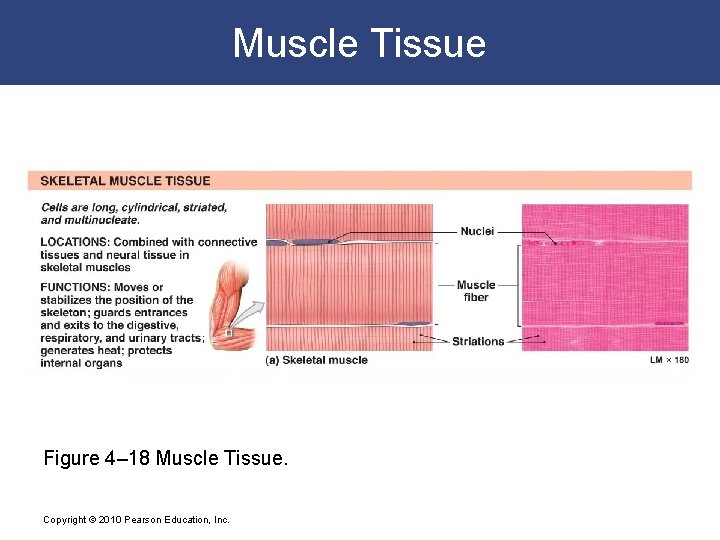
Muscle Tissue § Skeletal Muscle Cells § Are long and thin § Are usually called muscle fibers § Do not divide § New fibers are produced by stem cells (myosatellite cells) Copyright © 2010 Pearson Education, Inc.
Muscle Tissue Figure 4– 18 Muscle Tissue. Copyright © 2010 Pearson Education, Inc.
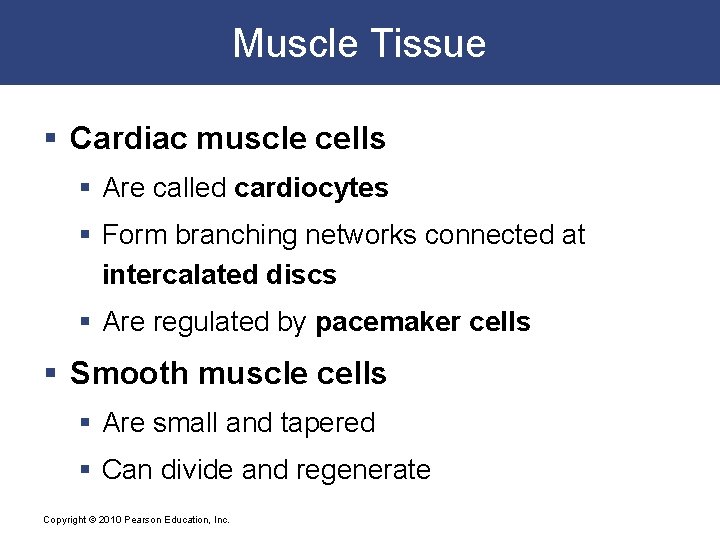
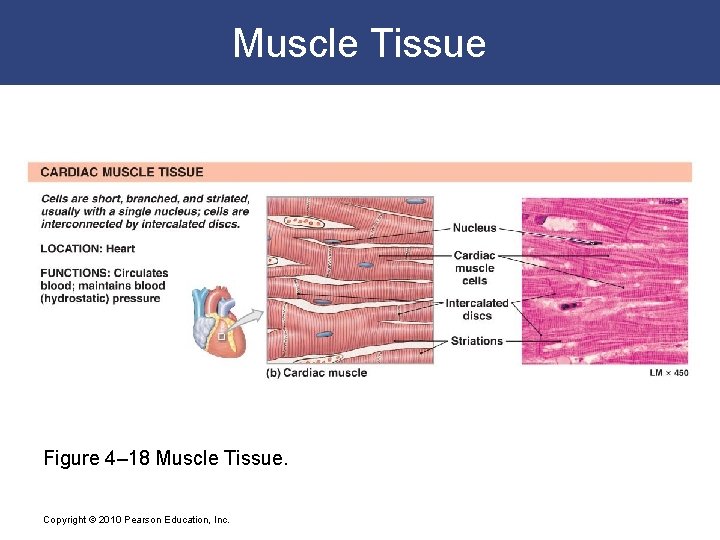
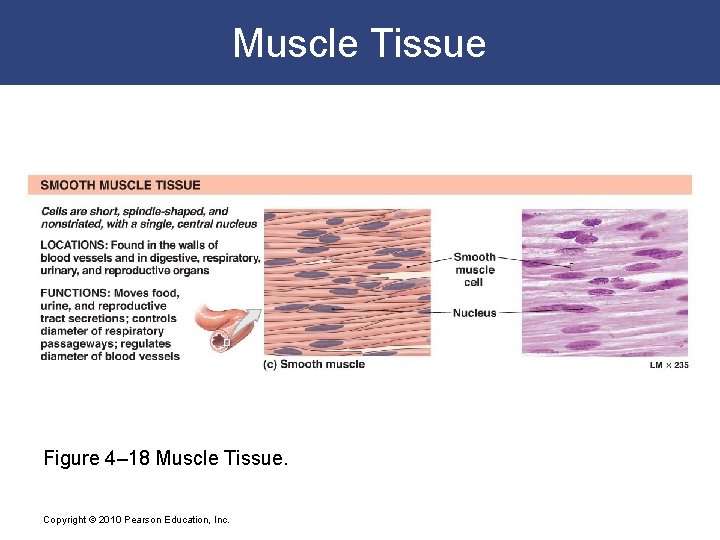
Muscle Tissue § Cardiac muscle cells § Are called cardiocytes § Form branching networks connected at intercalated discs § Are regulated by pacemaker cells § Smooth muscle cells § Are small and tapered § Can divide and regenerate Copyright © 2010 Pearson Education, Inc.
Muscle Tissue Figure 4– 18 Muscle Tissue. Copyright © 2010 Pearson Education, Inc.
Muscle Tissue Figure 4– 18 Muscle Tissue. Copyright © 2010 Pearson Education, Inc.
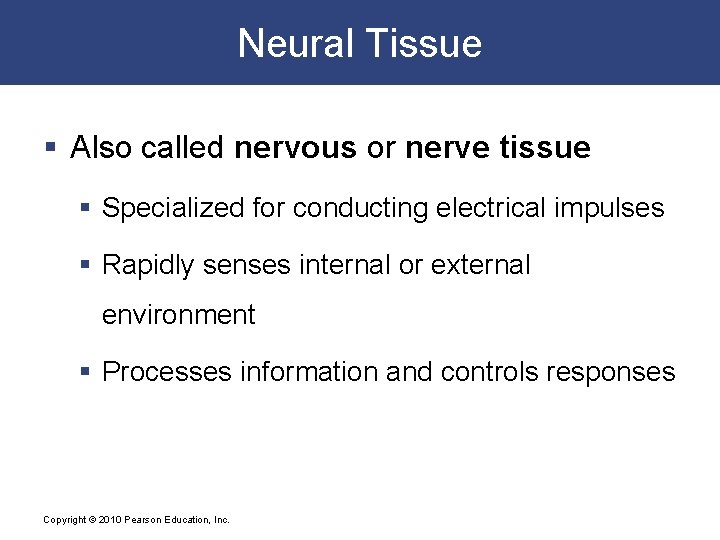
Neural Tissue § Also called nervous or nerve tissue § Specialized for conducting electrical impulses § Rapidly senses internal or external environment § Processes information and controls responses Copyright © 2010 Pearson Education, Inc.
Neural Tissue § Neural tissue is concentrated in the central nervous system § Brain § Spinal cord Copyright © 2010 Pearson Education, Inc.
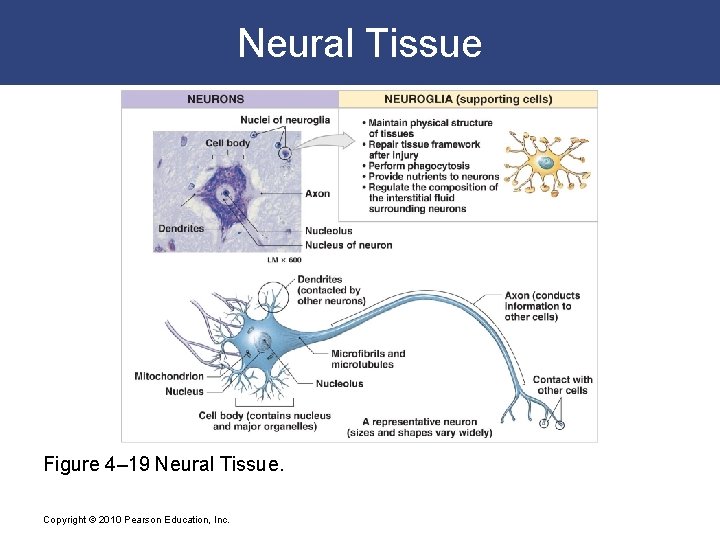
Neural Tissue § Two Kinds of Neural Cells § Neurons § Nerve cells § Perform electrical communication § Neuroglia § Supporting cells § Repair and supply nutrients to neurons Copyright © 2010 Pearson Education, Inc.
Neural Tissue § Cell Parts of a Neuron § Cell body § Contains the nucleus and nucleolus § Dendrites § Short branches extending from the cell body § Receive incoming signals § Axon (nerve fiber) § Long, thin extension of the cell body § Carries outgoing electrical signals to their destination Copyright © 2010 Pearson Education, Inc.
Neural Tissue Figure 4– 19 Neural Tissue. Copyright © 2010 Pearson Education, Inc.
Tissue Injuries and Repair § Tissues respond to injuries to maintain homeostasis § Cells restore homeostasis with two processes § Inflammation § Regeneration Copyright © 2010 Pearson Education, Inc.
Tissue Injuries and Repair § Inflammation = inflammatory response § The tissue’s first response to injury § Signs and symptoms of the inflammatory response include § Swelling § Redness § Heat § Pain Copyright © 2010 Pearson Education, Inc.
Tissue Injuries and Repair § Inflammatory Response § Can be triggered by § Trauma (physical injury) § Infection (the presence of harmful pathogens) Copyright © 2010 Pearson Education, Inc.
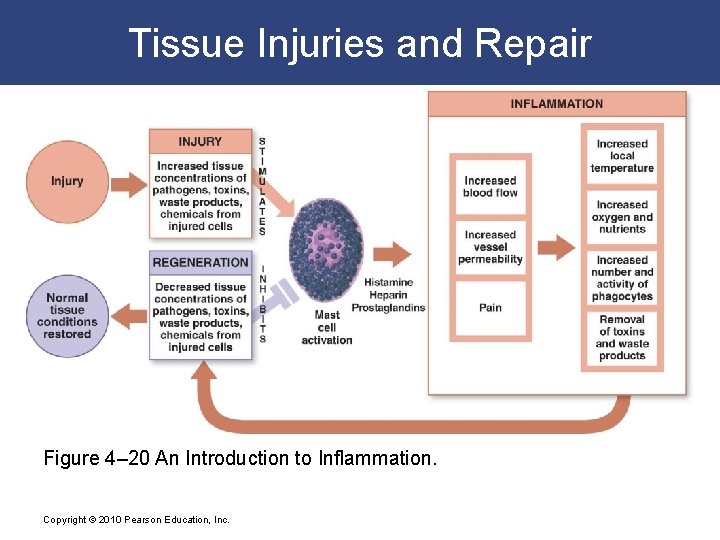
Tissue Injuries and Repair § The Process of Inflammation § Damaged cells release chemical signals into the surrounding interstitial fluid § Prostaglandins § Proteins § Potassium ions § As cells break down § Lysosomes release enzymes § That destroy the injured cell § And attack surrounding tissues § Tissue destruction is called necrosis Copyright © 2010 Pearson Education, Inc.
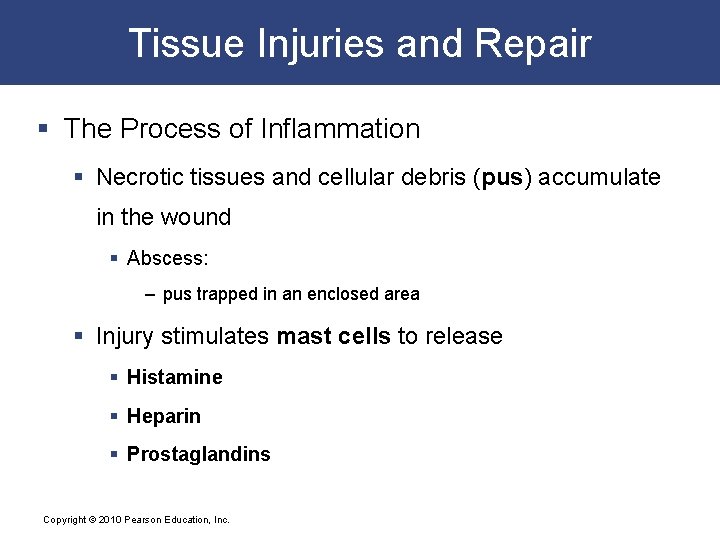
Tissue Injuries and Repair § The Process of Inflammation § Necrotic tissues and cellular debris (pus) accumulate in the wound § Abscess: – pus trapped in an enclosed area § Injury stimulates mast cells to release § Histamine § Heparin § Prostaglandins Copyright © 2010 Pearson Education, Inc.
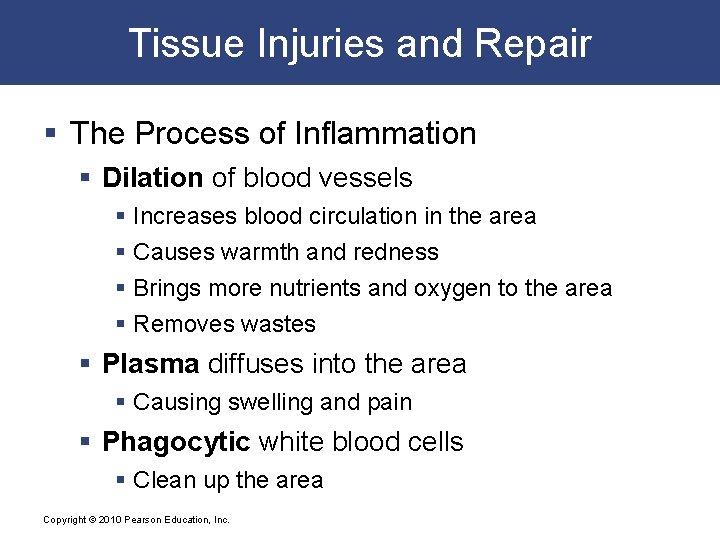
Tissue Injuries and Repair § The Process of Inflammation § Dilation of blood vessels § Increases blood circulation in the area § Causes warmth and redness § Brings more nutrients and oxygen to the area § Removes wastes § Plasma diffuses into the area § Causing swelling and pain § Phagocytic white blood cells § Clean up the area Copyright © 2010 Pearson Education, Inc.
Tissue Injuries and Repair Figure 4– 20 An Introduction to Inflammation. Copyright © 2010 Pearson Education, Inc.
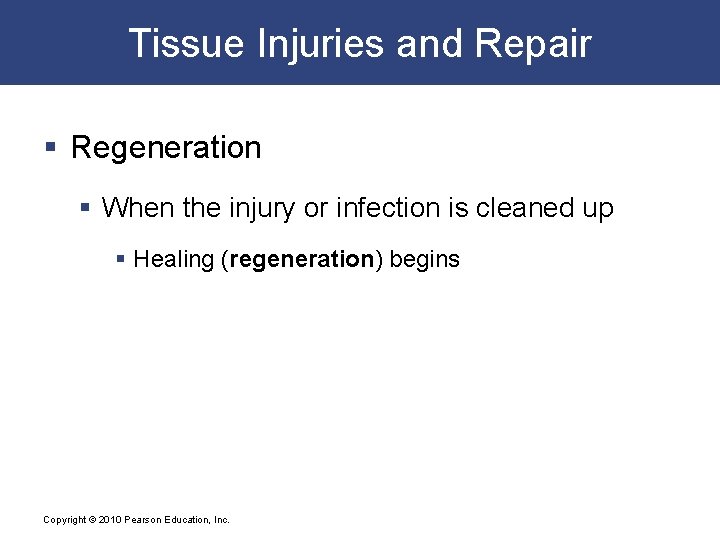
Tissue Injuries and Repair § Regeneration § When the injury or infection is cleaned up § Healing (regeneration) begins Copyright © 2010 Pearson Education, Inc.
Tissue Injuries and Repair § The Process of Regeneration § Fibrocytes move into necrotic area § Lay down collagen fibers § To bind the area together (scar tissue) § New cells migrate into area § Or are produced by mesenchymal stem cells § Not all tissues can regenerate § Epithelia and connective tissues regenerate well § Cardiac cells and neurons do not regenerate (or regenerate poorly) Copyright © 2010 Pearson Education, Inc.