
Connective Tissue Most widespread tissue Found in nearly
- Slides: 16
Connective Tissue
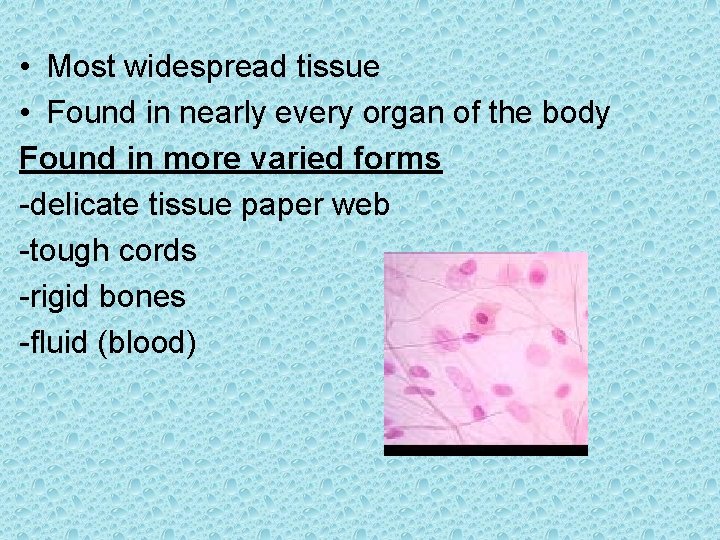
• Most widespread tissue • Found in nearly every organ of the body Found in more varied forms -delicate tissue paper web -tough cords -rigid bones -fluid (blood)
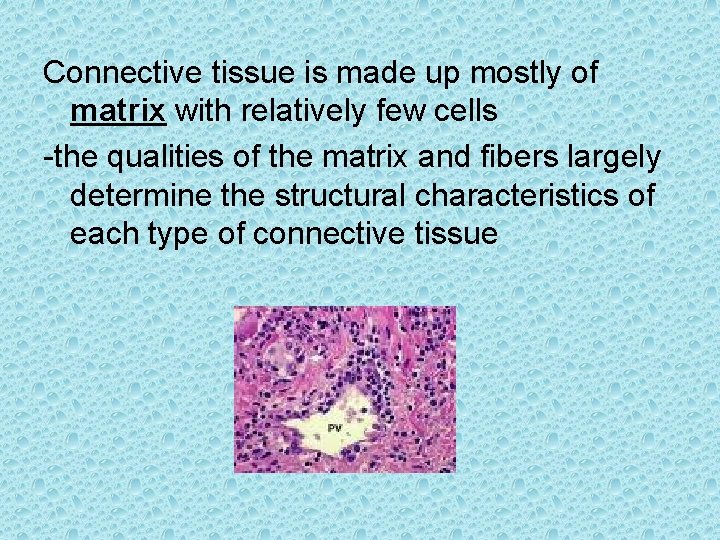
Connective tissue is made up mostly of matrix with relatively few cells -the qualities of the matrix and fibers largely determine the structural characteristics of each type of connective tissue
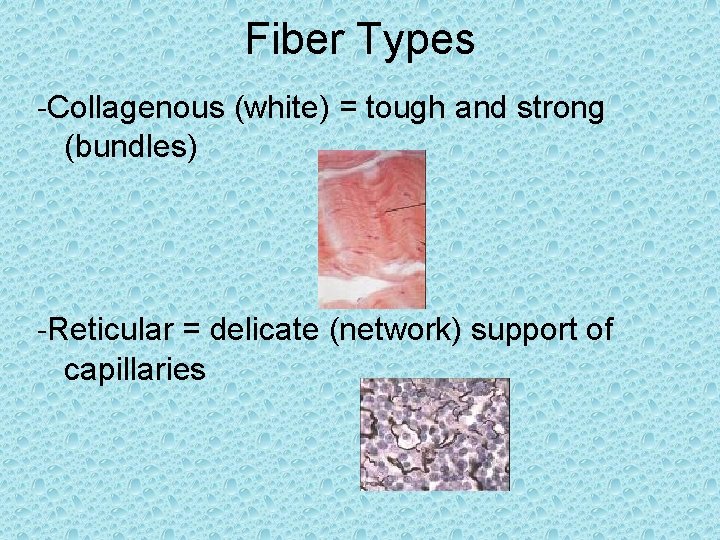
Fiber Types -Collagenous (white) = tough and strong (bundles) -Reticular = delicate (network) support of capillaries
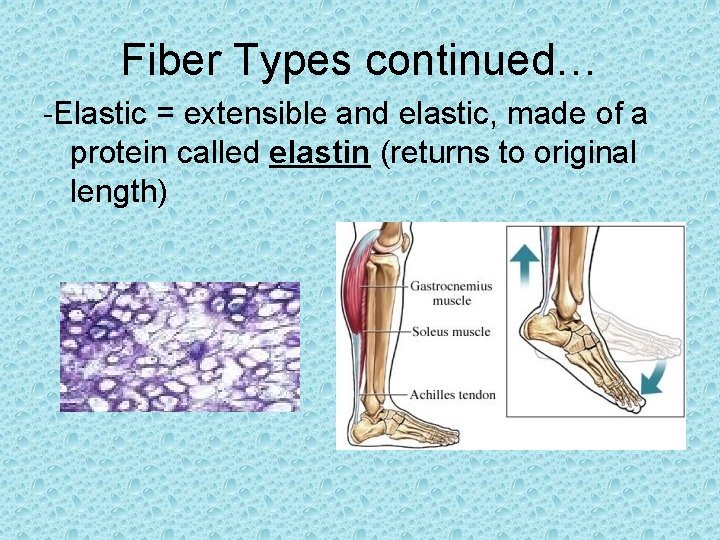
Fiber Types continued… -Elastic = extensible and elastic, made of a protein called elastin (returns to original length)
Classification for Connective Tissue • Fibrous A. loose, ordinary (areolar) B. adipose C. reticular D. dense • Bone • Cartilage A. hyaline B. fibrocartilage C. elastic • Blood
Fibrous Connective Tissue 1. Fibrous have extracellular fibers as their predominant feature. - The arrangement of those fibers is what makes each type in this group different. A. Loose (Areolar) : it connects many adjacent structures. It acts as a glue spread between them - Fibroblasts : usually present in large numbers in areolar tissue. Job: produce a gel-like ground substance - Macrophages: also found in large numbers, carry on phagocytosis (engulfment) B. Adipose: differs from loose, mainly by having a lot of fat cells. -forms supporting, protective pads around kidney and other organs - 2 other functions a. storage for excess food b. insulating material (body heat)
C. Reticular: forms the framework of the spleen, lymph nodes and bone marrow -Function: help defend against invaders -meshwork filters blood and lymph, then the reticular cells phagacytose them. D. Dense Fiber: consists mainly of fibers packed densely in the matrix -2 Types: regular and irregular a. regular – fibers are in parallel rows flexible but has great tensile strength *Tendons = anchor muscle to bone * Ligaments = connect bone to bone (contain elastic fibers, and do stretch a little) b. irregular- the bundles are not parallel. Instead they intertwine and form a thick material that can withstand stress from any direction *found: dermis – inner layer of skin, outer capsule of kidney and spleen
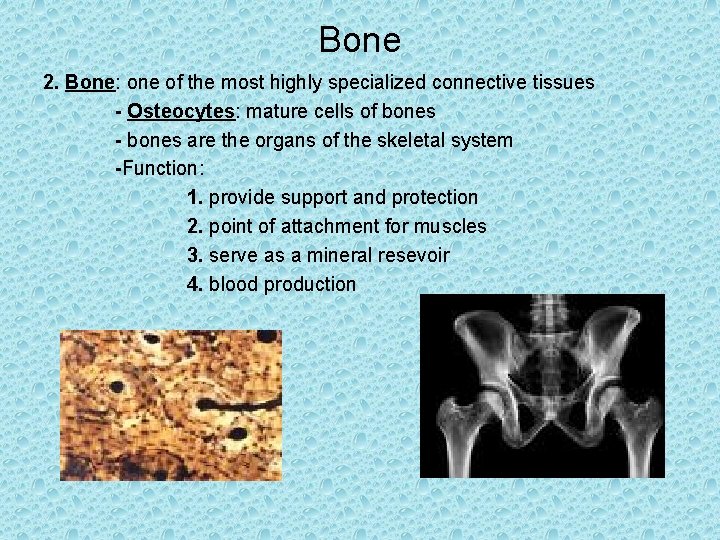
Bone 2. Bone: one of the most highly specialized connective tissues - Osteocytes: mature cells of bones - bones are the organs of the skeletal system -Function: 1. provide support and protection 2. point of attachment for muscles 3. serve as a mineral resevoir 4. blood production
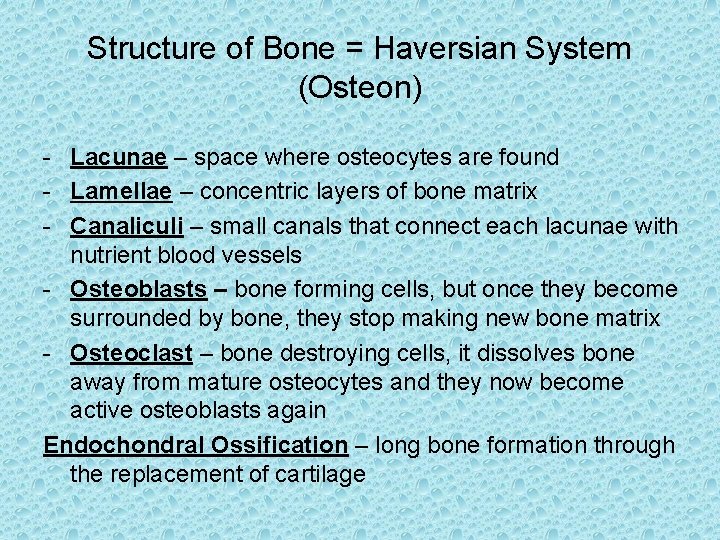
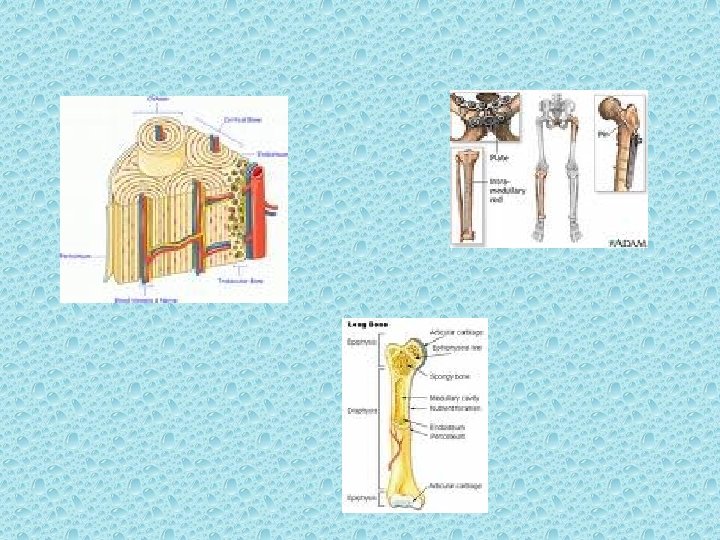
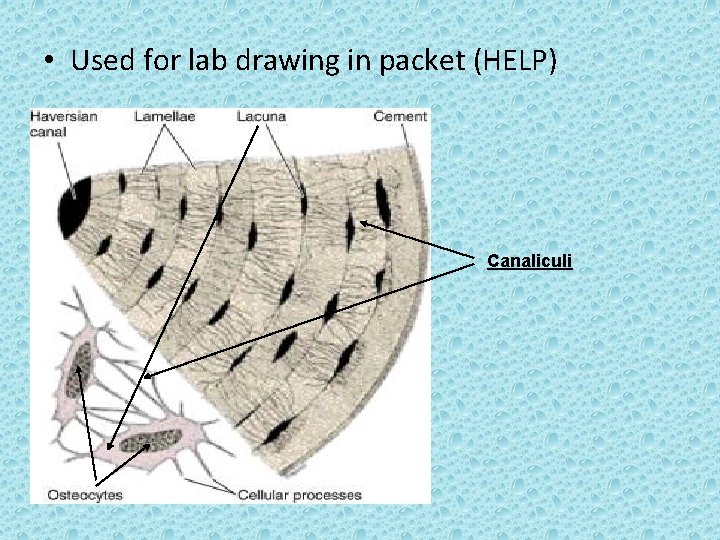
Structure of Bone = Haversian System (Osteon) - Lacunae – space where osteocytes are found - Lamellae – concentric layers of bone matrix - Canaliculi – small canals that connect each lacunae with nutrient blood vessels - Osteoblasts – bone forming cells, but once they become surrounded by bone, they stop making new bone matrix - Osteoclast – bone destroying cells, it dissolves bone away from mature osteocytes and they now become active osteoblasts again Endochondral Ossification – long bone formation through the replacement of cartilage
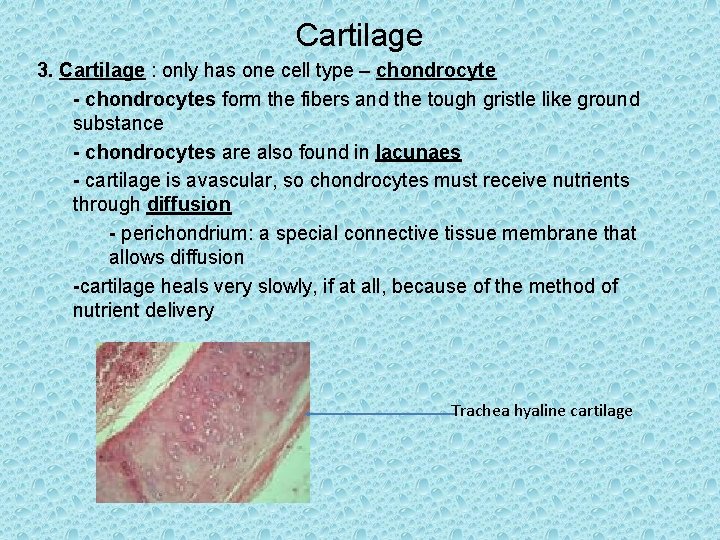
Cartilage 3. Cartilage : only has one cell type – chondrocyte - chondrocytes form the fibers and the tough gristle like ground substance - chondrocytes are also found in lacunaes - cartilage is avascular, so chondrocytes must receive nutrients through diffusion - perichondrium: a special connective tissue membrane that allows diffusion -cartilage heals very slowly, if at all, because of the method of nutrient delivery Trachea hyaline cartilage
3 Types of Cartilage 1. 2. 3. Hyaline cartilage: means “glass” appearance, is shiny and translucent - found in: rings of respiratory tubes and covering ends of bones that form joints Fibrocartilage: strongest, serve as shock absorbers between vertebrae -vertebral pads and menisci of the knee are common sport injury Elastic: contains very fine elastic fibers to add strength and flexibility -found in: external ear, voice box, and larynx
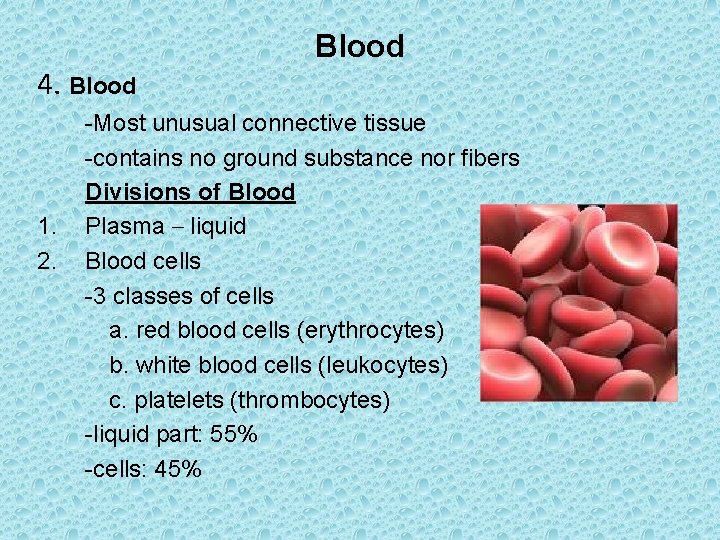
4. Blood 1. 2. Blood -Most unusual connective tissue -contains no ground substance nor fibers Divisions of Blood Plasma – liquid Blood cells -3 classes of cells a. red blood cells (erythrocytes) b. white blood cells (leukocytes) c. platelets (thrombocytes) -liquid part: 55% -cells: 45%
Blood Functions 1. Movement of respiratory gas (O 2 + CO 2), nutrients and waste products 2. Maintaining body temperature and regulating p. H 3. WBC – function in defense
• Used for lab drawing in packet (HELP) Canaliculi