
Connective Tissue General Characteristics n n n Bind
Connective Tissue
General Characteristics n n n Bind structures, support, protect, fill spaces, store fat, and transport substances Cells are farther apart than in epithelial tissue Intercellular material is called matrix q n Matrix consists of fibers and ground substance which ranges from fluid to solid Cells are usually able to reproduce, have good blood supply and are well nourished
Cell types n Fibroblasts—most common type of cell in Fibroblasts connective tissue q n Mast cells are large and usually located near blood vessels q n Produce fibers by secreting proteins Release chemicals such as heparin (an anticoagulant) and histamine (promotes dilation of blood vessels) Macrophages are almost as numerous and fibroblasts in some tissue q Move around within tissue to phagocytize foreign particles
Fibers n Collagenous fibers are thick and made of collagen q q n Elastic fibers are made of thin fibers called elastin q q n Not very elastic but have strong tensile strength Found in tendons—collagenous fibers are sometimes called white fibers Weaker than collagenous but stretch easily and will resume their original shapes and length Found in vocal cords—elastic fibers are sometimes called yellow fibers Reticular fibers are very thin collagenous fibers q Highly branched to form delicate supporting networks

Loose Fibrous Connective Tissue n n n Cells are mainly fibroblasts Cells are located far apart and have a gel-like matrix Binds the skin to the underlying organs and fills spaces between muscles
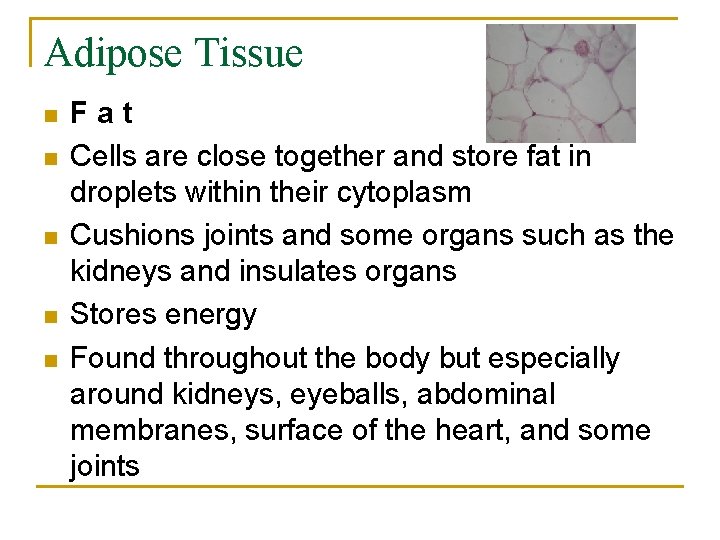
Adipose Tissue n n n Fat Cells are close together and store fat in droplets within their cytoplasm Cushions joints and some organs such as the kidneys and insulates organs Stores energy Found throughout the body but especially around kidneys, eyeballs, abdominal membranes, surface of the heart, and some joints
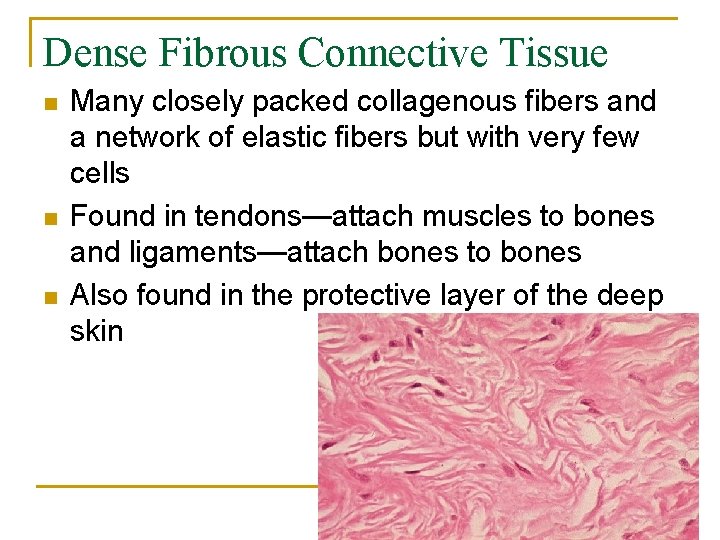
Dense Fibrous Connective Tissue n n n Many closely packed collagenous fibers and a network of elastic fibers but with very few cells Found in tendons—attach muscles to bones and ligaments—attach bones to bones Also found in the protective layer of the deep skin
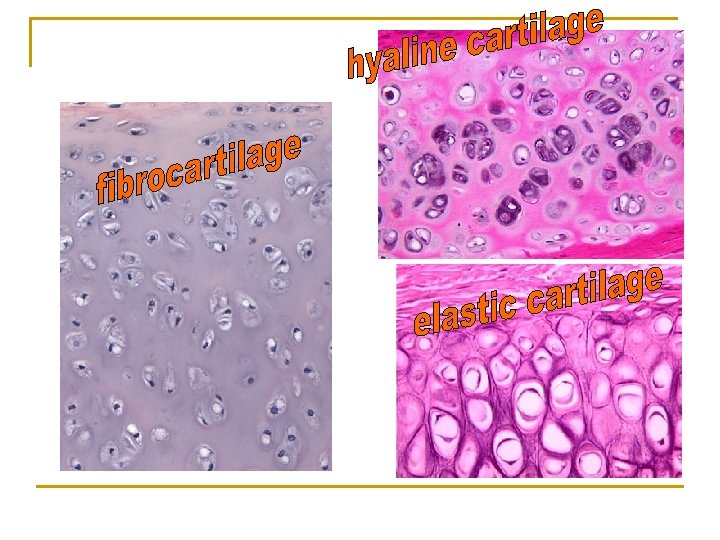
Cartilage n n n Partly rigid/partly flexible Provides support and a framework for attachments Matrix is mostly collagenous fibers in a gellike ground substance Cells are called chondrocytes and occupy small chambers (lacunae) Three basic types
Types of cartilage n Hyaline cartilage q q n Elastic cartilage q q n Most common type (looks like plastic) Found on the ends of bones and in many joints, soft part of the nose and respiratory passages The most flexible type Found in the external ear and parts of the larynx Fibrocartilage q q Very tough tissue Found between bones—intervertebral disks, knees, and pelvic girdle
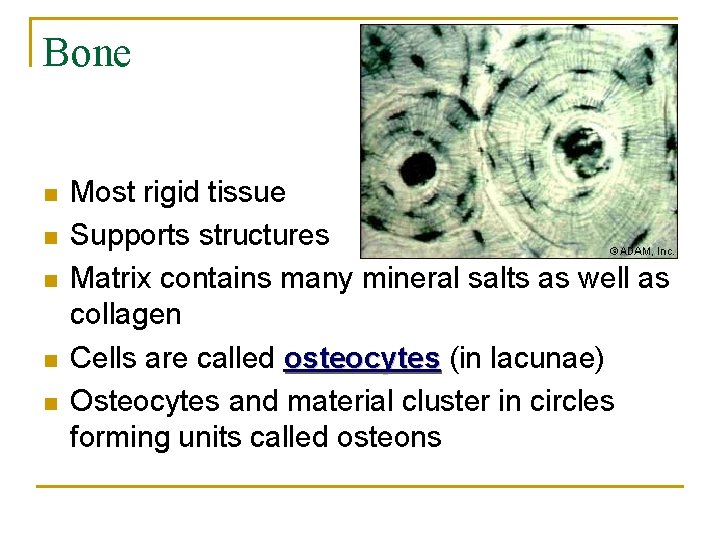
Bone n n n Most rigid tissue Supports structures Matrix contains many mineral salts as well as collagen Cells are called osteocytes (in lacunae) Osteocytes and material cluster in circles forming units called osteons
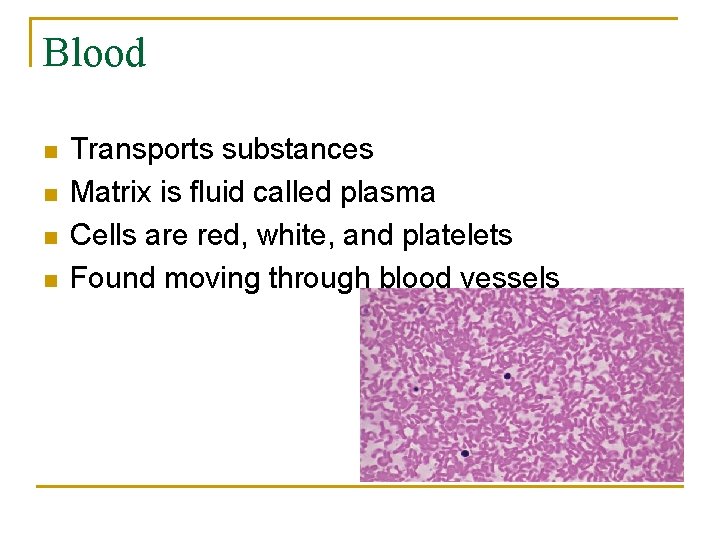
Blood n n Transports substances Matrix is fluid called plasma Cells are red, white, and platelets Found moving through blood vessels
- Slides: 12