
Connective Tissue 1 definition one of the basic
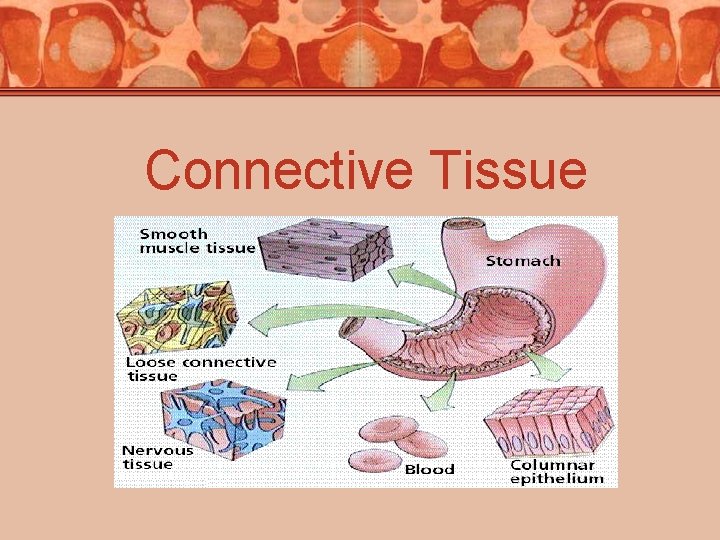
Connective Tissue
1. definition: one of the basic tissue types that provides a structural framework for the body that stabilizes the relative positions of the other tissue types; includes, blood, bone, cartilage, and loose and fibrous connective tissue
2. Functions: a. support and protection 1) minerals & fibers produced establish structural framework 2) protect organs 3) surround and interconnect b. transportation of materials by fluid C. T. c. storage of energy reserves d. defense of the body
3. Components a. special cells b. protein fibers form matrix: the extracellular fibers and ground substance of a C. T. c. ground substance
4. Classification: based on physical properties of matrix a. C. T. Proper 1) many types of cells and fibers w/i a matrix containing syrupy ground substance 2) examples: fatty tissue, tendons and ligaments, and underlying skin
4. Classification: cont’ b. Fluid C. T. 1) cells suspended in watery matrix 2) examples: blood & lymph
4. Classification: cont’ c. Supporting C. T. 1) matrix dense ground substance, closely packed fibers, less diverse cell population 2) examples: cartilage and bone
![5. Component Characteristics [Figure 4 -8 p 105] a. Tissue Cells 1) Fibroblasts a)](http://slidetodoc.com/presentation_image_h2/567634cf87b4b66c06f7538ac8d85c3c/image-8.jpg "5. Component Characteristics [Figure 4 -8 p 105] a. Tissue Cells 1) Fibroblasts a)")
5. Component Characteristics [Figure 4 -8 p 105] a. Tissue Cells 1) Fibroblasts a) most common b) produce fibers for secreting proteins into surrounding matrix 2) Fibrocytes: differentiates types
5. Component Characteristics cont’ 3) Macrophages a) phagocytize damaged cells or pathogens b) release chemicals that mobilize the immune system c) fixed and free 4) Fat cells (adipocytes)
5. Component Characteristics cont’ 5) Mast cells a) large and widely distributed near blood vessels b) release heparin (prevents blood from clotting) c) release histamine (promotes reactions associated with inflammation & allergies) d) initiates inflammatory response
b. Tissue Fibers 1) collagenous "white fibers" a) thick, threads made from molecules of collagen protein b) grouped in long parallel bundles c) flexible and only slightly elastic for binding d) great tensile strength (resist pulling force)
b. Tissue Fibers cont’ 2) elastic "yellow fibers" a) composed of the protein elastin b) thin fibers branch to form complex networks c) weaker than collagenous but stretch and resume
b. Tissue Fibers cont’ 3) reticular a) least common b) thin, collagenous fibers branching c) form delicate supporting networks for binding
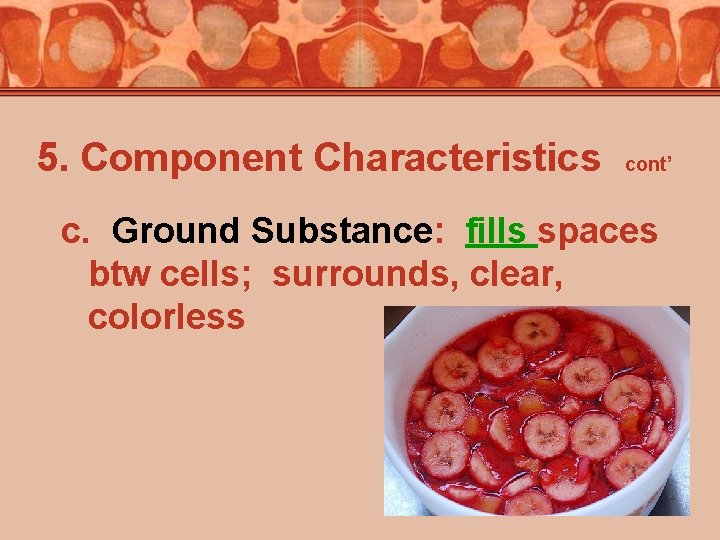
5. Component Characteristics cont’ c. Ground Substance: fills spaces btw cells; surrounds, clear, colorless
6. C. T. Proper a. Loose fibrous connective tissue 1) Description a) mainly fibroblast cells b) located some distance apart; irregular arrangement c) separated by a gel-like matrix d) has both elastin and collagenous fibers
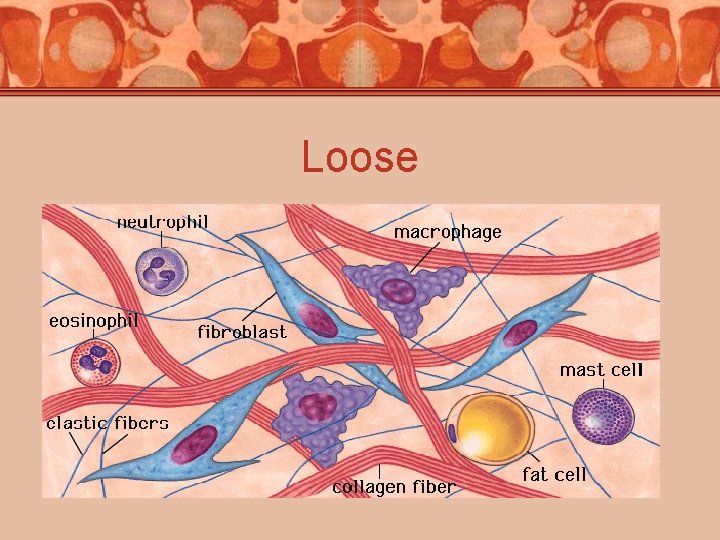
Loose
Loose fibrous C. T. cont’ 2) Location a) binds skin to underlying organs b) forms delicate, thin membranes throughout the body c) fills spaces between muscles d) found beneath most epithelial tissue e) many blood vessels which nourish epithelium
6. C. T. Proper cont’ b. Adipose tissue 1) description a) specialized loose, fibrous connective tissue w/ adipocytes b) develops when certain cells store fat droplets w/in cytoplasm and enlarge
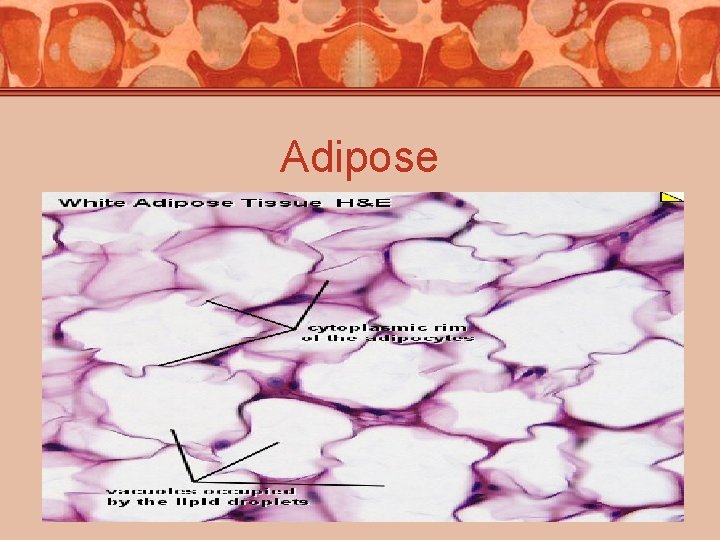
Adipose
Adipose tissue cont’ 2) Location a) in spaces between muscles b) around certain joints and some organs (ie. kidney, heart, eye, . . ) c) skin of sides, buttocks, breasts
Adipose tissue cont’ 3) Other--overeating and lack of exercise can cause them to become larger they shrink when fasting and become more like fibroblasts 4) Functions a) insulation b) stores energy c) protective padding
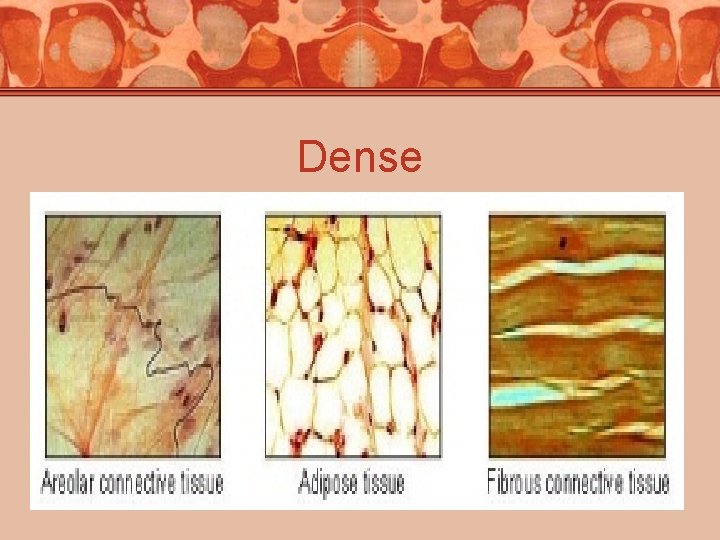
6. C. T. Proper c. Dense fibrous connective tissue (regular / irregular) 1) Description a) mostly thick collagenous fibers, closely packed b) fine network of elastic fibers c) few cells, most are fibroblasts
Dense
Dense fibrous connective tissue cont’ 2) Location a) deep skin layers b) protective layers of eyeball c) component of tendons and ligaments
Dense fibrous connective tissue cont’ 3) Function a) binds body parts together b) slow or incomplete in tissue repair due to poor blood supply
7. Fluid C. T. a. Blood 1) Functions a) maintains stable internal environment b) transports substances
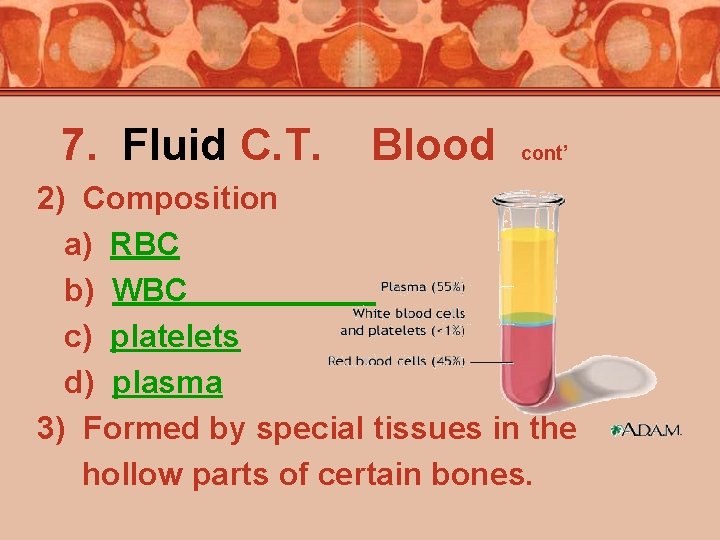
7. Fluid C. T. Blood cont’ 2) Composition a) RBC b) WBC c) platelets d) plasma 3) Formed by special tissues in the hollow parts of certain bones.
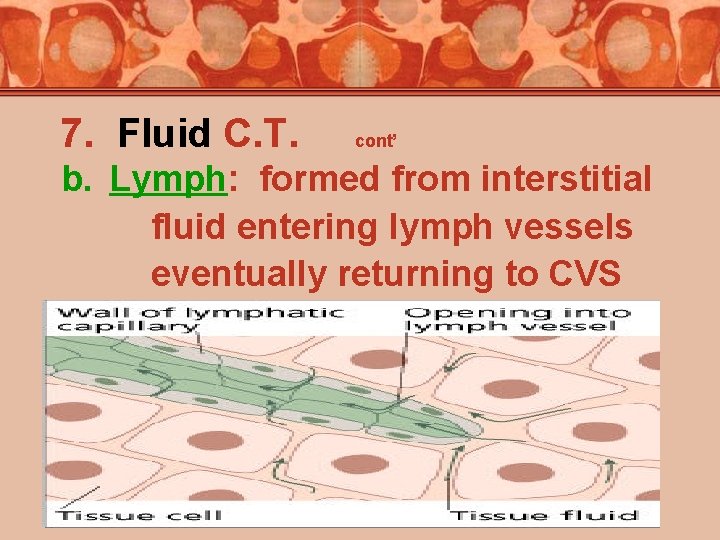
7. Fluid C. T. cont’ b. Lymph: formed from interstitial fluid entering lymph vessels eventually returning to CVS
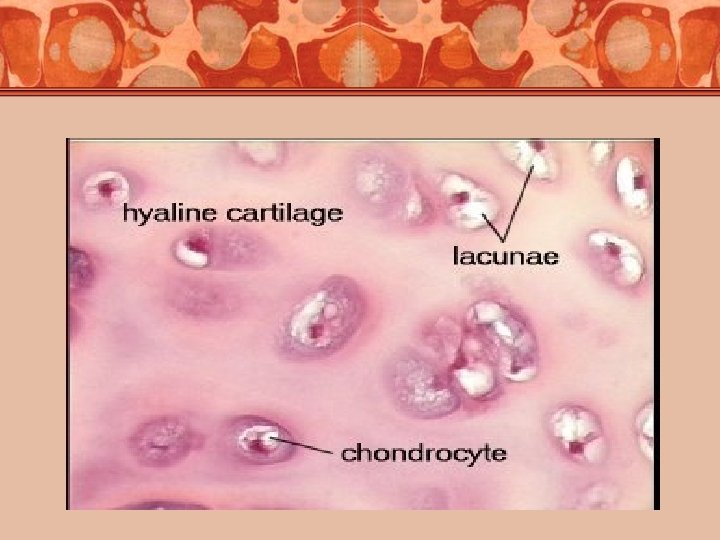
8. Supporting C. T. a. Cartilage 1) Definition: type of connective tissue in which cells (chondrocytes) are w/in lacunae (pockets) and separated by a semisolid matrix
Cartilage cont’ 2) Function a) support; frameworks & attachments b) protects underlying tissues c) forms structural models for many developing bones
Cartilage cont’ 3) Description a) intercellular material abundant b) composed of collagenous fibers embedded in gel-like grd. substance c) partly rigid, partly flexible d) enclosed in perichondrium e) lacks direct blood supply slow healing
4) Types: a) Hyaline (1) most common (2) has fine, loose collagenous fibers (resembles white plastic) (3) located on ends of bones, soft part of nose, supports rings of respiratory passages (4) important in the development of most bones
4) Types: b) Elastic (1) contains dense network of elastic fibers (2) more flexible than hyaline (3) located in frames of ears, parts of larynx, and auditory tube
4) Types: c) Fibrocartilage (1) tough with many collagen fibers (2) functions as shock absorber (3) located between parts of backbone, in knees, in pelvic girdle
e. Bone aka: osseous 1) Description a) most rigid due to mineral salt deposits between cells b) abundant collagen matrix which reinforces minerals c) organized in concentric circles
e. Bone cont’ 2) Functions a) supports body structures b) protects vital parts c) attachment for muscle d) houses marrow (where blood cells form) e) stores inorganic chemicals like Ca & P
e. Bone cont’ 3) Organization a) canaliculi: microscopic passageways btw. cells permitting diffusion of nutrient and waste b) osteocytes: bone cells in lacunae: small pit or cavity c) bone tissue is active tissue which heals rapidly
- Slides: 39