
CONNECTIONISM AND ARTIFICIAL INTELLIGENCE Brandon Herndon Wes Wynmor
CONNECTIONISM AND ARTIFICIAL INTELLIGENCE Brandon Herndon, Wes Wynmor, and Tyler Tuminski
What is Connectionism? � � Connectionism is a theory that seeks to explain the human thought process. It states that the mind is a system of “neural nets” composed of unsophisticated units that play simple roles in how information is gathered and processed.
What is Connectionism? (contd. ) � � � Input units – Units responsible for gathering sensory information. Hidden units – Units that process sensory information sent from input units. Output Units – Units that act on the conclusions drawn from processed information.
Connectionism vs. Classicism � � Classical cognitive theory states that the mind functions by decoding symbols based upon “strings” of pre-decoded symbols. Connectionists propose that the mind functions as connections are drawn between trillions of simple units.
Artificial Intelligence (AI) � The term “artificial intelligence” refers to a field of computer science that seeks to create computers capable of independent thought.

Connectionism and AI � � The “brains” of “intelligent” computers function based on connectionist systems. Watson, the IBM super-computer that beat two of Jeopardy’s finest, has a brain that operates based on a system of algorithm-based connections and analysis.
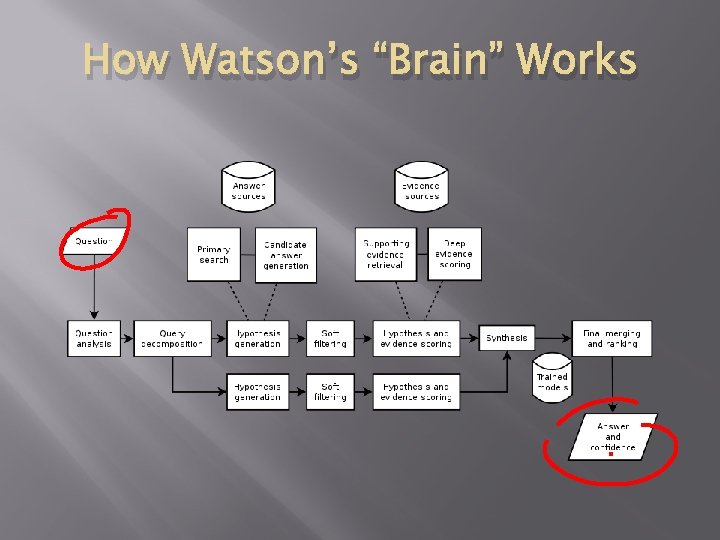
How Watson’s “Brain” Works
Connectionism and Language � � When one has a conversation numerous connectionist principles are in place. When one communicates his or her brain subconsciously considers millions of combinations of words, inflections, and expressions.
Bibliography � � "Connectionism (Stanford Encyclopedia of Philosophy). " Stanford Encyclopedia of Philosophy. Web. 07 Apr. 2011. <http: //plato. stanford. edu/entries/connectionism />.
- Slides: 9