
Connecting the Inside and Outside Worlds Wideband Communication
Connecting the Inside and Outside Worlds: Wideband Communication Across the Skin Maysam Ghovanloo, Ph. D. GT-Bionics Lab School of Electrical and Computer Engineering www. GTBionics. org © 2011 Maysam Ghovanloo 1
Questions A) Important and growth areas in the fields of body area networks and in general signal processing for biomedical engineering? B) How these areas could drive communications, signal processing and networking research? C) Your views on global standards and their status and impact D) Challenging research problems and possible solutions Implantable microelectronic devices that need wideband communication channels with outside of the human body www. GTBionics. org © 2011 Maysam Ghovanloo 2
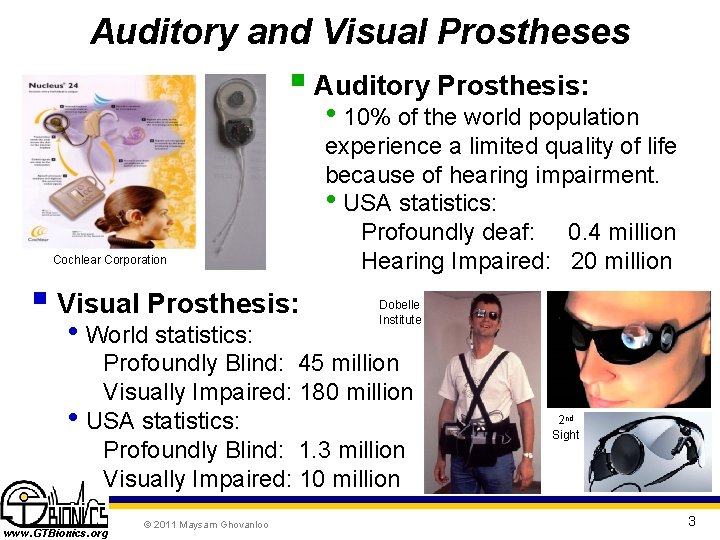
Auditory and Visual Prostheses § Auditory Prosthesis: • 10% of the world population Cochlear Corporation § Visual Prosthesis: • World statistics: experience a limited quality of life because of hearing impairment. • USA statistics: Profoundly deaf: 0. 4 million Hearing Impaired: 20 million Dobelle Institute Profoundly Blind: 45 million Visually Impaired: 180 million • USA statistics: Profoundly Blind: 1. 3 million Visually Impaired: 10 million www. GTBionics. org © 2011 Maysam Ghovanloo 2 nd Sight 3
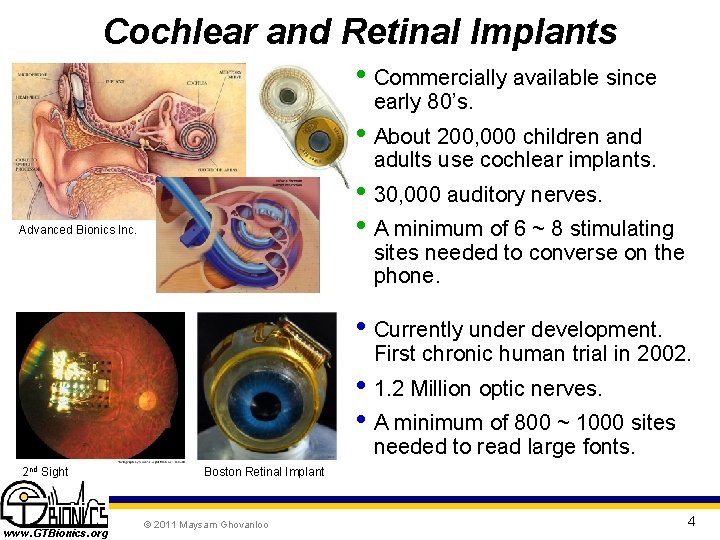
Cochlear and Retinal Implants • Commercially available since early 80’s. • About 200, 000 children and adults use cochlear implants. • 30, 000 auditory nerves. • A minimum of 6 ~ 8 stimulating Advanced Bionics Inc. sites needed to converse on the phone. • Currently under development. First chronic human trial in 2002. • 1. 2 Million optic nerves. • A minimum of 800 ~ 1000 sites needed to read large fonts. 2 nd Sight www. GTBionics. org Boston Retinal Implant © 2011 Maysam Ghovanloo 4
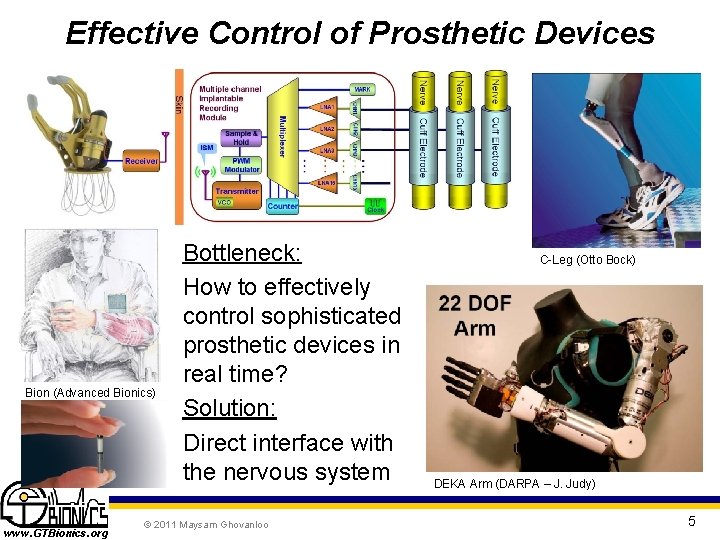
Effective Control of Prosthetic Devices Bion (Advanced Bionics) www. GTBionics. org Bottleneck: How to effectively control sophisticated prosthetic devices in real time? Solution: Direct interface with the nervous system © 2011 Maysam Ghovanloo C-Leg (Otto Bock) DEKA Arm (DARPA – J. Judy) 5
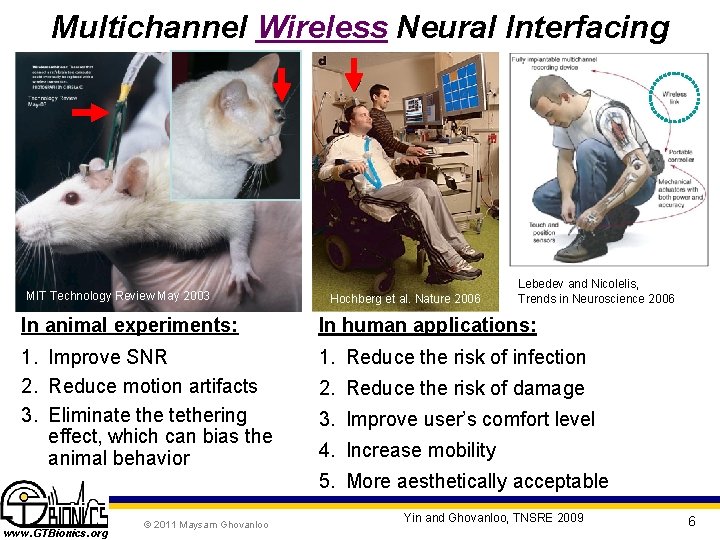
Multichannel Wireless Neural Interfacing MIT Technology Review May 2003 Hochberg et al. Nature 2006 Lebedev and Nicolelis, Trends in Neuroscience 2006 In animal experiments: In human applications: 1. Improve SNR 2. Reduce motion artifacts 3. Eliminate the tethering effect, which can bias the animal behavior 1. Reduce the risk of infection 2. Reduce the risk of damage 3. Improve user’s comfort level 4. Increase mobility 5. More aesthetically acceptable www. GTBionics. org © 2011 Maysam Ghovanloo Yin and Ghovanloo, TNSRE 2009 6
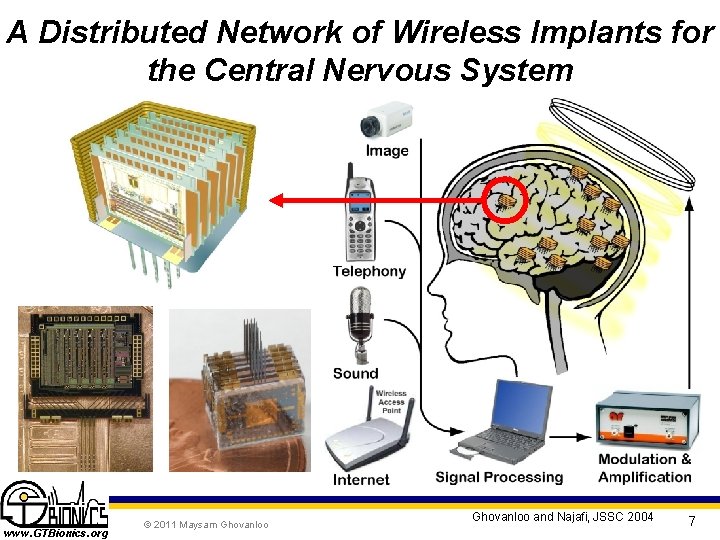
A Distributed Network of Wireless Implants for the Central Nervous System www. GTBionics. org © 2011 Maysam Ghovanloo and Najafi, JSSC 2004 7
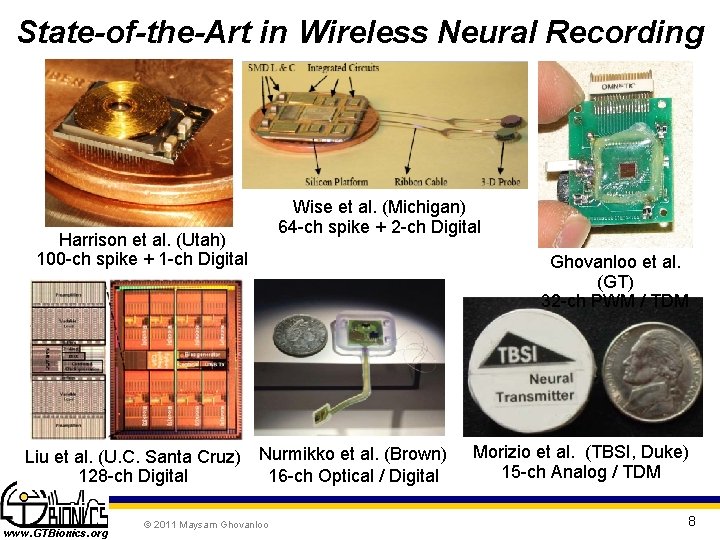
State-of-the-Art in Wireless Neural Recording Wise et al. (Michigan) 64 -ch spike + 2 -ch Digital Harrison et al. (Utah) 100 -ch spike + 1 -ch Digital Liu et al. (U. C. Santa Cruz) 128 -ch Digital www. GTBionics. org Ghovanloo et al. (GT) 32 -ch PWM / TDM Nurmikko et al. (Brown) 16 -ch Optical / Digital © 2011 Maysam Ghovanloo Morizio et al. (TBSI, Duke) 15 -ch Analog / TDM 8
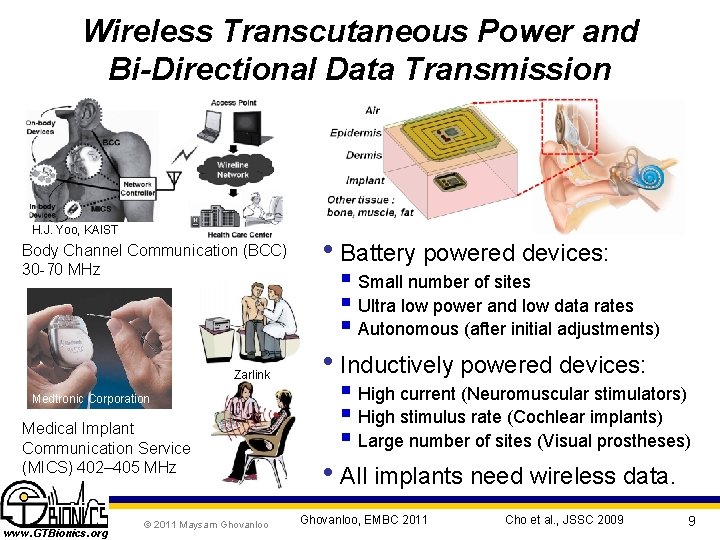
Wireless Transcutaneous Power and Bi-Directional Data Transmission H. J. Yoo, KAIST Body Channel Communication (BCC) 30 -70 MHz Zarlink Medtronic Corporation Medical Implant Communication Service (MICS) 402– 405 MHz www. GTBionics. org © 2011 Maysam Ghovanloo • Battery powered devices: § Small number of sites § Ultra low power and low data rates § Autonomous (after initial adjustments) • Inductively powered devices: § High current (Neuromuscular stimulators) § High stimulus rate (Cochlear implants) § Large number of sites (Visual prostheses) • All implants need wireless data. Ghovanloo, EMBC 2011 Cho et al. , JSSC 2009 9
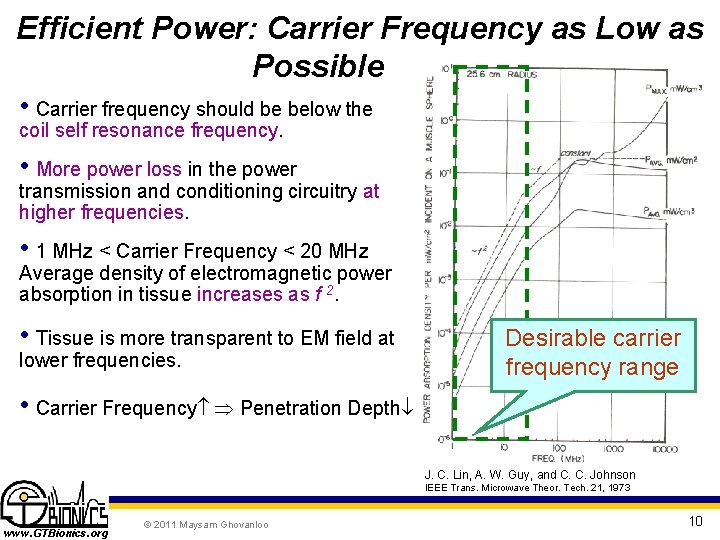
Efficient Power: Carrier Frequency as Low as Possible • Carrier frequency should be below the coil self resonance frequency. • More power loss in the power transmission and conditioning circuitry at higher frequencies. • 1 MHz < Carrier Frequency < 20 MHz Average density of electromagnetic power absorption in tissue increases as f 2. • Tissue is more transparent to EM field at lower frequencies. Desirable carrier frequency range • Carrier Frequency Penetration Depth J. C. Lin, A. W. Guy, and C. C. Johnson IEEE Trans. Microwave Theor. Tech. 21, 1973 www. GTBionics. org © 2011 Maysam Ghovanloo 10
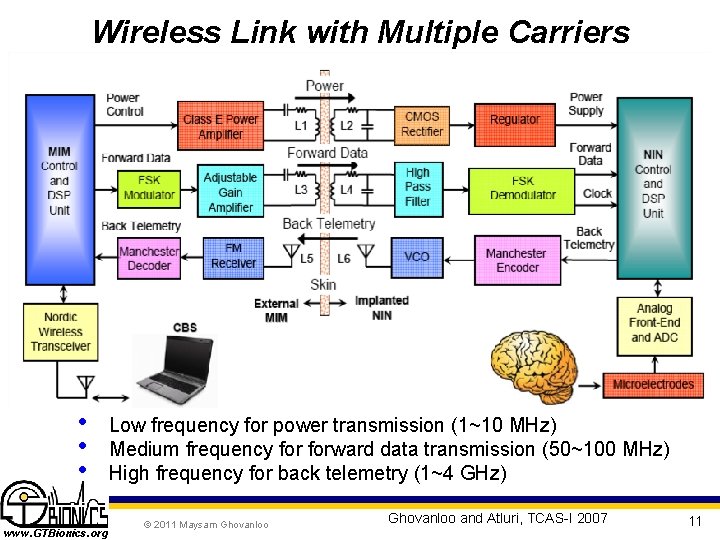
Wireless Link with Multiple Carriers • • • www. GTBionics. org Low frequency for power transmission (1~10 MHz) Medium frequency forward data transmission (50~100 MHz) High frequency for back telemetry (1~4 GHz) © 2011 Maysam Ghovanloo and Atluri, TCAS-I 2007 11
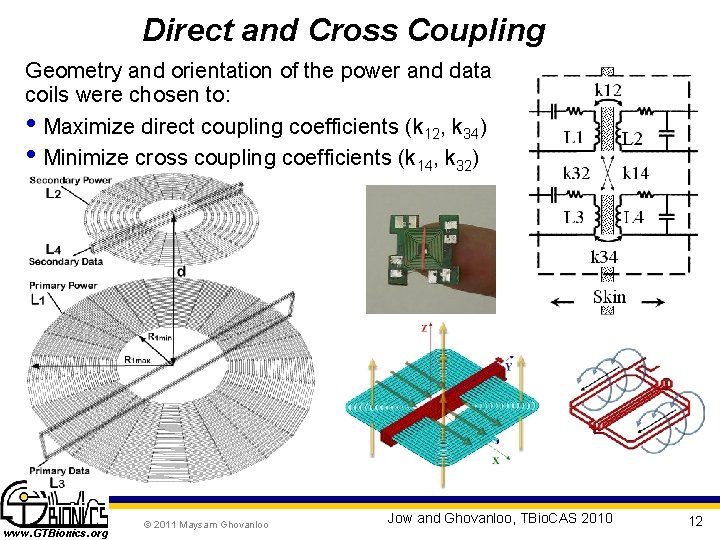
Direct and Cross Coupling Geometry and orientation of the power and data coils were chosen to: • Maximize direct coupling coefficients (k 12, k 34) • Minimize cross coupling coefficients (k 14, k 32) www. GTBionics. org © 2011 Maysam Ghovanloo Jow and Ghovanloo, TBio. CAS 2010 12
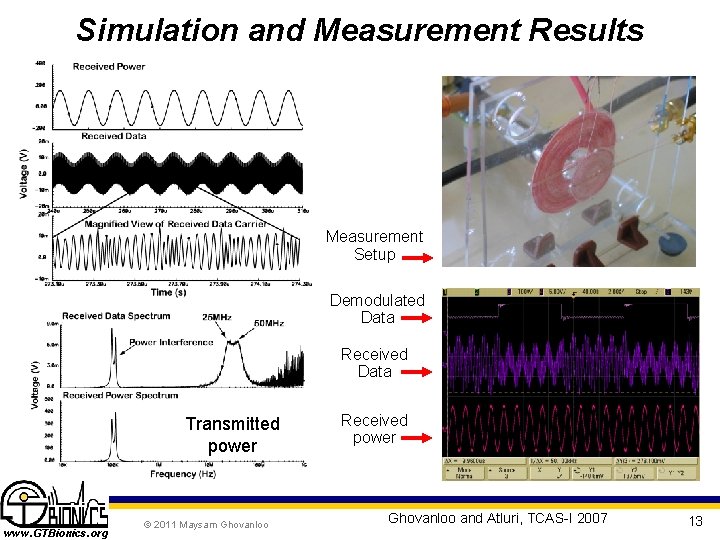
Simulation and Measurement Results Measurement Setup Demodulated Data Received Data Transmitted power www. GTBionics. org © 2011 Maysam Ghovanloo Received power Ghovanloo and Atluri, TCAS-I 2007 13
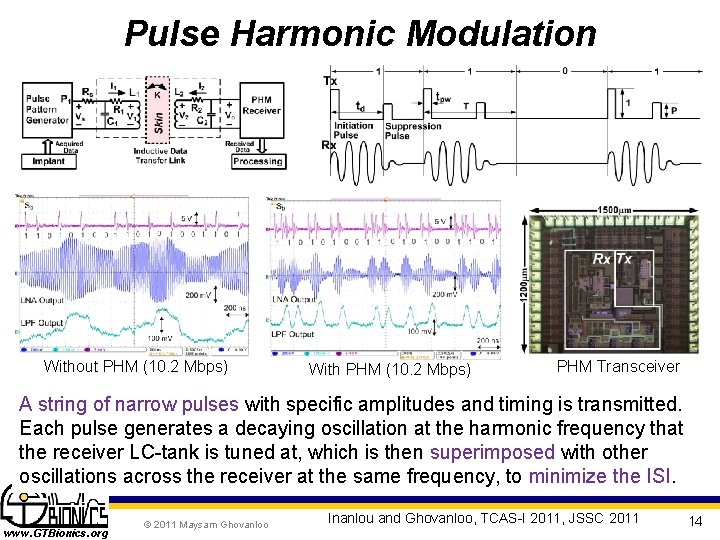
Pulse Harmonic Modulation Without PHM (10. 2 Mbps) With PHM (10. 2 Mbps) PHM Transceiver A string of narrow pulses with specific amplitudes and timing is transmitted. Each pulse generates a decaying oscillation at the harmonic frequency that the receiver LC-tank is tuned at, which is then superimposed with other oscillations across the receiver at the same frequency, to minimize the ISI. www. GTBionics. org © 2011 Maysam Ghovanloo Inanlou and Ghovanloo, TCAS-I 2011, JSSC 2011 14
GT- Bionics Lab Members Xueliang Huo Ph. D. Student xhuo@gatech. edu Uei-Ming Jow Ph. D. Student jow 0209@gatech. edu Hyung-Min Lee Ph. D. Student hyungminlee@gatech. edu Mehdi Kiani Ph. D. Student mkiani 3@gatech. edu Jeonghee Kim Ph. D. Student jkim 448@gatech. edu Hangue Park Ph. D. Student hpark 90@gatech. edu Sergio Carlo Ph. D. Student sergio. carlo@gatec h. edu Elnaz B. Sadeghian Ph. D. Student hpark 90@gatech. edu Undergraduate researchers: Ø Mingjie Zhou Ø Rui Ding www. GTBionics. org © 2011 Maysam Ghovanloo Ø Chukwuyem (Doyle) Emelue Ø Peter Mc. Menamin Ø Jecolia Longtchi Seung Bae Lee Ph. D. Student slee 87@gatech. edu 15
Acknowledgements • Funding provided by: – – National Science Foundation Christopher and Dana Reeve Foundation National Institutes of Health Army Research Office (ARO) • Collaborators: – – – – Dr. Michael Jones, Shepherd Center, Atlanta, GA Dr. Ann Laumann, Northwestern University, Chicago, IL Dr. Joseph Manns, Emory University, Atlanta, GA Dr. Elliot Roth, Rehab. Institute of Chicago, IL Dr. Elizabeth Bailey, University of Arizona, Tucson, AZ Dr. Karim Oweiss, Michigan State University, Lansing, MI Dr. Kimberly Wilson, Emory Hospital, Atlanta, GA Dr. Stephen Sprigle, Georgia Tech, Atlanta, GA www. GTBionics. org © 2011 Maysam Ghovanloo 16
- Slides: 16