
Connecting Research Policy and Practice IES Grant Writing
- Slides: 69
Connecting Research, Policy and Practice IES Grant Writing Workshop for Development & Innovation Projects Jacquelyn Buckley, Ph. D. Program Officer National Center for Special Education Research Emily Doolittle, Ph. D. Program Officer National Center for Education Research ies. ed. gov
Agenda • Introduction to IES • Education Research Grants (84. 305 A) and Special Education Research Grants (84. 324 A) • The Development & Innovation Goal • Four Sections of the Research Narrative – – Significance Research Plan Personnel Resources • Application Submission and Review ies. ed. gov 2
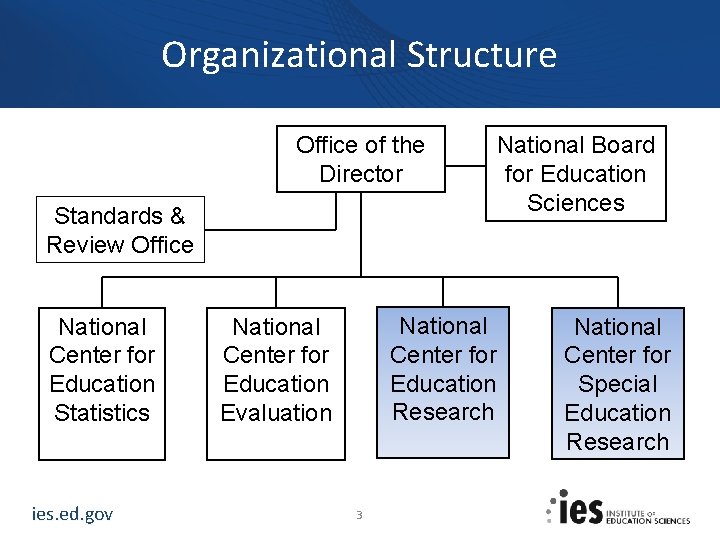
Organizational Structure Office of the Director Standards & Review Office National Center for Education Statistics ies. ed. gov National Board for Education Sciences National Center for Education Research National Center for Education Evaluation 3 National Center for Special Education Research
Overall Research Objectives • Develop or identify education interventions (i. e. , practices, programs, policies, and approaches) that enhance academic achievement and that can be widely deployed • Identify what does not work and thereby encourage innovation and further research • Understand the processes that underlie the effectiveness of education interventions and the variation in their effectiveness ies. ed. gov 4
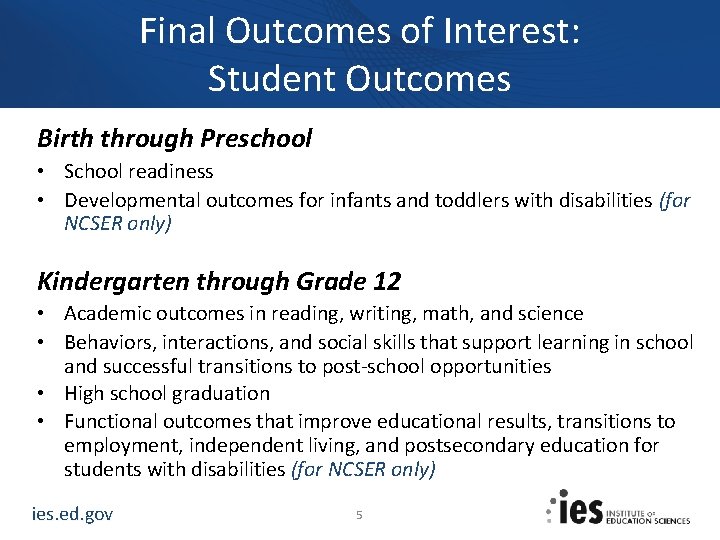
Final Outcomes of Interest: Student Outcomes Birth through Preschool • School readiness • Developmental outcomes for infants and toddlers with disabilities (for NCSER only) Kindergarten through Grade 12 • Academic outcomes in reading, writing, math, and science • Behaviors, interactions, and social skills that support learning in school and successful transitions to post-school opportunities • High school graduation • Functional outcomes that improve educational results, transitions to employment, independent living, and postsecondary education for students with disabilities (for NCSER only) ies. ed. gov 5
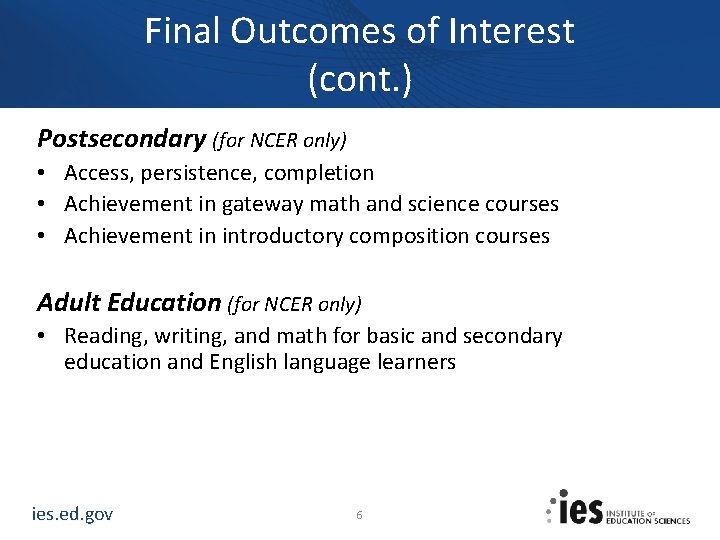
Final Outcomes of Interest (cont. ) Postsecondary (for NCER only) • Access, persistence, completion • Achievement in gateway math and science courses • Achievement in introductory composition courses Adult Education (for NCER only) • Reading, writing, and math for basic and secondary education and English language learners ies. ed. gov 6
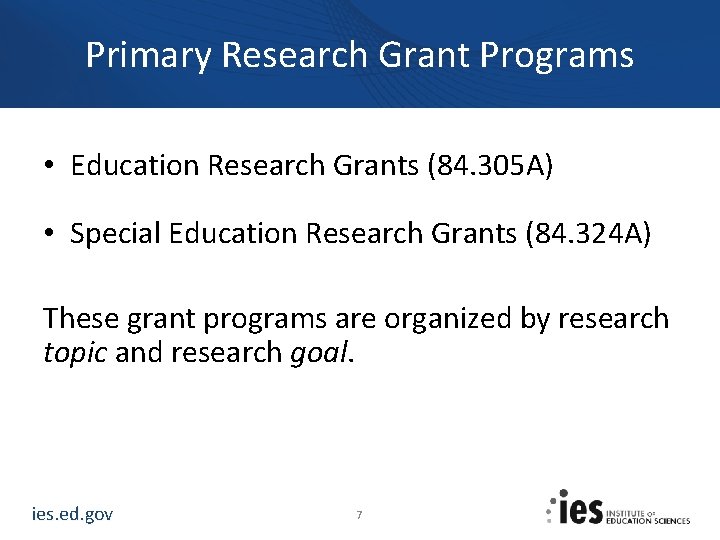
Primary Research Grant Programs • Education Research Grants (84. 305 A) • Special Education Research Grants (84. 324 A) These grant programs are organized by research topic and research goal. ies. ed. gov 7
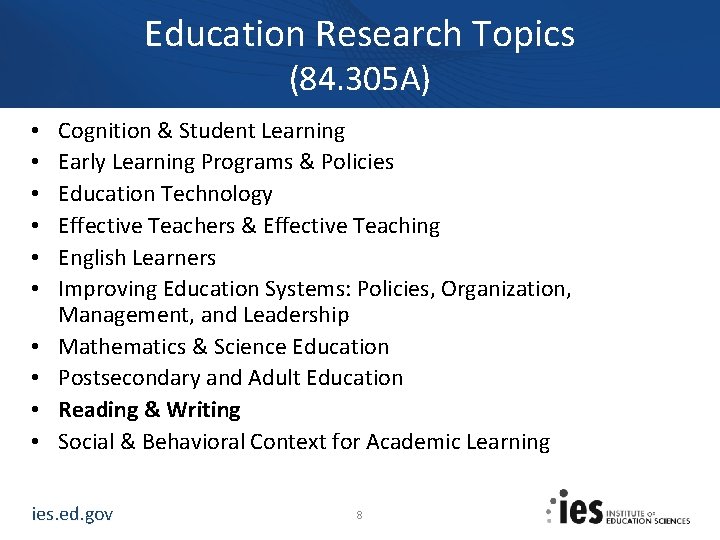
Education Research Topics (84. 305 A) • • • Cognition & Student Learning Early Learning Programs & Policies Education Technology Effective Teachers & Effective Teaching English Learners Improving Education Systems: Policies, Organization, Management, and Leadership Mathematics & Science Education Postsecondary and Adult Education Reading & Writing Social & Behavioral Context for Academic Learning ies. ed. gov 8
Special Education Research Topics (84. 324 A) Autism Spectrum Disorders Cognition & Student Learning in Special Education Early Intervention & Early Learning in Special Education Families of Children with Disabilities Mathematics & Science Education in Special Education Professional Development for Teachers & Related Service Providers • Reading, Writing, and Language Development • Social & Behavioral Outcomes to Support Learning • Special Education Policy, Finance, and Systems • Technology for Special Education • ies. ed. gov Transition Outcomes for Secondary Students with Disabilities 9 • • •
Agenda • Introduction to IES • Education Research Grants (84. 305 A) and Special Education Research Grants (84. 324 A) • The Development & Innovation Goal • Four Sections of the Research Narrative – – Significance Research Plan Personnel Resources • Application Submission and Review ies. ed. gov 10
The 5 Research Goals • Exploration • Development & Innovation • Efficacy & Replication • Effectiveness • Measurement ies. ed. gov 11
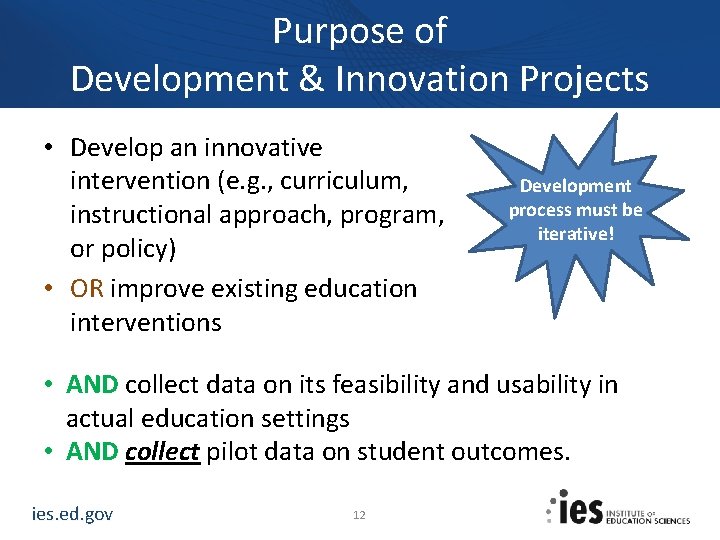
Purpose of Development & Innovation Projects • Develop an innovative intervention (e. g. , curriculum, instructional approach, program, or policy) • OR improve existing education interventions Development process must be iterative! • AND collect data on its feasibility and usability in actual education settings • AND collect pilot data on student outcomes. ies. ed. gov 12
Is Development the right goal for me? Ask, “Do I understand the problem? ” • Can I explain the underlying processes? • Do I know what malleable factors might be targets for intervention? • Do I know what distinguishes effective and less effective practices? ies. ed. gov 13
Development & Innovation Projects • About 50% of funded research projects across both Centers ies. ed. gov 14
Development & Innovation Projects SHOULD • Develop a new intervention or further develop an existing intervention • Implement intervention in authentic education delivery settings • Examine potential/promise of impact on education outcomes for students ies. ed. gov 15
Development & Innovation Projects SHOULD NOT • Propose only minor development activities and focus primarily on rigorous test of the intervention on student outcomes – Such projects should be submitted under the Efficacy goal ies. ed. gov 16
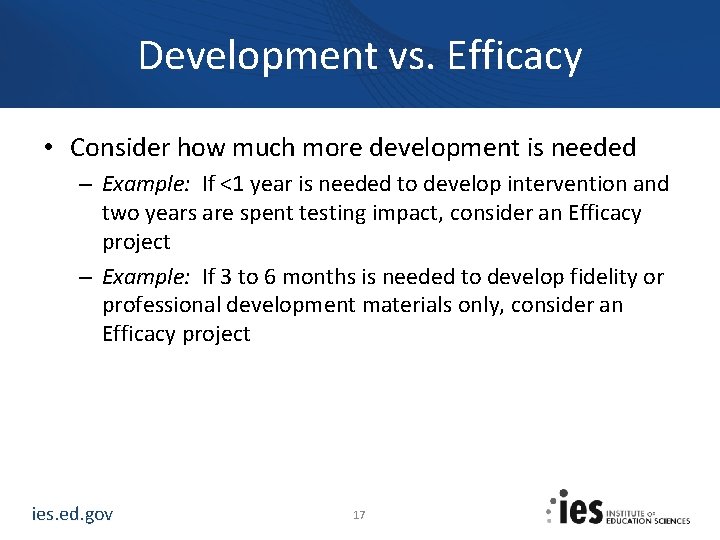
Development vs. Efficacy • Consider how much more development is needed – Example: If <1 year is needed to develop intervention and two years are spent testing impact, consider an Efficacy project – Example: If 3 to 6 months is needed to develop fidelity or professional development materials only, consider an Efficacy project ies. ed. gov 17
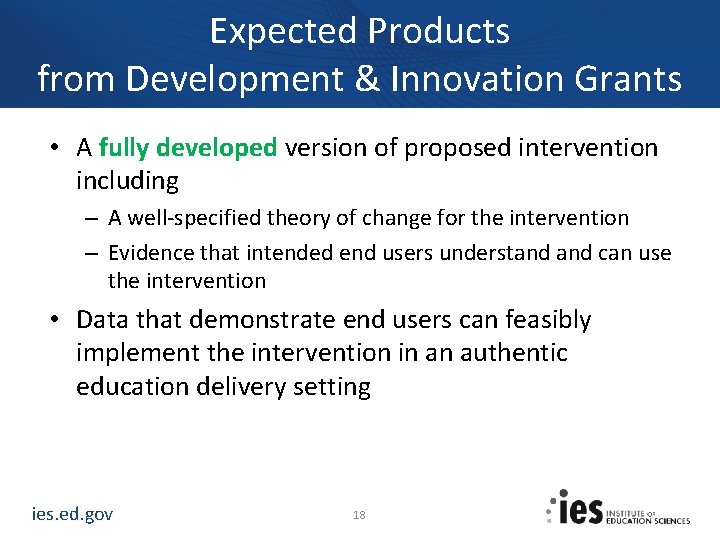
Expected Products from Development & Innovation Grants • A fully developed version of proposed intervention including – A well-specified theory of change for the intervention – Evidence that intended end users understand can use the intervention • Data that demonstrate end users can feasibly implement the intervention in an authentic education delivery setting ies. ed. gov 18
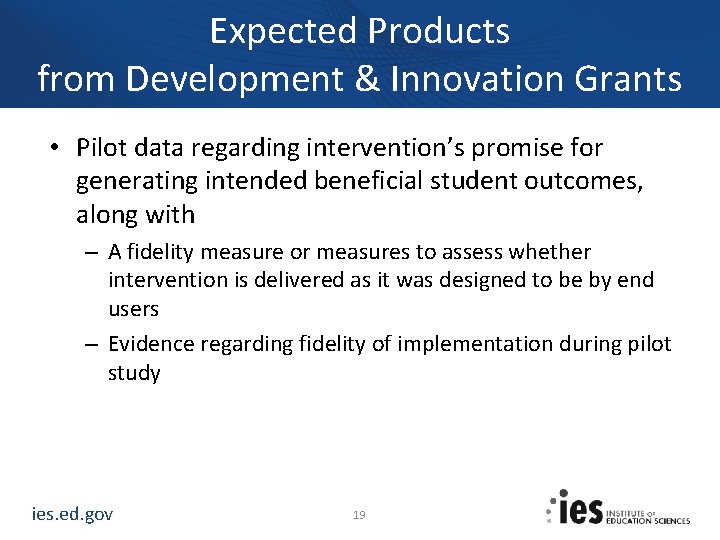
Expected Products from Development & Innovation Grants • Pilot data regarding intervention’s promise for generating intended beneficial student outcomes, along with – A fidelity measure or measures to assess whether intervention is delivered as it was designed to be by end users – Evidence regarding fidelity of implementation during pilot study ies. ed. gov 19
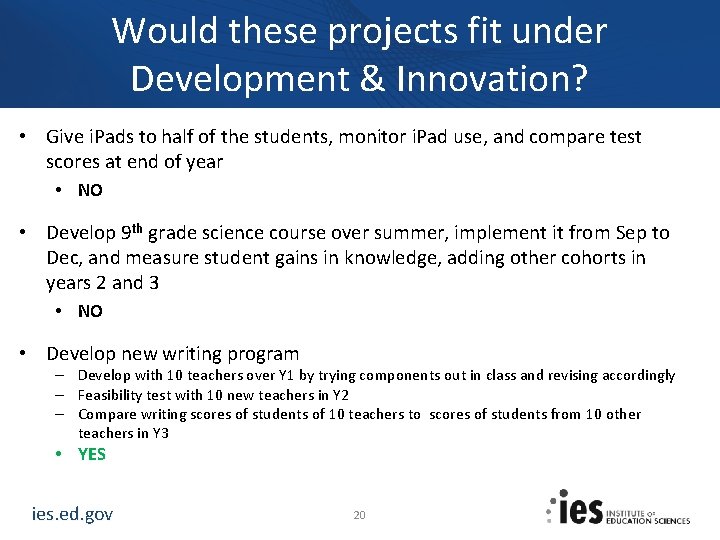
Would these projects fit under Development & Innovation? • Give i. Pads to half of the students, monitor i. Pad use, and compare test scores at end of year • NO • Develop 9 th grade science course over summer, implement it from Sep to Dec, and measure student gains in knowledge, adding other cohorts in years 2 and 3 • NO • Develop new writing program – Develop with 10 teachers over Y 1 by trying components out in class and revising accordingly – Feasibility test with 10 new teachers in Y 2 – Compare writing scores of students of 10 teachers to scores of students from 10 other teachers in Y 3 • YES ies. ed. gov 20
Development & Innovation Projects: Challenges • No widely accepted, systematic process for developing interventions • Education interventions cover wide range in scope • Disciplinary differences in approaches ies. ed. gov 21
Agenda • Introduction to IES • Education Research Grants (84. 305 A) and Special Education Research Grants (84. 324 A) • The Development & Innovation Goal • Four Sections of the Research Narrative – – Significance Research Plan Personnel Resources • Application Submission and Review ies. ed. gov 22
Research Narrative • Key portion of your application • Comprised of four sections – – Significance Research Plan Personnel Resources ies. ed. gov 23
Significance Answers these “big picture” questions: 1. What is the specific intervention to be developed/revised? 2. Why is this intervention expected to produce better student outcomes than current education practice 3. What is the overall importance of the proposed project? ies. ed. gov 24
Significance: Describe specific issue or problem • Address overall importance of issue/problem • Describe how its resolution will contribute to improvement of student outcomes • Include discussion of importance of problem to education stakeholders ies. ed. gov 25
Significance: Intervention Description • What are the components or features of the proposed intervention? • How do the features or components relate to each other? • Who will implement or use it? • How will it be used? Contrast these with current practice and its identified shortcomings ies. ed. gov 26
Significance: KEY QUESTION • Why is the proposed intervention likely to produce better student outcomes relative to current education practices? ies. ed. gov 27
Example: Teacher PD for Pre-K ELL Vocabulary Instruction • Content – Which words will be taught? What is the rationale for that decision? • Strategies for vocabulary instruction – What techniques? Rationale? • Delivery of information to teachers – What materials? What mode of instruction for teachers? Rationale? • Objective – What should teachers be able to do? – What should their students be able to do? ies. ed. gov 28
Significance: Initial Theory of Change • What is the causal chain of events that leads from the implementation of the intervention to the desired outcome? ies. ed. gov 29
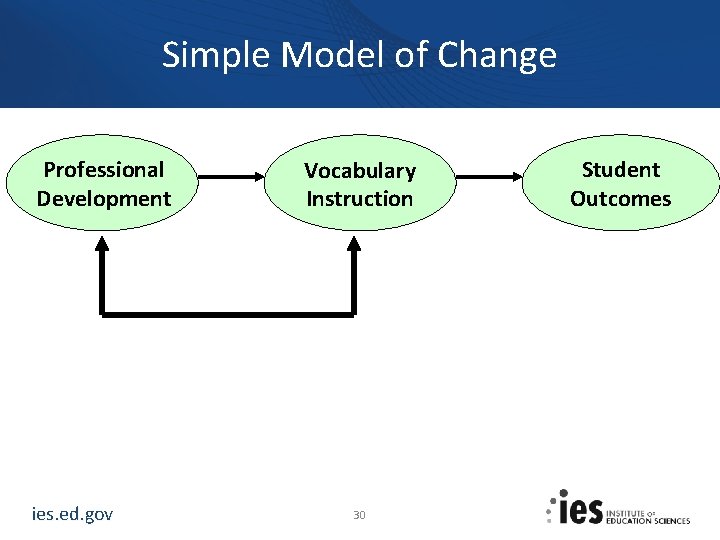
Simple Model of Change Professional Development ies. ed. gov Vocabulary Instruction 30 Student Outcomes
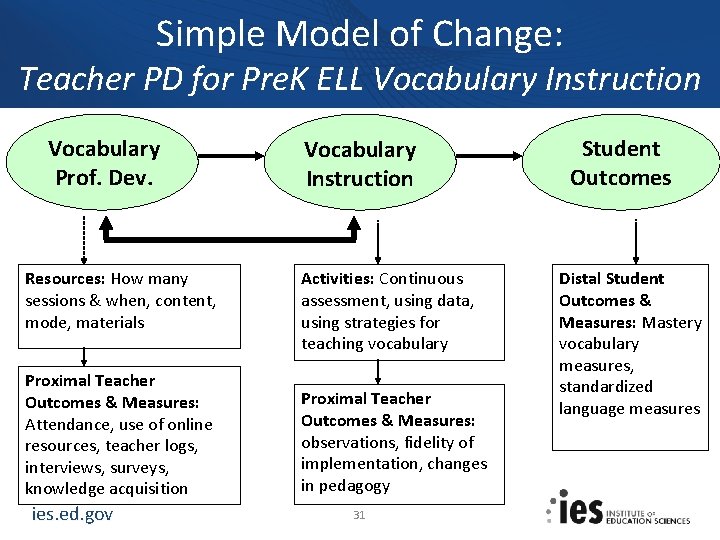
Simple Model of Change: Teacher PD for Pre. K ELL Vocabulary Instruction Vocabulary Prof. Dev. Resources: How many sessions & when, content, mode, materials Proximal Teacher Outcomes & Measures: Attendance, use of online resources, teacher logs, interviews, surveys, knowledge acquisition ies. ed. gov Vocabulary Instruction Activities: Continuous assessment, using data, using strategies for teaching vocabulary Proximal Teacher Outcomes & Measures: observations, fidelity of implementation, changes in pedagogy 31 Student Outcomes Distal Student Outcomes & Measures: Mastery vocabulary measures, standardized language measures
Significance: Theoretical & Empirical Rationale • What are theoretical justifications supporting theory of change? • What is the empirical evidence supporting theory of change? ies. ed. gov 32
Significance: Practical importance • Describe why fully developed intervention will have potential to improve student outcomes in educationally meaningful increments • Describe why proposed intervention may be affordable for and easily implemented by authentic education delivery settings ies. ed. gov 33
Additional Considerations If Seeking a Second Development Award • If seeking to further develop or extend an intervention from a previous Development award, you should – Justify need for a second Development award – Describe results and outcomes from other Development efforts – Describe related efficacy evaluations and data (if available) ies. ed. gov 34
Four Sections of the Research Narrative • • Significance Research Plan Personnel Resources ies. ed. gov 35
Research Plan • Clear description of development activities, so that reviewers will understand – What will be developed – How it will be developed – When the development will take place ies. ed. gov 36
Research Plan 1. 2. 3. 4. 5. Sample Iterative development process Feasibility of implementation Pilot study Measures ies. ed. gov 37
Sample • Describe samples & settings that will be used to – iteratively develop intervention – assess feasibility of implementation – assess promise of intervention in pilot data ies. ed. gov 38
Iterative Development Process Make clear • What will be developed • How it will be developed to ensure usability • Chronological order of development ies. ed. gov 39
Iterative Development Process • How will initial version of intervention be developed • How will you refine and improve upon initial version of intervention • What data will be collected to determine how intervention (or component) is operating • How will data collected be used to revise intervention • What criteria will be used to determine if intervention can be successfully used by intended end user ies. ed. gov 40
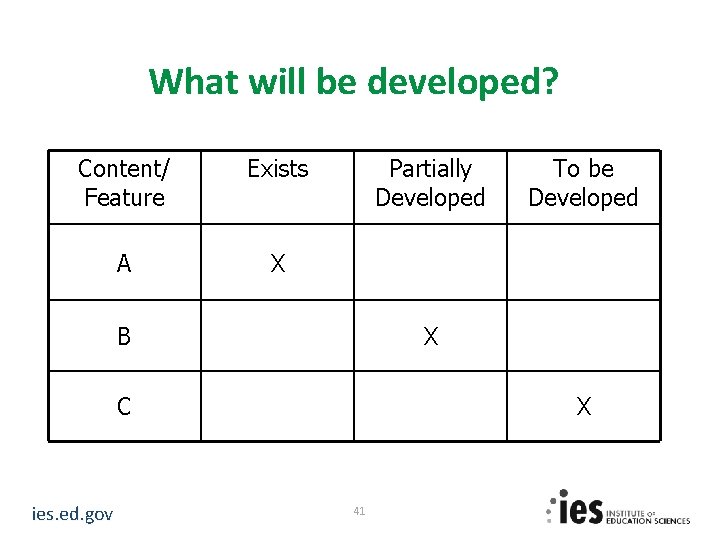
What will be developed? Content/ Feature Exists A X Partially Developed B X C ies. ed. gov To be Developed X 41
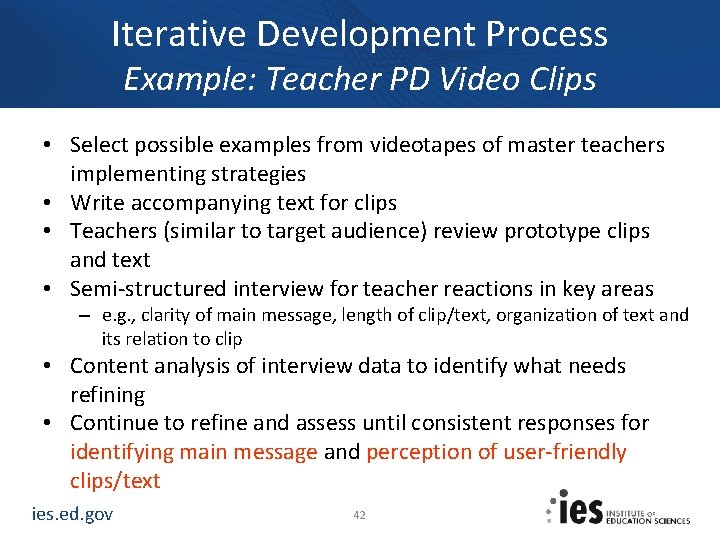
Iterative Development Process Example: Teacher PD Video Clips • Select possible examples from videotapes of master teachers implementing strategies • Write accompanying text for clips • Teachers (similar to target audience) review prototype clips and text • Semi-structured interview for teacher reactions in key areas – e. g. , clarity of main message, length of clip/text, organization of text and its relation to clip • Content analysis of interview data to identify what needs refining • Continue to refine and assess until consistent responses for identifying main message and perception of user-friendly clips/text ies. ed. gov 42
How many iterations? ? Depends on intervention • Complexity • Implementation ies. ed. gov 43
Feasibility of Intervention • Demonstrate that intervention can be implemented with fidelity – In settings that represent type of settings for which intervention is intended – By users who are like those for whom product is intended ies. ed. gov 44
Pilot Study: Promise of the Intervention • Do targeted student outcomes change in the appropriate direction? • Is implementation of intervention associated with changes in activities and behaviors that are consistent with theory of change? ies. ed. gov 45
Pilot Study: Promise of the Intervention • Type of pilot study depends upon – Complexity of intervention, – Level of intervention implementation, – 30% limit on grants funds that can be used for pilot study ies. ed. gov 46
Pilot Study: Promise of the Intervention • Pilot studies may range along continuum of rigor – – Efficacy studies Underpowered efficacy studies Single-case experimental studies Quasi-experimental studies ies. ed. gov 47
Measures • Procedures for collecting data – Often includes collection of process data using observational, survey, or qualitative methodologies • Measures to be used – Including reliability and validity information, where appropriate • Measures of fidelity of implementation ies. ed. gov 48
Measures • Give careful consideration to measures of student outcomes – Measures sensitive to intervention – Measures of practical interest to education policymakers and practitioners ies. ed. gov 49
Four Sections of the Research Narrative • • Significance Research Plan Personnel Resources ies. ed. gov 50
Personnel Section • Describe key personnel – Show that every aspect of project has person with expertise to do it • • Appropriate methodological expertise Substantive person for all issues addressed Do not propose to hire a key person with X expertise Project management skills – Show that every aspect of project has enough time from expert • Orient CVs so specific to project – 4 pages plus 1 page for other sources of support ies. ed. gov 51
Personnel Strategies for PI • Senior Researcher as PI – Show adequate time to be PI – Make credentials clear (not all reviewers may know) • Junior Researcher as PI – Show you have adequate expertise not only to do work but to manage project • Continuation of graduate research • Management skills as graduate student – Reviewers more comfortable if you have senior person(s) on project to turn to for advice • Co-PI, Co-I, contractors, advisory board • Have them on for enough time to be taken seriously 52 ies. ed. gov
Resources • Show institutions involved have capacity to support work – Do not use university boilerplate • Show that all organizations involved understand agree to their roles – What will each institution, including schools, contribute to the project – Show strong commitment of schools and districts and alternatives in case of attrition • If you have received a Development grant, describe whether it led to further research ies. ed. gov 53
Resources (cont. ) • Appendix C should back this up – Detailed Letters of Support from research institutions, States, districts, schools ies. ed. gov 54
Additional Considerations If Seeking a Second Development Award • If you have had other Development awards and you want to develop a new intervention, you should: – Indicate whether first intervention has been evaluated for efficacy and describe results (if available) – Show that previous intervention improves or shows promise for improving education outcomes ies. ed. gov 55
Appendices • Appendix A (15 page limit) – Figures, charts, and tables – Examples of measures – 3 pages to address past reviewer comments or to argue that a proposal is a new submission • Appendix B (10 page limit) – Examples of materials used in an intervention or assessment • Appendix C (no page limit) – Letters of agreement (districts, schools, data providers, other partners, consultants) ies. ed. gov 56
Budget and Budget Narrative • Provide a clear budget and budget narrative for overall project and each sub-award • IES Grants. gov Application Submission Guide describes budget categories • Check RFA for specific budget requirements for Research Goals and Grant Programs • Ensure alignment among Research Narrative, Budget, and Budget Narrative ies. ed. gov 57
Awards • Maximum of $1, 500, 000 total cost (direct + indirect) • Maximum of 4 years • Applications proposing more than a maximum will not be accepted for review • In budget narrative, note budgeted cost of pilot study to ensure it does not exceed 30% of total funds ies. ed. gov 58
Agenda • Introduction to IES • Education Research Grants (84. 305 A) and Special Education Research Grants (84. 324 A) • The Development & Innovation Goal • Four Sections of the Research Narrative – Significance – Research Plan – Personnel – Resources • Application Submission and Review ies. ed. gov 59
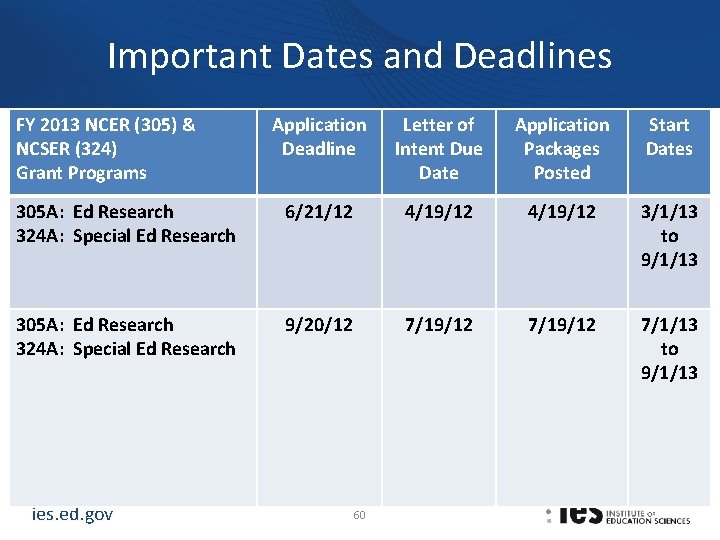
Important Dates and Deadlines FY 2013 NCER (305) & NCSER (324) Grant Programs Application Deadline Letter of Intent Due Date Application Packages Posted Start Dates 305 A: Ed Research 324 A: Special Ed Research 6/21/12 4/19/12 3/1/13 to 9/1/13 305 A: Ed Research 324 A: Special Ed Research 9/20/12 7/19/12 7/1/13 to 9/1/13 ies. ed. gov 60
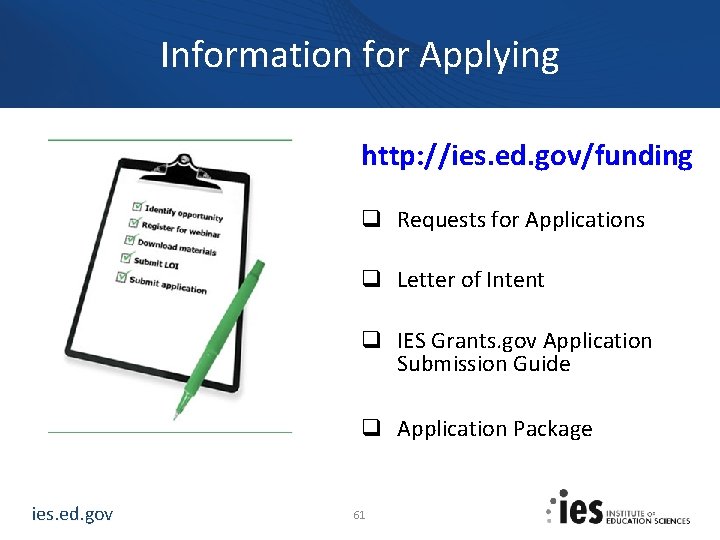
Information for Applying http: //ies. ed. gov/funding q Requests for Applications q Letter of Intent q IES Grants. gov Application Submission Guide q Application Package ies. ed. gov 61
Grant Submission • Make sure your institution is registered on Grants. gov • Complete your online forms and upload PDFs • Authorized representative completes the process • Submit by 4: 30: 00 pm DC time on deadline – earlier is safer • If problems uploading – Contact Help Line 1 -800 -518 -4726 and get a case number ies. ed. gov 62
Verification of Submission • You should receive three e-mails – Grants. gov will say they have received your submission and assign you a number that starts with GRANT – Grants. gov will say your application is validated or rejected due to errors. If the latter, resubmit until validated. – Department of Education will assign you a grant number starting with R 305 or R 324 ies. ed. gov 63
Application Review (Standards & Review Office) • Compliance screening format requirements • Responsiveness screening to program/goal requirements • Assigned to review panel – 2 -3 reviewers (substantive and methodology) – If scored high enough, application is reviewed by full panel • Many panelists will be generalists to your topic • There will be an expert in every procedure you use – Overall score plus scores on Significance, Research Plan, Personnel, and Resources – So far, all applications with overall score of Outstanding and Excellent have been funded • Resubmissions encouraged: Talk to program officer and address reviewer comments ies. ed. gov 64
Peer Review Process Information http: //ies. ed. gov/director/sro/peer_review/index. asp ies. ed. gov 65
Notification • All applicants will receive e-mail notification of the status of their application • All applicants receive copies of reviewer comments • If you are not granted an award the first time, plan on resubmitting and talk to your program officer ies. ed. gov 66
Additional Webinars Available http: //ies. ed. gov/funding/webinars/index. asp Basic Overview Application Process Grant Writing Workshops for each goal Grant Writing Workshops for early career researchers and minority serving institutions • Overviews of research training programs • Overviews of NCSER funding opportunities • • ies. ed. gov 67
For Further Information http: //ies. ed. gov/funding • Contact the program officer for the topic under which you intend to apply: – Available in the Request for Applications – http: //ies. ed. gov/funding/ncer_progs. asp – http: //ies. ed. gov/funding/ncser_progs. asp ies. ed. gov 68
For Further Information Jacquelyn. Buckley@ed. gov Emily. Doolittle@ed. gov ies. ed. gov 69