
Connecting Nursing Theory to Practice How can I
- Slides: 11
Connecting Nursing Theory to Practice How can I think differently?
Introduction In this slide show presentation we will be looking at two major nursing theorists; one contemporary and one classic. I will then briefly explain how these theorists and their theories are applied to nursing practice.
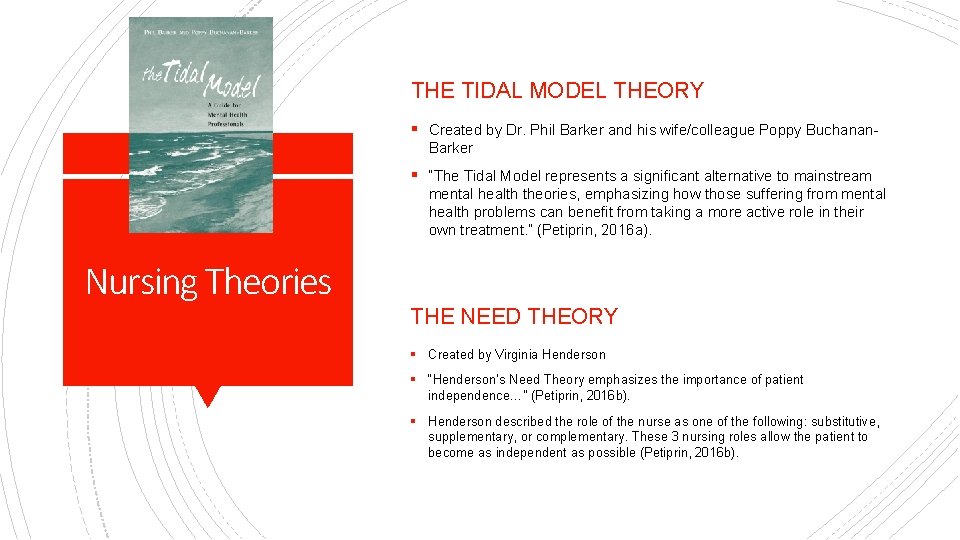
THE TIDAL MODEL THEORY § Created by Dr. Phil Barker and his wife/colleague Poppy Buchanan. Barker § “The Tidal Model represents a significant alternative to mainstream mental health theories, emphasizing how those suffering from mental health problems can benefit from taking a more active role in their own treatment. ” (Petiprin, 2016 a). Nursing Theories THE NEED THEORY § Created by Virginia Henderson § “Henderson’s Need Theory emphasizes the importance of patient independence…” (Petiprin, 2016 b). § Henderson described the role of the nurse as one of the following: substitutive, supplementary, or complementary. These 3 nursing roles allow the patient to become as independent as possible (Petiprin, 2016 b).
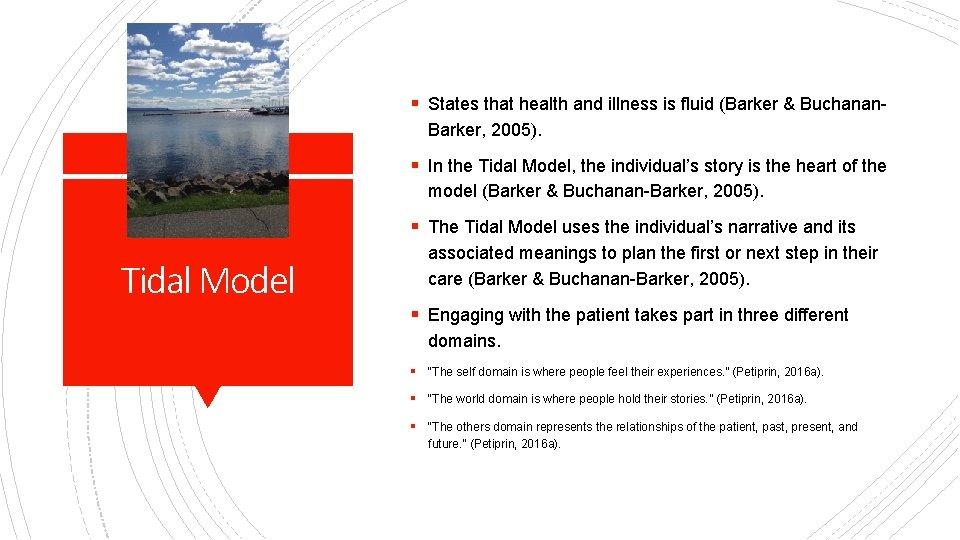
§ Below is a Tidal Model metaphor which explains the model and its application in the healthcare system. Tidal Model Metaphor “Life is a voyage undertaken on an ocean of experience. All human development, including the experience of illness and health, involves discoveries made on that voyage. At critical points in the voyage the person may experience storms or even piracy -in everyday terms this might be called a crisis. At other times the ship may begin to take in water and the person may face the prospect of drowning or shipwreck - commonly called a breakdown. The person may seekor be guided to - a safe haven, to undertake repairs, or otherwise address the effects of the trauma - we might call this rehabilitation. Only once the ship is made intact, and the person has regained the necessary sea-legs, can the ship set sail again, aiming to put the person back on the life course. This is the next stage in the voyage of recovery. ” (“What is the Tidal Model? ”, 2015).
§ States that health and illness is fluid (Barker & Buchanan. Barker, 2005). § In the Tidal Model, the individual’s story is the heart of the model (Barker & Buchanan-Barker, 2005). § The Tidal Model uses the individual’s narrative and its Tidal Model associated meanings to plan the first or next step in their care (Barker & Buchanan-Barker, 2005). § Engaging with the patient takes part in three different domains. § “The self domain is where people feel their experiences. ” (Petiprin, 2016 a). § “The world domain is where people hold their stories. ” (Petiprin, 2016 a). § “The others domain represents the relationships of the patient, past, present, and future. ” (Petiprin, 2016 a).
§ Dr. Phil Barker has more than 40 years of experience in the mental health field (Petiprin, 2016 a). § First professor in the U. K. of psychiatric nursing at Newcastle University (Petiprin, 2016 a). § Author of several books one of which is the Tidal Model of Dr. Phil Barker Biography Mental Health Recovery and Reclamation (Petiprin, 2016 a). § “Barker’s Tidal Model helps nurses care for patients in the mental health field by recognizing and working with the inevitability of change in a patient’s life and environment. ” (Petiprin, 2016 a).
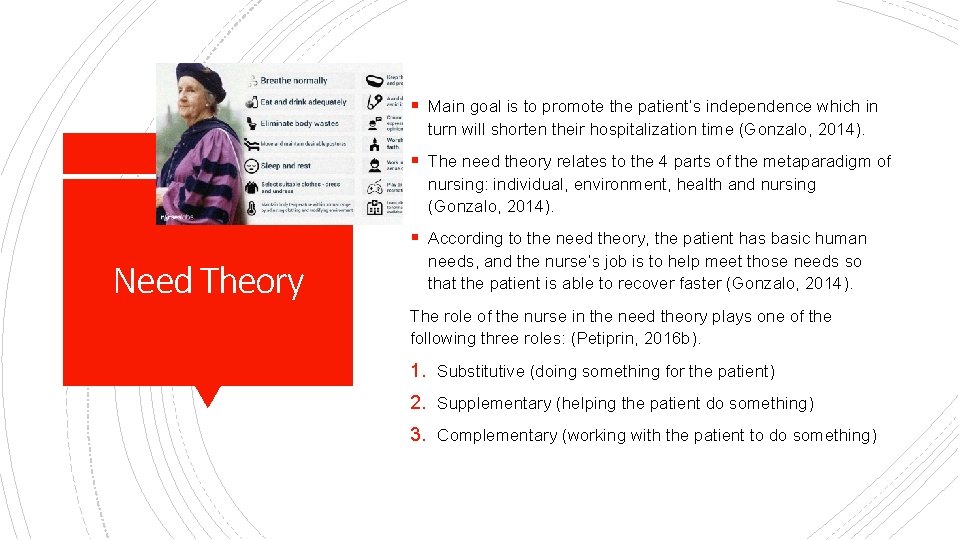
§ Main goal is to promote the patient’s independence which in turn will shorten their hospitalization time (Gonzalo, 2014). § The need theory relates to the 4 parts of the metaparadigm of nursing: individual, environment, health and nursing (Gonzalo, 2014). § According to the need theory, the patient has basic human Need Theory needs, and the nurse’s job is to help meet those needs so that the patient is able to recover faster (Gonzalo, 2014). The role of the nurse in the need theory plays one of the following three roles: (Petiprin, 2016 b). 1. Substitutive (doing something for the patient) 2. Supplementary (helping the patient do something) 3. Complementary (working with the patient to do something)
§ Virginia Henderson graduated from the Army School of Nursing and then worked at the Henry Street Visiting Service (Petiprin, 2016 b). § She then earned her Master’s Degree, and became a faculty member a the Teachers College until 1948 (Petiprin, 2016 b). § In 1953, Henderson served as a research associate at the Yale University School of Nursing (Petiprin, 2016 b). Virginia Henderson § Henderson received several Honorary Doctoral degrees from several universities including Yale University (Petiprin, 2016 b). § The International Council of Nurses awarded Henderson with the first Christianne Reimann Prize in 1985 (Petiprin, 2016 b). § Henderson’s definition of nursing states, “The unique function of the nurse is to assist the individual, sick or well, in the performance of those activities contributing to health or its recovery (or to peaceful death) that he would perform unaided if he had the necessary strength, will or knowledge. ” (Petiprin, 2016 b).
§ Patient with a diagnosis of schizophrenia and delusional disorder approaches you, the nurse, and tells their life story which is scattered and unorganized. When other nurses have challenged these delusions in the past, the patient becomes defensive and irritable. § Working with the patient you ask him to clarify and help you understand his life story by writing it out in a timeline. Patient tells his story in great detail although there is overlapping dates and information in his timeline. § Patient states that when he was writing his timeline that he had a hard time Practice Application focusing and piecing together things due to his scattered thinking. Patient and you, the nurse, agree that increasing his medication and beginning to use CBT may help with some of his scattered thinking and will allow him to use proper coping skills when he is overwhelmed. § In this scenario the nurse uses the core concept of the tidal model by allowing the patient to tell his or her own story. They then work together to create a plan of care and take the first step that the patient and nurse together feel is necessary. § The nurse also utilizes the need theory by acting in the complementary role to work with the patient to complete a task. The nurse meets several of the patients current needs in this scenario by creating dialogue that allows the patient to communicate emotions, needs, opinions and fears with the nurse. The patient and the nurse also work towards an end goal and have accomplished something which creates a positive therapeutic interaction.
Videos for Reference “What is Mental Health Recovery? ” https: //www. youtube. com/watch? v=UPUh. NKc. BXsg (Wagner, 2018) “The Tidal Model - by Dr. Phil Barker” https: //www. youtube. com/watch? v=Soy. YS 7 oqg 0 Y (Social and Health School, 2014) “Virginia Henderson’s Nursing Need Theory” https: //www. youtube. com/watch? v=y 6 o. Maxhxuto (Lewis, 2018)
References Barker, P. , & Buchanan-Barker, P. (2005). The Tidal Model. Brunner-Routledge. ISBN 1 -58391 -801 -9 Gonzalo, A. (2014, August 6). Virginia Henderson: Need Theory Study Guide. Retrieved November 10, 2019, from https: //nurseslabs. com/virginia-hendersons-need-theory/. Lewis, J. (2018). Virginia Henderson’s Nursing Need Theory. Retrieved from https: //www. youtube. com/watch? v=y 6 o. Maxhxuto Petiprin, A. (2016 a). Phil Barker. Retrieved November 18, 2019, from https: //nursing-theory. org/nursing-theorists/Phil-Barker. php Petiprin, A. (2016 b). Virginia Henderson. Retrieved November 18, 2019, from https: //nursing-theory. org/nursing-theorists/Virginia. Henderson. php Social and Health School. (2014) The Tidal Model – by Dr. Phil Barker. Retrieved from https: //www. youtube. com/watch? v=Soy. YS 7 oqg 0 Y Wagner, C. (2018). What is Mental Health Recovery? Scottish Recovery Network. Retrieved November 16, 2019, from https: //www. youtube. com/watch? v=UPUh. NKc. BXsg What is the Tidal Model? (2015). Retrieved November 18, 2019, from http: //www. tidal-model. com/index. html