
Connecting Knowledge Silos Tying Together Institutional Repositories for
- Slides: 28
Connecting Knowledge Silos: Tying Together Institutional Repositories for Research Cohesion and Inclusive Information Access Digital Commons Southeastern User Group Embry-Riddle Aeronautical University, Daytona Beach, Florida Bebe S. Chang, Archives & Digital Librarian, Nova Southeastern University Sunghae Ress, Digital Projects Librarian, Florida Atlantic University
(Recent) History of Information - Selected Points ● 1933 - Vannevar Bush, Massachusetts Institute of Technology, constructs the differential analyzer, a powerful analog computer. ● 1945 - First modern stored memory computer designed by Johann von Neumann, J. Presper Eckert, and John W. Mauchly. ● 1989 - Tim Berners-Lee and his colleagues at CERN create first Web browser, based on Hyper. Text Transfer Protocol (HTTP), which standardizes communication between servers and clients.
(Recent) History of Information - Selected Points, con’t. ● 1996 - US Telecommunications Act authorizes subsidies for information technology to libraries and schools. The provision of universal access the Internet becomes a policy goal a number of nations. ● 2013 - US Office of Science & Technology Policy released increasing access to the results of federally-funded research.
Vannevar Bush: As We May Think ● Atlantic magazine, July 1945 ○ Director of the Office of Scientific Research and Development ● If the aggregate time spent in writing scholarly works and in reading them could be evaluated, the ratio between these amounts of time might well be startling. ○ Mendel's concept of the laws of genetics was lost to the world for a generation because his publication did not reach the few who were capable of grasping and extending it; and this sort of catastrophe is undoubtedly being repeated all about us, as truly significant attainments become lost in the mass of the inconsequential.
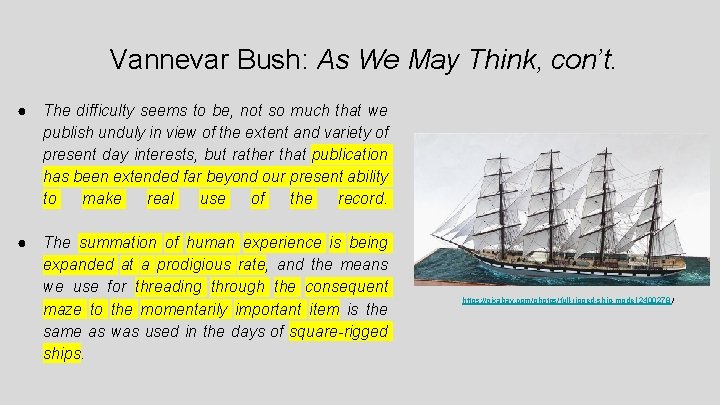
Vannevar Bush: As We May Think, con’t. ● The difficulty seems to be, not so much that we publish unduly in view of the extent and variety of present day interests, but rather that publication has been extended far beyond our present ability to make real use of the record. ● The summation of human experience is being expanded at a prodigious rate, and the means we use for threading through the consequent maze to the momentarily important item is the same as was used in the days of square-rigged ships. https: //pixabay. com/photos/full-rigged-ship-model-2400278 /
Vannevar Bush: As We May Think, con’t. ● Thus far we seem to be worse off than before—for we can enormously extend the record; yet even in its present bulk we can hardly consult it. ● There may be millions of fine thoughts, and the account of the experience on which they are based, all encased within stone walls of acceptable architectural form; but if the scholar can get at only one a week by diligent search, his syntheses are not likely to keep up with the current scene.
Vannevar Bush: As We May Think, con’t. ● Our ineptitude in getting at the record is largely caused by the artificiality of systems of indexing… Having found one item. . . one has to emerge from the system and re-enter on a new path… ● The human mind… operates by association. With one item in its grasp, it snaps instantly to the next that is suggested by the association of thoughts, in accordance with some intricate web of trails carried by the cells of the brain.
ar. Xiv. org ● First Free Research-sharing site ● Preprint archive, 1991 ● Paul Ginsparg, Los Alamos National Lab ⇒ Cornell U. ● Automated electronic archive and distribution server for research articles ● Physics, mathematics, computer science, nonlinear sciences, quantitative biology, quantitative finance, statistics, electrical engineering and systems science, and economics. ● Users can retrieve previous and updated versions of papers Image credit: Cornell U.
IR Purpose: Opposing Viewpoints ● 2003, Clifford Lynch, Executive Director, CNI ○ ● ● IRs: Essential Infrastructure for Scholarship in the Digital Age (article) Critical components of scholarly communication ○ Expands access ○ Reduces monopoly power over journals ○ Brings economic relief ○ Increases institution’s visibility, status, and public value. 2003, Stevan Harnad, University of Southampton ○ ● Not to promote new forms of scholarship ○ ● “Cliff Lynch on Institutional Archives” To promote refereed research “Immediate rationale” ○ For self-archiving of research output.
Burns, Lana & Budd, IRs: Exploration of Costs & Value, 2013 ● A question that should be asked of the users of repositories is whether their needs are met by the dispersed model of repositories that exists at the present time, or if some kind of unification (or at least unified search and retrieval capability) would be more useful.
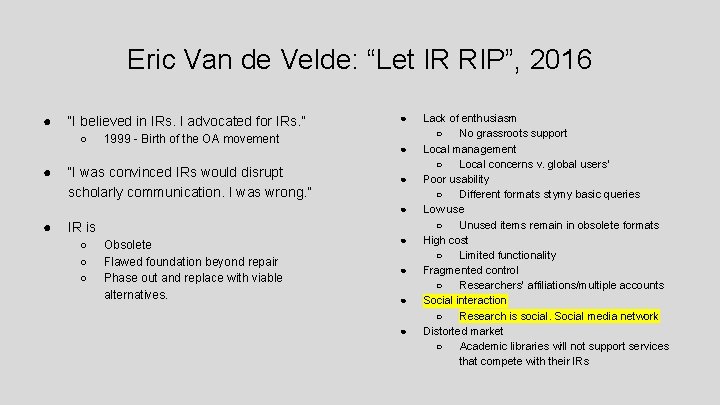
Eric Van de Velde: “Let IR RIP”, 2016 ● “I believed in IRs. I advocated for IRs. ” ○ ● 1999 - Birth of the OA movement “I was convinced IRs would disrupt scholarly communication. I was wrong. ” ● ● ● IR is ○ ○ ○ Obsolete Flawed foundation beyond repair Phase out and replace with viable alternatives. ● ● Lack of enthusiasm ○ No grassroots support Local management ○ Local concerns v. global users’ Poor usability ○ Different formats stymy basic queries Low use ○ Unused items remain in obsolete formats High cost ○ Limited functionality Fragmented control ○ Researchers’ affiliations/multiple accounts Social interaction ○ Research is social. Social media network Distorted market ○ Academic libraries will not support services that compete with their IRs
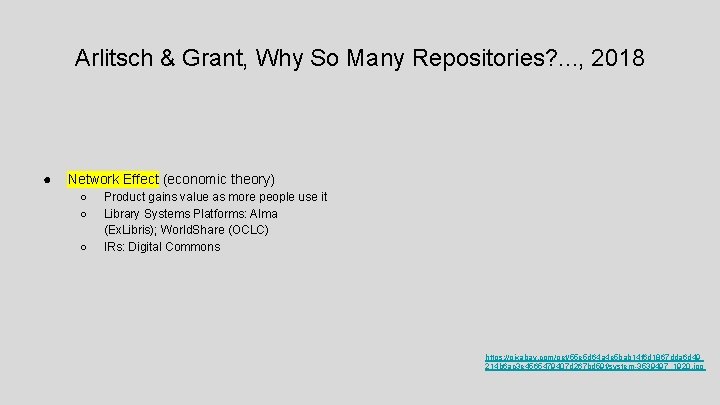
Arlitsch & Grant, Why So Many Repositories? . . . , 2018 ● Network Effect (economic theory) ○ ○ ○ Product gains value as more people use it Library Systems Platforms: Alma (Ex. Libris); World. Share (OCLC) IRs: Digital Commons https: //pixabay. com/get/55 e 5 d 64 a 4 e 5 bab 14 f 6 d 1867 dda 6 d 49 214 b 6 ac 3 e 4565479407 d 267 bd 59 f/system-3539497_1920. jpg
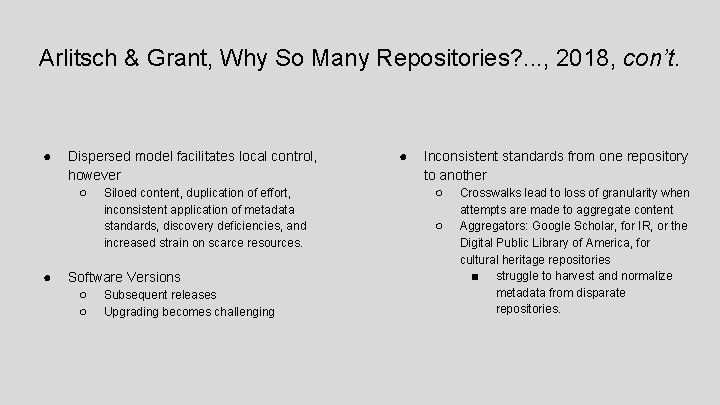
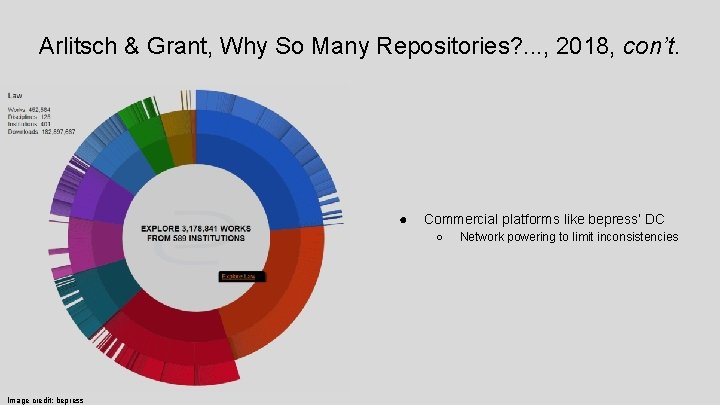
Arlitsch & Grant, Why So Many Repositories? . . . , 2018, con’t. ● Dispersed model facilitates local control, however ○ Siloed content, duplication of effort, inconsistent application of metadata standards, discovery deficiencies, and increased strain on scarce resources. ● Software Versions ○ Subsequent releases ○ Upgrading becomes challenging ● Inconsistent standards from one repository to another ○ Crosswalks lead to loss of granularity when ○ attempts are made to aggregate content Aggregators: Google Scholar, for IR, or the Digital Public Library of America, for cultural heritage repositories ■ struggle to harvest and normalize metadata from disparate repositories.
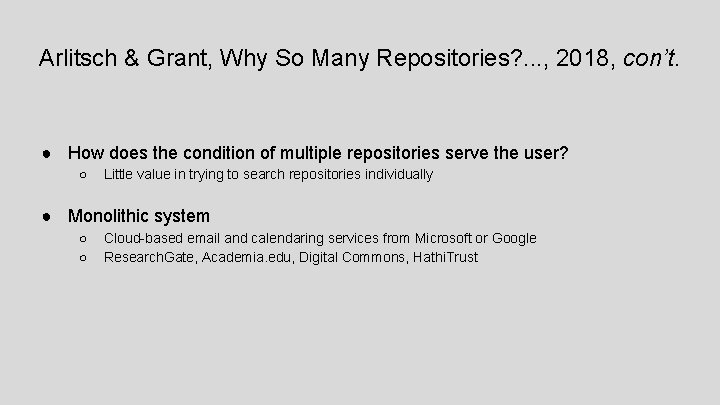
Arlitsch & Grant, Why So Many Repositories? . . . , 2018, con’t. ● How does the condition of multiple repositories serve the user? ○ Little value in trying to search repositories individually ● Monolithic system ○ ○ Cloud-based email and calendaring services from Microsoft or Google Research. Gate, Academia. edu, Digital Commons, Hathi. Trust
Arlitsch & Grant, Why So Many Repositories? . . . , 2018, con’t. ● Commercial platforms like bepress’ DC ○ Image credit: bepress Network powering to limit inconsistencies
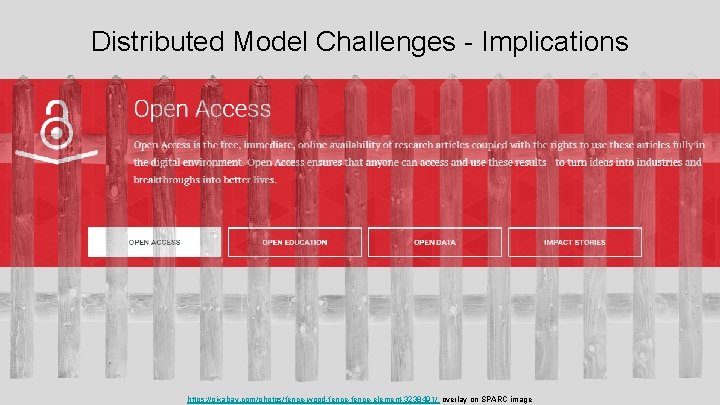
Distributed Model Challenges - Implications https: //pixabay. com/photos/fence-wood-fence-element-3238491/ overlay on SPARC image
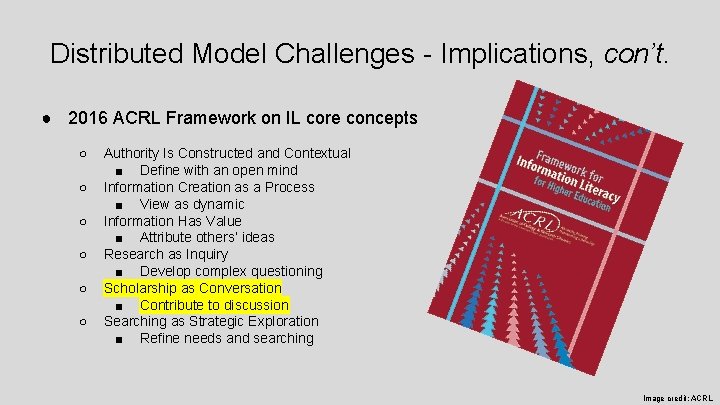
Distributed Model Challenges - Implications, con’t. ● 2016 ACRL Framework on IL core concepts ○ ○ ○ Authority Is Constructed and Contextual ■ Define with an open mind Information Creation as a Process ■ View as dynamic Information Has Value ■ Attribute others’ ideas Research as Inquiry ■ Develop complex questioning Scholarship as Conversation ■ Contribute to discussion Searching as Strategic Exploration ■ Refine needs and searching Image credit: ACRL
Distributed Model Challenges - Implications, con’t. Image credit: ACRL
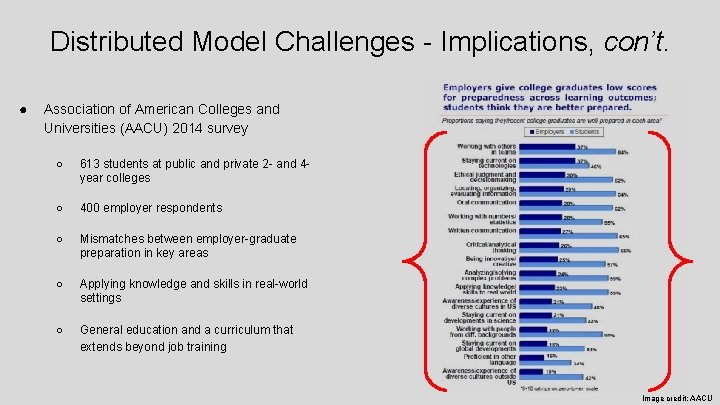
Distributed Model Challenges - Implications, con’t. ● Association of American Colleges and Universities (AACU) 2014 survey ○ 613 students at public and private 2 - and 4 year colleges ○ 400 employer respondents ○ Mismatches between employer-graduate preparation in key areas ○ Applying knowledge and skills in real-world settings ○ General education and a curriculum that extends beyond job training Image credit: AACU
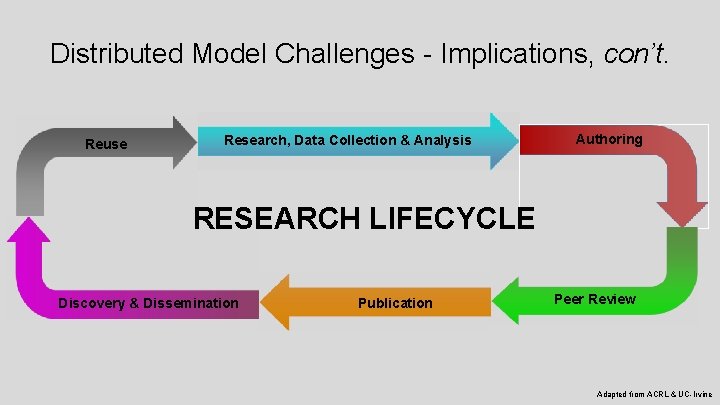
Distributed Model Challenges - Implications, con’t. Reuse Research, Data Collection & Analysis Authoring RESEARCH LIFECYCLE Discovery & Dissemination Publication Peer Review Adapted from ACRL & UC-Irvine
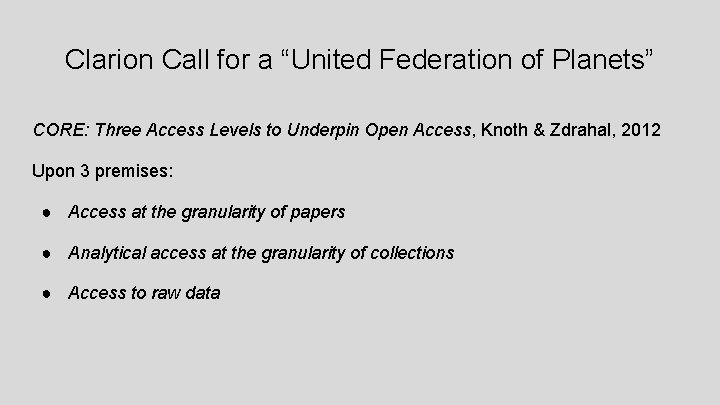
Clarion Call for a “United Federation of Planets” CORE: Three Access Levels to Underpin Open Access, Knoth & Zdrahal, 2012 Upon 3 premises: ● Access at the granularity of papers ● Analytical access at the granularity of collections ● Access to raw data
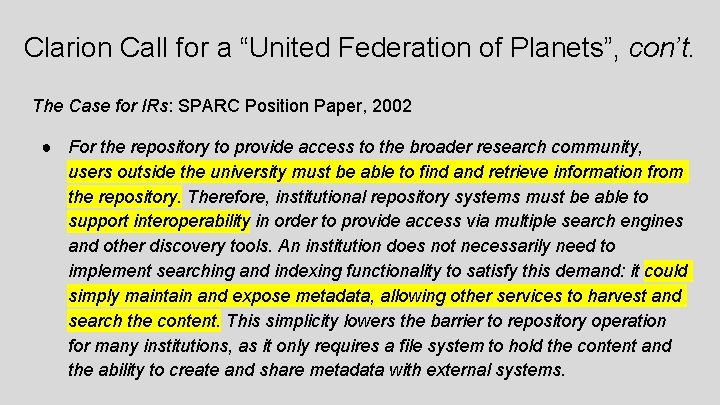
Clarion Call for a “United Federation of Planets”, con’t. The Case for IRs: SPARC Position Paper, 2002 ● For the repository to provide access to the broader research community, users outside the university must be able to find and retrieve information from the repository. Therefore, institutional repository systems must be able to support interoperability in order to provide access via multiple search engines and other discovery tools. An institution does not necessarily need to implement searching and indexing functionality to satisfy this demand: it could simply maintain and expose metadata, allowing other services to harvest and search the content. This simplicity lowers the barrier to repository operation for many institutions, as it only requires a file system to hold the content and the ability to create and share metadata with external systems.
Clarion Call for a “United Federation of Planets”, con’t. Confederation of Open Access Repositories (COAR), The Case for Interoperability for Open Access Repositories, 2011 ● The real value of repositories lies in the potential to interconnect them to create a network of repositories, a network that can provide unified access to research outputs and be (re-) used by machines and researchers. However, in order to achieve this potential, we need interoperability.
Clarion Call for a “United Federation of Planets”, con’t. Time to re-think the IR, Lynch, 2016 ● Technology has moved on quite a bit in the last fifteen years, and it may be that it makes more sense to think about how to do this in a way that involves more shared or collective platforms and services rather than highly distributed approaches.
Clarion Call for a “United Federation of Planets”, con’t. ● Need for collective will (Arlitsch & Grant, 2018) ○ ○ Problem is not $$$ Requires “will to pool our resources and act collectively” ● Mere compression… is not enough; one needs not only to make and store a record but also be able to consult it. . . (Bush, 1945)
Bibliography ● ● ● ● Arlitsch, K. , & Grant, C. (2018). Why So Many Repositories? Examining the Limitations and Possibilities of the Institutional Repositories Landscape. Journal of Library Administration, 58(3), 264– 281. https: //scholarworks. montana. edu/xmlui/handle/1/14529. Burns, C. S. et al. (2013, January/February). Institutional Repositories: Exploration of Costs and Value. D-Lib Magazine, 19(1/2). http: //www. dlib. org/dlib/january 13/burns/01 burns. html. Bush, V. (1945, July). As We May Think. The Atlantic. https: //www. theatlantic. com/magazine/archive/1945/07/as-we-may-think/303881/. Confederation of Open Access Repositories (COAR). (2011). Repository Interoperability. https: //www. coarrepositories. org/activities/repository-interoperability/. Cornell University. (2019). ar. Xiv, General Information About ar. Xiv, https: //arxiv. org/help/general. Crow, R. (2002, August). The Case for Institutional Repositories: A SPARC Position Paper. ARL Bimonthly Report 223. http: //www. sparc. arl. org/resources/papers-guides/the-case-for-institutional-repositories. Fischman, J. (2011, August 10). The First Free Research-Sharing Site, ar. Xiv, Turns 20 With an Uncertain Future. The Chronicle of Higher Education. https: //www. chronicle. com/blogs/wiredcampus/the-first-free-research-sharing-site-arxiv-turns-20/32778. Harnad, S. (2003, March 15). Cliff Lynch on Institutional Repositories. [Blog]. https: //www. southampton. ac. uk/~harnad/Hypermail/Amsci/2744. html. Hart Research Associates. Falling Short? College Learning and Career Success. Washington, DC: Association of American Colleges and Universities. https: //www. aacu. org/leap/public-opinion-research/2015 -survey-falling-short. Jisc [Joint Information Systems Committee]. (2019). Open. DOAR Statistics. http: //v 2. sherpa. ac. uk/view/repository_visualisations/1. html. Lynch, C. A. (2003, February). Institutional Repositories: Essential Infrastructure for Scholarship in the Digital Age. ARL Bimonthly Report 226. https: //www. cni. org/publications/cliffs-pubs/institutional-repositories-infrastructure-for-scholarship. Poynder, R. (2016, September 22). Q&A with CNI’s Clifford Lynch: Time to re-think the institutional repository? [Blog]. https: //poynder. blogspot. com/2016/09/q-with-cnis-clifford-lynch-time-to-re_22. html. Montana State University. (n. d. ). Repository Analytics & Metrics Portal (RAMP). http: //ramp. montana. edu/. Nunberg, G. and Brownstein, D. (2002). Timeline of the History of Information. http: //people. ischool. berkeley. edu/~nunberg/timeline. html. Van de Velde. (2016, July 24). Let IR RIP. Sci. Tech. Society. http: //scitechsociety. blogspot. com/2016/07/let-ir-rip. html.