
Connecting global approaches to regional priorities Connective Cities
Connecting global approaches to regional priorities “Connective Cities” and “Integrated Implementation of Agenda 2030 in Cities and City-Regions” 29 January 2019, 9: 30 – 11: 00 CET Transformation - Urban Opportunities - Climate Change (TUrb. OCli. C) Cross-sectoral group of the TUEWAS and SNGA network of GIZ
Programme • Welcome and Moderation: Ms. Vaishali Nandan, Project Manager - Climate Smart Cities India and Joint Speaker of TUrb. OCli. C • Connective Cities - Prospects for Collaboration - Mr. Manfred Poppe – Program Coordinator • Integrated Implementation of Agenda 2030 in Cities and City -Regions – Call for ideas for Model Projects on “CITIES CHALLENGE – 2030 Agenda meets Urban Climate Action” – Mr. Toni Kaatz-Dubberke, Advisor • Interactive discussion with audience 29 January 2019 1 st Webinar - Series 2019 of TUrb. OCli. C
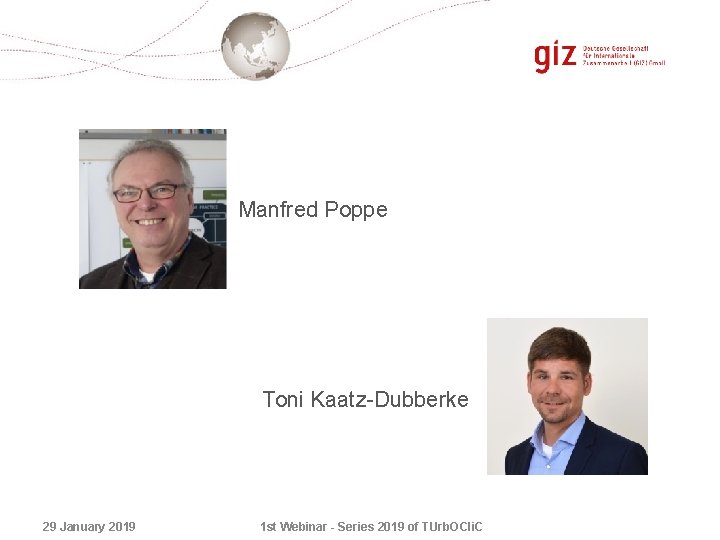
Manfred Poppe Toni Kaatz-Dubberke 29 January 2019 1 st Webinar - Series 2019 of TUrb. OCli. C
Programme • Welcome and Moderation: Ms. Vaishali Nandan, Project Manager - Climate Smart Cities India and Joint Speaker of TUrb. OCli. C • Connective Cities - Prospects for Collaboration - Mr. Manfred Poppe – Program Coordinator • Integrated Implementation of Agenda 2030 in Cities and City -Regions – Call for ideas for Model Projects on “CITIES CHALLENGE – 2030 Agenda meets Urban Climate Action” – Mr. Toni Kaatz-Dubberke, Advisor • Interactive discussion with audience 29 January 2019 1 st Webinar - Series 2019 of TUrb. OCli. C
INTERNATIONAL COMMUNITY OF PRACTICE F O R SUSTAINABLE URBAN DEVELOPMENT Implemented by
Key Features • TIME PERIODS • 1 st Phase: 07/2013 – 12/2015 • 2 nd Phase: 01/2016 – 03/2019 • 3 rd Phase: 04/2019 – 03/2022 • BUDGETS • 1. Phase: 3, 0 Mio Euro • 2. Phase: 4, 5 Mio Euro • 3. Phase: 4, 0 Mio Euro (plus BMZ grant to EG/DST) • OUTCOMES • Almost 2. 000 urban practitioners from more than 350 municipalities from about 60 countries have been involved in thematic exchanges of experience and peer-to-peer learning and consultations. • Around 250 German urban practitioners have supported the formulation of more than 100 ideas for urban change projects in partner countries of German DC and contributed to synergies with existing bilateral programmes. 2
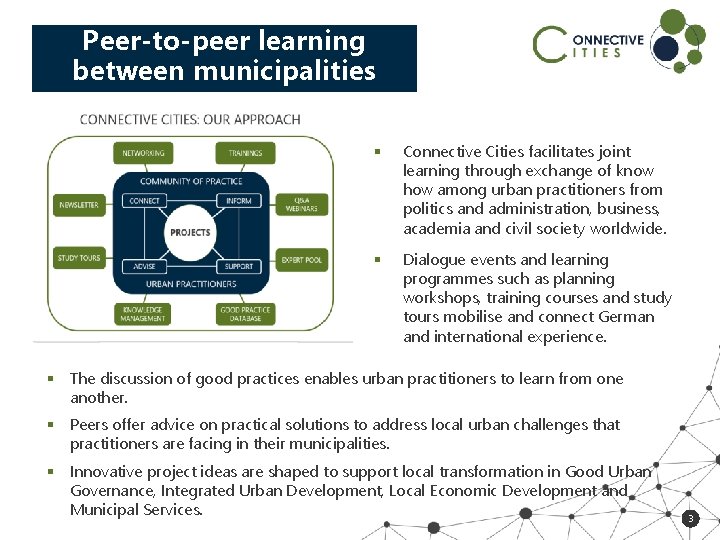
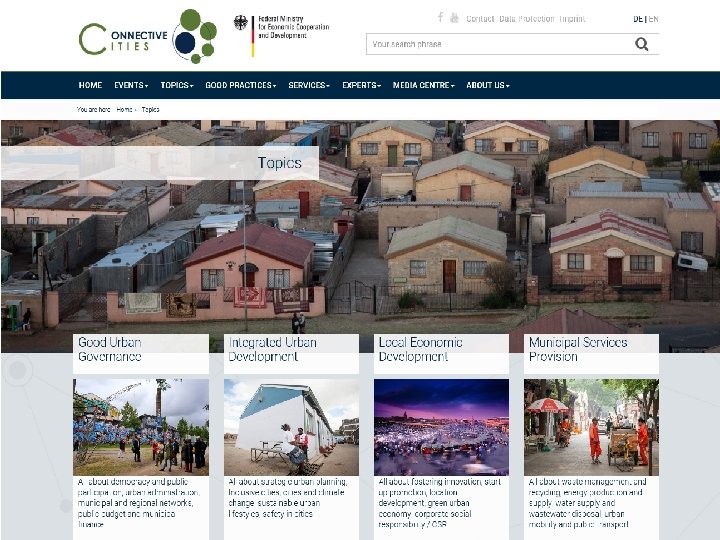
Peer-to-peer learning between municipalities § Connective Cities facilitates joint learning through exchange of know how among urban practitioners from politics and administration, business, academia and civil society worldwide. § Dialogue events and learning programmes such as planning workshops, training courses and study tours mobilise and connect German and international experience. § The discussion of good practices enables urban practitioners to learn from one another. § Peers offer advice on practical solutions to address local urban challenges that practitioners are facing in their municipalities. § Innovative project ideas are shaped to support local transformation in Good Urban Governance, Integrated Urban Development, Local Economic Development and Municipal Services. 3
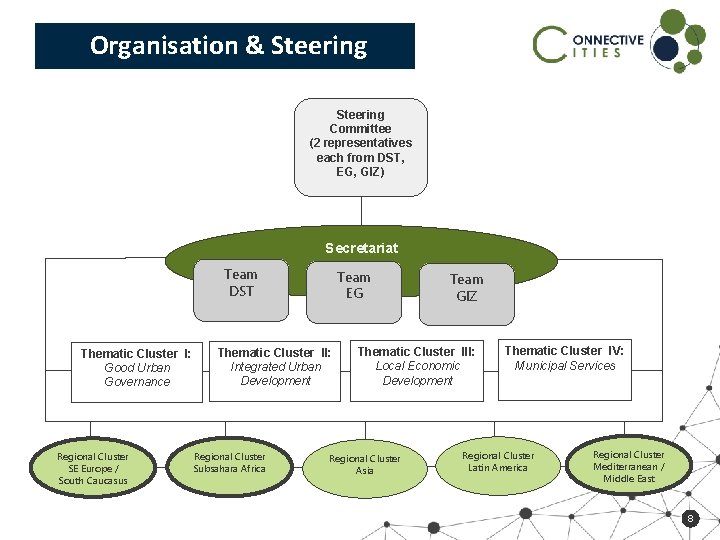
Organisation & Steering Committee (2 representatives each from DST, EG, GIZ) Secretariat Team DST Thematic Cluster I: Good Urban Governance Regional Cluster SE Europe / South Caucasus Team EG Thematic Cluster II: Integrated Urban Development Regional Cluster Subsahara Africa Team GIZ Thematic Cluster III: Local Economic Development Regional Cluster Asia Thematic Cluster IV: Municipal Services Regional Cluster Latin America Regional Cluster Mediterranean / Middle East 8
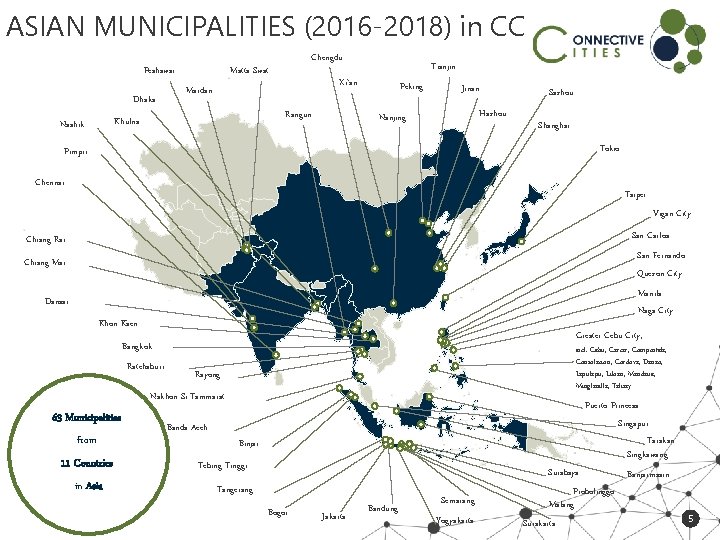
ASIAN MUNICIPALITIES (2016 -2018) in CC Matta Swat Peshawar Dhaka Tianjin Xi‘an Mardan Rangun Khulna Nashik Chengdu Peking Jinan Sazhou Hazhou Nanjing Shanghai Tokio Pimpri Chennai Taipei Vigan City San Carlos Chiang Rai San Fernando Quezon City Chiang Mai Manila Naga City Dansai Khon Kaen Greater Cebu City, Bangkok Ratchaburi incl. Cebu, Carcar, Compostela, Consolacion, Cordova, Danao, Lapulapu, Liloan, Mandaue, Minglanilla, Talisay Rayong Nakhon Si Tammarat 63 Municipalities from 11 Countries in Asia Banda Aceh Puerto Princesa Singapur Tarakan Singkawang Binjai Tebing Tinggi Surabaya Tangerang Bogor Jakarta Bandung Semarang Yogyakarta Probolinggo Malang Surakarta Banjarmasin 5 9
COMMUNITY OF PRACTICE
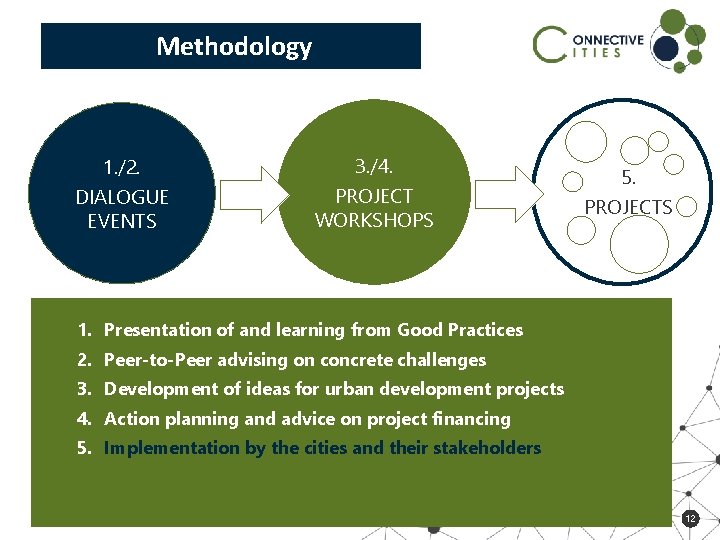
Methodology 1. /2. DIALOGUE EVENTS 3. /4. PROJECT WORKSHOPS 5. PROJECTS 1. Presentation of and learning from Good Practices 2. Peer-to-Peer advising on concrete challenges 3. Development of ideas for urban development projects 4. Action planning and advice on project financing 5. Implementation by the cities and their stakeholders 12
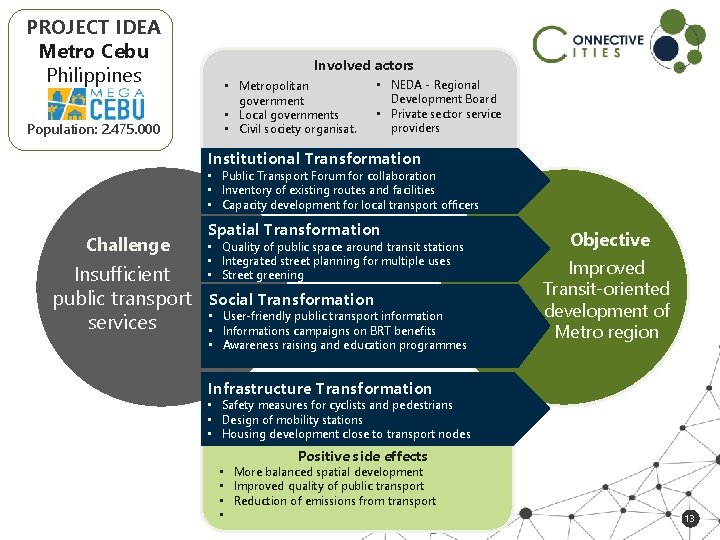
PROJECT IDEA Metro Cebu Philippines Population: 2. 475. 000 Involved actors • Metropolitan government • Local governments • Civil society organisat. • NEDA - Regional Development Board • Private sector service providers Institutional Transformation • Public Transport Forum for collaboration • Inventory of existing routes and facilities • Capacity development for local transport officers Challenge Insufficient public transport services Spatial Transformation • Quality of public space around transit stations • Integrated street planning for multiple uses • Street greening Social Transformation • User-friendly public transport information • Informations campaigns on BRT benefits • Awareness raising and education programmes Objective Improved Transit-oriented development of Metro region Infrastructure Transformation • Safety measures for cyclists and pedestrians • Design of mobility stations • Housing development close to transport nodes Positive side effects • More balanced spatial development • Improved quality of public transport • Reduction of emissions from transport • 13
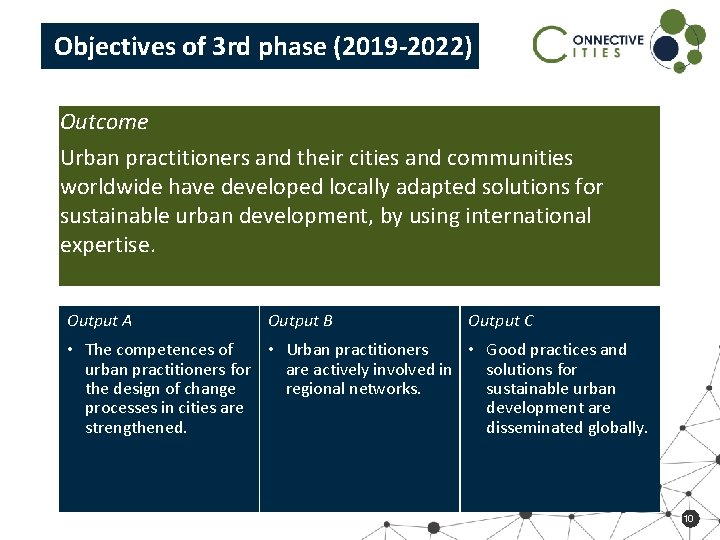
Objectives of 3 rd phase (2019 -2022) Outcome Urban practitioners and their cities and communities worldwide have developed locally adapted solutions for sustainable urban development, by using international expertise. Output A Output B Output C • The competences of • Good practices and • Urban practitioners urban practitioners for solutions for are actively involved in the design of change sustainable urban regional networks. processes in cities are development are strengthened. disseminated globally. 10
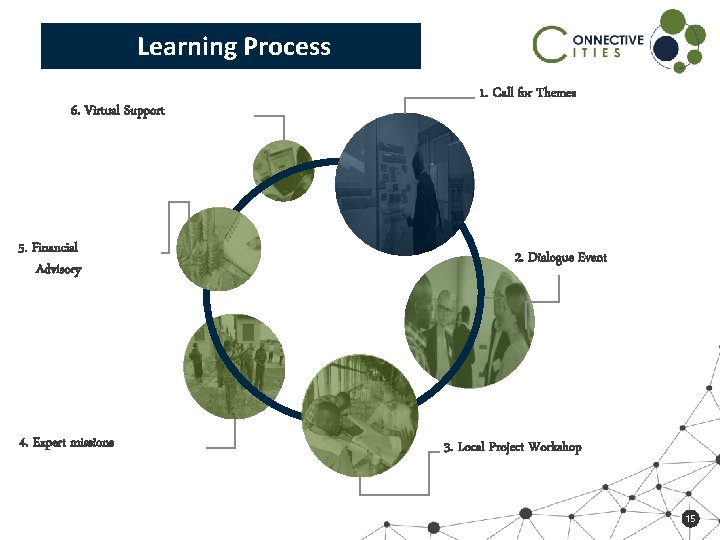
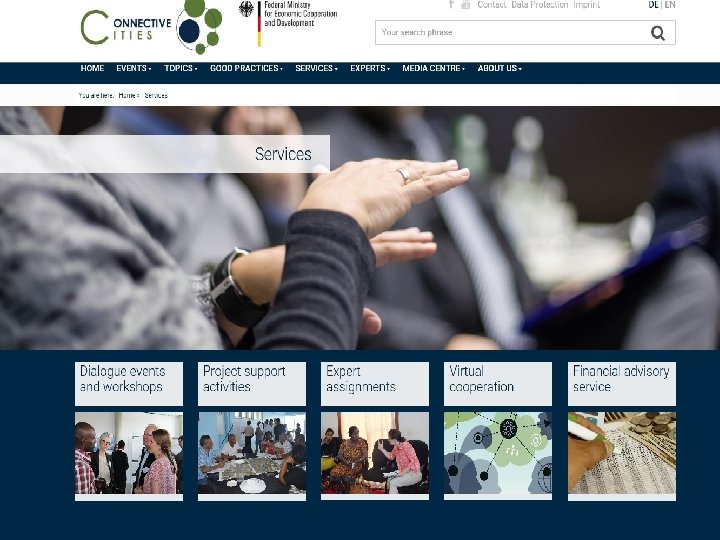
Learning Process 6. Virtual Support 5. Financial Advisory 4. Expert missions 1. Call for Themes 2. Dialogue Event 3. Local Project Workshop 15
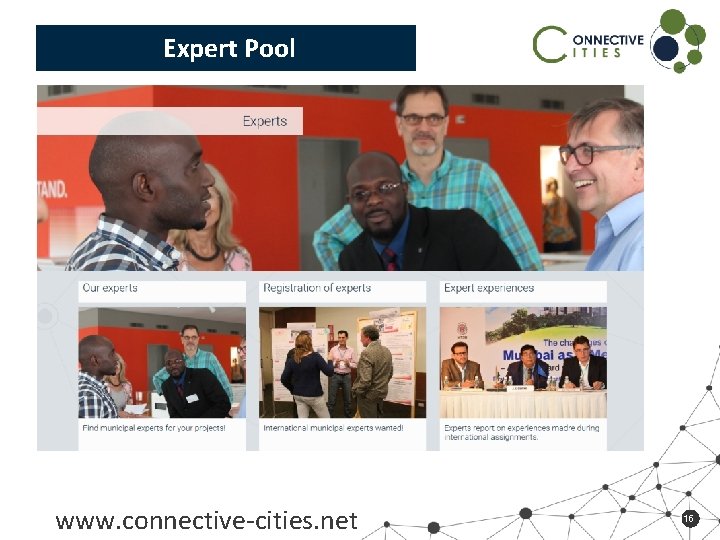
Expert Pool www. connective-cities. net 16
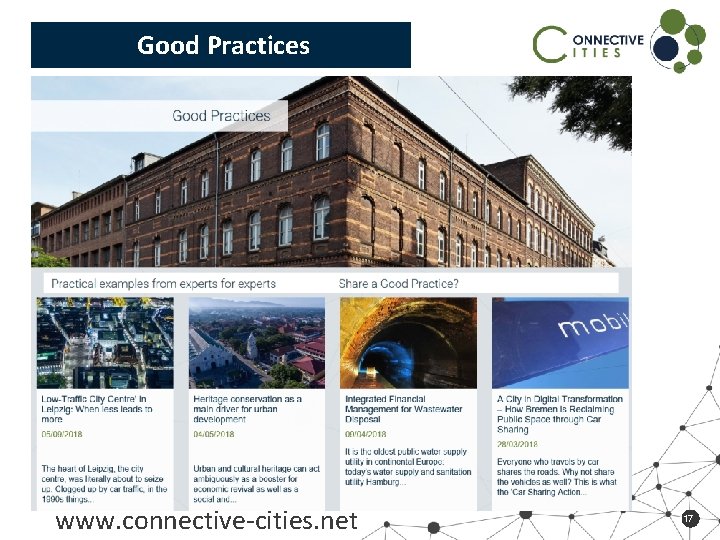
Good Practices www. connective-cities. net 17
Benefits • Quick access to international know-how and to innovations as well as practical experiences about urban transformation processes • Involvement in international networks among dedicated practitioners with hands-on experience • Development of individual and institutional capacities for local innovations based on state-of-the-art learning concepts and technology • Implementation of innovative and collaborative projects 18
Get connected on www. connective-cities. net Follow Connective Cities on Facebook! Implemented by 19
Programme • Welcome and Moderation: Ms. Vaishali Nandan, Project Manager - Climate Smart Cities India and Joint Speaker of TUrb. OCli. C • Connective Cities - Prospects for Collaboration - Mr. Manfred Poppe – Program Coordinator • Integrated Implementation of Agenda 2030 in Cities and City -Regions – Call for ideas for Model Projects on “CITIES CHALLENGE – 2030 Agenda meets Urban Climate Action” – Mr. Toni Kaatz-Dubberke, Advisor • Interactive discussion with audience 29 January 2019 1 st Webinar - Series 2019 of TUrb. OCli. C
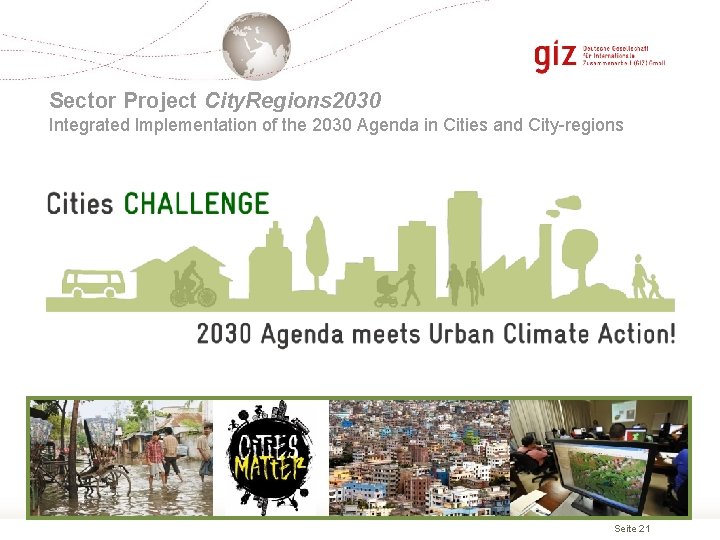
Sector Project City. Regions 2030 Integrated Implementation of the 2030 Agenda in Cities and City-regions Seite 21
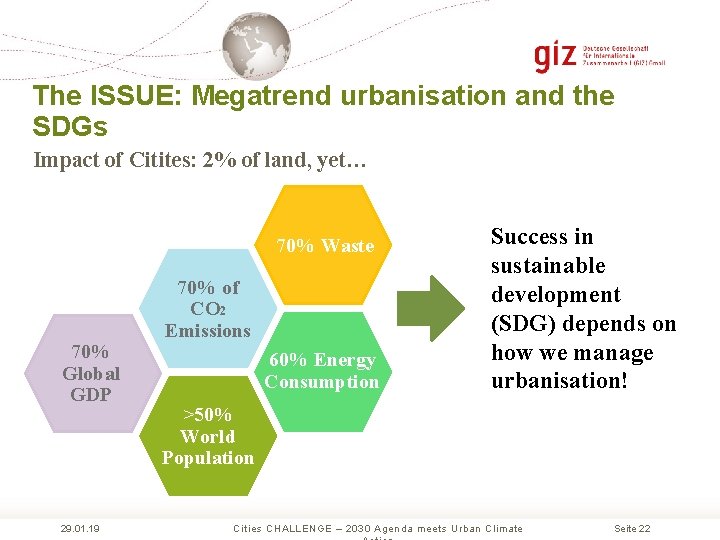
The ISSUE: Megatrend urbanisation and the SDGs Impact of Citites: 2% of land, yet… 70% Waste 70% Global GDP 29. 01. 19 70% of CO 2 Emissions 60% Energy Consumption Success in sustainable development (SDG) depends on how we manage urbanisation! >50% World Population Cities CHALLENGE – 2030 Agenda meets Urban Climate Seite 22
Making the 2030 Agenda tangible: Your solution for climate-friendly urban development… Is concrete, tangible, scalable Implements SDGs in urban areas: think them together! Focuses on climate change: mitigation and/or adaptation in urban areas, Focuses on women and girls: as target group; as actors for urban development Involves partner for on-site implementation: Ø Municipalities, private sector, civil society org. , innovation labs, … 02. 12. 2020 29. 01. 19 Cities CHALLENGE – 2030 Agenda meets Urban Climate Seite 23
Also consider… Appropriate team structure for on-site implementation: 35 persons Embedding in the reference framework in the partner country (national & subnational development plans, sustainability strategies, etc. ) Sound budget planning Using digital solutions wherever appropriate and useful Own contributions from projects and partners for implementation are appreciated Implementation period of 6 -12 months 29. 01. 19 Cities CHALLENGE – 2030 Agenda meets Urban Climate Seite 24
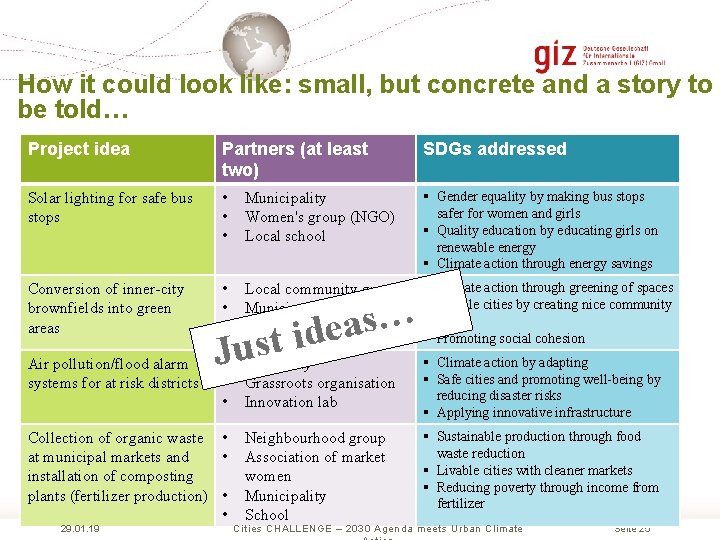
How it could look like: small, but concrete and a story to be told… Project idea Partners (at least two) SDGs addressed Solar lighting for safe bus stops • • • Municipality Women's group (NGO) Local school § Gender equality by making bus stops safer for women and girls § Quality education by educating girls on renewable energy § Climate action through energy savings Conversion of inner-city brownfields into green areas • • Local community groups Municipal administration § Climate action through greening of spaces § Livable cities by creating nice community areas § Promoting social cohesion Air pollution/flood alarm systems for at risk districts J • u. University • • Collection of organic waste • at municipal markets and • installation of composting plants (fertilizer production) • • 29. 01. 19 … s a e st id Grassroots organisation Innovation lab § Climate action by adapting § Safe cities and promoting well-being by reducing disaster risks § Applying innovative infrastructure Neighbourhood group Association of market women Municipality School § Sustainable production through food waste reduction § Livable cities with cleaner markets § Reducing poverty through income from fertilizer Cities CHALLENGE – 2030 Agenda meets Urban Climate Seite 25
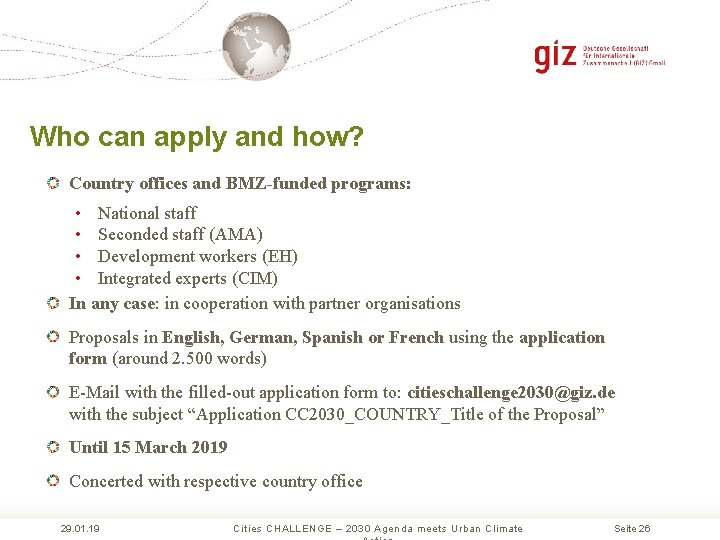
Who can apply and how? Country offices and BMZ-funded programs: • National staff • Seconded staff (AMA) • Development workers (EH) • Integrated experts (CIM) In any case: in cooperation with partner organisations Proposals in English, German, Spanish or French using the application form (around 2. 500 words) E-Mail with the filled-out application form to: citieschallenge 2030@giz. de with the subject “Application CC 2030_COUNTRY_Title of the Proposal” Until 15 March 2019 Concerted with respective country office 29. 01. 19 Cities CHALLENGE – 2030 Agenda meets Urban Climate Seite 26
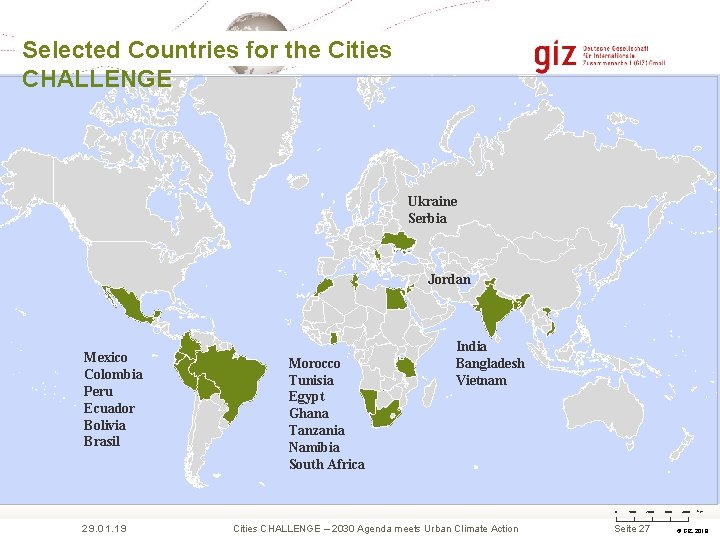
Selected Countries for the Cities CHALLENGE Ukraine Serbia Jordan Mexico Colombia Peru Ecuador Bolivia Brasil Morocco Tunisia Egypt Ghana Tanzania Namibia South Africa India Bangladesh Vietnam 0 29. 01. 19 Cities CHALLENGE – 2030 Agenda meets Urban Climate Action 1000 2000 Seite 27 3000 4000 Km © GIZ 2018
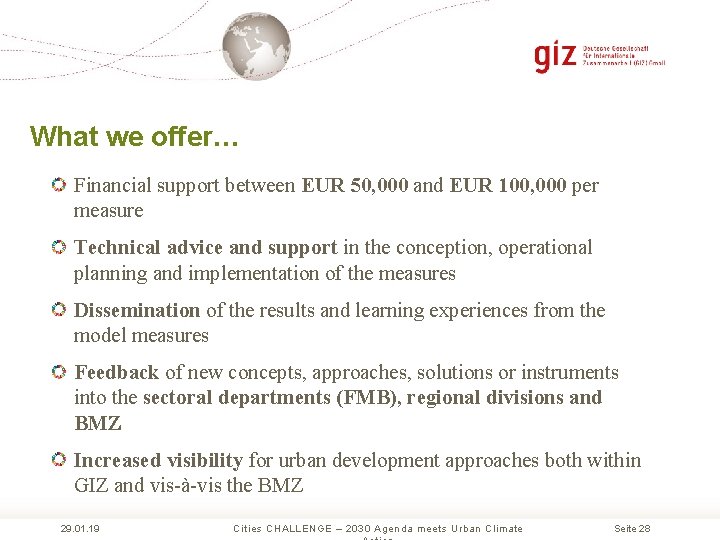
What we offer… Financial support between EUR 50, 000 and EUR 100, 000 per measure Technical advice and support in the conception, operational planning and implementation of the measures Dissemination of the results and learning experiences from the model measures Feedback of new concepts, approaches, solutions or instruments into the sectoral departments (FMB), regional divisions and BMZ Increased visibility for urban development approaches both within GIZ and vis-à-vis the BMZ 29. 01. 19 Cities CHALLENGE – 2030 Agenda meets Urban Climate Seite 28
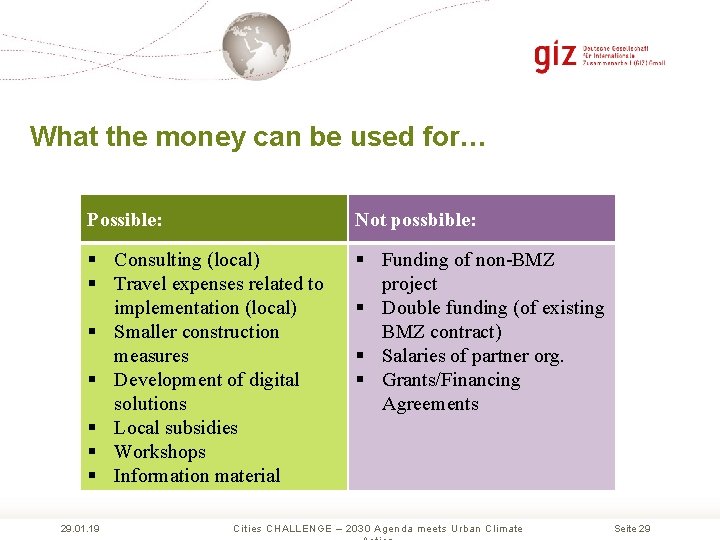
What the money can be used for… Possible: Not possbible: § Consulting (local) § Travel expenses related to implementation (local) § Smaller construction measures § Development of digital solutions § Local subsidies § Workshops § Information material § Funding of non-BMZ project § Double funding (of existing BMZ contract) § Salaries of partner org. § Grants/Financing Agreements 29. 01. 19 Cities CHALLENGE – 2030 Agenda meets Urban Climate Seite 29
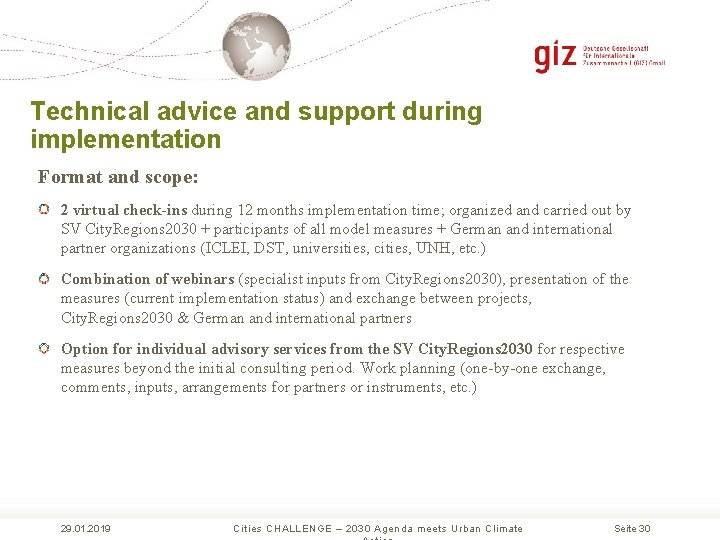
Technical advice and support during implementation Format and scope: 2 virtual check-ins during 12 months implementation time; organized and carried out by SV City. Regions 2030 + participants of all model measures + German and international partner organizations (ICLEI, DST, universities, cities, UNH, etc. ) Combination of webinars (specialist inputs from City. Regions 2030), presentation of the measures (current implementation status) and exchange between projects, City. Regions 2030 & German and international partners Option for individual advisory services from the SV City. Regions 2030 for respective measures beyond the initial consulting period. Work planning (one-by-one exchange, comments, inputs, arrangements for partners or instruments, etc. ) 29. 01. 2019 Cities CHALLENGE – 2030 Agenda meets Urban Climate Seite 30
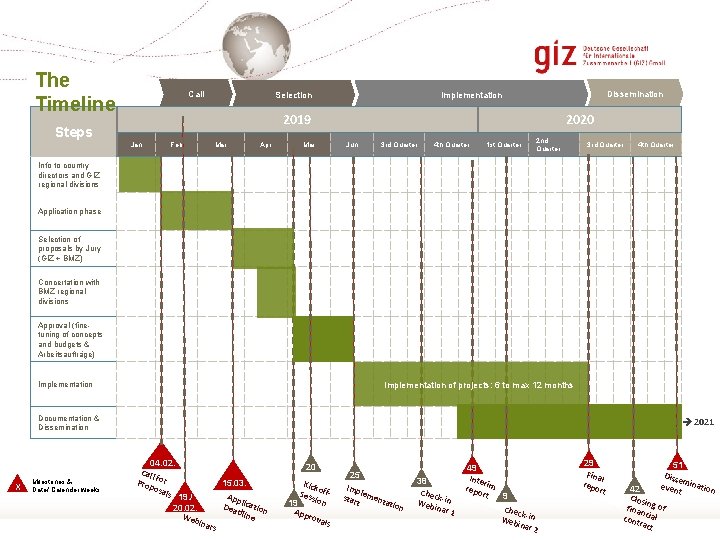
The Timeline Call Dissemination Implementation Selection 2019 Steps Jan Feb Mar Apr Mai 2020 Jun 3 rd Quarter 4 th Quarter 1 st Quarter 2 nd Quarter 3 rd Quarter 4 th Quarter Info to country directors and GIZ regional divisions Application phase Selection of proposals by Jury (GIZ + BMZ) Concertation with BMZ regional divisions Approval (finetuning of concepts and budgets & Arbeitsaufträge) Implementation of projects: 6 to max 12 months Implementation Documentation & Dissemination X Milestones & Date/ Calender weeks 2021 04. 02. Call Pro for pos als 19. / 20. 02. We bina 20 rs 15. 03. App l Dea ication dlin e Kick o Sess ffi o n 19 App rova ls 25 Imp l star ement atio t n 38 Chec k Web -in inar 1 49 Inte r repo im rt 9 Chec k Web -in inar 2 29 Fina l repo rt 51 Diss e even mination t 42 Clos in finan g of cont cial ract Seite 31
citieschallenge 2030@gi z. de 29. 01. 19 Cities CHALLENGE – 2030 Agenda meets Urban Climate Seite 32
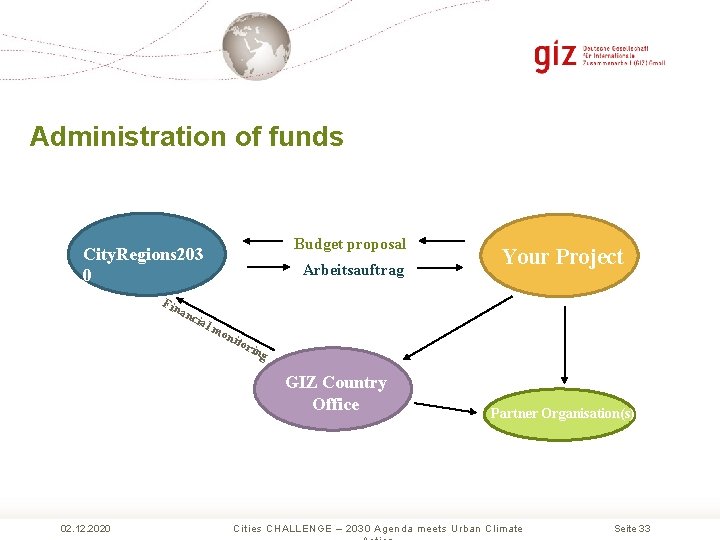
Administration of funds Budget proposal City. Regions 203 0 Fin anc ial Arbeitsauftrag mo nit o rin g GIZ Country Office 02. 12. 2020 Your Project Partner Organisation(s) Cities CHALLENGE – 2030 Agenda meets Urban Climate Seite 33
Programme • Welcome and Moderation: Ms. Vaishali Nandan, Project Manager - Climate Smart Cities India and Joint Speaker of TUrb. OCli. C • Connective Cities – Prospects for Collaboration - Mr. Manfred Poppe – Program Coordinator • Integrated Implementation of Agenda 2030 in Cities and City -Regions – Call for ideas for Model Projects on “CITIES CHALLENGE – 2030 Agenda meets Urban Climate Action” – Mr. Toni Kaatz-Dubberke, Advisor • Interactive discussion with audience 29 January 2019 1 st Webinar - Series 2019 of TUrb. OCli. C Seite 34
- Slides: 34