
Connecting for Social Good Using Social Marketing to
- Slides: 14
Connecting for Social Good Using Social Marketing to Improve Oral Health Linda Orgain, MPH Health Communications Specialist, Division of Oral Health National Center for Chronic Disease Prevention and Health Promotion, CDC 1
What is Social Marketing? “The application of commercial marketing technologies to the analysis, planning, execution, and evaluation of programs designed to influence the voluntary behavior or target audiences in order to improve their personal welfare and that of their society. ” Alan Andreasen, 1995 Marketing Social Change 2
Key Principles q Target Audience q Desired Behavior q Benefits and Exchange Concept q Barriers q 4 Ps Ø Ø Ø Price Product Place Promotion Sometimes Policy q Competition 3
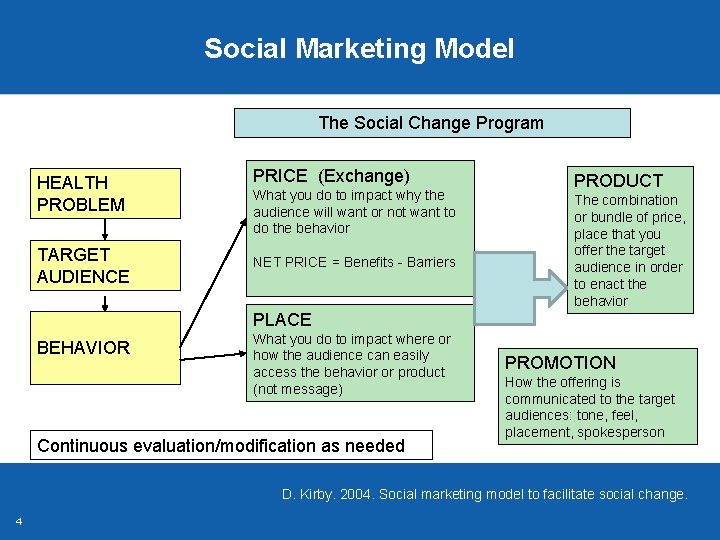
Social Marketing Model The Social Change Program HEALTH PROBLEM TARGET AUDIENCE PRICE (Exchange) What you do to impact why the audience will want or not want to do the behavior NET PRICE = Benefits - Barriers PRODUCT The combination or bundle of price, place that you offer the target audience in order to enact the behavior PLACE BEHAVIOR What you do to impact where or how the audience can easily access the behavior or product (not message) Continuous evaluation/modification as needed PROMOTION How the offering is communicated to the target audiences: tone, feel, placement, spokesperson D. Kirby. 2004. Social marketing model to facilitate social change. 4
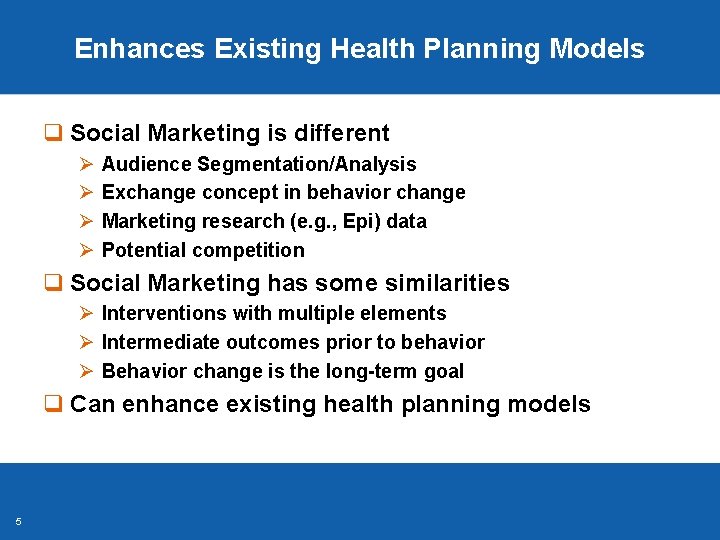
Enhances Existing Health Planning Models q Social Marketing is different Ø Ø Audience Segmentation/Analysis Exchange concept in behavior change Marketing research (e. g. , Epi) data Potential competition q Social Marketing has some similarities Ø Interventions with multiple elements Ø Intermediate outcomes prior to behavior Ø Behavior change is the long-term goal q Can enhance existing health planning models 5
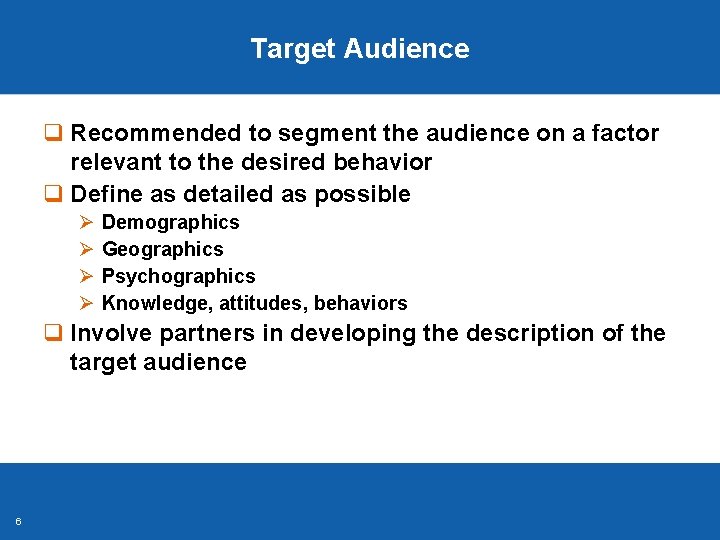
Target Audience q Recommended to segment the audience on a factor relevant to the desired behavior q Define as detailed as possible Ø Ø Demographics Geographics Psychographics Knowledge, attitudes, behaviors q Involve partners in developing the description of the target audience 6
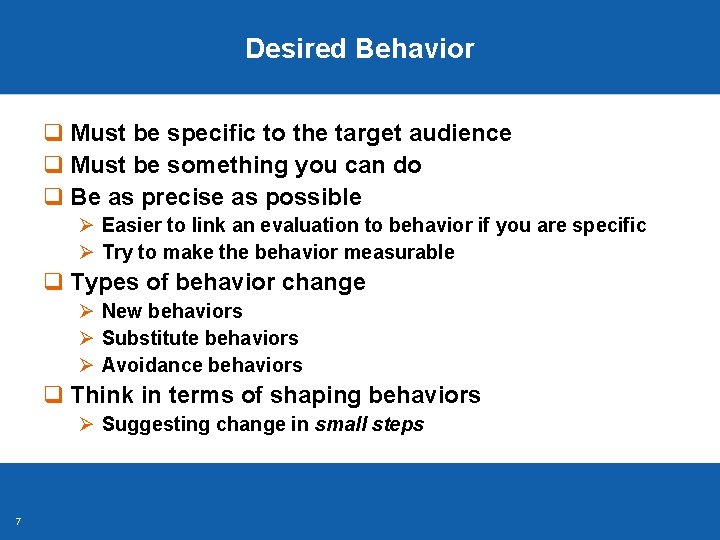
Desired Behavior q Must be specific to the target audience q Must be something you can do q Be as precise as possible Ø Easier to link an evaluation to behavior if you are specific Ø Try to make the behavior measurable q Types of behavior change Ø New behaviors Ø Substitute behaviors Ø Avoidance behaviors q Think in terms of shaping behaviors Ø Suggesting change in small steps 7
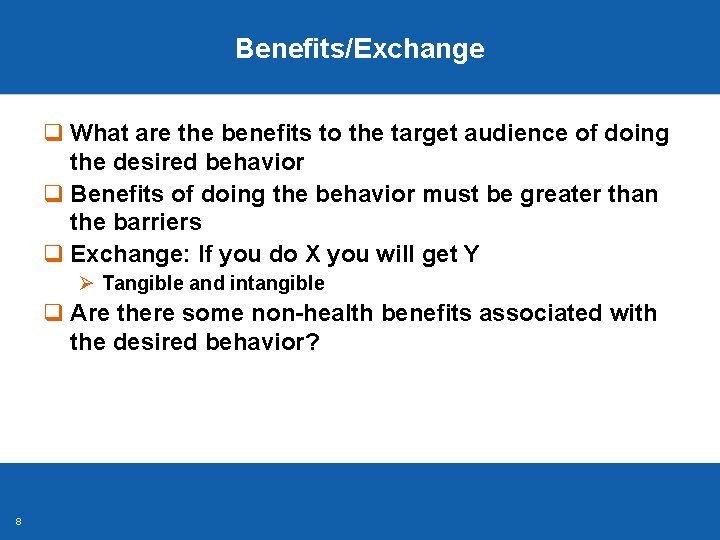
Benefits/Exchange q What are the benefits to the target audience of doing the desired behavior q Benefits of doing the behavior must be greater than the barriers q Exchange: If you do X you will get Y Ø Tangible and intangible q Are there some non-health benefits associated with the desired behavior? 8
Barriers q What would hinder the target audience from doing the desired behavior? Ø Internal, e. g. skills, beliefs Ø External, availability of facilities q Related to the Ps: Ø Part of the Price – the cost of adopting a behavior Ø Part of Place – location of where to perform the behavior may not be close to home/work/school 9
4 Ps q Price: Ø The net price offered the target audience based on research q Place Ø How the behavior is made more convenient and accessible q Product Ø The bundle of Price and Place that is offered q Promotion Ø How you communicate with them about the other 3 Ps 10
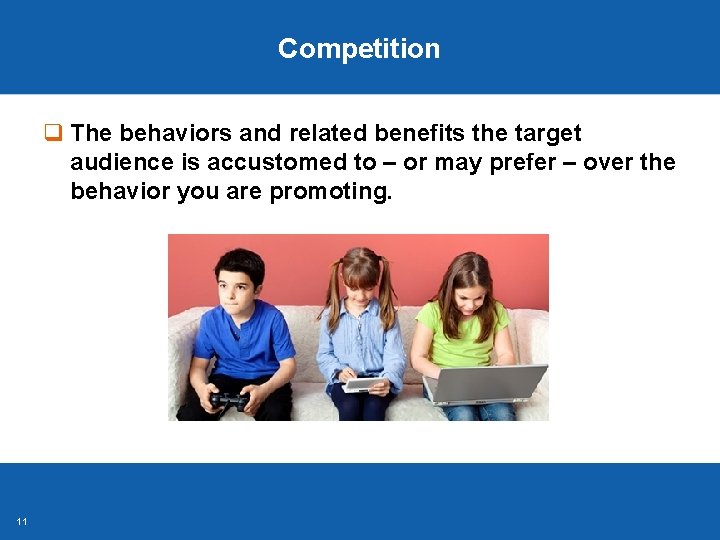
Competition q The behaviors and related benefits the target audience is accustomed to – or may prefer – over the behavior you are promoting. 11
VERBtm Campaign q VERB in a nutshell… Ø Ø Ø 12 Target Audience Desired Behavior Benefits and Exchange Concept Barriers 4 Ps Competition
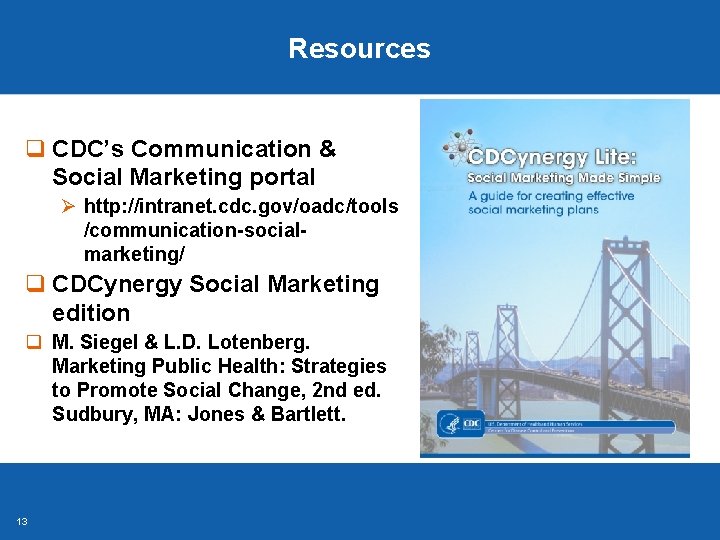
Resources q CDC’s Communication & Social Marketing portal Ø http: //intranet. cdc. gov/oadc/tools /communication-socialmarketing/ q CDCynergy Social Marketing edition q M. Siegel & L. D. Lotenberg. Marketing Public Health: Strategies to Promote Social Change, 2 nd ed. Sudbury, MA: Jones & Bartlett. 13
Thank you Linda S. Orgain, MPH LBO 6@cdc. gov 14