
CONNECTING AT THE POINT OF CARE INDIRECT SUPERVISION


- Slides: 20
CONNECTING AT THE POINT OF CARE: INDIRECT SUPERVISION IN NURSING PRACTICE EDUCATION Caroline Park Jocelyne Van Neste-Kenny Pamela Burton Richard Kenny
Nursing Education Practice Preceptorship Shift from preceptorship in final practice courses to across the years of the program Need increased number of preceptors because of increased practice settings and “burn out” Collaborative Learning Unit Indirect Supervision of students- instructor not present “in real-time” at the point-of care.
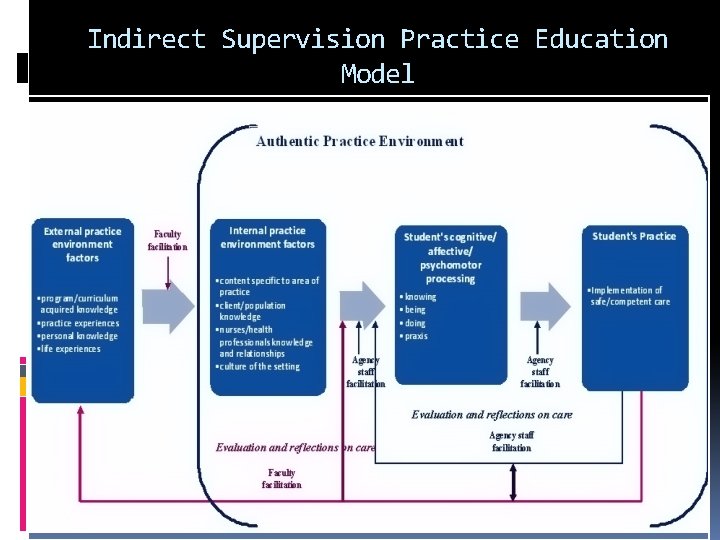
Indirect Supervision Pedagogical concerns Preceptors do not have pedagogical background to support all aspects of practice education Faculty role is to bridge the gap between pedagogy and practice
Indirect Supervision Practice Education Model
Potential of Mobile Learning To support learning that is more situated, experiential and contextualized within specific domains To support creation and use of more up-todate and authentic content (Kukulska-Hulme & Traxler, 2005)
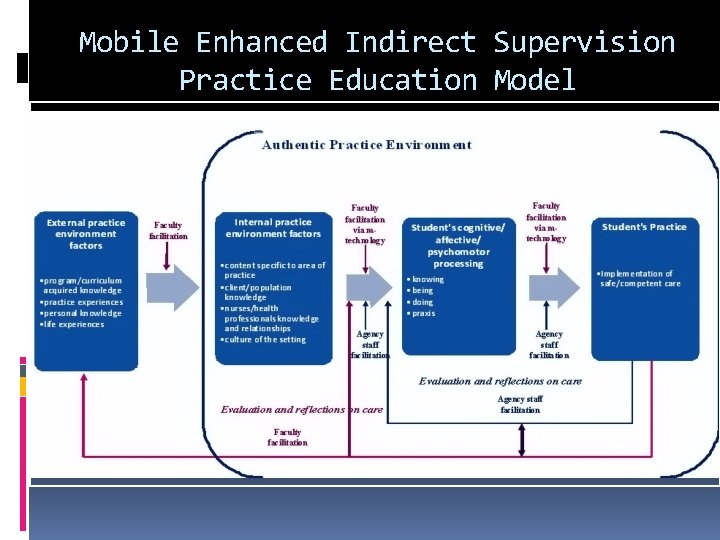
Mobile Enhanced Indirect Supervision Practice Education Model Vision of faculty involvement at the point-of-care from a distance Bringing the instructor back to the point-of-care in the “just in case, just in time, just enough and just for me” (Traxler, 2007)
Literature on Mobile Technology in Nursing Current Uses Task lists, memo pads, calculators, expense trackers, calendar/date books, patient manager, practice reference material, address book, information exchange, games, recreational reading, email and Internet (Cahoon, 2002: Rosenthal, 2003 & Stroud et al. , 2005) Records of student assignments, checklists for completing physical assessments, as a source of point-of-care reference and to document student progress on-the-spot (Lehman, 2003). Potential Interdisciplinary consultations, electronic ordering and test results, patient histories, progress notes and assessments, references, protocols, and prescription information (Newbold, 2003)
Literature on Mobile Technology in Nursing Research on students use Significant increase in self-efficacy in preparation for medication administration (Goldsworthy, Lawrence & Goodman, 2006). Increased numbers of questions and greater recognition of the need to use current resources ( Miller et al. , 2005) Potential Recognized for nursing consultation (Newbold , 2003) Instructor-student communication (White et al. , 2005). The study of connectivity potential of mobile devices is limited
Research Questions Can the use of mobile devices to connect instructors to students in real-time at the point-of-care be implemented and sustained in indirect supervision models of nursing practice education? Is the use of mobile devices feasible and practical in nursing practice education settings?
Mobile Enhanced Indirect Supervision Practice Education Model
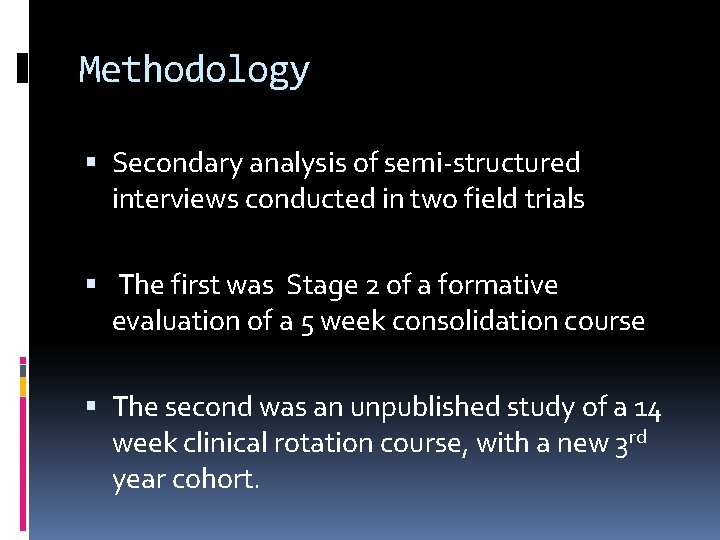
Methodology Secondary analysis of semi-structured interviews conducted in two field trials The first was Stage 2 of a formative evaluation of a 5 week consolidation course The second was an unpublished study of a 14 week clinical rotation course, with a new 3 rd year cohort.
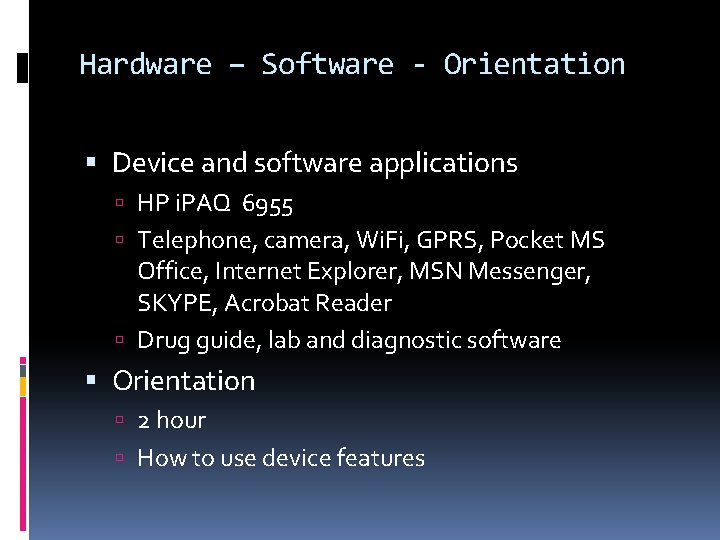
Hardware – Software - Orientation Device and software applications HP i. PAQ 6955 Telephone, camera, Wi. Fi, GPRS, Pocket MS Office, Internet Explorer, MSN Messenger, SKYPE, Acrobat Reader Drug guide, lab and diagnostic software Orientation 2 hour How to use device features
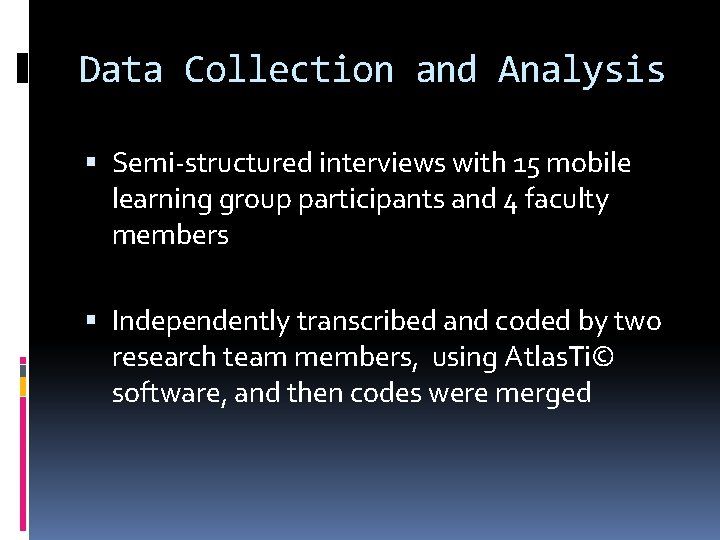
Data Collection and Analysis Semi-structured interviews with 15 mobile learning group participants and 4 faculty members Independently transcribed and coded by two research team members, using Atlas. Ti© software, and then codes were merged
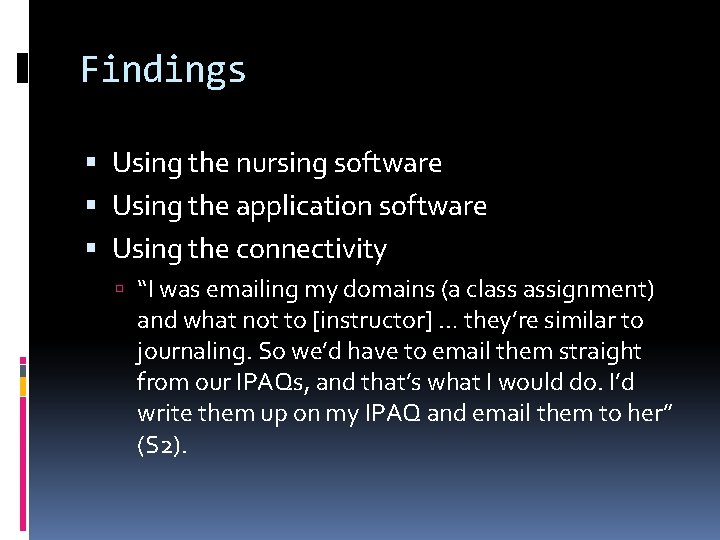
Findings Using the nursing software Using the application software Using the connectivity “I was emailing my domains (a class assignment) and what not to [instructor] … they’re similar to journaling. So we’d have to email them straight from our IPAQs, and that’s what I would do. I’d write them up on my IPAQ and email them to her” (S 2).
Barriers to Full Exploration Time to learn and practice Integration to Practice Connectivity at the point-of-care Technical support Comfort with technology Device features
Discussion Seeing the potential “I think that this is probably a direction that nursing is gonna go in the future. It’s gonna be a tool and that’s what got my interest. We’re heading towards being more technical out there and for instance as a home care nurse you’re out there and you’ve got a client who’s got a wound and you don’t know what to do. You snap a picture, send it to the physician and get a full colour text message back giving you some directions. So it’s… it has potential to be a great cost saving device as well… in future”. (S 6) Projected uses feasible and realistic
Discussion Mobile Enhance Indirect Practice Supervision has the potential to Enhance pedagogical dialogues at the point of care Support agency staff to situate their work with students within their scope of expertise Increase student autonomy in their practice Create virtual communities of inquiry and practice
Conclusion Need to critically examine potential consequences of shifts in health care delivery for practice education New tools for new challenges Ensuring that pedagogical requirements drive the use of technology The “Digital Citizens” are upon us Use of technology is no longer optional Use of mobile technologies must be “normalized” into the real world of practice
Questions Contact Information Caroline Parks clpark@athabascau. ca Jocelyne Van Neste-Kenny jvannest@nic. bc. ca Pam Burton pam. burton@nic. bc. ca Rick Kenny rickk@athabascau. ca
References Cahoon, J. (2002, April). Handhelds in healthcare. Advances in Clinical Knowledge Management, 5. Available: http: //www. openclinical. org/docs/ext/workshops/ackm 5/asb. Cahoon. pdf Goldsworthy, S. , Lawrence, N. , & Goodman, W. (2006). The use of Personal Digital Assistants at the point of care in an undergraduate nursing program [Electronic version]. CIN, 24(3), 138 -143. Kukulska-Hulme, A. , & Traxler, J. ( 2005). Mobile learning: A handbook for educators and trainers. London: Routledge. Lehman, K. (2003). Clinical nursing instructors’ use of handheld computers for student recordkeeping [Electronic version]. Journal of Nursing Education, 42(10), 41 -42. Miller, J. , Shaw-Kokot, J. R. , Arnold, M. S. , Boggin, T. , Crowell, K. E. , Allehri, F. , et al. (2005). A study of personal digital assistants to enhance undergraduate clinical nursing education. Journal of Nursing Education, 44, 19 -26. Newbold, S. K. (2003, October). New uses for wireless technology. Nursing Management, 22 -32. Rosenthal, K. (2003). “Touch” vs. “tech”: Valuing nursing specific PDA software. Nursing Management, 34(7), 58. Stroud, S. D. , Erkel, E. A. , & Smith, C. A. (2005). The use of Personal Digital Assistants by Nurse Practitioner students and faculty [Electronic version]. Journal of the American Academy of Nurse Practitioners, 17(2), 67 -75. Traxler, J. (2007). Defining, discussing and evaluating mobile learning: The moving finger writes and having writ. . The International Review of Research in Open and Distance Learning, 8(2). Available: http: //www. irrodl. org/index. php/irrodl/article/view/346/882 White, A. , Allen, P. , Goodwin, L. , Breckinridge, D. , Dowell, J. , & Garvey, R. (2005). Infusing PDA technology into nursing education. Nurse Educator, 30(4), 150 -154.