
CONNECTICUT STATE DEPARTMENT OF EDUCATION Computer Science Standards
- Slides: 26
CONNECTICUT STATE DEPARTMENT OF EDUCATION Computer Science Standards From Adoption to Implementation
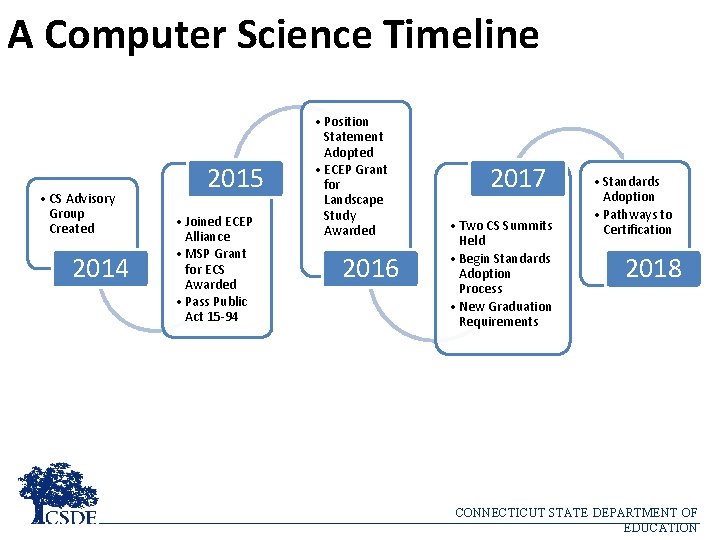
A Computer Science Timeline • CS Advisory Group Created 2014 2015 • Joined ECEP Alliance • MSP Grant for ECS Awarded • Pass Public Act 15 -94 • Position Statement Adopted • ECEP Grant for Landscape Study Awarded 2016 2017 • Two CS Summits Held • Begin Standards Adoption Process • New Graduation Requirements • Standards Adoption • Pathways to Certification 2018 CONNECTICUT STATE DEPARTMENT OF EDUCATION
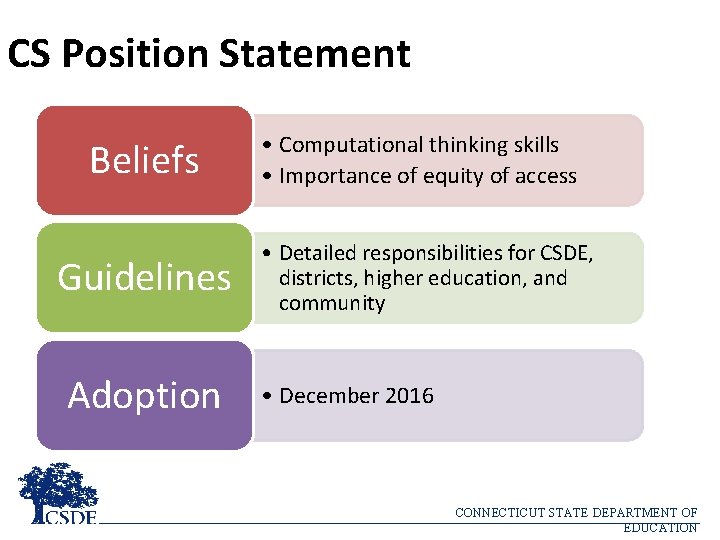
CS Position Statement Beliefs Guidelines Adoption • Computational thinking skills • Importance of equity of access • Detailed responsibilities for CSDE, districts, higher education, and community • December 2016 CONNECTICUT STATE DEPARTMENT OF PAGE 3 EDUCATION
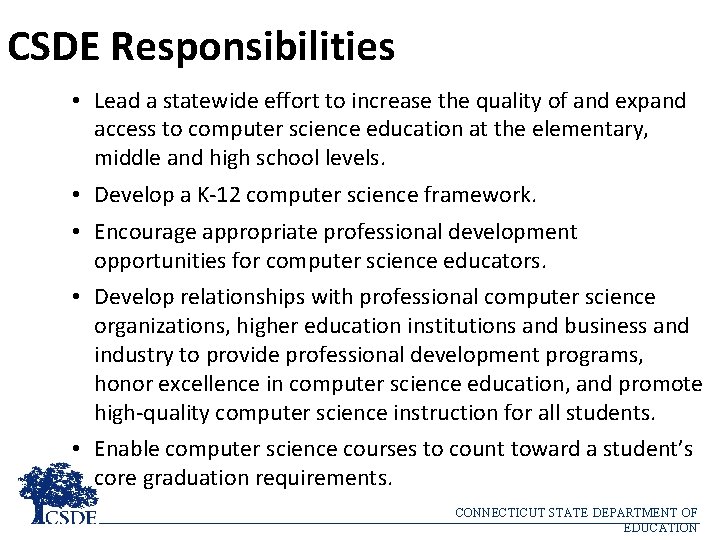
CSDE Responsibilities • Lead a statewide effort to increase the quality of and expand access to computer science education at the elementary, middle and high school levels. • Develop a K-12 computer science framework. • Encourage appropriate professional development opportunities for computer science educators. • Develop relationships with professional computer science organizations, higher education institutions and business and industry to provide professional development programs, honor excellence in computer science education, and promote high-quality computer science instruction for all students. • Enable computer science courses to count toward a student’s core graduation requirements. CONNECTICUT STATE DEPARTMENT OF PAGE 4 EDUCATION
School District Responsibilities • Ensure that computer science is made accessible to all students, especially traditionally under-represented groups. • Ensure instructional time for computer science education for all learners. • Increase the number of students who take computer science courses at the high school level. • Offer a continuum of courses that will allow interested students to study facets of computer science in more depth and prepare them for entry into the work force or college. CONNECTICUT STATE DEPARTMENT OF PAGE 5 EDUCATION
K-12 Computer Science Framework October 2016 CONNECTICUT STATE DEPARTMENT OF EDUCATION
Background of the Framework ● 27 writers ● 14 states represented ● 4 districts represented ● 25 advisors from the CS education community ● Industry: Google, Amazon, Microsoft, Apple. . . ●Organizations: College Board, PLTW, Achieve, CCSSO, NGA, ISTE, NAF. . . CONNECTICUT STATE DEPARTMENT OF 7 EDUCATION
Vision A framework that will empower students to… ● ● be informed citizens who can critically engage in CS-related discussions develop as learners, users, and creators of CS knowledge and artifacts better understand the role of computing in the world around them learn, perform, and express themselves in other subjects and interests CONNECTICUT STATE DEPARTMENT OF EDUCATION
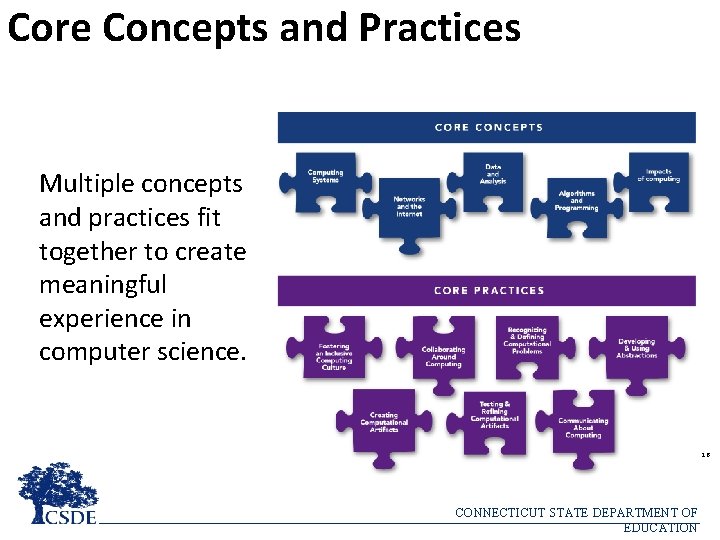
Core Concepts and Practices Multiple concepts and practices fit together to create meaningful experience in computer science. 16 CONNECTICUT STATE DEPARTMENT OF EDUCATION
CONNECTICUT STATE DEPARTMENT OF EDUCATION
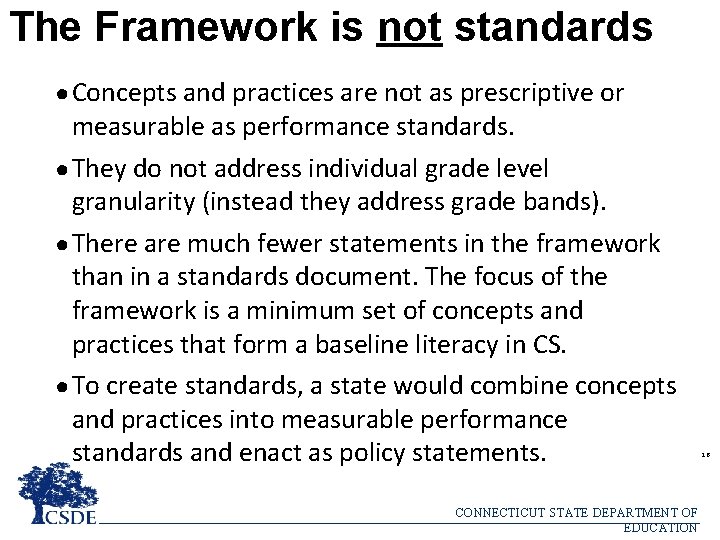
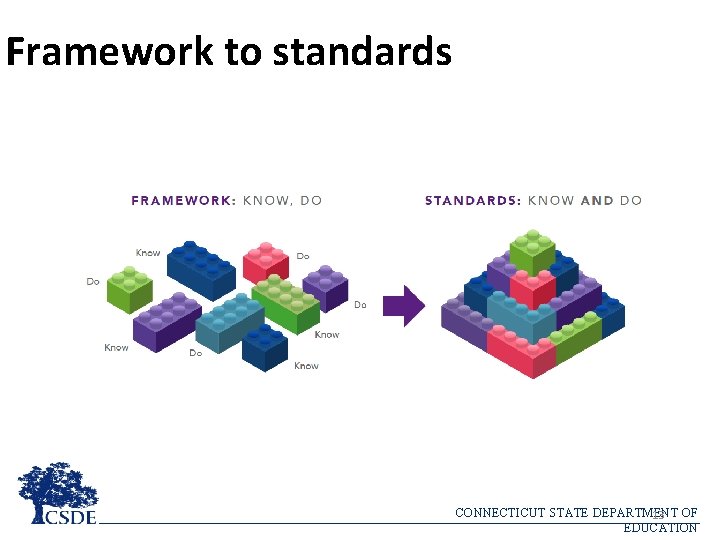
The Framework is not standards ● Concepts and practices are not as prescriptive or measurable as performance standards. ● They do not address individual grade level granularity (instead they address grade bands). ● There are much fewer statements in the framework than in a standards document. The focus of the framework is a minimum set of concepts and practices that form a baseline literacy in CS. ● To create standards, a state would combine concepts and practices into measurable performance standards and enact as policy statements. CONNECTICUT STATE DEPARTMENT OF EDUCATION 16
Framework to Standards CSTA Computer Science Standards 2017 CONNECTICUT STATE DEPARTMENT OF EDUCATION
Framework to standards CONNECTICUT STATE DEPARTMENT 13 OF EDUCATION
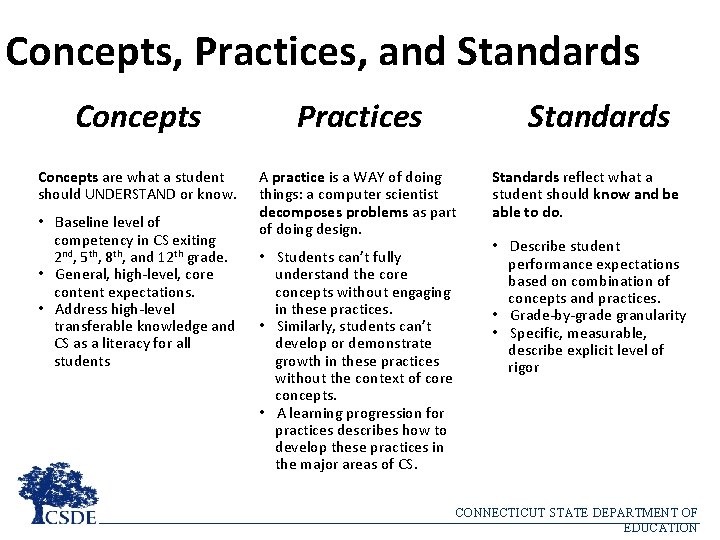
Concepts, Practices, and Standards Concepts Practices Concepts are what a student should UNDERSTAND or know. A practice is a WAY of doing things: a computer scientist decomposes problems as part of doing design. • Baseline level of competency in CS exiting 2 nd, 5 th, 8 th, and 12 th grade. • General, high-level, core content expectations. • Address high-level transferable knowledge and CS as a literacy for all students • Students can’t fully understand the core concepts without engaging in these practices. • Similarly, students can’t develop or demonstrate growth in these practices without the context of core concepts. • A learning progression for practices describes how to develop these practices in the major areas of CS. Standards reflect what a student should know and be able to do. • Describe student performance expectations based on combination of concepts and practices. • Grade-by-grade granularity • Specific, measurable, describe explicit level of rigor CONNECTICUT STATE DEPARTMENT OF EDUCATION
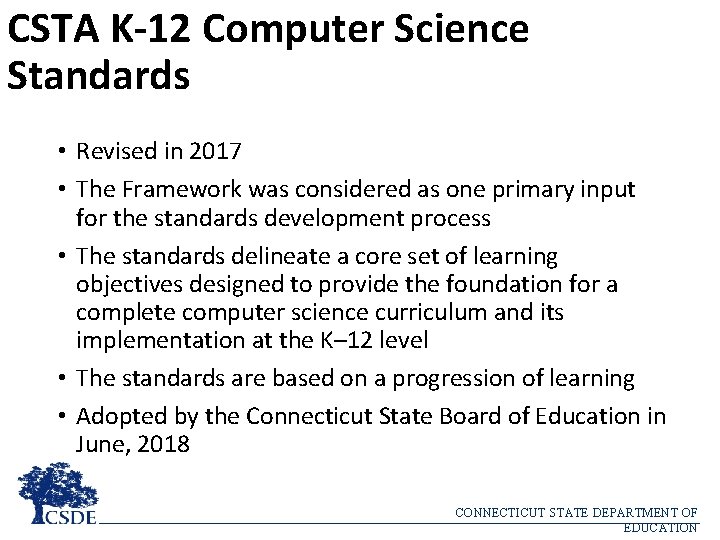
CSTA K-12 Computer Science Standards • Revised in 2017 • The Framework was considered as one primary input for the standards development process • The standards delineate a core set of learning objectives designed to provide the foundation for a complete computer science curriculum and its implementation at the K– 12 level • The standards are based on a progression of learning • Adopted by the Connecticut State Board of Education in June, 2018 CONNECTICUT STATE DEPARTMENT OF EDUCATION
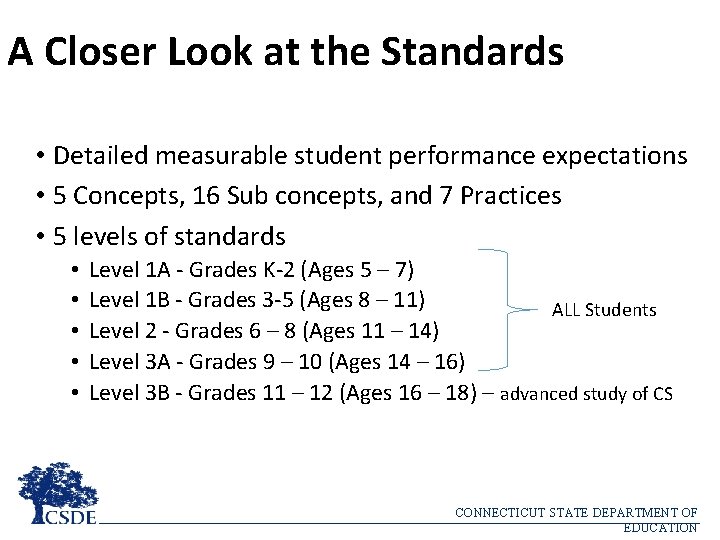
A Closer Look at the Standards • Detailed measurable student performance expectations • 5 Concepts, 16 Sub concepts, and 7 Practices • 5 levels of standards • • • Level 1 A - Grades K-2 (Ages 5 – 7) Level 1 B - Grades 3 -5 (Ages 8 – 11) ALL Students Level 2 - Grades 6 – 8 (Ages 11 – 14) Level 3 A - Grades 9 – 10 (Ages 14 – 16) Level 3 B - Grades 11 – 12 (Ages 16 – 18) – advanced study of CS CONNECTICUT STATE DEPARTMENT OF EDUCATION
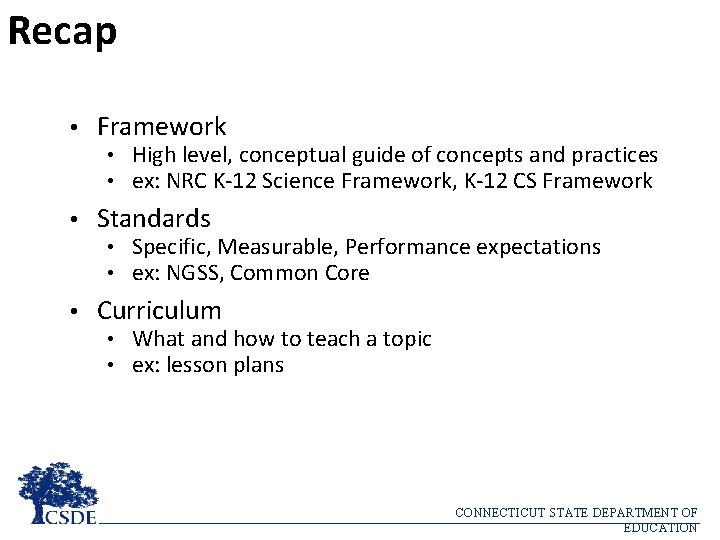
Recap • Framework • High level, conceptual guide of concepts and practices • ex: NRC K-12 Science Framework, K-12 CS Framework • Standards • Specific, Measurable, Performance expectations • ex: NGSS, Common Core • Curriculum • What and how to teach a topic • ex: lesson plans CONNECTICUT STATE DEPARTMENT OF EDUCATION
Standards to Implementation CONNECTICUT STATE DEPARTMENT OF EDUCATION
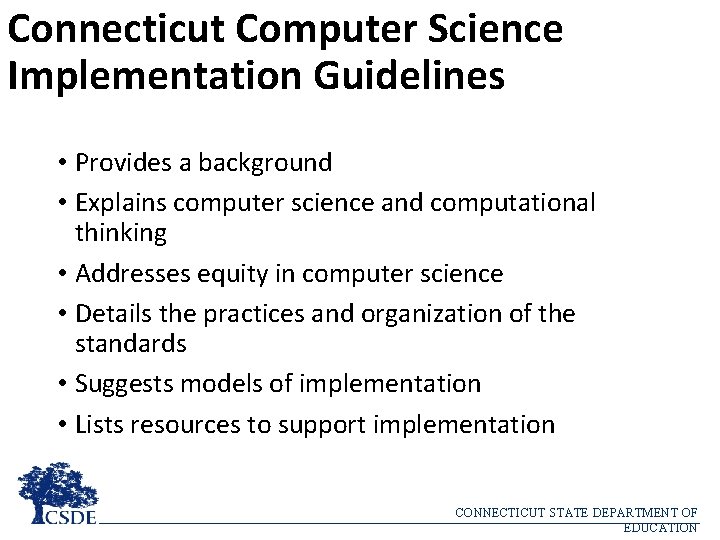
Connecticut Computer Science Implementation Guidelines • Provides a background • Explains computer science and computational thinking • Addresses equity in computer science • Details the practices and organization of the standards • Suggests models of implementation • Lists resources to support implementation CONNECTICUT STATE DEPARTMENT OF EDUCATION
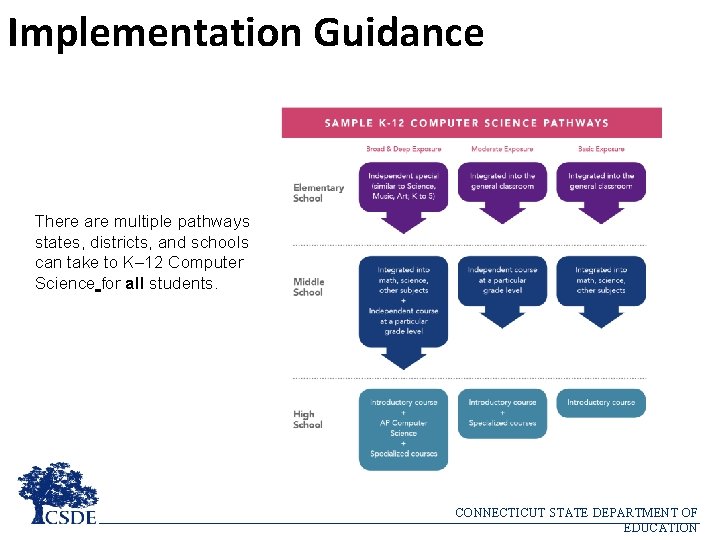
Implementation Guidance There are multiple pathways states, districts, and schools can take to K– 12 Computer Science for all students. CONNECTICUT STATE DEPARTMENT OF EDUCATION
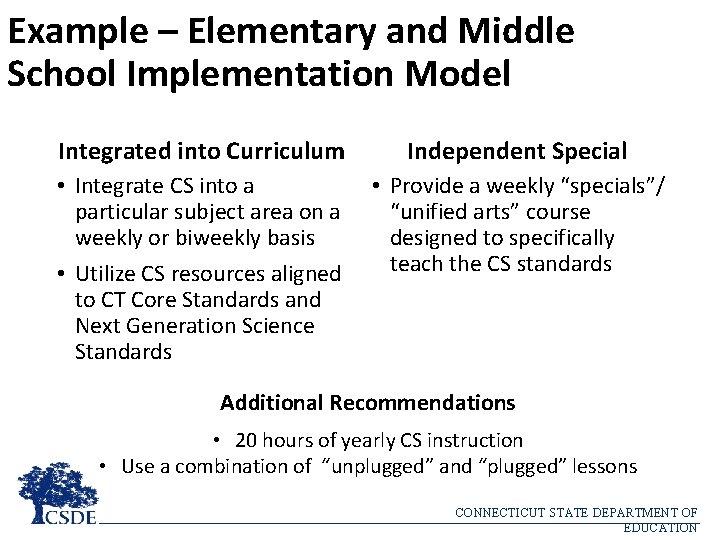
Example – Elementary and Middle School Implementation Model Integrated into Curriculum Independent Special • Integrate CS into a particular subject area on a weekly or biweekly basis • Utilize CS resources aligned to CT Core Standards and Next Generation Science Standards • Provide a weekly “specials”/ “unified arts” course designed to specifically teach the CS standards Additional Recommendations • 20 hours of yearly CS instruction • Use a combination of “unplugged” and “plugged” lessons CONNECTICUT STATE DEPARTMENT OF EDUCATION
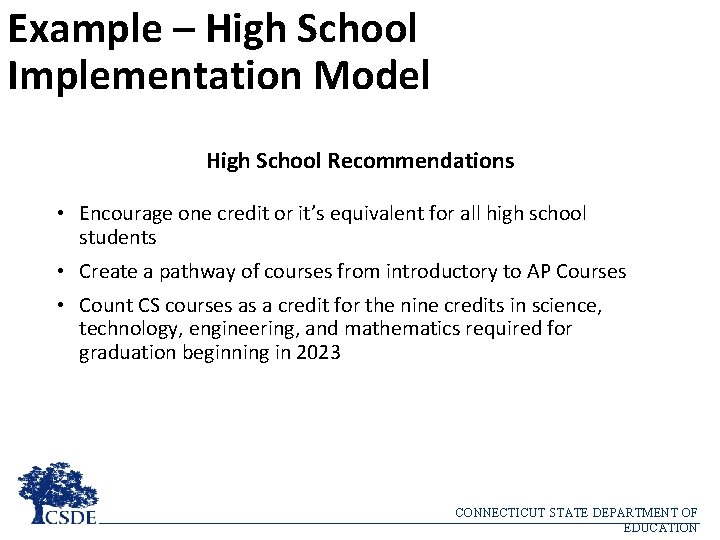
Example – High School Implementation Model High School Recommendations • Encourage one credit or it’s equivalent for all high school students • Create a pathway of courses from introductory to AP Courses • Count CS courses as a credit for the nine credits in science, technology, engineering, and mathematics required for graduation beginning in 2023 CONNECTICUT STATE DEPARTMENT OF EDUCATION
Computer Science in CT Summary CONNECTICUT STATE DEPARTMENT OF EDUCATION
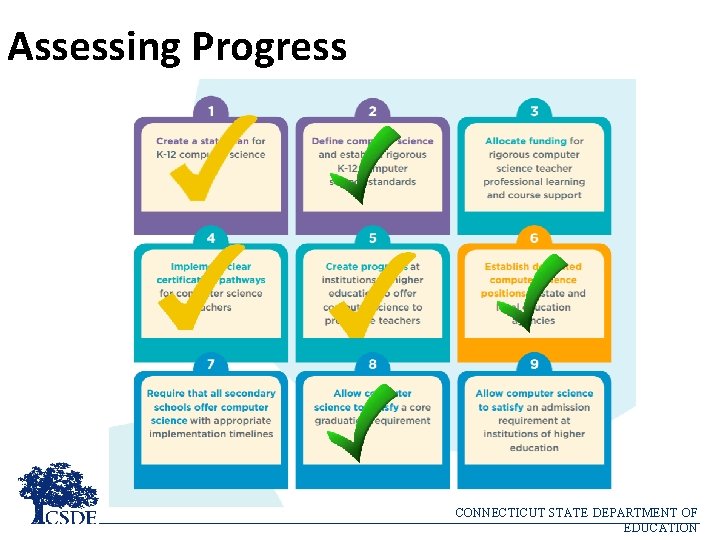
Assessing Progress CONNECTICUT STATE DEPARTMENT OF PAGE 24 EDUCATION
For Additional Information • Visit the Connecticut State Department of Education Computer Science webpage: https: //portal. ct. gov/SDE/Computer. Science/Computer-Science • Join the Computer Science listserv: email Jennifer. Michalek@ct. gov • Visit the Connecticut Computer Science Teachers Association website: http: //www. ctcsta. org/ CONNECTICUT STATE DEPARTMENT OF EDUCATION
Thank You Jennifer Michalek Education Consultant Jennifer. Michalek@ct. gov 860 -713 -6557 CONNECTICUT STATE DEPARTMENT OF EDUCATION