
Connect Learn Break Thru Summative Findings from Five
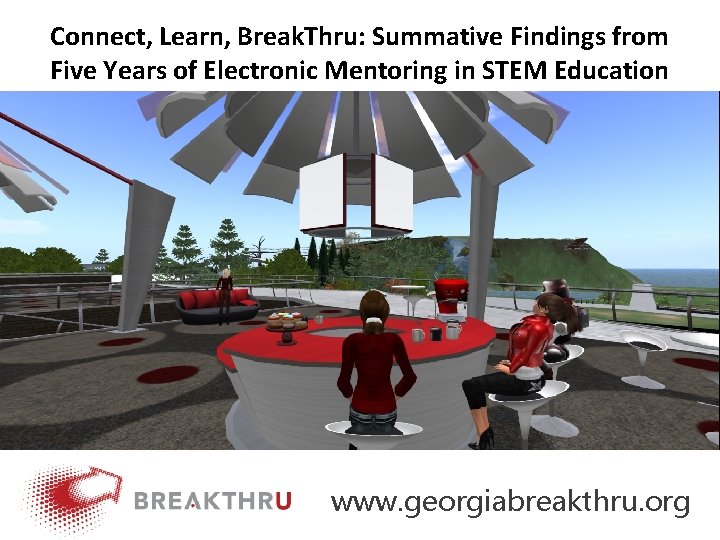
Connect, Learn, Break. Thru: Summative Findings from Five Years of Electronic Mentoring in STEM Education www. georgiabreakthru. org
Georgia STEM Accessibility Alliance (GSAA) Funded by a grant from the National Science Foundation (NSF), Research in Disabilities Education (RDE), Grant Nos. 1027635 and 1027655. Break. Thru is a collaboration between the Georgia Institute of Technology and the University of Georgia. www. georgiabreakthru. org
GSAA Collaborative Leaders University of Georgia Noel Gregg (ngregg@uga. edu) Gerri Wolfe (gwolfe@uga. edu) Georgia Institute of Technology Robert L. Todd (robert. todd@coa. gatech. edu) Chris L. Langston (chris. Langston@coa. gatech. edu) Nathan W. Moon (nathan. moon@cacp. gatech. edu) www. georgiabreakthru. org
What is Break. Thru? • Online learning and mentoring community • Connects students and mentors virtually • Promotes accessibility and achievement in Science, Technology, Engineering, and Math (STEM) courses www. georgiabreakthru. org
Project Goals The project serves as a pipeline between secondary and postsecondary institutions to strengthen students with disabilities’ capacities to access and succeed in STEM programs across critical junctures: high school > two-year college > fouryear college > graduate school. The overall project goals are to increase the retention of students with disabilities who are enrolled in STEM classes and majors and the number of students participating in Break. Thru mentoring activities. www. georgiabreakthru. org
NSF Project Goals 1. Retain Students in Virtual Mentoring and STEM Majors: – Year‐to‐year persistence rate of at least 50%. 2. Enroll to Virtual Mentoring: – 105 unduplicated high school students with disabilities by end of project period. – 65 unduplicated two‐year students with disabilities by end of project period. – 55 unduplicated four‐year students with disabilities by end of the project period. www. georgiabreakthru. org
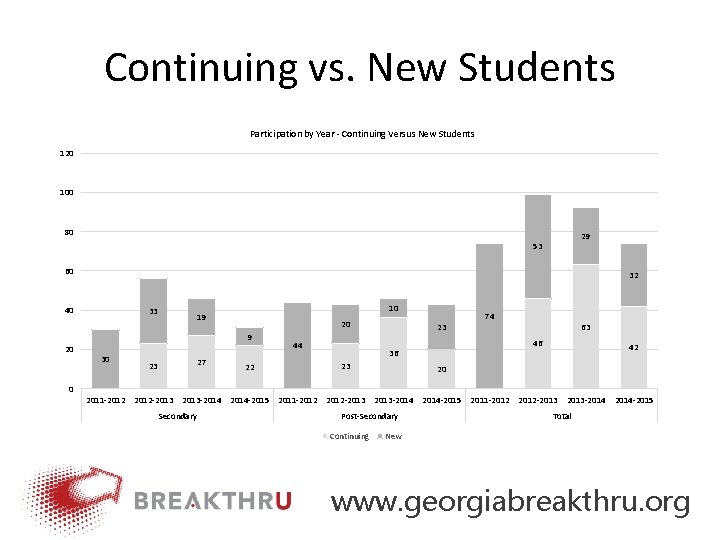
Continuing vs. New Students Participation by Year ‐ Continuing Versus New Students 120 100 80 29 53 60 32 40 33 10 19 20 0 30 27 23 22 44 23 63 46 36 23 74 42 20 2011‐ 2012‐ 2013‐ 2014‐ 2015 2011‐ 2012‐ 2013‐ 2014‐ 2015 Secondary Post‐Secondary Continuing Total New www. georgiabreakthru. org
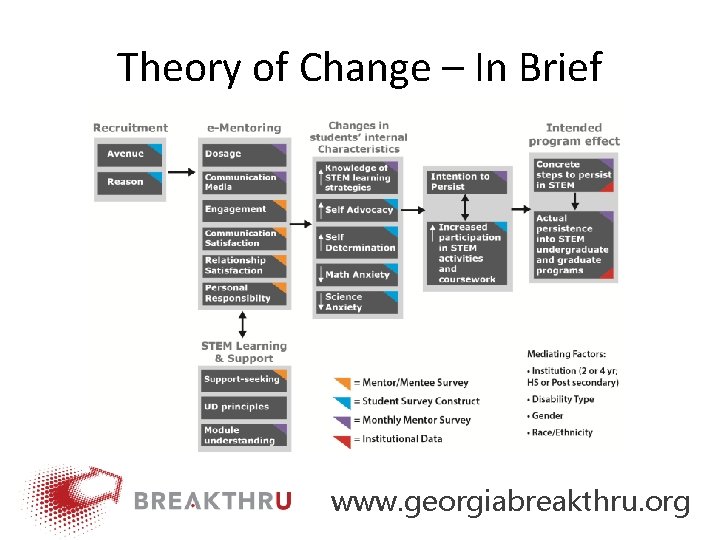
Theory of Change – In Brief www. georgiabreakthru. org
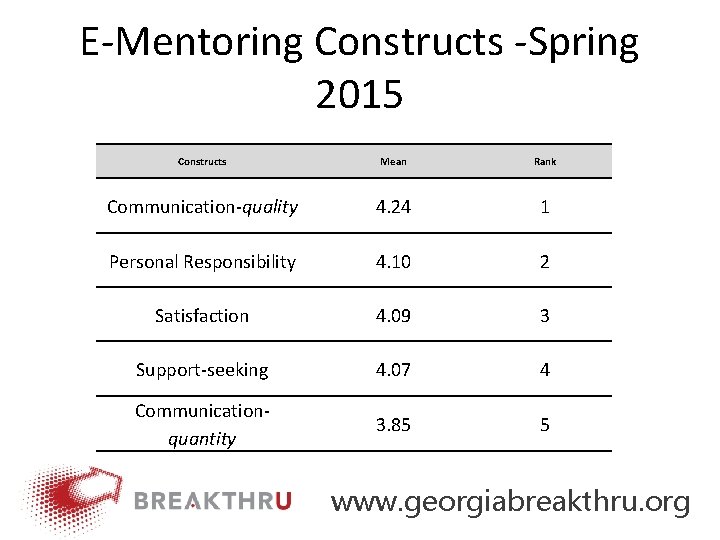
E‐Mentoring Constructs ‐Spring 2015 Constructs Mean Rank Communication‐quality 4. 24 1 Personal Responsibility 4. 10 2 Satisfaction 4. 09 3 Support‐seeking 4. 07 4 Communication‐ quantity 3. 85 5 www. georgiabreakthru. org
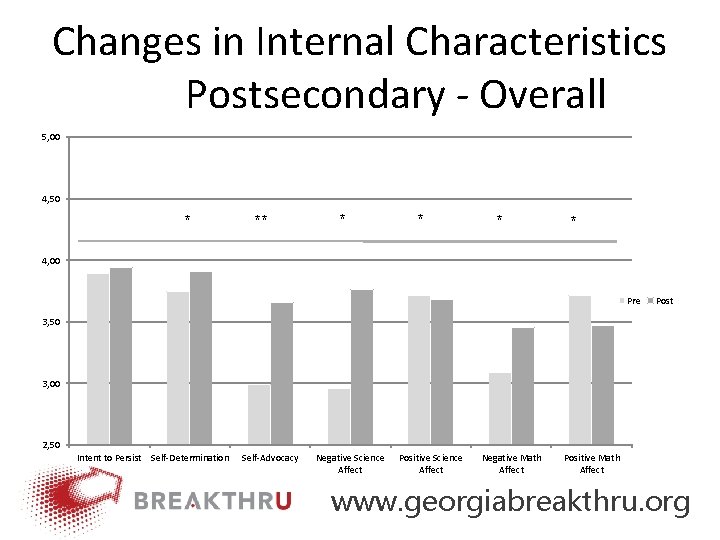
Changes in Internal Characteristics Postsecondary ‐ Overall 5, 00 4, 50 * ** * * 4, 00 Pre Post 3, 50 3, 00 2, 50 Intent to Persist Self‐Determination Self‐Advocacy Negative Science Affect Positive Science Affect Negative Math Affect Positive Math Affect www. georgiabreakthru. org
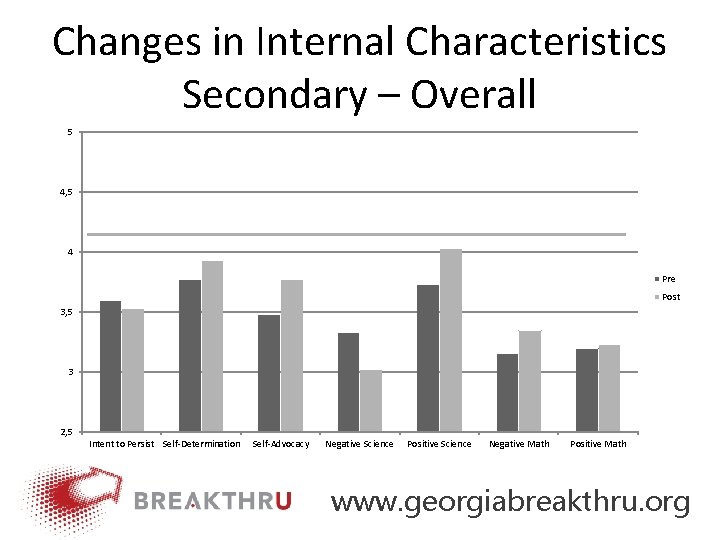
Changes in Internal Characteristics Secondary – Overall 5 4, 5 4 Pre Post 3, 5 3 2, 5 Intent to Persist Self‐Determination Self‐Advocacy Negative Science Positive Science Negative Math Positive Math www. georgiabreakthru. org
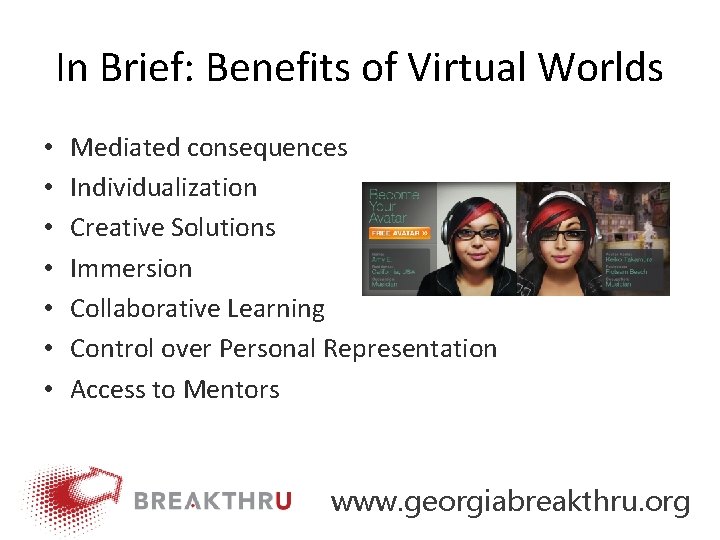
In Brief: Benefits of Virtual Worlds • • Mediated consequences Individualization Creative Solutions Immersion Collaborative Learning Control over Personal Representation Access to Mentors www. georgiabreakthru. org
The Good, the Bad – the Avatars in virtual worlds and other forms of online engagement can offer important affordances: • Immersion • Active engagement • Creating • Making real‐world disabilities ‐ disappear www. georgiabreakthru. org
The Good, the Bad – the Avatars But virtual avatars and other online tools can create significant barriers: • Complexity of access and use • Student and teacher reluctance to accept as educational tools • Information technology issues • Privacy, security, distraction www. georgiabreakthru. org
Effectiveness of Virtual Worlds and Communications Platforms 1. Selection of Communications Platform • Text (E‐mail, Facebook, SMS) • Voice (Second Life, Skype, Telephone) • In‐person 2. Usage Characteristics for Second Life • Frequency and Concurrency • Use of Badging and Features www. georgiabreakthru. org

Communication Methods • Table 1. Communications Methods Utilized Across 5 Reporting Periods Email Text Facebook SMS Secondary Mentees Total (=36) 81% 8% Post. Secondary Mentees Total (n=61) 97% Secondary Mentors Total (n=43) Post. Secondary Mentors Total (n=61) Survey Responses Second Life Voice Skype In Phone Person 75% 47% 11% 69% 61% 31% 57% 52% 20% 69% 15% 84% 5% 67% 44% 16% 70% 44% 97% 31% 57% 32% 20% 69% 15% www. georgiabreakthru. org
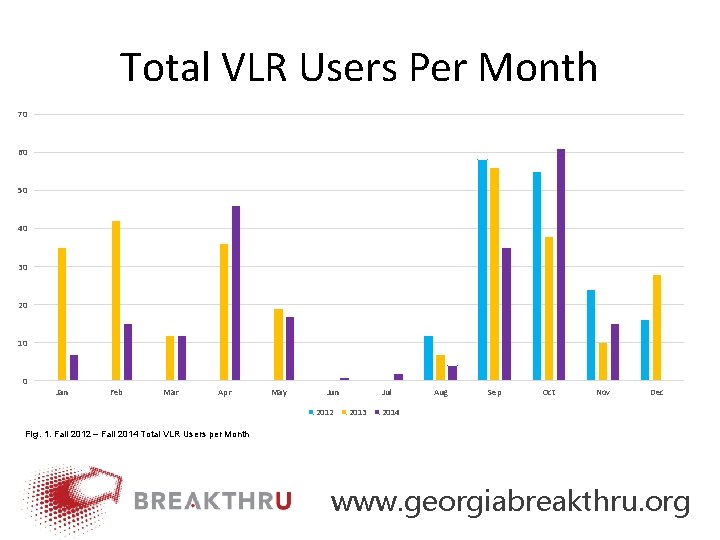
Total VLR Users Per Month 70 60 50 40 30 20 10 0 Jan Feb Mar Apr May Jun 2012 Jul 2013 Aug Sep Oct Nov Dec 2014 Fig. 1. Fall 2012 – Fall 2014 Total VLR Users per Month www. georgiabreakthru. org
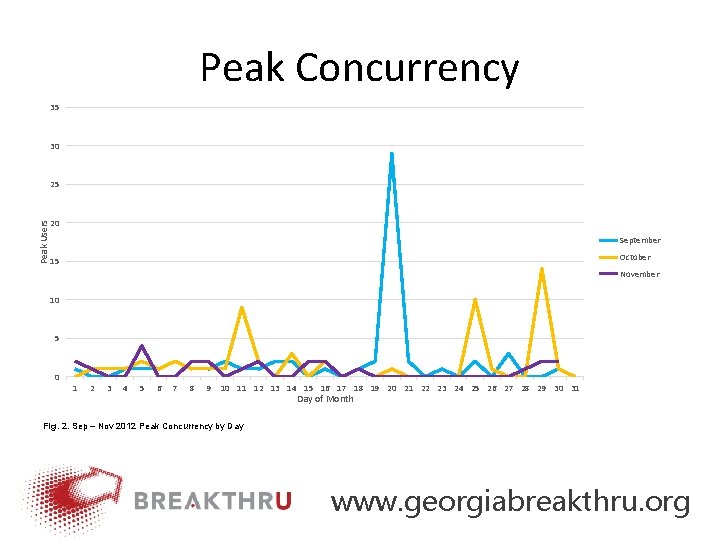
Peak Concurrency 35 30 25 Peak Users 20 September October 15 November 10 5 0 1 2 3 4 5 6 7 8 9 10 11 12 13 14 15 16 17 18 19 20 21 22 23 24 25 26 27 28 29 30 31 Day of Month Fig. 2. Sep – Nov 2012 Peak Concurrency by Day www. georgiabreakthru. org
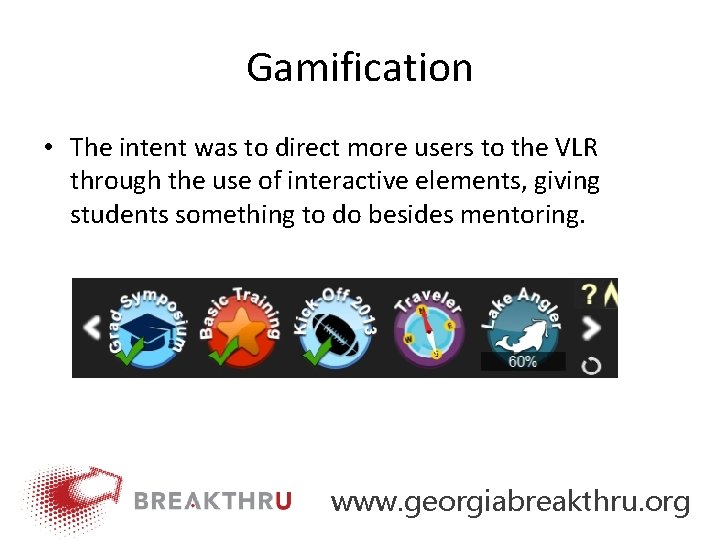
Gamification • The intent was to direct more users to the VLR through the use of interactive elements, giving students something to do besides mentoring. www. georgiabreakthru. org
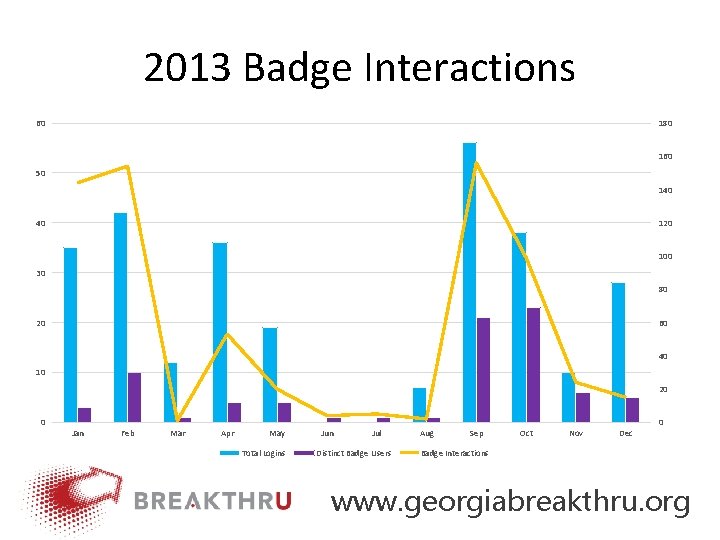
2013 Badge Interactions 60 180 160 50 140 40 120 100 30 80 20 60 40 10 20 0 Jan Feb Mar Apr May Total Logins Jun Jul Distinct Badge Users Aug Sep Oct Nov Dec 0 Badge Interactions www. georgiabreakthru. org
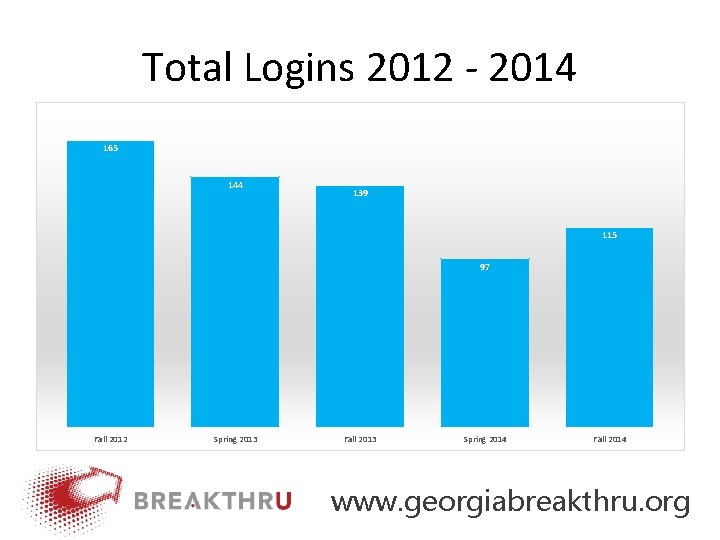
Total Logins 2012 ‐ 2014 165 144 139 115 97 Fall 2012 Spring 2013 Fall 2013 Spring 2014 Fall 2014 www. georgiabreakthru. org
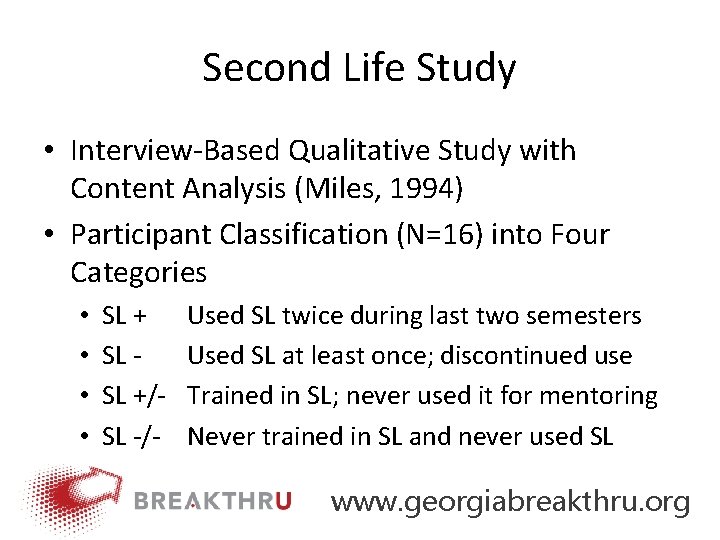
Second Life Study • Interview‐Based Qualitative Study with Content Analysis (Miles, 1994) • Participant Classification (N=16) into Four Categories • • SL + SL ‐ SL +/‐ SL ‐/‐ Used SL twice during last two semesters Used SL at least once; discontinued use Trained in SL; never used it for mentoring Never trained in SL and never used SL www. georgiabreakthru. org

Decision Tree for Protocols www. georgiabreakthru. org
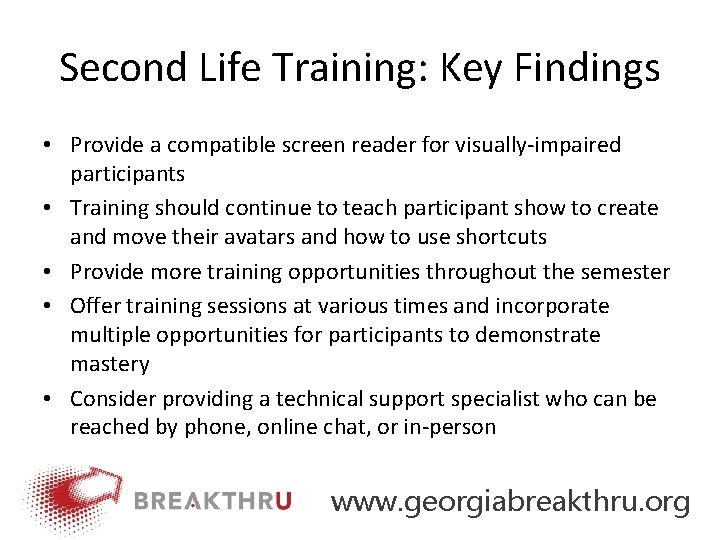
Second Life Training: Key Findings • Provide a compatible screen reader for visually‐impaired participants • Training should continue to teach participant show to create and move their avatars and how to use shortcuts • Provide more training opportunities throughout the semester • Offer training sessions at various times and incorporate multiple opportunities for participants to demonstrate mastery • Consider providing a technical support specialist who can be reached by phone, online chat, or in‐person www. georgiabreakthru. org
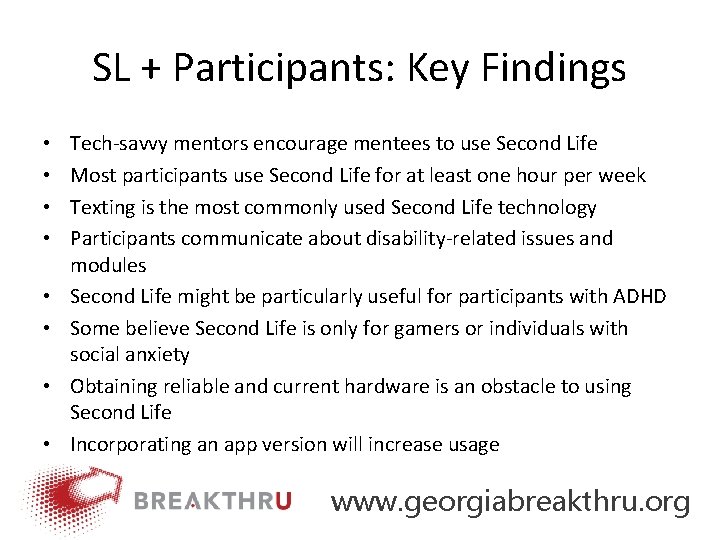
SL + Participants: Key Findings • • Tech‐savvy mentors encourage mentees to use Second Life Most participants use Second Life for at least one hour per week Texting is the most commonly used Second Life technology Participants communicate about disability‐related issues and modules Second Life might be particularly useful for participants with ADHD Some believe Second Life is only for gamers or individuals with social anxiety Obtaining reliable and current hardware is an obstacle to using Second Life Incorporating an app version will increase usage www. georgiabreakthru. org
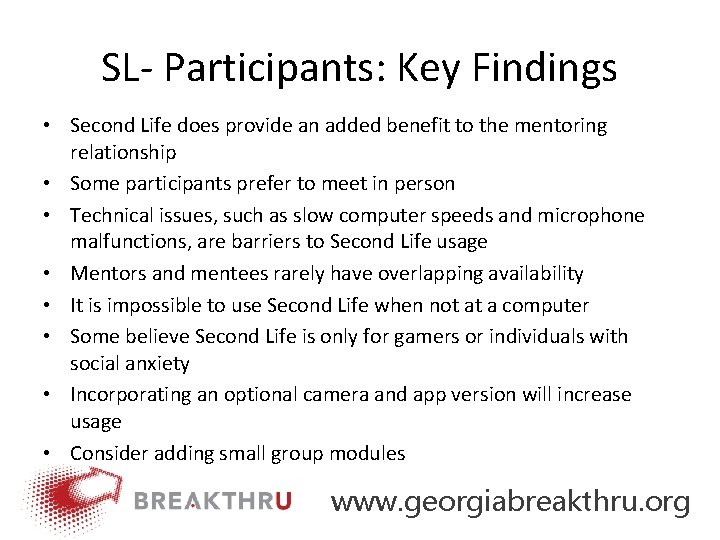
SL‐ Participants: Key Findings • Second Life does provide an added benefit to the mentoring relationship • Some participants prefer to meet in person • Technical issues, such as slow computer speeds and microphone malfunctions, are barriers to Second Life usage • Mentors and mentees rarely have overlapping availability • It is impossible to use Second Life when not at a computer • Some believe Second Life is only for gamers or individuals with social anxiety • Incorporating an optional camera and app version will increase usage • Consider adding small group modules www. georgiabreakthru. org
SL+/‐ Participants: Key Findings • Computer and Internet access at work and home are barriers for secondary participants • Mentors and mentees rarely have overlapping availability • Second Life is not integrated into daily life and is therefore not easy to use • Some believe Second Life is only for gamers or individuals with social anxiety • Participants may experience inappropriate content on Second Life • Mentees find Second Life to be out‐of‐date • Incorporating an app version will increase usage www. georgiabreakthru. org
SL‐/‐ Participants: Key Findings • Currently, visually‐impaired participants cannot use Second Life • Some associate a negative stigma of Second Life from a Law & Order: SVU episode • Provide a compatible screen reader and incorporate an app to increase usage www. georgiabreakthru. org
Overarching Lessons • Second Life is not intuitive; training is essential • Synchronous nature of Second Life may work against its use • Second Life requires processing power and fast Internet speed; out‐of‐touch in increasingly mobile world • Accessibility issues, especially for JAWS (Job Access with Speech) users • Perception—both positive and negative—is determinant in use or disuse • For committed users, however, it can deliver a positive experience www. georgiabreakthru. org
Technology Considerations • • • Platforms evolve faster than research projects Hardware requirements sometimes cause a barrier Participants increasingly rely on mobile technology Convenience and costs as drivers Most readily available platform is typically chosen – 89% of Americans age 18‐ 29 use social media. – Students are best reached through tools they already know. www. georgiabreakthru. org
Mentoring Conclusions • Mentoring in Second Life and other virtual worlds holds great promise • Careful development of environment with disability‐ related tools is essential • Supplement with additional communication methods • Giving students passive activities wasn’t effective. • Providing live training, guest speakers, or special events drove traffic to the VLR. www. georgiabreakthru. org
Mentoring Conclusions • Imperative that students and mentors form a lasting mentoring relationship. • Retention starts early by choosing the right participants. • Mentor and mentee applicants are screened and matched through an active process www. georgiabreakthru. org
Final Thoughts • Deeper research on efficacy of e‐mentoring • Increased focus on duration and modes of communication and quality of mentoring relationship • Wider range of communications technologies, especially mobile technologies • Focus on understanding qualitative factors rather than just increasing enrollment, retention, and graduation www. georgiabreakthru. org
Questions? www. georgiabreakthru. org
Break. Thru Contacts University of Georgia Noel Gregg (ngregg@uga. edu) Gerri Wolfe (gwolfe@uga. edu) Georgia Institute of Technology Robert Todd (robert. todd@coa. gatech. edu) Chris Langston (chris. Langston@coa. gatech. edu) Nathan Moon (Nathan. moon@cacp. gatech. edu) www. georgiabreakthru. org
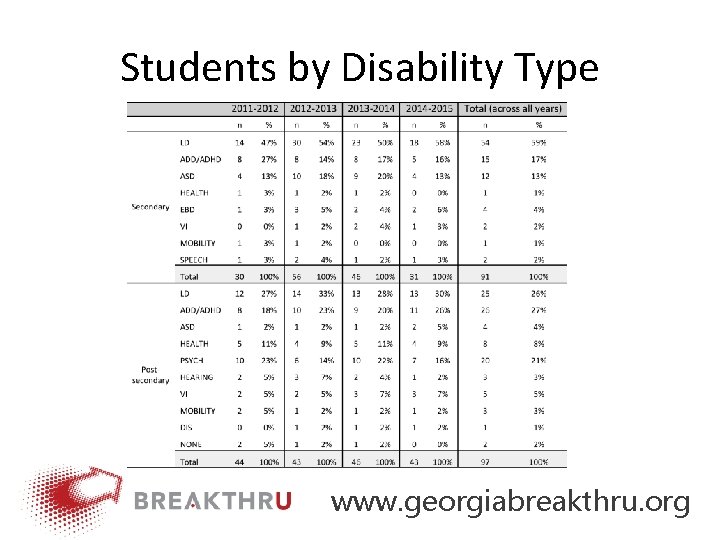
Students by Disability Type www. georgiabreakthru. org
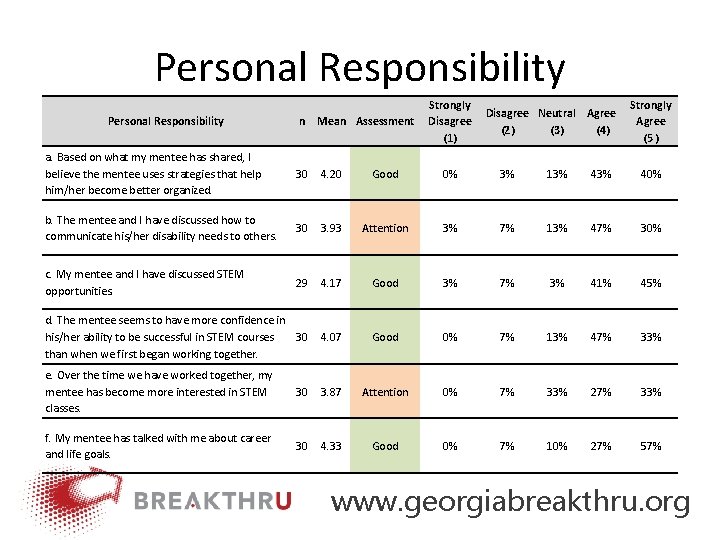
Personal Responsibility n Mean Assessment Strongly Disagree (1) Disagree Neutral Agree (2) (3) (4) Strongly Agree (5 ) a. Based on what my mentee has shared, I believe the mentee uses strategies that help him/her become better organized. 30 4. 20 Good 0% 3% 13% 40% b. The mentee and I have discussed how to communicate his/her disability needs to others. 30 3. 93 Attention 3% 7% 13% 47% 30% c. My mentee and I have discussed STEM opportunities. 29 4. 17 Good 3% 7% 3% 41% 45% d. The mentee seems to have more confidence in his/her ability to be successful in STEM courses 30 than when we first began working together. 4. 07 Good 0% 7% 13% 47% 33% e. Over the time we have worked together, my mentee has become more interested in STEM classes. 30 3. 87 Attention 0% 7% 33% 27% 33% f. My mentee has talked with me about career and life goals. 30 4. 33 Good 0% 7% 10% 27% 57% www. georgiabreakthru. org
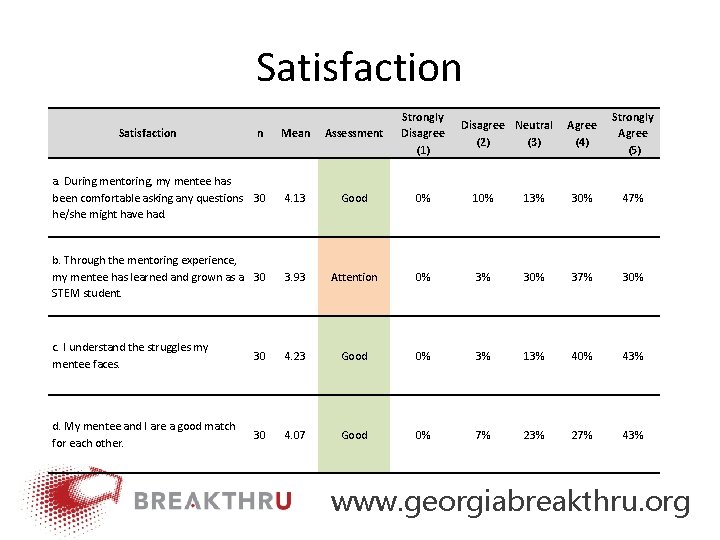
Satisfaction Mean Assessment Strongly Disagree (1) a. During mentoring, my mentee has been comfortable asking any questions 30 he/she might have had. 4. 13 Good 0% 13% 30% 47% b. Through the mentoring experience, my mentee has learned and grown as a 30 STEM student. 3. 93 Attention 0% 3% 30% 37% 30% c. I understand the struggles my mentee faces. 30 4. 23 Good 0% 3% 13% 40% 43% d. My mentee and I are a good match for each other. 30 4. 07 Good 0% 7% 23% 27% 43% Satisfaction n Disagree Neutral (2) (3) Agree (4) Strongly Agree (5) www. georgiabreakthru. org
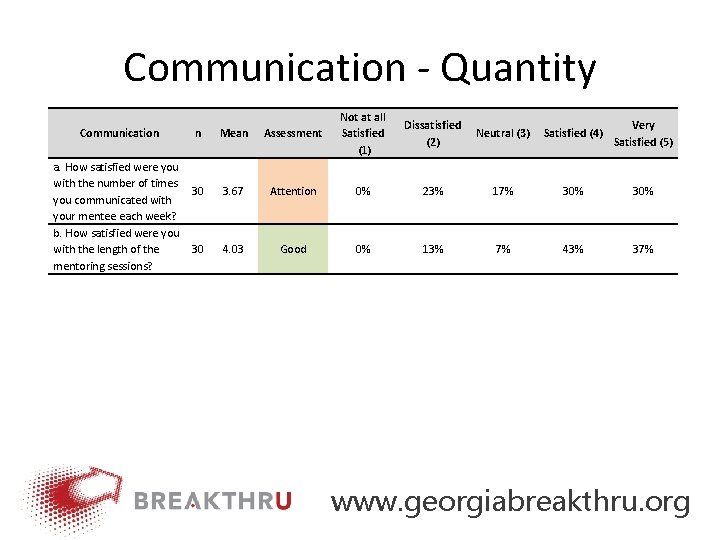
Communication ‐ Quantity Communication a. How satisfied were you with the number of times you communicated with your mentee each week? b. How satisfied were you with the length of the mentoring sessions? n Mean Assessment Not at all Satisfied (1) 30 3. 67 Attention 0% 23% 17% 30% 30 4. 03 Good 0% 13% 7% 43% 37% Dissatisfied (2) Neutral (3) Satisfied (4) Very Satisfied (5) www. georgiabreakthru. org
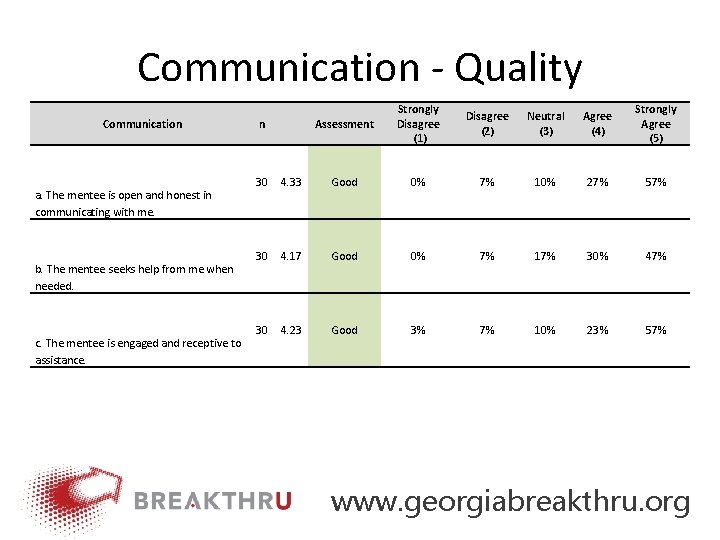
Communication ‐ Quality Communication a. The mentee is open and honest in communicating with me. b. The mentee seeks help from me when needed. c. The mentee is engaged and receptive to assistance. n Assessment Strongly Disagree (1) Disagree (2) Neutral (3) Agree (4) Strongly Agree (5) 30 4. 33 Good 0% 7% 10% 27% 57% 30 4. 17 Good 0% 7% 17% 30% 47% 30 4. 23 Good 3% 7% 10% 23% 57% www. georgiabreakthru. org
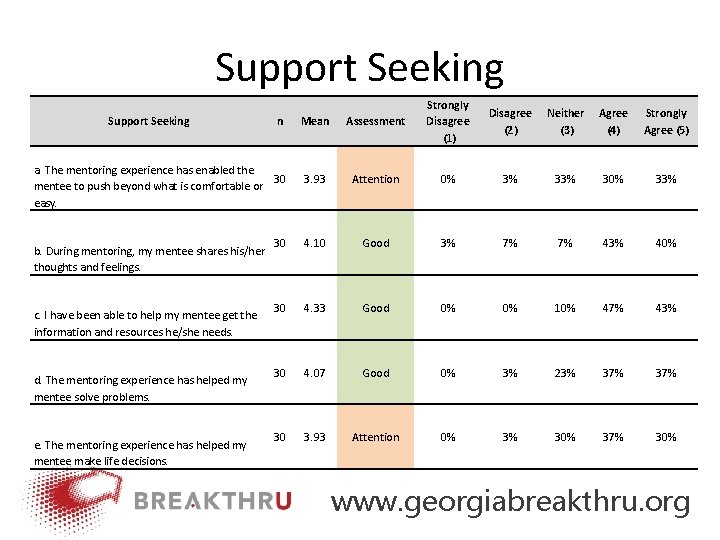
Support Seeking Mean Assessment Strongly Disagree (1) 3. 93 Attention 0% 3% 30% 33% 30 4. 10 Good 3% 7% 7% 43% 40% 30 4. 33 Good 0% 0% 10% 47% 43% 30 4. 07 Good 0% 3% 23% 37% 30 3. 93 Attention 0% 3% 30% 37% 30% n a. The mentoring experience has enabled the 30 mentee to push beyond what is comfortable or easy. b. During mentoring, my mentee shares his/her thoughts and feelings. c. I have been able to help my mentee get the information and resources he/she needs. d. The mentoring experience has helped my mentee solve problems. e. The mentoring experience has helped my mentee make life decisions. Disagree (2) Neither (3) Agree (4) Strongly Agree (5) www. georgiabreakthru. org
- Slides: 41