
CONNECT COLLABORATE GROW INSTRUCTIONAL ROUNDS NETWORK Term 3
CONNECT COLLABORATE GROW INSTRUCTIONAL ROUNDS NETWORK Term 3 Round, 2019 OAKHILL DRIVE PS
GROUPS FOR THIS MORNING English Maths Geography History
INTRODUCTION TO OAKHILL DRIVE PS & PROBLEM OF PRACTICE
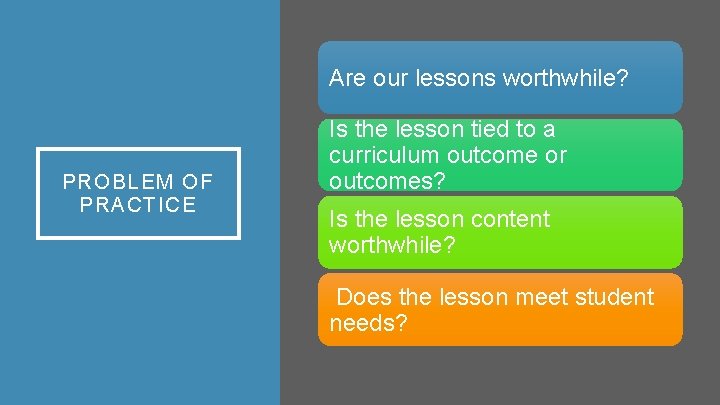
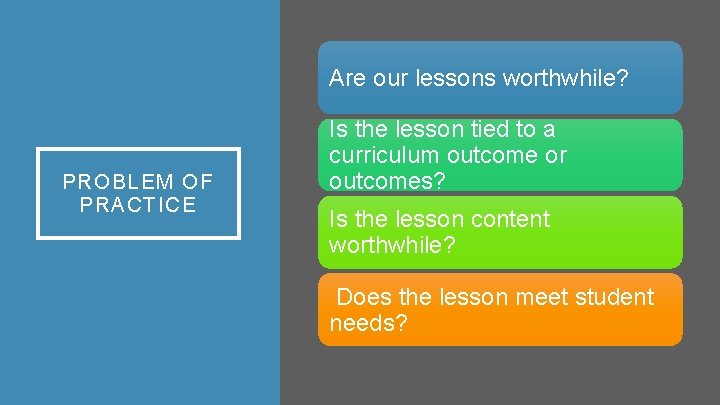
Are our lessons worthwhile? PROBLEM OF PRACTICE Is the lesson tied to a curriculum outcome or outcomes? Is the lesson content worthwhile? Does the lesson meet student needs?
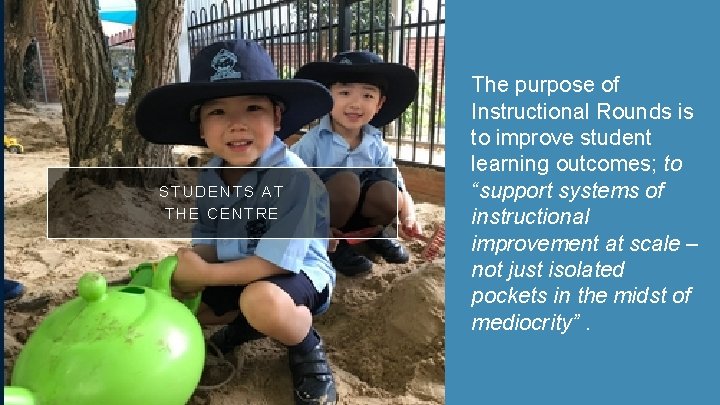
STUDENTS AT THE CENTRE The purpose of Instructional Rounds is to improve student learning outcomes; to “support systems of instructional improvement at scale – not just isolated pockets in the midst of mediocrity”.
Instructional Rounds has the main purpose of strengthening classroom practice and, through that, improving student outcomes. Operates at two levels: 1. Individual level – gain knowledge about learning, teaching & leading 2. Whole school level – major input to your school improvement process
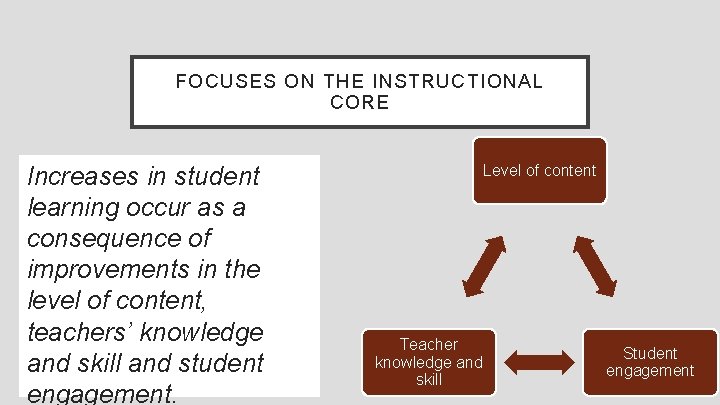
FOCUSES ON THE INSTRUCTIONAL CORE Increases in student learning occur as a consequence of improvements in the level of content, teachers’ knowledge and skill and student engagement. Level of content Teacher knowledge and skill Student engagement
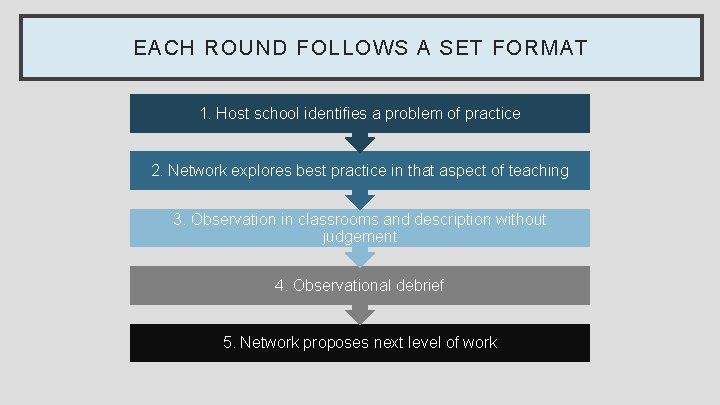
EACH ROUND FOLLOWS A SET FORMAT 1. Host school identifies a problem of practice 2. Network explores best practice in that aspect of teaching 3. Observation in classrooms and description without judgement 4. Observational debrief 5. Network proposes next level of work
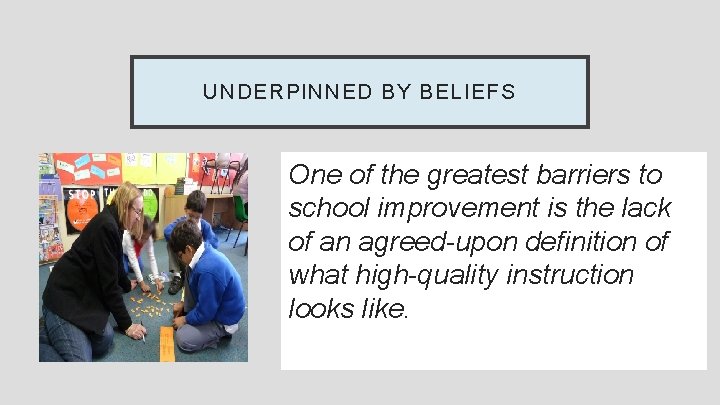
UNDERPINNED BY BELIEFS One of the greatest barriers to school improvement is the lack of an agreed-upon definition of what high-quality instruction looks like.
Sixth Principle We learn to do the work by doing the work, not by telling other people to do the work, not by having done the work at some time in the past, and not by hiring experts who can act as proxies for our knowledge about how to do the work.
Our knowledge of instruction builds over time • In IR we build a common language of instructional practice. Our knowledge and understanding builds over time. • Within and between schools we build a culture of inquiring and learning at a deep level. • As a network we support leaders and teachers develop their practice by focusing attention on the knowledge and skill needed for both teaching and leading.
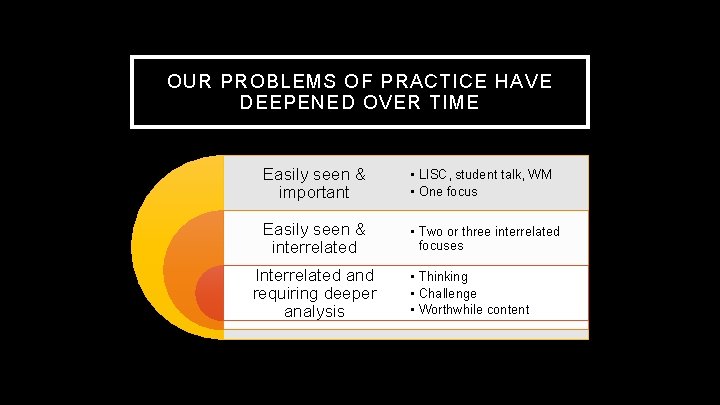
OUR PROBLEMS OF PRACTICE HAVE DEEPENED OVER TIME Easily seen & important • LISC, student talk, WM • One focus Easily seen & interrelated • Two or three interrelated focuses Interrelated and requiring deeper analysis • Thinking • Challenge • Worthwhile content
TODAY’S LEARNING This Photo by Unknown Author is licensed under CC BY-ND
Are our lessons worthwhile? PROBLEM OF PRACTICE Is the lesson tied to a curriculum outcome or outcomes? Is the lesson content worthwhile? Does the lesson meet student needs?
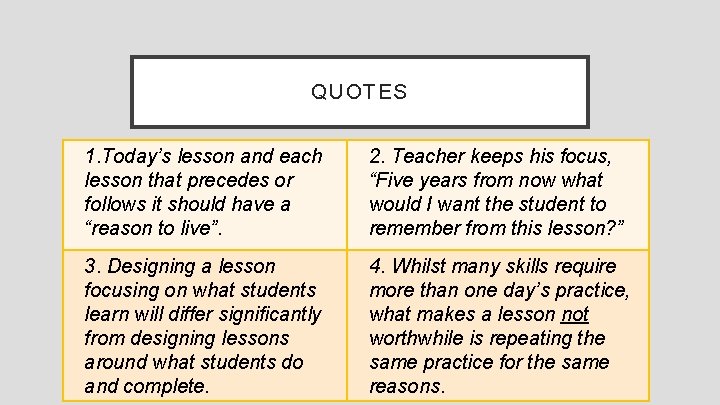
QUOTES 1. Today’s lesson and each lesson that precedes or follows it should have a “reason to live”. 2. Teacher keeps his focus, “Five years from now what would I want the student to remember from this lesson? ” 3. Designing a lesson focusing on what students learn will differ significantly from designing lessons around what students do and complete. 4. Whilst many skills require more than one day’s practice, what makes a lesson not worthwhile is repeating the same practice for the same reasons.
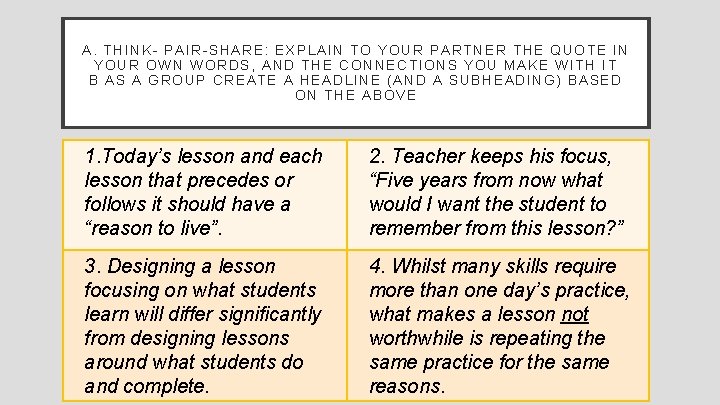
A. THINK- PAIR-SHARE: EXPLAIN TO YOUR PARTNER THE QUOTE IN YOUR OWN WORDS, AND THE CONNECTIONS YOU MAKE WITH IT B AS A GROUP CREATE A HEADLINE (AND A SUBHEADING) BASED ON THE ABOVE 1. Today’s lesson and each lesson that precedes or follows it should have a “reason to live”. 2. Teacher keeps his focus, “Five years from now what would I want the student to remember from this lesson? ” 3. Designing a lesson focusing on what students learn will differ significantly from designing lessons around what students do and complete. 4. Whilst many skills require more than one day’s practice, what makes a lesson not worthwhile is repeating the same practice for the same reasons.

HEADLINE & SUB-HEADING NEWS WITHOUT NEWSPAPERS LOCAL ACTION FOR A GLOBAL CAUSE ”Hyperlocal” Updates from Blogs, Police, And Even Reporters American Youth Collect Dry Waste in Pune, Do Their Bit to Conserve the Earth on International Day of Climate Action
PROFESSIONAL KNOWLEDGE AUSTRALIAN TEACHING STANDARDS • Teachers know the content of their subjects and curriculum. They know and understand the fundamental concepts, structure and enquiry processes relevant to programs they teach. • Teachers understand what constitutes effective, developmentally appropriate strategies in their learning and teaching programs and use this knowledge to make the content meaningful to students.
INSTRUCTIONAL OBJECTIVE You will deepen your understanding of the principles of selection and organization of content knowledge, and how they’re applied to develop engaging learning and teaching programs.
LEARNING TARGET You will deepen your understanding of the three sources that contribute to a “worthwhile lesson”. You will apply that understanding to planning a lesson in one Key Learning
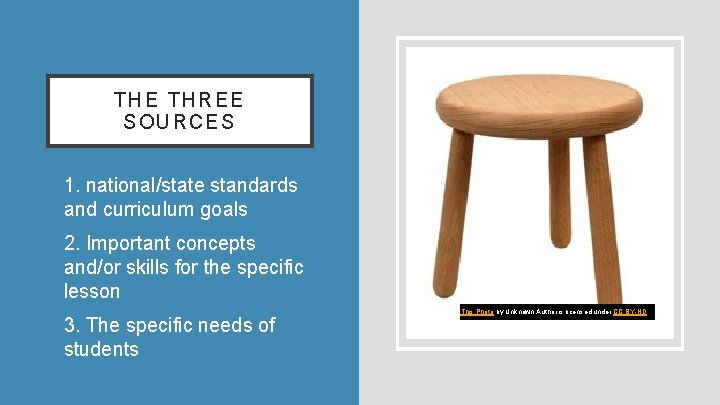
T HE T HREE S OURCES 1. national/state standards and curriculum goals 2. Important concepts and/or skills for the specific lesson 3. The specific needs of students This Photo by Unknown Author is licensed under CC BY-ND
PERFORMANCE OF UNDERSTANDING • You will collaboratively develop a list of key ideas for the three sources of a “worthwhile lesson”. • You will collaborative develop a lesson to meet the requirements of the three sources as stated in the “Collaborative Inquiry Guide for a Worthwhile Lesson”. • You will apply your knowledge of the three sources when giving feedback to another group’s lesson plan; and when categorising your classroom observations during the round debrief.
How will we cater for individual differences? • Activities to identify and draw on your background knowledge; • Opportunities to ask questions; • Participation in robust conversations.
LEARNING TARGET You will deepen your understanding of the three sources that contribute to a “worthwhile lesson”. You will apply that understanding to planning a lesson in one Key Learning Area. 1 -10 How important is this learning target for you as a teacher and learner? How easy do you think it will be to collaboratively plan a lesson to
PERFORMANCE OF UNDERSTANDING • You will collaborative develop a lesson to meet the requirements of the three sources as stated in the “Collaborative Inquiry Guide for a Worthwhile Lesson”. • You will apply your knowledge of the three sources when giving feedback to another group’s lesson plan; and when categorising your classroom observations during the round debrief. Think about the lesson sequence Focus on one lesson Add a brief summary of what students’ learnt before &
SHARE YOUR PRE-ROUND TASK 1. Take turns to share your key ideas from the readings. 2. As a group collate these key ideas. 3. Look at the questions you have that are still unanswered. Discuss these with you group. 4. What questions are still unanswered. Write each of these on a separate sheet of coloured paper.
MY QUESTIONS • Is all curriculum content equally important? • What are the “reasoning processes” for your Key Learning Area? • To present appropriately increased level of understanding, we need to know where students are currently at. How do we find this out? • How will you support diversity in students’ reasoning processes?
TERM 4 ROUND How well does the qualities of the tasks deepen thinking and learning? • do they challenge students by pushing them in new directions? • encourage students to generate original ideas, explanations, solutions, responses or findings? • have depth and push students beyond their current level of understanding or skill? • - assist students’ understanding of big ideas? How can you deepen your knowledge of: - Quality tasks in your KLA? - The background to the specific content you’ve selected? - The disciplinary skills you’ve selected to
Descriptive Observation What causes the learning we want to see?
DATA “Give me any data from your school and I’ll tell you five different stories about it. Just tell me which ones you want to hear. ” Don’t be data driven. Be driven to find the data that actually matters. Changing our practice hinges on changing our lens. ” - Jeff Duncan Andrade
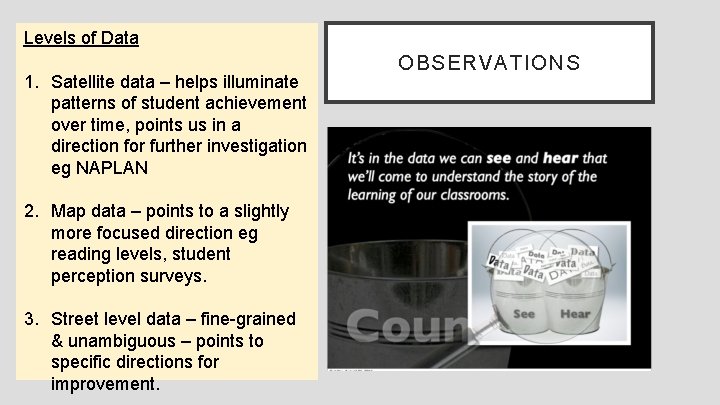
Levels of Data 1. Satellite data – helps illuminate patterns of student achievement over time, points us in a direction for further investigation eg NAPLAN 2. Map data – points to a slightly more focused direction eg reading levels, student perception surveys. 3. Street level data – fine-grained & unambiguous – points to specific directions for improvement. OBSERVATIONS
DATA THAT MATTERS “Raising student achievement doesn’t happen one test at a time, whether that test is standardized or teacher made. Test results are always an incomplete picture of what’s happening in a classroom. Yet we continue to tweak instructional methods to raise test scores so that we can build and marvel at data sets that allow us to claim ”data-driven decision making”. It is a logic model that ignores the most critical source of evidence – what students are actually learning. Gathering information about that learning should be everyone’s role, and turning that data into evidence by using it to improve student learning should be everyone’s most important work”. Connie Moss and Susan Brookhart, Formative Classroom Walkthroughs,
Underpinned by Beliefs What determines what students know and are able to do is not what the curriculum says they are supposed to do, or even what the teacher thinks he or she is asking the students to do. What predicts performance is what students are actually doing. If you can’t see it in the instructional core, it’s not there!
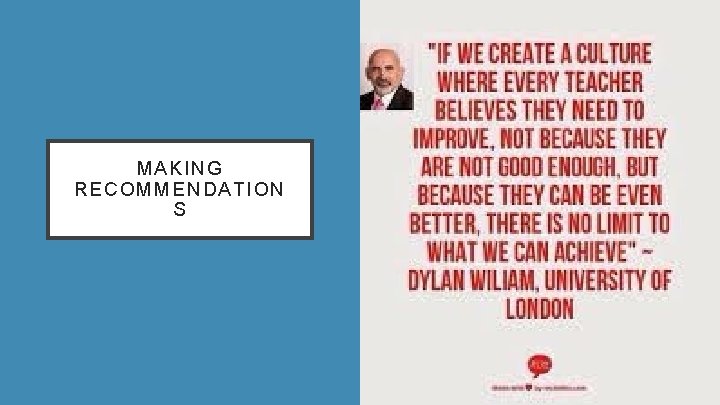
MAKING RECOMMENDATION S
VIVIANE ROBINSON ON COMPLEX PROBLEM SOLVING
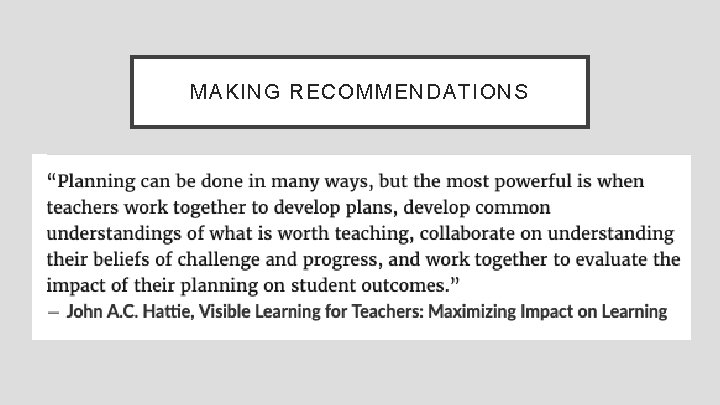
MAKING RECOMMENDATIONS
HOW WILL YOUR TEACHING/LEADING CHANGE NOW? AITSL SURVEY • After professional learning 76% wanted to change something in their teaching • Only 20% of leaders are involved in the professional learning of their school • 15% of professional learning focused on learning and teaching (34% content & 33% assessment)
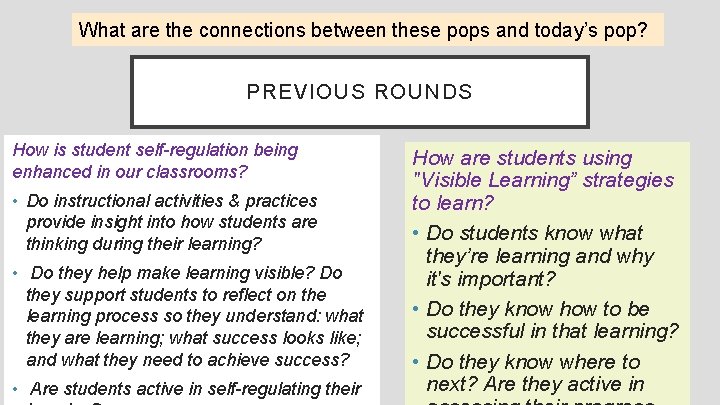
What are the connections between these pops and today’s pop? PREVIOUS ROUNDS How is student self-regulation being enhanced in our classrooms? • Do instructional activities & practices provide insight into how students are thinking during their learning? • Do they help make learning visible? Do they support students to reflect on the learning process so they understand: what they are learning; what success looks like; and what they need to achieve success? • Are students active in self-regulating their How are students using "Visible Learning” strategies to learn? • Do students know what they’re learning and why it's important? • Do they know how to be successful in that learning? • Do they know where to next? Are they active in
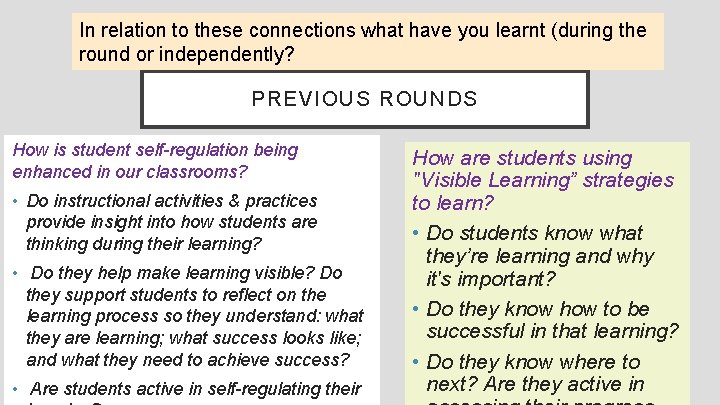
In relation to these connections what have you learnt (during the round or independently? PREVIOUS ROUNDS How is student self-regulation being enhanced in our classrooms? • Do instructional activities & practices provide insight into how students are thinking during their learning? • Do they help make learning visible? Do they support students to reflect on the learning process so they understand: what they are learning; what success looks like; and what they need to achieve success? • Are students active in self-regulating their How are students using "Visible Learning” strategies to learn? • Do students know what they’re learning and why it's important? • Do they know how to be successful in that learning? • Do they know where to next? Are they active in
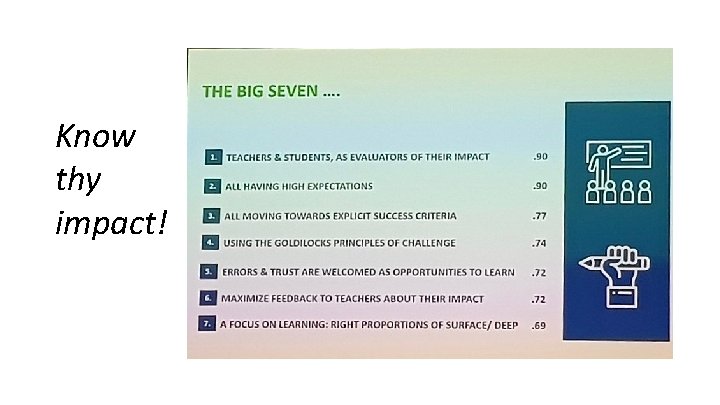
Hattie 2019 Know thy impact!
I USED TO THINK …. AND NOW I THINK …. This Photo by Unknown Author is licensed under CC BY-NC-ND
- Slides: 41