
Conjunctive Queries Containment Mappings Canonical Databases Sariayas Algorithm
Conjunctive Queries Containment Mappings Canonical Databases Sariaya’s Algorithm 1
Conjunctive Queries u. A CQ is a single Datalog rule, with all subgoals assumed to be EDB. u. Meaning of a CQ is the mapping from databases (the EDB) to the relation produced for the head predicate by applying that rule to the EDB. 2
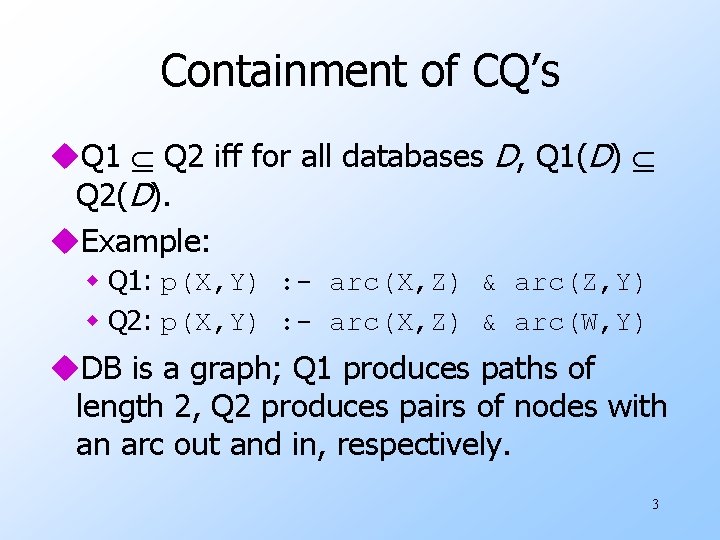
Containment of CQ’s u. Q 1 Q 2 iff for all databases D, Q 1(D) Q 2(D). u. Example: w Q 1: p(X, Y) : - arc(X, Z) & arc(Z, Y) w Q 2: p(X, Y) : - arc(X, Z) & arc(W, Y) u. DB is a graph; Q 1 produces paths of length 2, Q 2 produces pairs of nodes with an arc out and in, respectively. 3
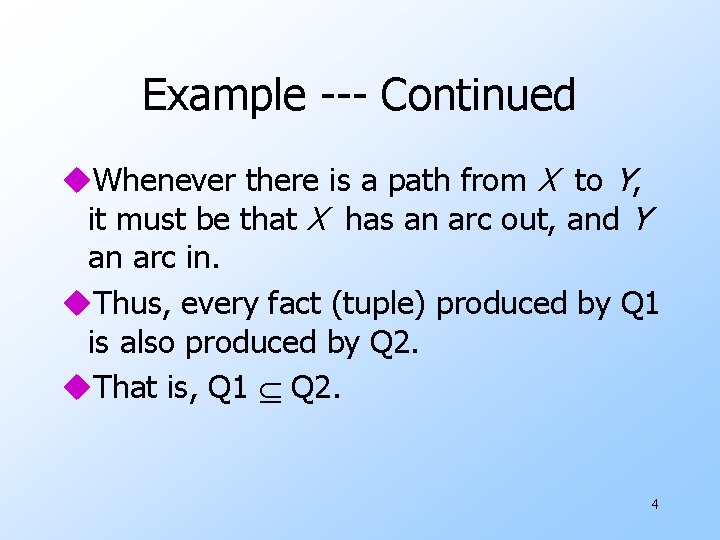
Example --- Continued u. Whenever there is a path from X to Y, it must be that X has an arc out, and Y an arc in. u. Thus, every fact (tuple) produced by Q 1 is also produced by Q 2. u. That is, Q 1 Q 2. 4

Why Care About CQ Containment? u. Important optimization: if we can break a query into terms that are CQ’s, we can eliminate those terms contained in another. w Especially important when we deal with integration of information: CQ containment is almost the only way to tell what information from sources we don’t need. 5

Why Care? --- Continued u. Containment tests imply equivalence-ofprograms tests. w Any theory of program (query) design or optimization requires us to know when programs are equivalent. w CQ’s, and some generalizations to be discussed, are the most powerful class of programs for which equivalence is known to be decidable. 6

Why Care --- Concluded u. Although CQ theory first appeared at a database conference, the AI community has taken CQ’s to heart. u. CQ’s, or similar logics like description logic, are used in a number of AI applications. w Again --- their design theory is really containment and equivalence. 7
Testing Containment u Two approaches: 1. Containment mappings. 2. Canonical databases. u Really the same in the simple CQ case covered so far. u Containment is NP-complete, but CQ’s tend to be small so here is one case where intractability doesn’t hurt you. 8
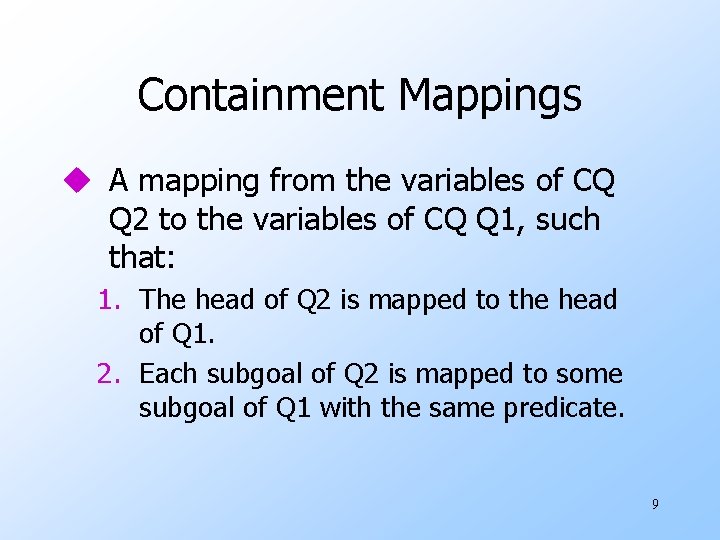
Containment Mappings u A mapping from the variables of CQ Q 2 to the variables of CQ Q 1, such that: 1. The head of Q 2 is mapped to the head of Q 1. 2. Each subgoal of Q 2 is mapped to some subgoal of Q 1 with the same predicate. 9
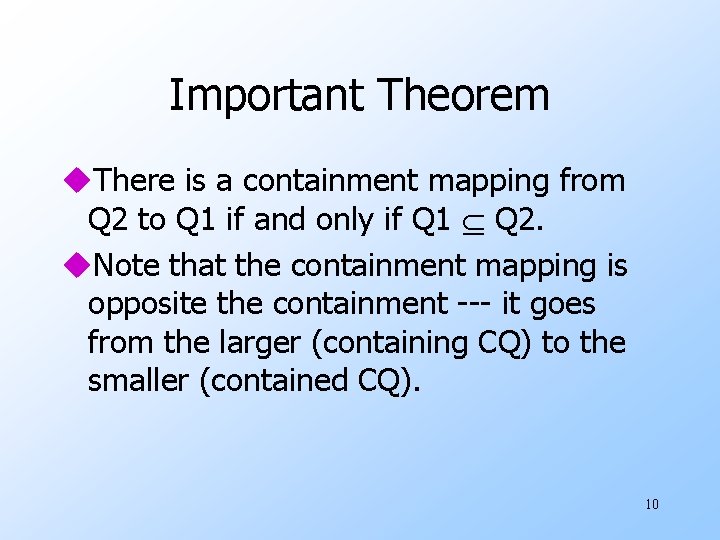
Important Theorem u. There is a containment mapping from Q 2 to Q 1 if and only if Q 1 Q 2. u. Note that the containment mapping is opposite the containment --- it goes from the larger (containing CQ) to the smaller (contained CQ). 10

Example Q 1: p(X, Y): -r(X, Z) & g(Z, Z) & r(Z, Y) Q 2: p(A, B): -r(A, C) & g(C, D) & r(D, B) Q 1 looks for: X Z Y C D Q 2 looks for: A Since C=D is possible, expect Q 1 Q 2. B 11

Example --- Continued Q 1: p(X, Y): -r(X, Z) & g(Z, Z) & r(Z, Y) Q 2: p(A, B): -r(A, C) & g(C, D) & r(D, B) Containment mapping: m(A)=X; m(B)=Y; m(C)=m(D)=Z. 12
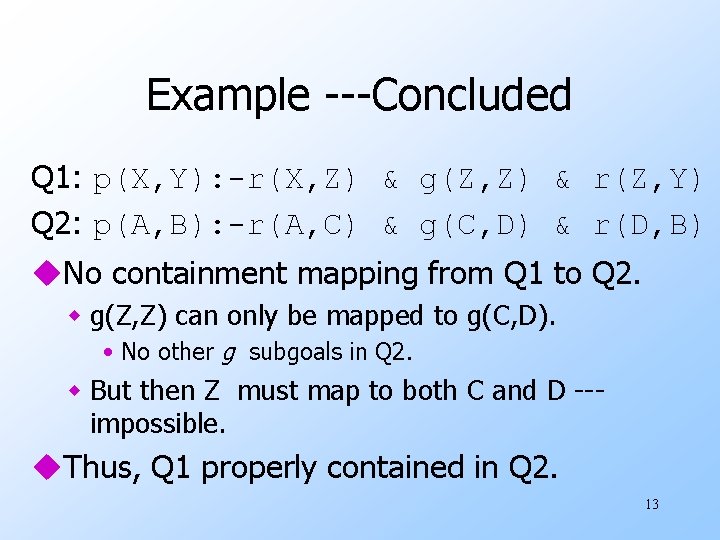
Example ---Concluded Q 1: p(X, Y): -r(X, Z) & g(Z, Z) & r(Z, Y) Q 2: p(A, B): -r(A, C) & g(C, D) & r(D, B) u. No containment mapping from Q 1 to Q 2. w g(Z, Z) can only be mapped to g(C, D). • No other g subgoals in Q 2. w But then Z must map to both C and D --impossible. u. Thus, Q 1 properly contained in Q 2. 13

Another Example Q 1: p(X, Y): -r(X, Y) & g(Y, Z) Q 2: p(A, B): -r(A, B) & r(A, C) Q 1 looks for: X Y Z Q 2 looks for: A B C 14

Example --- Continued Q 1: p(X, Y): -r(X, Y) & g(Y, Z) And not every subgoal need be a target. Q 2: p(A, B): -r(A, B) & r(A, C) Containment mapping: m(A)=X; Notice two subgoals can m(B)=m(C)=Y. map to one. 15
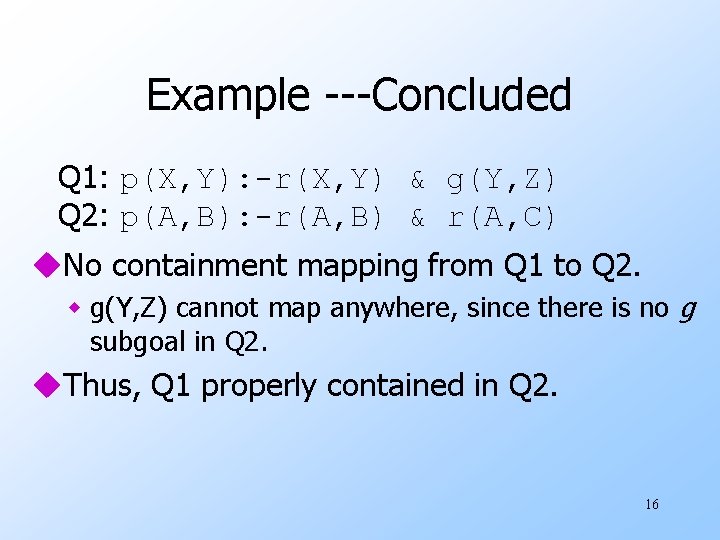
Example ---Concluded Q 1: p(X, Y): -r(X, Y) & g(Y, Z) Q 2: p(A, B): -r(A, B) & r(A, C) u. No containment mapping from Q 1 to Q 2. w g(Y, Z) cannot map anywhere, since there is no g subgoal in Q 2. u. Thus, Q 1 properly contained in Q 2. 16

Proof of Containment-Mapping Theorem --- (1) u. First, assume there is a CM m : Q 2 ->Q 1. u. Let D be any database; we must show that Q 1(D) Q 2(D). u. Suppose t is a tuple in Q 1(D); we must show t is also in Q 2(D). 17
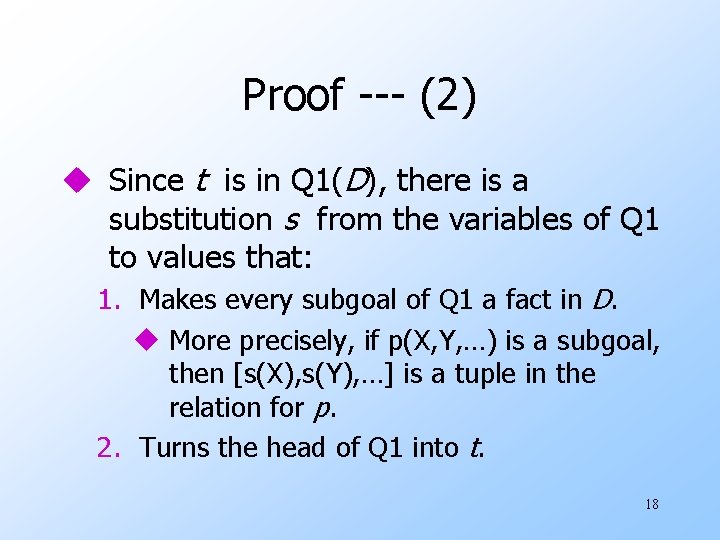
Proof --- (2) u Since t is in Q 1(D), there is a substitution s from the variables of Q 1 to values that: 1. Makes every subgoal of Q 1 a fact in D. u More precisely, if p(X, Y, …) is a subgoal, then [s(X), s(Y), …] is a tuple in the relation for p. 2. Turns the head of Q 1 into t. 18
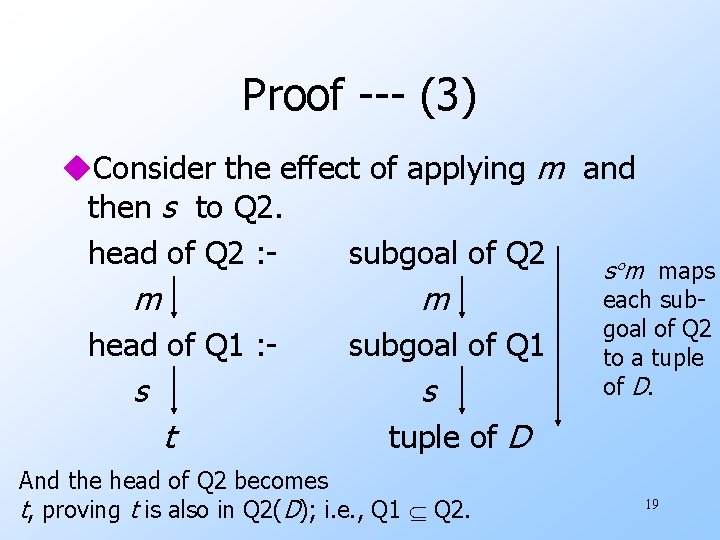
Proof --- (3) u. Consider the effect of applying m and then s to Q 2. head of Q 2 : subgoal of Q 2 s m maps each subm m goal of Q 2 head of Q 1 : subgoal of Q 1 to a tuple of D. s s t tuple of D And the head of Q 2 becomes t, proving t is also in Q 2(D); i. e. , Q 1 Q 2. 19
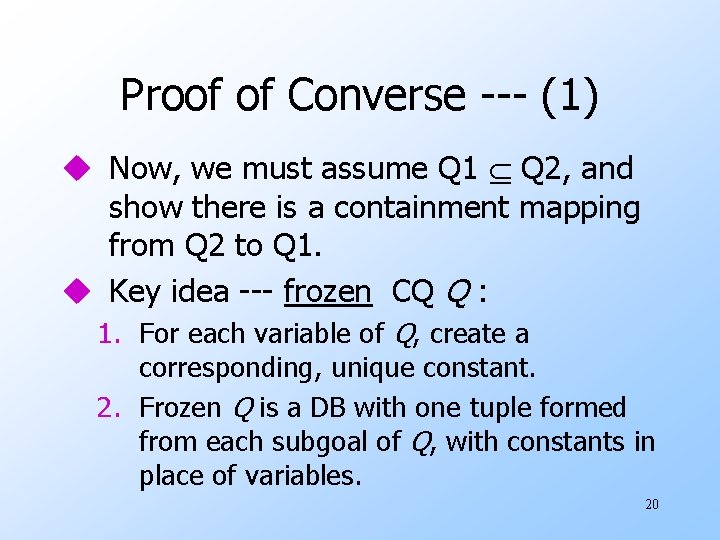
Proof of Converse --- (1) u Now, we must assume Q 1 Q 2, and show there is a containment mapping from Q 2 to Q 1. u Key idea --- frozen CQ Q : 1. For each variable of Q, create a corresponding, unique constant. 2. Frozen Q is a DB with one tuple formed from each subgoal of Q, with constants in place of variables. 20
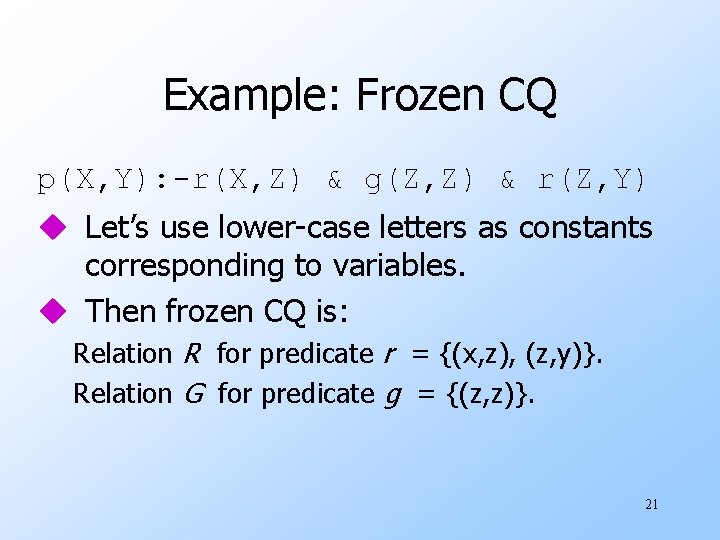
Example: Frozen CQ p(X, Y): -r(X, Z) & g(Z, Z) & r(Z, Y) u Let’s use lower-case letters as constants corresponding to variables. u Then frozen CQ is: Relation R for predicate r = {(x, z), (z, y)}. Relation G for predicate g = {(z, z)}. 21
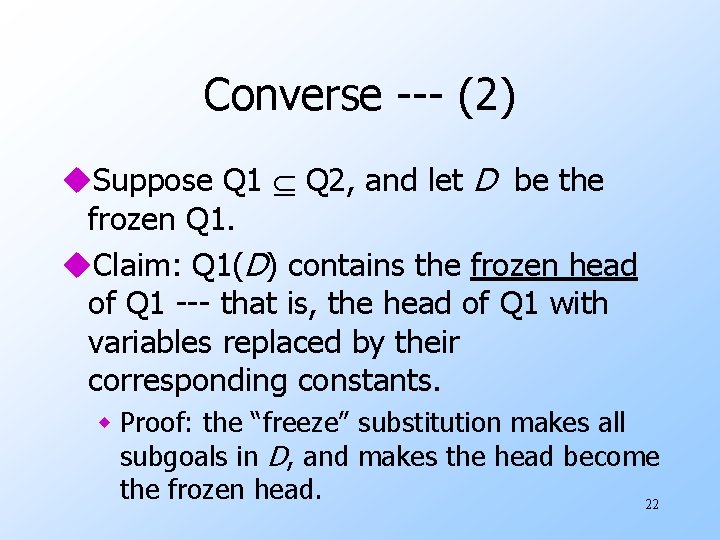
Converse --- (2) u. Suppose Q 1 Q 2, and let D be the frozen Q 1. u. Claim: Q 1(D) contains the frozen head of Q 1 --- that is, the head of Q 1 with variables replaced by their corresponding constants. w Proof: the “freeze” substitution makes all subgoals in D, and makes the head become the frozen head. 22
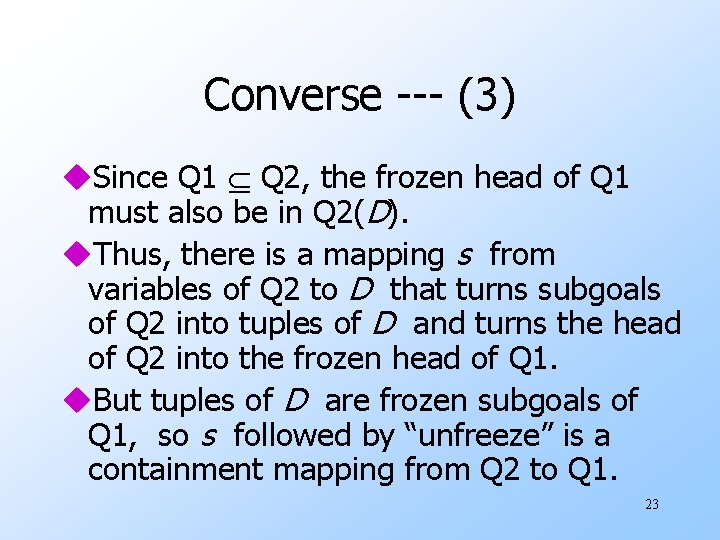
Converse --- (3) u. Since Q 1 Q 2, the frozen head of Q 1 must also be in Q 2(D). u. Thus, there is a mapping s from variables of Q 2 to D that turns subgoals of Q 2 into tuples of D and turns the head of Q 2 into the frozen head of Q 1. u. But tuples of D are frozen subgoals of Q 1, so s followed by “unfreeze” is a containment mapping from Q 2 to Q 1. 23
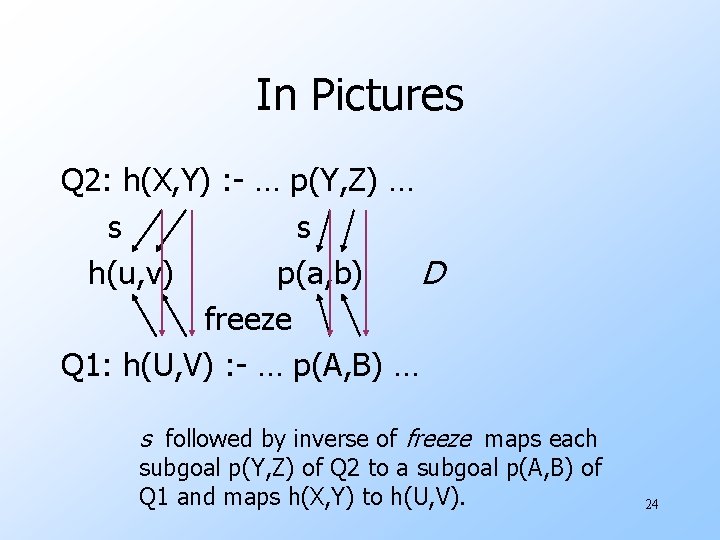
In Pictures Q 2: h(X, Y) : - … p(Y, Z) … s s h(u, v) p(a, b) D freeze Q 1: h(U, V) : - … p(A, B) … s followed by inverse of freeze maps each subgoal p(Y, Z) of Q 2 to a subgoal p(A, B) of Q 1 and maps h(X, Y) to h(U, V). 24
Dual View of CM’s u Instead of thinking of a CM as a mapping on variables, think of a CM as a mapping from atoms to atoms. u Required conditions: 1. The head must map to the head. 2. Each subgoal maps to a subgoal. 3. As a consequence, no variable is mapped to two different variables. 25
Canonical Databases u. General idea: test Q 1 Q 2 by checking that Q 1(D 1) Q 2(D 1), …, Q 1(Dn) Q 2(Dn), where D 1, …, Dn are the canonical databases. u. For the standard CQ case, we only need one canonical DB --- the frozen Q 1. u. But in more general forms of queries, larger sets of canonical DB’s are needed. 26

Why Canonical DB Test Works u. Let D = frozen body of Q 1; h = frozen head of Q 1. u. Theorem: Q 1 Q 2 iff Q 2(D) contains h. u. Proof (only if): Suppose Q 2(D) does not contain h. Since Q 1(D) surely contains h, it follows that Q 1 is not contained in Q 2. 27
Proof (if): u. Suppose Q 2(D) contains h. u. Then there is a mapping from the variables of Q 2 to the constants of D that maps: w The head of Q 2 to h. w Each subgoal of Q 2 to a frozen subgoal of Q 1. u. This mapping, followed by “unfreeze, ” is a containment mapping, so Q 1 Q 2. 28
Constants u CQ’s are often allowed to have constants in subgoals. w Corresponds to selection in relational algebra. u CM’s and CM test are the same, but: 1. A variable can map to one variable or one constant. 2. A constant can only map to itself. 29
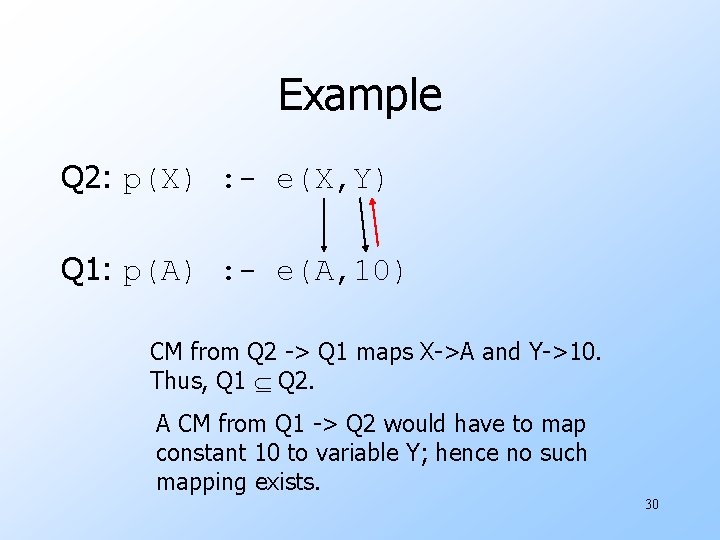
Example Q 2: p(X) : - e(X, Y) Q 1: p(A) : - e(A, 10) CM from Q 2 -> Q 1 maps X->A and Y->10. Thus, Q 1 Q 2. A CM from Q 1 -> Q 2 would have to map constant 10 to variable Y; hence no such mapping exists. 30
Sariaya’s Algorithm u. Containment of CQ’s is NP-complete. u. But Sariaya’s algorithm is a linear-time test for the common situation where Q 1 (the contained query) has no more than two subgoals with any one predicate. u. Reduction to 2 SAT. u. We’ll give a simple, quadratic version. 31

Saraiya’s Algorithm --- (2) 1. For any subgoal p(…) of Q 2, where there is only one p –subgoal of Q 1, we know exactly where p(…) must map. 2. If there is a subgoal of Q 2 that can map to two different subgoals of Q 1, assume one choice, and chase down the “consequences. ” 32
Consequences 1. If p(X 1, …, Xn) is known to map to p(Y 1, …, Yn), then we know each vaiable Xi maps to Yi. 2. If p(X 1, …, Xn) is a subgoal of Q 2, and we know Xi maps to some variable Z, and only one of the p –subgoals of Q 1 has Z in the i th component, then p(X 1, …, Xn) must map to that subgoal. 33
Sariaya’s Algorithm --- (3) u Eventually, one of two things happens: 1. We derive a contradiction --- a subgoal or variable that must map to two different things. 2. We close the set of inferences --- there is no contradiction, and no more consequences. 34
Case (1): Contradiction u. In this case, we go back and try the other choice if there is one, and fail if there is no other choice. 35
Case (2): Closure u. In this case, we have found some variables and subgoals of Q 2 that can be mapped as chosen, with no effect on any remaining subgoals or variables. u. Fix these choices, and consider any remaining subgoals. u. If all subgoals are now mapped, we have found a CM and are done. 36

Example Q 2: p(X) : - a(X, Y) & b(Y, Z) & b(Z, W) & a(W, X) Q 1: p(B) : - a(A, B) & a(B, A) & b(A, C) & b(C, B) Start by choosing a(X, Y) -> a(A, B) Then X->A and Y->B Now, b(Y, Z) must map to some b(B, ? ). But both choices do not have first component B. 37
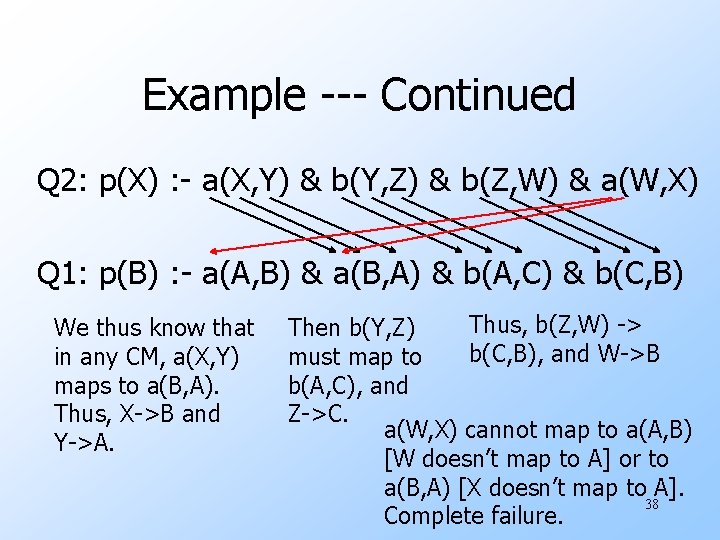
Example --- Continued Q 2: p(X) : - a(X, Y) & b(Y, Z) & b(Z, W) & a(W, X) Q 1: p(B) : - a(A, B) & a(B, A) & b(A, C) & b(C, B) We thus know that in any CM, a(X, Y) maps to a(B, A). Thus, X->B and Y->A. Thus, b(Z, W) -> Then b(Y, Z) b(C, B), and W->B must map to b(A, C), and Z->C. a(W, X) cannot map to a(A, B) [W doesn’t map to A] or to a(B, A) [X doesn’t map to A]. 38 Complete failure.
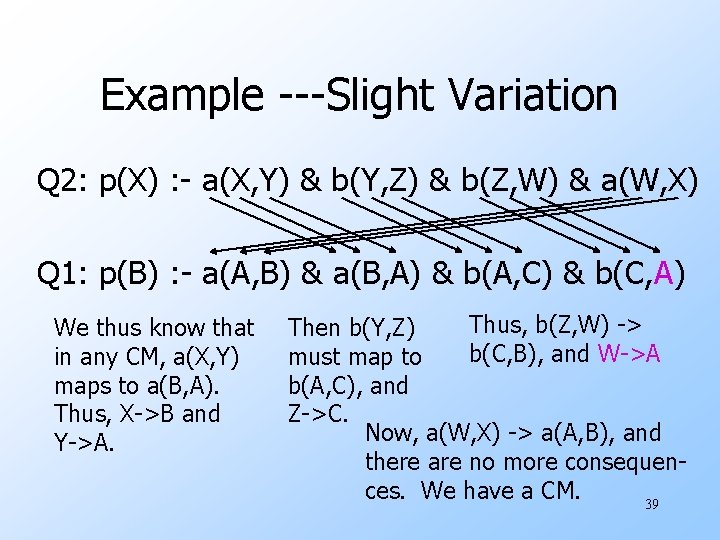
Example ---Slight Variation Q 2: p(X) : - a(X, Y) & b(Y, Z) & b(Z, W) & a(W, X) Q 1: p(B) : - a(A, B) & a(B, A) & b(A, C) & b(C, A) We thus know that in any CM, a(X, Y) maps to a(B, A). Thus, X->B and Y->A. Thus, b(Z, W) -> Then b(Y, Z) b(C, B), and W->A must map to b(A, C), and Z->C. Now, a(W, X) -> a(A, B), and there are no more consequences. We have a CM. 39
- Slides: 39