
Conjunctions What is a conjunction Conjunctions involve the
- Slides: 8
Conjunctions
What is a conjunction? Conjunctions involve the use of formal markers to relate (words, phrases) sentences, clauses and paragraphs to each other. Conjunctions signal the way the writer wants the reader to relate what is about to be said to what has been said before. n There are two different types of conjunctions: coordinating conjunctions and subordinating conjunctions. n
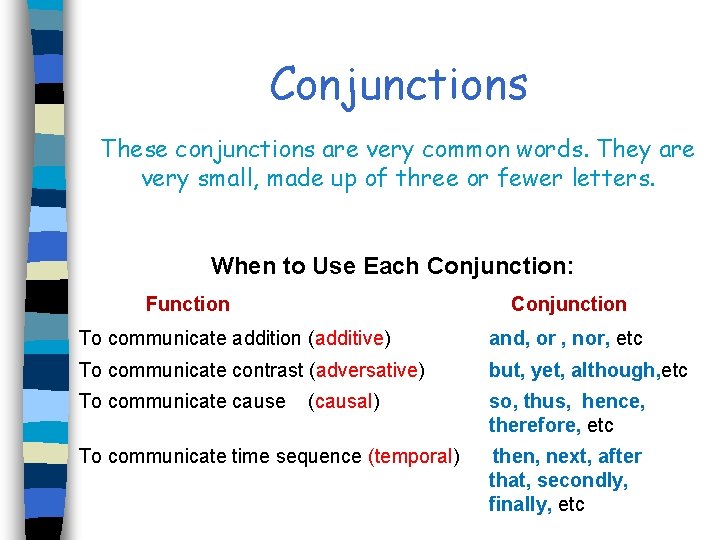
Conjunctions These conjunctions are very common words. They are very small, made up of three or fewer letters. When to Use Each Conjunction: Function Conjunction To communicate addition (additive) and, or , nor, etc To communicate contrast (adversative) but, yet, although, etc To communicate cause so, thus, hence, therefore, etc (causal) To communicate time sequence (temporal) then, next, after that, secondly, finally, etc
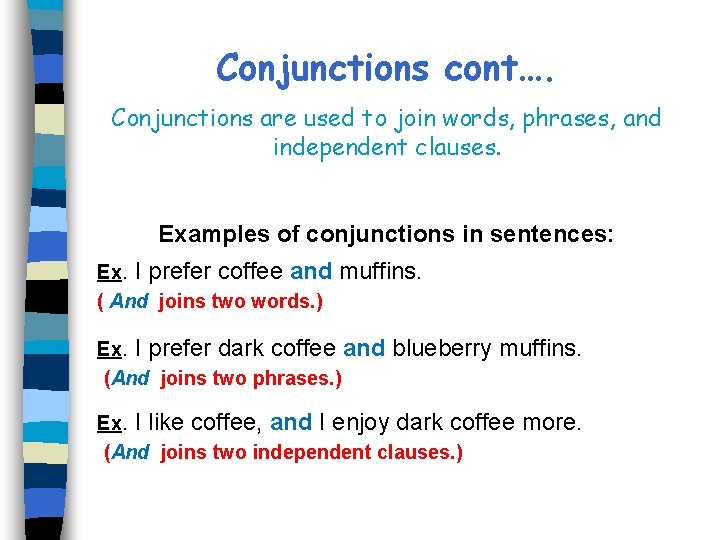
Conjunctions cont…. Conjunctions are used to join words, phrases, and independent clauses. Examples of conjunctions in sentences: Ex. I prefer coffee and ( And joins two words. ) muffins. Ex. I prefer dark coffee and (And joins two phrases. ) blueberry muffins. Ex. I like coffee, and I enjoy dark coffee (And joins two independent clauses. ) more.
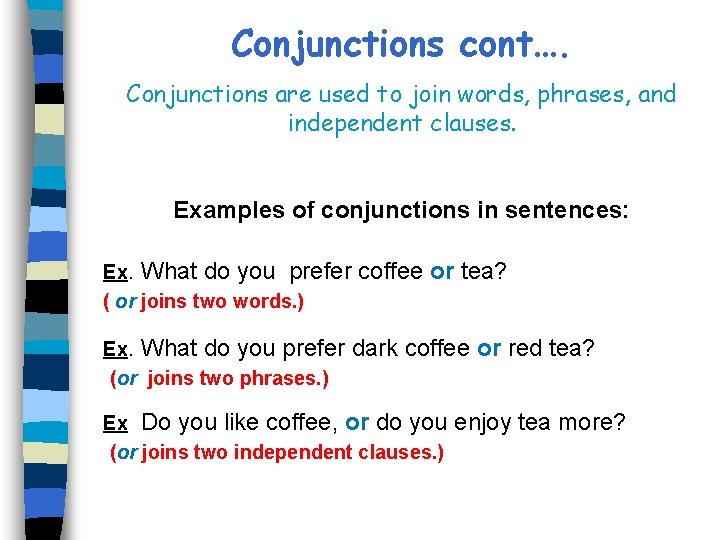
Conjunctions cont…. Conjunctions are used to join words, phrases, and independent clauses. Examples of conjunctions in sentences: Ex. What do you prefer ( or joins two words. ) Ex. What do you prefer (or joins two phrases. ) coffee or tea? dark coffee or red tea? Ex Do you like coffee, or do you (or joins two independent clauses. ) enjoy tea more?
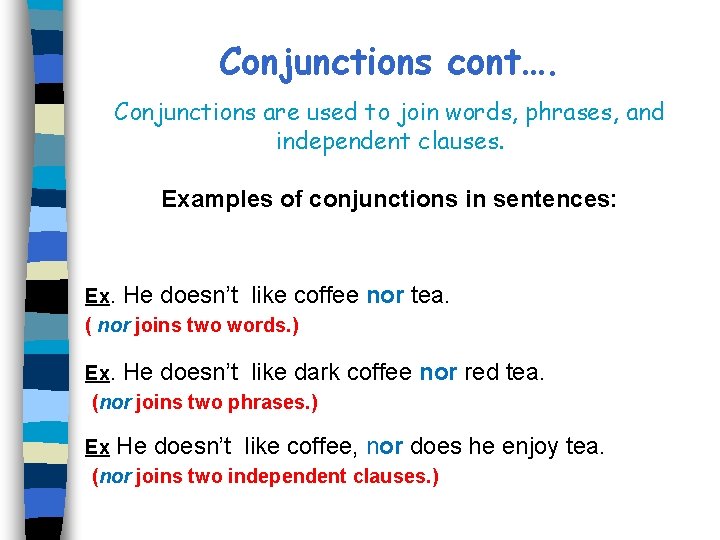
Conjunctions cont…. Conjunctions are used to join words, phrases, and independent clauses. Examples of conjunctions in sentences: Ex. He doesn’t like coffee ( nor joins two words. ) Ex. He doesn’t like dark (nor joins two phrases. ) nor tea. coffee nor red tea. Ex He doesn’t like coffee, nor does (nor joins two independent clauses. ) he enjoy tea.
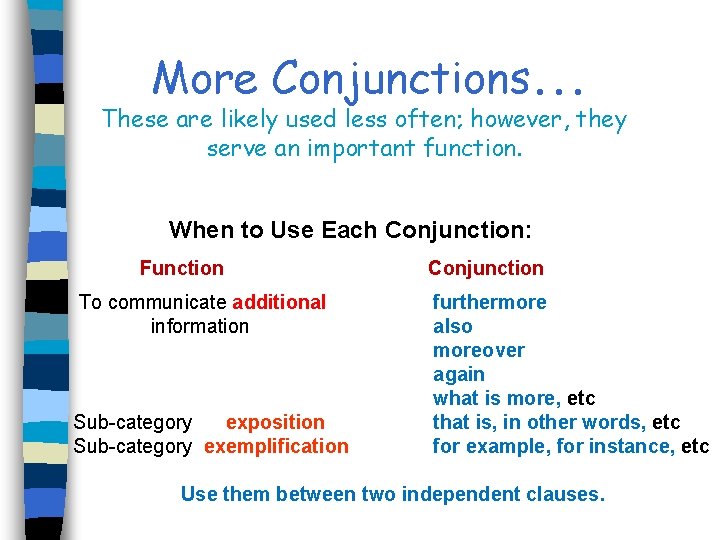
More Conjunctions. . . These are likely used less often; however, they serve an important function. When to Use Each Conjunction: Function To communicate additional information Sub-category exposition Sub-category exemplification Conjunction furthermore also moreover again what is more, etc that is, in other words, etc for example, for instance, etc Use them between two independent clauses.
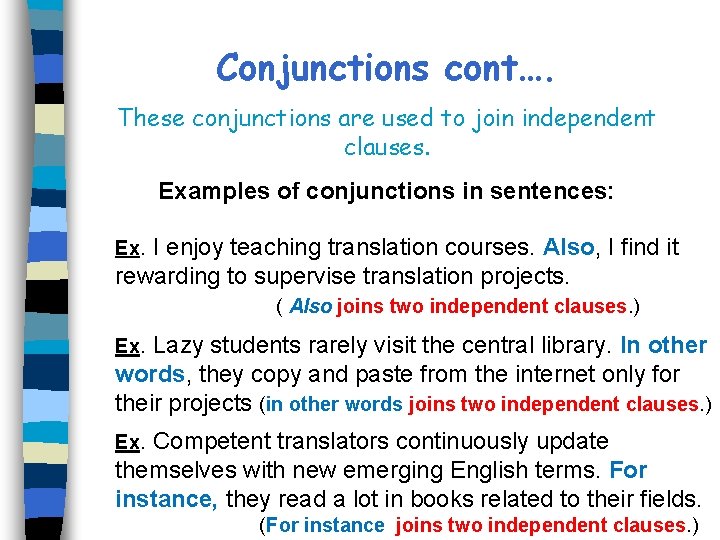
Conjunctions cont…. These conjunctions are used to join independent clauses. Examples of conjunctions in sentences: Ex. I enjoy teaching translation courses. Also, I find it rewarding to supervise translation projects. ( Also joins two independent clauses. ) Ex. Lazy students rarely visit the central library. In other words, they copy and paste from the internet only for their projects (in other words joins two independent clauses. ) Ex. Competent translators continuously update themselves with new emerging English terms. For instance, they read a lot in books related to their fields. (For instance joins two independent clauses. )