
Conjunctions linking words Conjunctions link 2 parts of
- Slides: 7
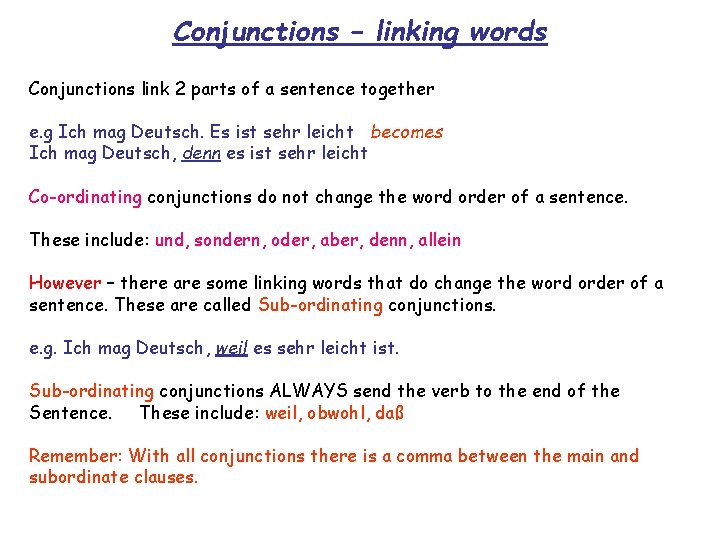
Conjunctions – linking words Conjunctions link 2 parts of a sentence together e. g Ich mag Deutsch. Es ist sehr leicht becomes Ich mag Deutsch, denn es ist sehr leicht Co-ordinating conjunctions do not change the word order of a sentence. These include: und, sondern, oder, aber, denn, allein However – there are some linking words that do change the word order of a sentence. These are called Sub-ordinating conjunctions. e. g. Ich mag Deutsch, weil es sehr leicht ist. Sub-ordinating conjunctions ALWAYS send the verb to the end of the Sentence. These include: weil, obwohl, daß Remember: With all conjunctions there is a comma between the main and subordinate clauses.
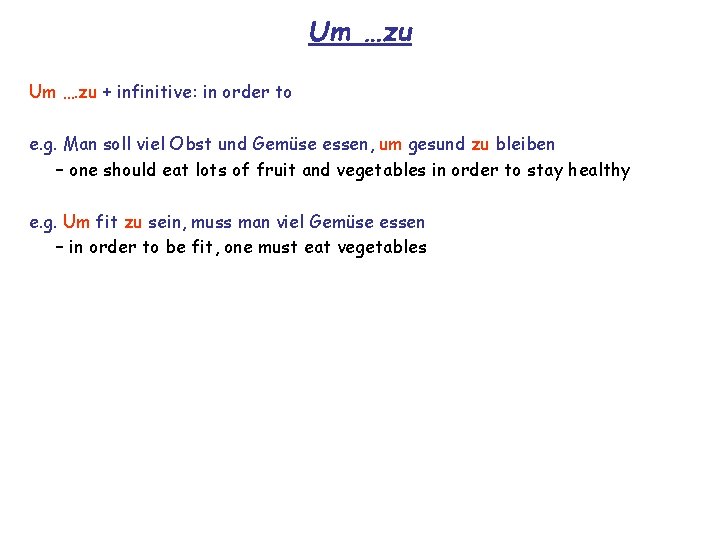
Um …zu Um …. zu + infinitive: in order to e. g. Man soll viel Obst und Gemüse essen, um gesund zu bleiben – one should eat lots of fruit and vegetables in order to stay healthy e. g. Um fit zu sein, muss man viel Gemüse essen – in order to be fit, one must eat vegetables
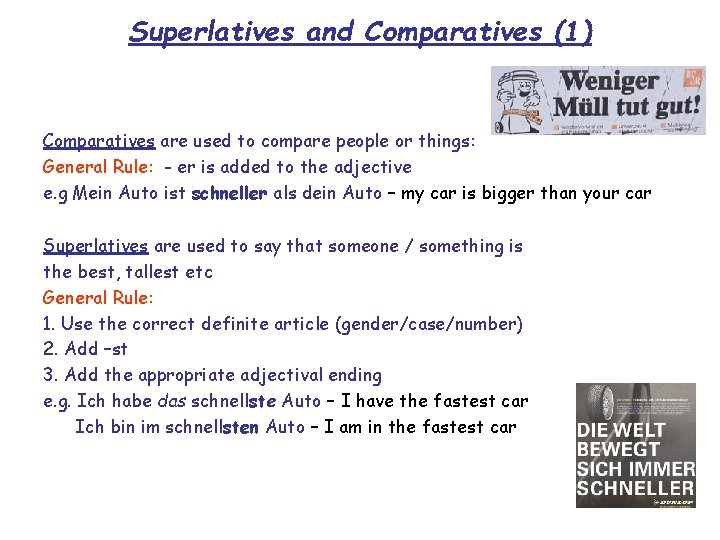
Superlatives and Comparatives (1) Comparatives are used to compare people or things: General Rule: - er is added to the adjective e. g Mein Auto ist schneller als dein Auto – my car is bigger than your car Superlatives are used to say that someone / something is the best, tallest etc General Rule: 1. Use the correct definite article (gender/case/number) 2. Add –st 3. Add the appropriate adjectival ending e. g. Ich habe das schnellste Auto – I have the fastest car Ich bin im schnellsten Auto – I am in the fastest car
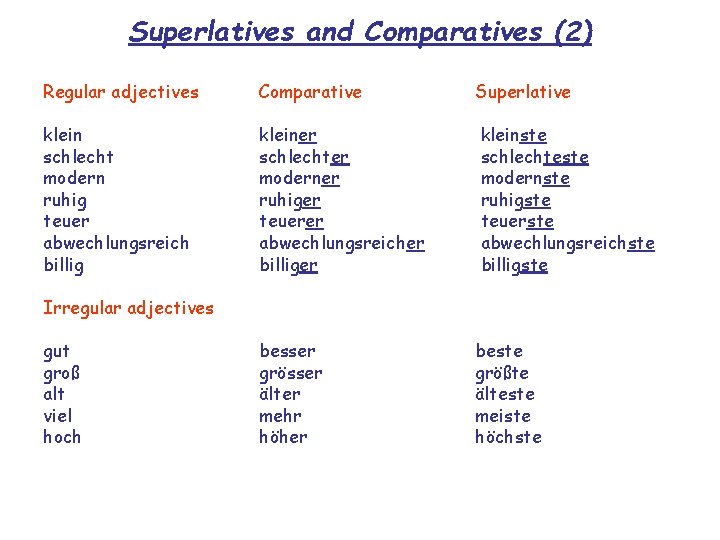
Superlatives and Comparatives (2) Regular adjectives Comparative Superlative klein schlecht modern ruhig teuer abwechlungsreich billig kleiner schlechter moderner ruhiger teuerer abwechlungsreicher billiger kleinste schlechteste modernste ruhigste teuerste abwechlungsreichste billigste besser grösser älter mehr höher beste größte älteste meiste höchste Irregular adjectives gut groß alt viel hoch
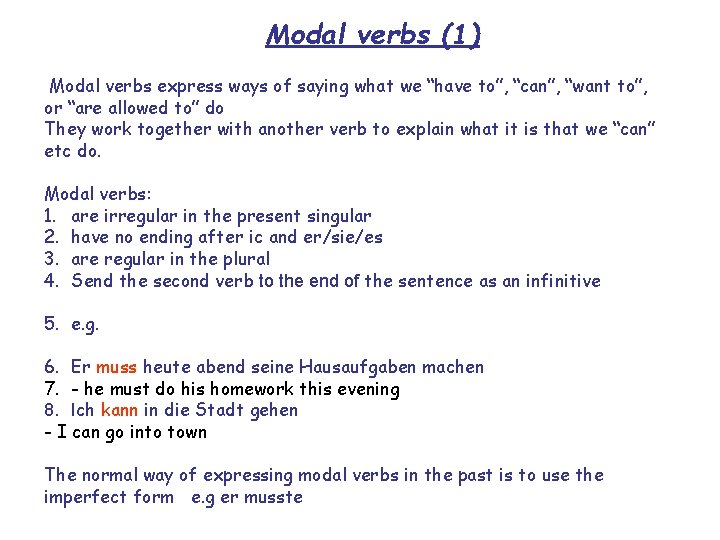
Modal verbs (1) Modal verbs express ways of saying what we “have to”, “can”, “want to”, or “are allowed to” do They work together with another verb to explain what it is that we “can” etc do. Modal verbs: 1. are irregular in the present singular 2. have no ending after ic and er/sie/es 3. are regular in the plural 4. Send the second verb to the end of the sentence as an infinitive 5. e. g. 6. Er muss heute abend seine Hausaufgaben machen 7. - he must do his homework this evening 8. Ich kann in die Stadt gehen - I can go into town The normal way of expressing modal verbs in the past is to use the imperfect form e. g er musste
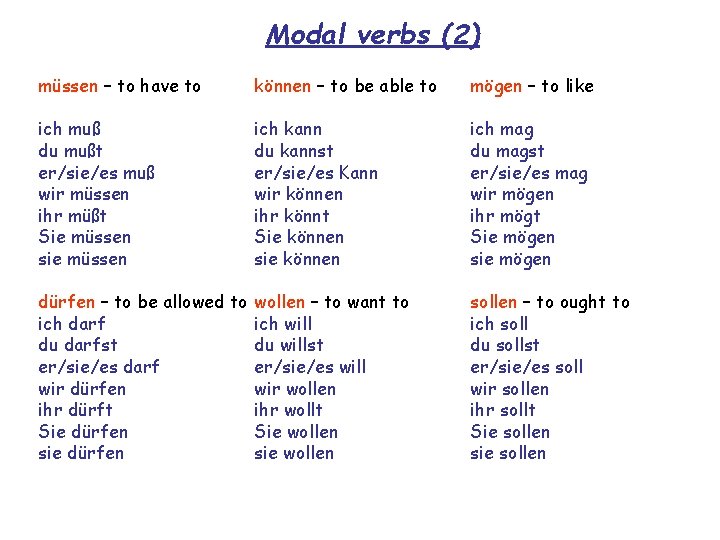
Modal verbs (2) müssen – to have to können – to be able to mögen – to like ich muß du mußt er/sie/es muß wir müssen ihr müßt Sie müssen sie müssen ich kann du kannst er/sie/es Kann wir können ihr könnt Sie können sie können ich mag du magst er/sie/es mag wir mögen ihr mögt Sie mögen sie mögen dürfen – to be allowed to ich darf du darfst er/sie/es darf wir dürfen ihr dürft Sie dürfen sie dürfen wollen – to want to ich will du willst er/sie/es will wir wollen ihr wollt Sie wollen sollen – to ought to ich soll du sollst er/sie/es soll wir sollen ihr sollt Sie sollen sie sollen
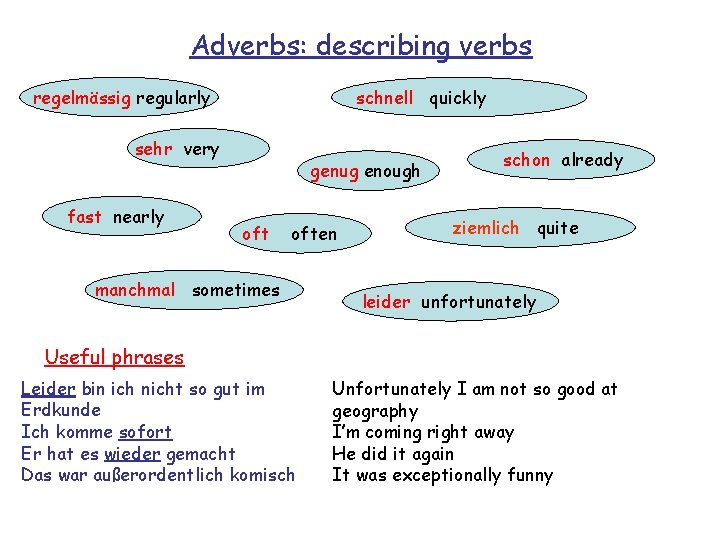
Adverbs: describing verbs regelmässig regularly schnell quickly sehr very fast nearly genug enough often manchmal sometimes schon already ziemlich quite leider unfortunately Useful phrases Leider bin ich nicht so gut im Erdkunde Ich komme sofort Er hat es wieder gemacht Das war außerordentlich komisch Unfortunately I am not so good at geography I’m coming right away He did it again It was exceptionally funny