
Conjunctions Functional English What is a Conjunction This
- Slides: 17
Conjunctions Functional English
What is a Conjunction? This word is from the Latin con meaning ‘together’ and jungere meaning ‘to join’. A conjunction joins two or more parts of speech of a similar kind or two or more parts of a sentence.
Use of Conjunctions are used for two purposes: 1. to join sentences 2. to introduce a clause
Difference between Relative Pronoun, Relative Adverb and Conjunction Relative pronoun refers back to a noun while relative adverb modifies a verb. A conjunction merely joins two sentences without referring to any part of speech. .
Kinds of Conjunction Coordinating Subordinating Correlative
Coordinating A coordinating conjunction connects words, phrases or clauses of equal rank. For example: and, also, moreover, likewise
Types of Coordinating Conjunction 1. cumulative 2. adversative 3. disjunctive or alternative 4. illative
Cumulative Which merely add one statement to another. For example: he is going to Lahore and he will visit his uncle there.
Adversative Which expresses opposition or contrast between two statements. For example: I was annoyed still I kept quiet.
Disjunctive or Alternative Which expresses a choice between two alternatives. For example walk quickly else you will not miss the bus.
Illative Which express an inference. For example: someone certainly fell in for I heard a splash
Subordinating A subordinating conjunction connects words, phrases or clauses of unequal rank i. e. subordinating or dependent clause to an independent one. For example when, because, for, since, so that, if unless, until, though etc.
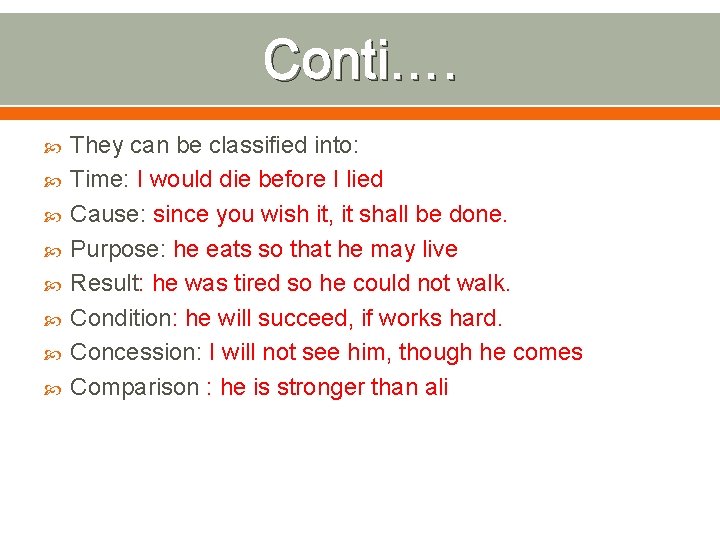
Conti…. They can be classified into: Time: I would die before I lied Cause: since you wish it, it shall be done. Purpose: he eats so that he may live Result: he was tired so he could not walk. Condition: he will succeed, if works hard. Concession: I will not see him, though he comes Comparison : he is stronger than ali
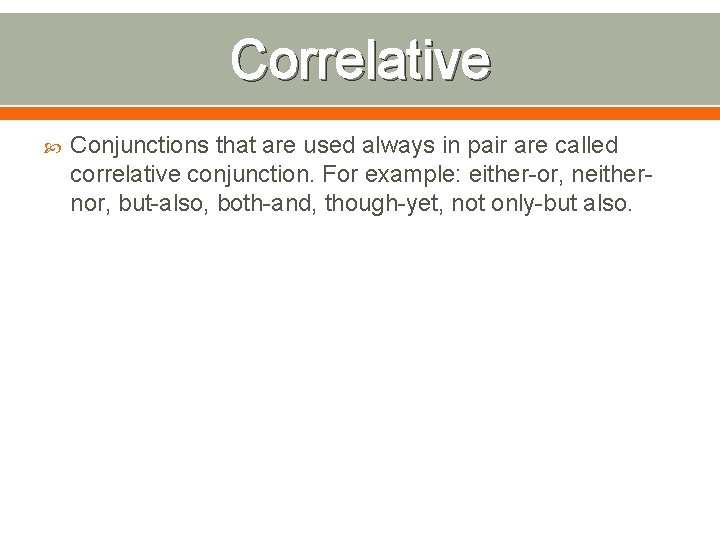
Correlative Conjunctions that are used always in pair are called correlative conjunction. For example: either-or, neithernor, but-also, both-and, though-yet, not only-but also.
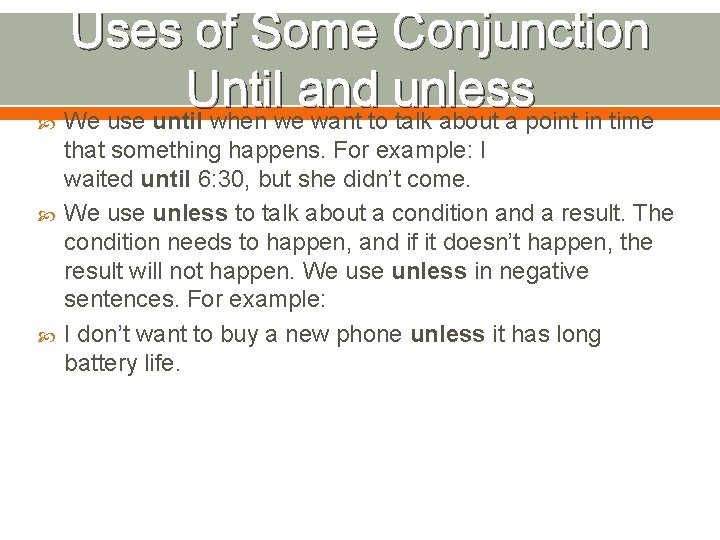
Uses of Some Conjunction Until and unless We use until when we want to talk about a point in time that something happens. For example: I waited until 6: 30, but she didn’t come. We use unless to talk about a condition and a result. The condition needs to happen, and if it doesn’t happen, the result will not happen. We use unless in negative sentences. For example: I don’t want to buy a new phone unless it has long battery life.
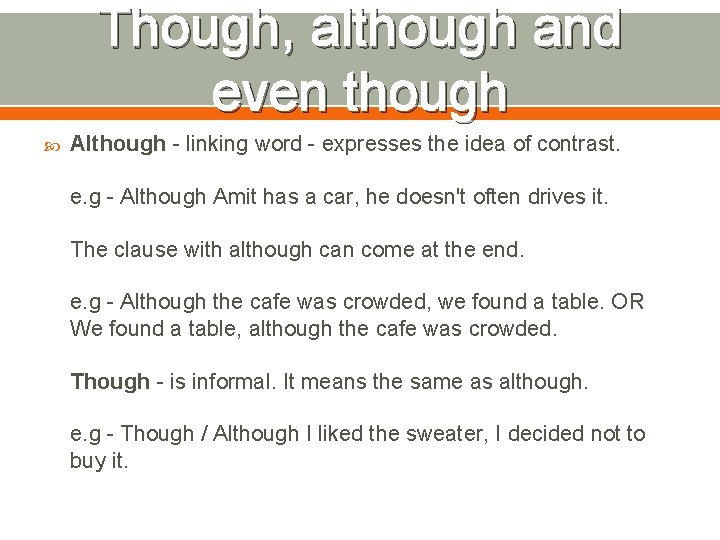
Though, although and even though Although - linking word - expresses the idea of contrast. e. g - Although Amit has a car, he doesn't often drives it. The clause with although can come at the end. e. g - Although the cafe was crowded, we found a table. OR We found a table, although the cafe was crowded. Though - is informal. It means the same as although. e. g - Though / Although I liked the sweater, I decided not to buy it.
Conti…. We can use though at the end of a sentence. e. g - I liked the sweater. I decided not to buy it, though. Even though - is stronger, more emphatic than although. e. g 1). Ram looked quite fresh, even though he'd been playing cricket. 2). Even though you dislike Sanya, you should try to be nice to her.