
Conjunctions Disjunctions and Negations Symbolic Logic 2122001 Outline
Conjunctions, Disjunctions, and Negations Symbolic Logic 2/12/2001

Outline • • Test Homework & Schedule Truth Tables Negation Conjunction Disjunction Ambiguity & Parentheses
Test • • • Handed back Wednesday Solutions posted after all have taken it. See Sara if you have questions. Note on Caps & letters: Caps (A, B, C…) are reserved for Predicates. Letters like (a, b, c…) are usually for constants. • Letters like (x, y, z…) are usually for variables.
Homeworks & Schedule • New Procedures for homeworks. • Homework will be Due in class every Monday. • You will hand in a disk and/or paper. • What is due is the problems for the sections on the schedule for the preceding week. • An updated schedule with tests & assignments is online.
More on Homework • Problems will be sampled. That is, not every problem of every assignment will be graded. You are expected to do all the assignments. • You will need two disks for your homework so that you can keep working while the current assignment is being graded. • Your second disk will also serve as a backup.

Truth Tables • We use a truth table to define logical constants. • A truth table lists all possible combinations of truth values for a particular constant. • The left side of the table contains the truth values of the components of a sentence. • The right side contains the truth value of the sentence.
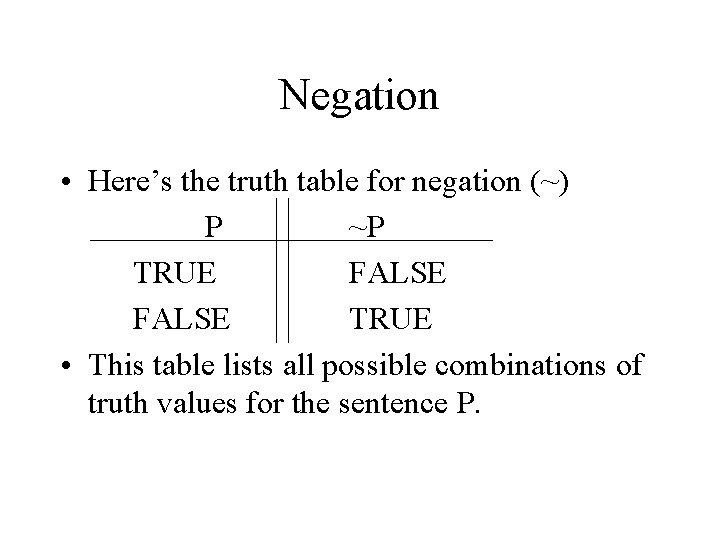
Negation • Here’s the truth table for negation (~) P ~P TRUE FALSE TRUE • This table lists all possible combinations of truth values for the sentence P.
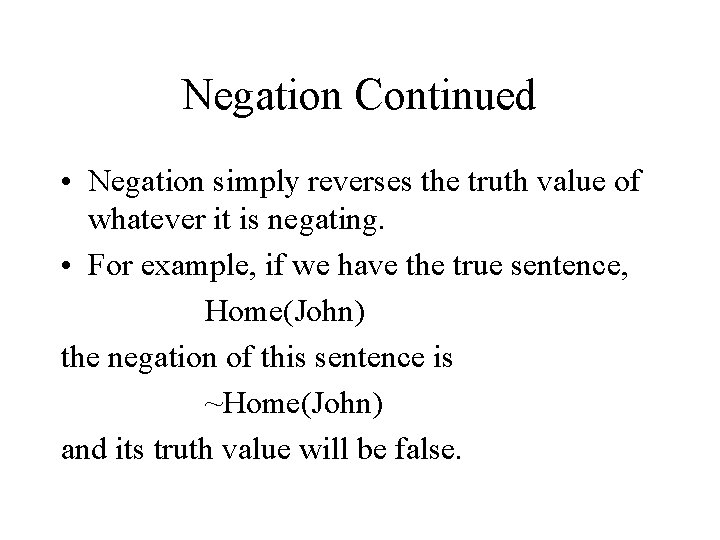
Negation Continued • Negation simply reverses the truth value of whatever it is negating. • For example, if we have the true sentence, Home(John) the negation of this sentence is ~Home(John) and its truth value will be false.
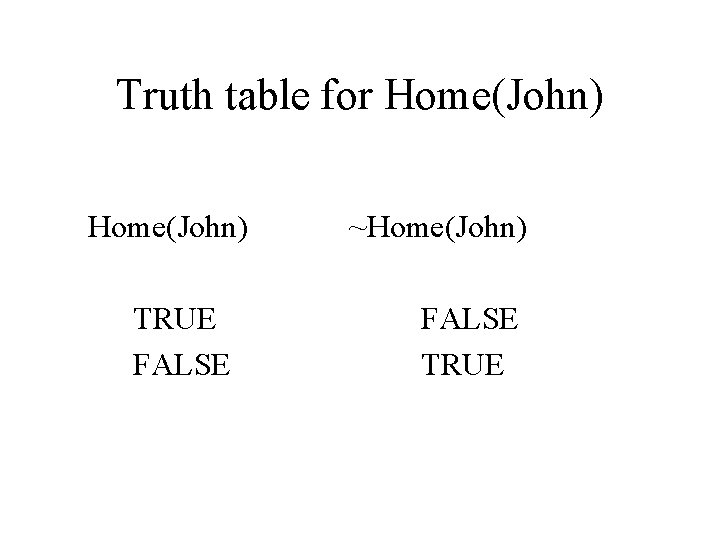
Truth table for Home(John) TRUE FALSE ~Home(John) FALSE TRUE

Conjunction • The ordinary language definition of conjunction is AND. • Words like “but” and “moreover” also do much the same thing in English as “^” in FOL. • ^ implies that a compound sentence will be truth IFF both sides are true, false otherwise.
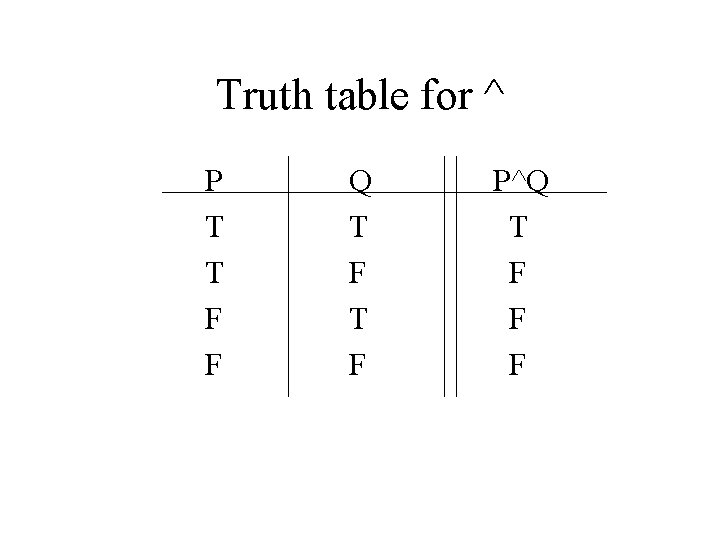
Truth table for ^ P T T F F Q T F P^Q T F F F
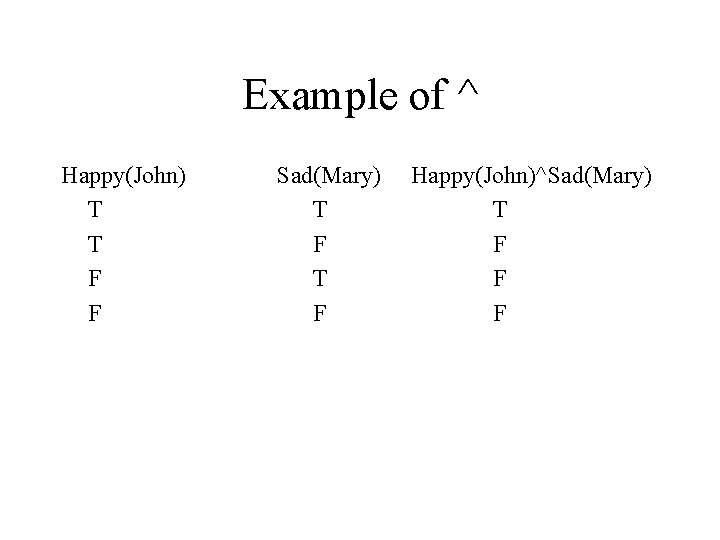
Example of ^ Happy(John) T T F F Sad(Mary) T F Happy(John)^Sad(Mary) T F F F
Disjunction • Logical OR (v) • The resulting sentence is true if either or both sentences are true. • This differs from the ordinary English meaning of OR
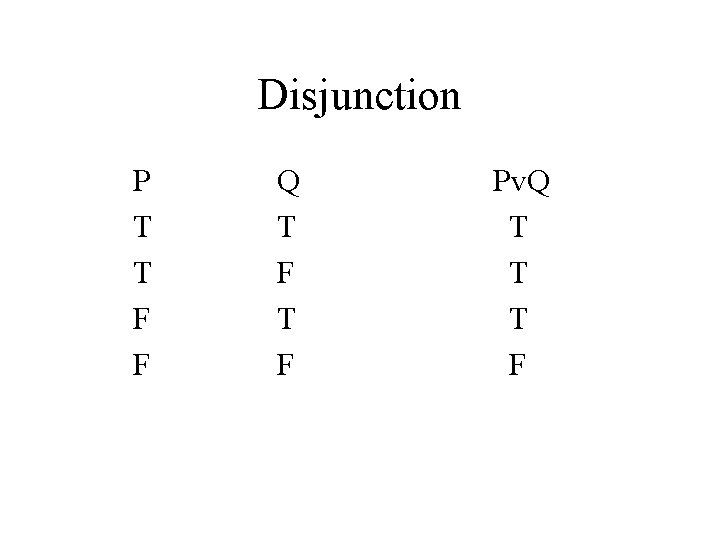
Disjunction P T T F F Q T F Pv. Q T T T F
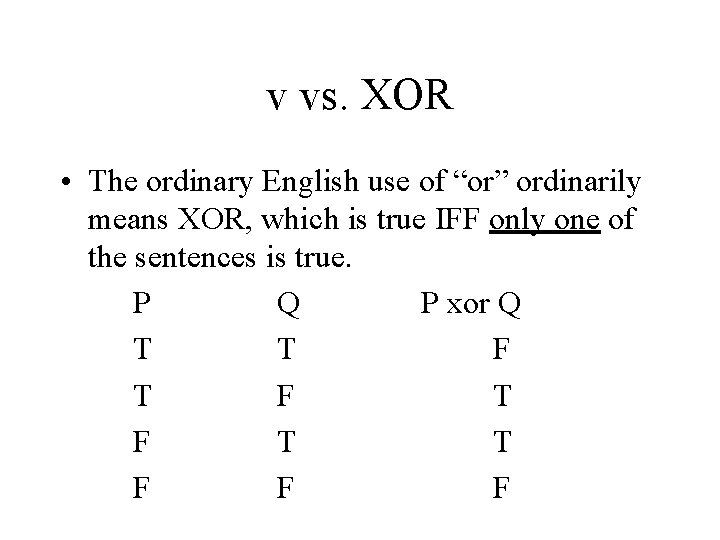
v vs. XOR • The ordinary English use of “or” ordinarily means XOR, which is true IFF only one of the sentences is true. P Q P xor Q T T F T F T T F F F
Exercises
- Slides: 16