
Conjunctions Combining Sentences Write down whatever is in
Conjunctions & Combining Sentences Write down whatever is in PINK!
Definition: A conjunction is a joiner, a word that connects (joins) parts of a sentence (two independent clauses). The simple, little conjunctions are called coordinating conjunctions. When you use conjunctions, you are combining sentences.
Coordinating Conjunctions: For, And, Nor, But, Or, Yet, So To remember them, think of the acronym FANBOYS. These are simple words that work to connect two sentences.
Why do conjunctions matter? ! A paper containing sentences of one short pattern bores both the writer and the reader for two reasons: 1. Repetition of a single, simple sentence pattern draws attention to itself, not to the ideas in the paper. 2. Simple, short sentences cannot show the reader the many relationships that exist among ideas of different importance. It is important that your sentences flow and connect easily to each other, because it will reduce wordiness, make your paper more clear and precise, and it is easer for your reader to read and it demonstrates your strengths as a writer.
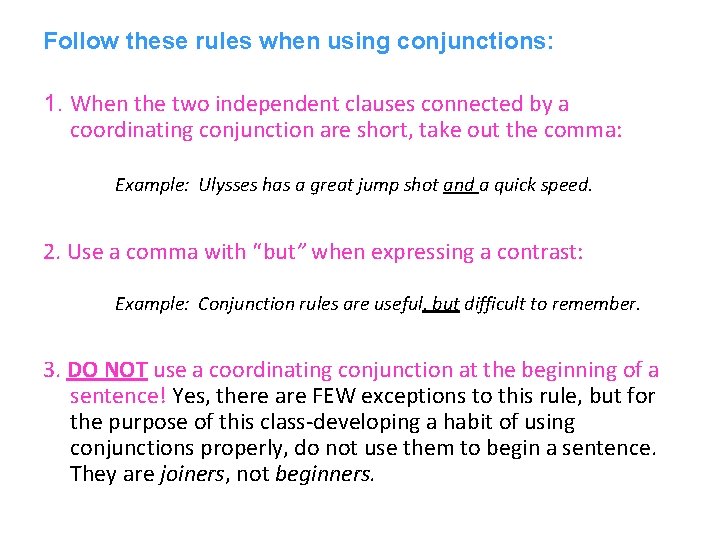
Follow these rules when using conjunctions: 1. When the two independent clauses connected by a coordinating conjunction are short, take out the comma: Example: Ulysses has a great jump shot and a quick speed. 2. Use a comma with “but” when expressing a contrast: Example: Conjunction rules are useful, but difficult to remember. 3. DO NOT use a coordinating conjunction at the beginning of a sentence! Yes, there are FEW exceptions to this rule, but for the purpose of this class-developing a habit of using conjunctions properly, do not use them to begin a sentence. They are joiners, not beginners.
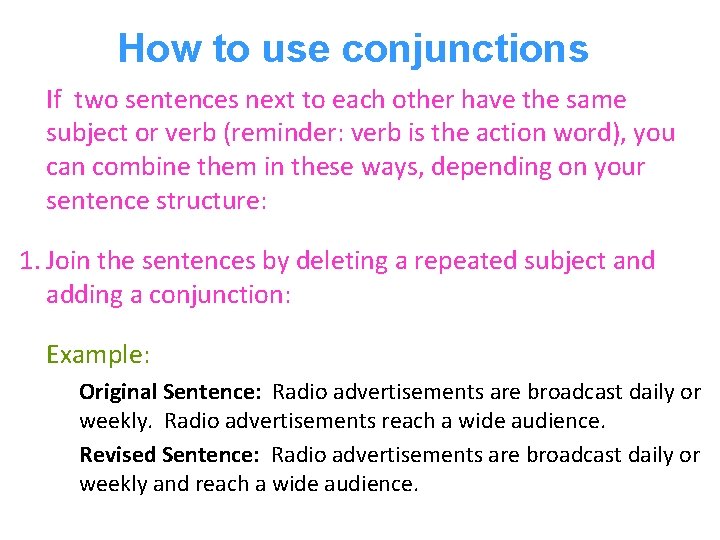
How to use conjunctions If two sentences next to each other have the same subject or verb (reminder: verb is the action word), you can combine them in these ways, depending on your sentence structure: 1. Join the sentences by deleting a repeated subject and adding a conjunction: Example: Original Sentence: Radio advertisements are broadcast daily or weekly. Radio advertisements reach a wide audience. Revised Sentence: Radio advertisements are broadcast daily or weekly and reach a wide audience.
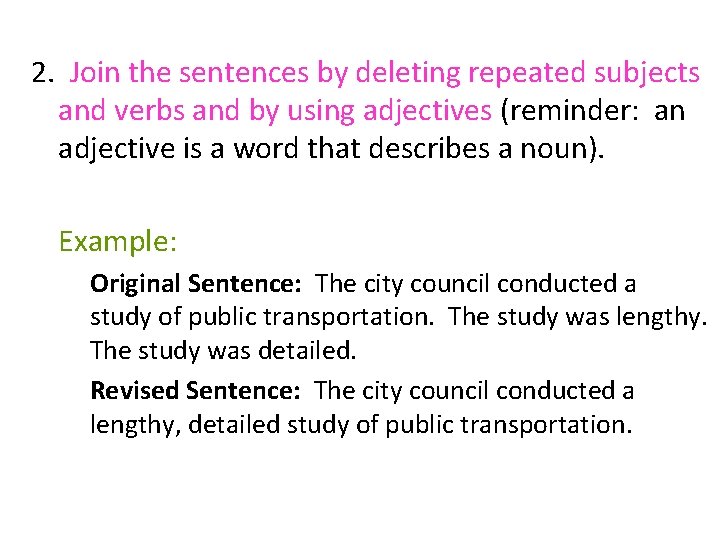
2. Join the sentences by deleting repeated subjects and verbs and by using adjectives (reminder: an adjective is a word that describes a noun). Example: Original Sentence: The city council conducted a study of public transportation. The study was lengthy. The study was detailed. Revised Sentence: The city council conducted a lengthy, detailed study of public transportation.
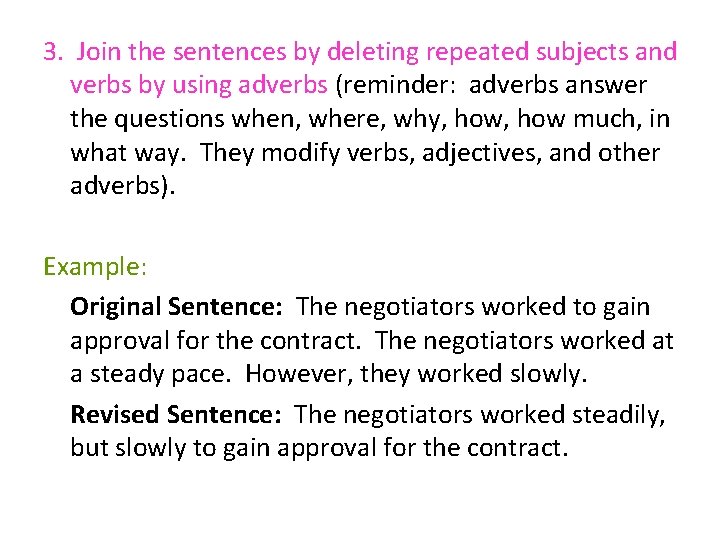
3. Join the sentences by deleting repeated subjects and verbs by using adverbs (reminder: adverbs answer the questions when, where, why, how much, in what way. They modify verbs, adjectives, and other adverbs). Example: Original Sentence: The negotiators worked to gain approval for the contract. The negotiators worked at a steady pace. However, they worked slowly. Revised Sentence: The negotiators worked steadily, but slowly to gain approval for the contract.
- Slides: 8