
Conjunctions and Other Connectives Conjunctions Other Connectives l
- Slides: 61
Conjunctions and Other Connectives
Conjunctions & Other Connectives l “Conjunctions are often neglected in discussions of structure, but they provide some of the best formal indications of how the author intended the discourse to be processed” (Westfall 2009).
καί and δέ : Review l Turner (1963) was wrong to assert that δε is “usually. . . indistinguishable from και ”. l Winer (1882) was right to claim that “Δε is often used when the writer subjoins some thingnew, different and distinct from what precedes”.
καί and δέ : Review l Kαί is the default way of linking the events of a narrative in the Synoptic Gospels and Acts. l Δέ constrains what follows to be interpreted as “distinctive material that is relevant to the author’s story or argument”.
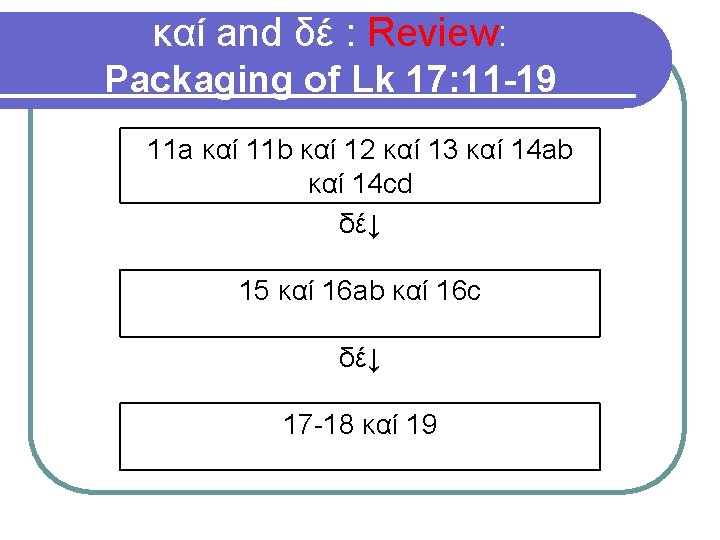
καί and δέ : Review: Packaging of Lk 17: 11 -19 11 a καί 11 b καί 12 καί 13 καί 14 ab καί 14 cd δέ↓ 15 καί 16 ab καί 16 c δέ↓ 17 18 καί 19
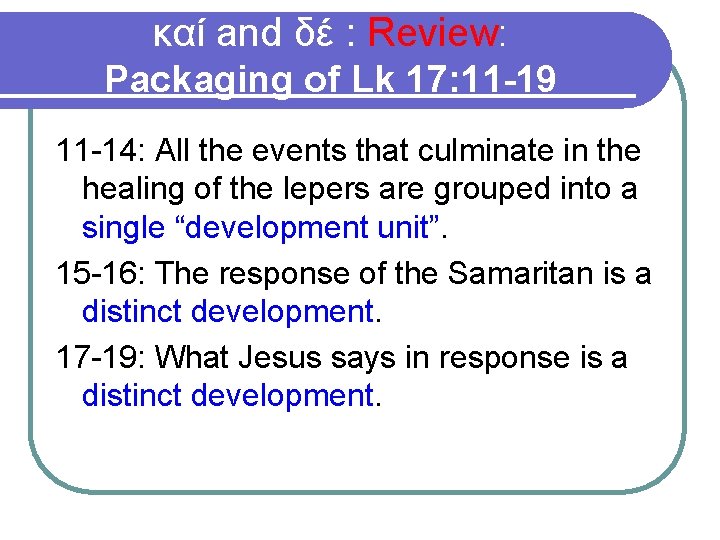
καί and δέ : Review: Packaging of Lk 17: 11 -19 11 14: All the events that culminate in the healing of the lepers are grouped into a single “development unit”. 15 16: The response of the Samaritan is a distinct development. 17 19: What Jesus says in response is a distinct development.
Conjunctions: Review l NOT to be defined in terms of lists of multiple semantic senses such as “Adversative or Connective or Emphatic”. l Such senses reflect the content of the propositions that are being linked, NOT the function of the conjunction.
Conjunctions: Review l Each conjunction is to be defined in terms of the unique cognitive constraint on interpretation that its presence conveys (Blakemore 2002).
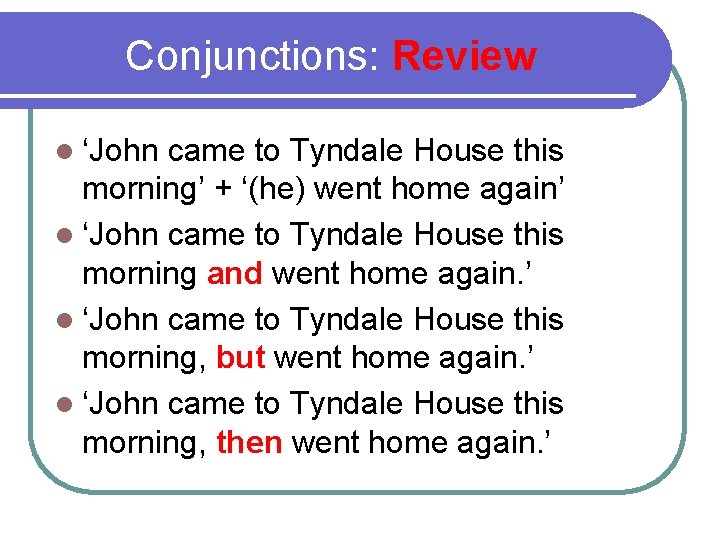
Conjunctions: Review l ‘John came to Tyndale House this morning’ + ‘(he) went home again’ l ‘John came to Tyndale House this morning and went home again. ’ l ‘John came to Tyndale House this morning, but went home again. ’ l ‘John came to Tyndale House this morning, then went home again. ’
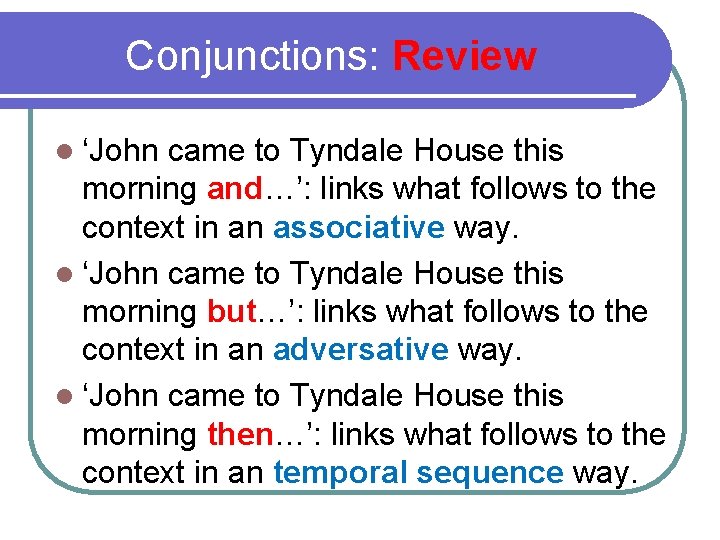
Conjunctions: Review l ‘John came to Tyndale House this morning and…’: links what follows to the context in an associative way. l ‘John came to Tyndale House this morning but…’: links what follows to the context in an adversative way. l ‘John came to Tyndale House this morning then…’: links what follows to the context in an temporal sequence way.
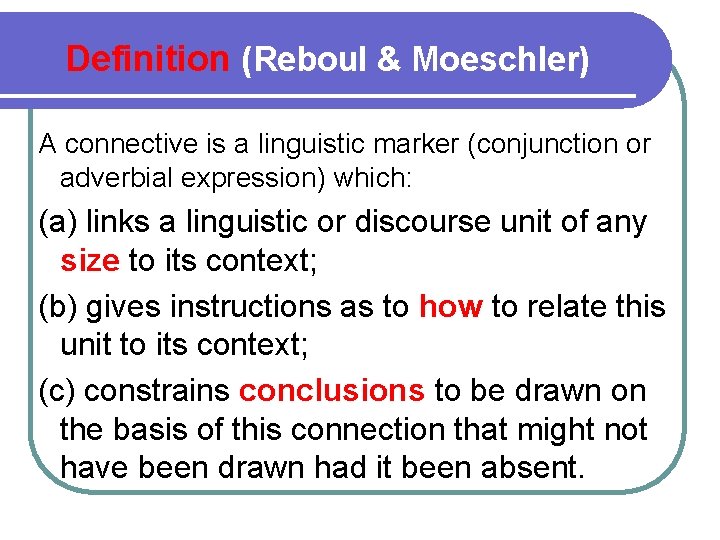
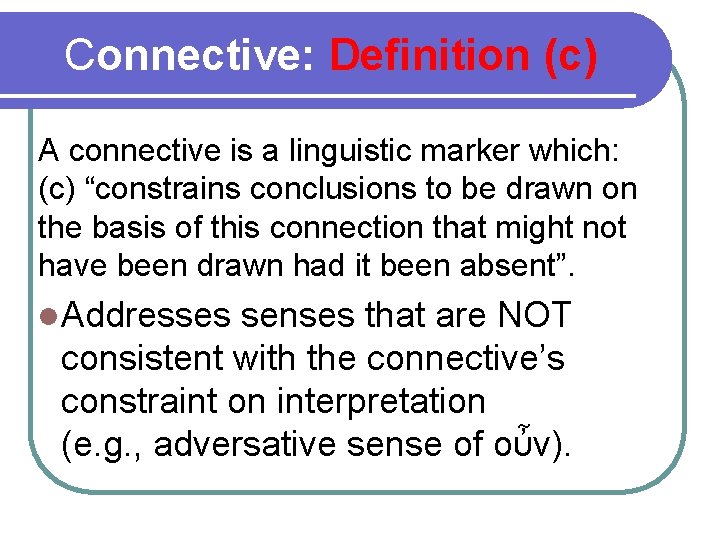
Definition (Reboul & Moeschler) A connective is a linguistic marker (conjunction or adverbial expression) which: (a) links a linguistic or discourse unit of any size to its context; (b) gives instructions as to how to relate this unit to its context; (c) constrains conclusions to be drawn on the basis of this connection that might not have been drawn had it been absent.
Connective: Definition (a) “A linguistic marker which: (a) links a linguistic or discourse unit of any size to its context; ” l One cannot tell the size of the unit being linked from the connective itself.
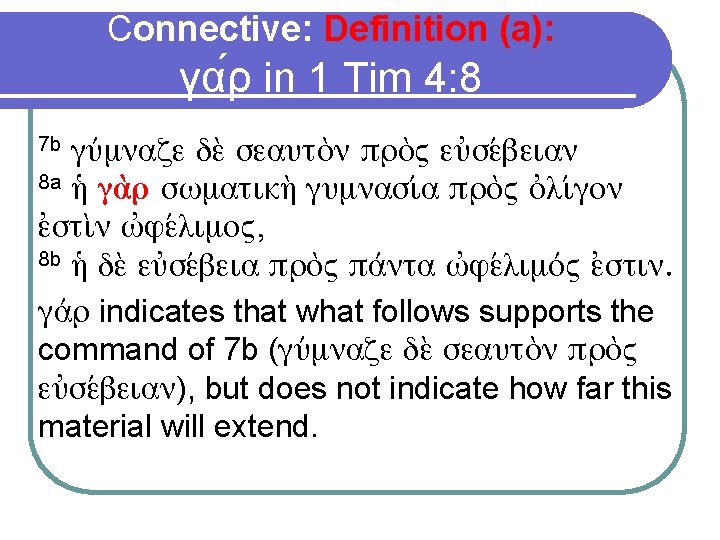
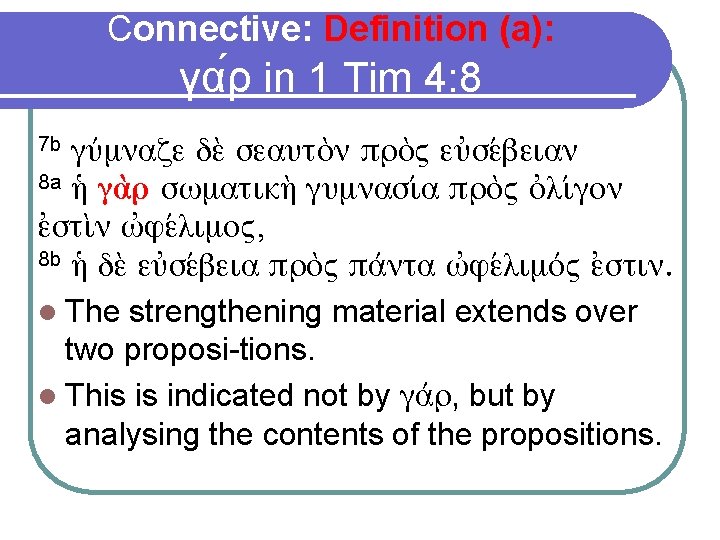
Connective: Definition (a): γα ρ in 1 Tim 4: 8 γυ μναζε δε σεαυτο ν προ ς ευ σε βειαν 8 a η γα ρ σωματικη γυμνασι α προ ς ο λι γον ε στι ν ω φε λιμος, 8 b η δε ευ σε βεια προ ς πα ντα ω φε λιμο ς ε στιν. l The strengthening material extends over two proposi tions. l This is indicated not by γα ρ, but by analysing the contents of the propositions. 7 b
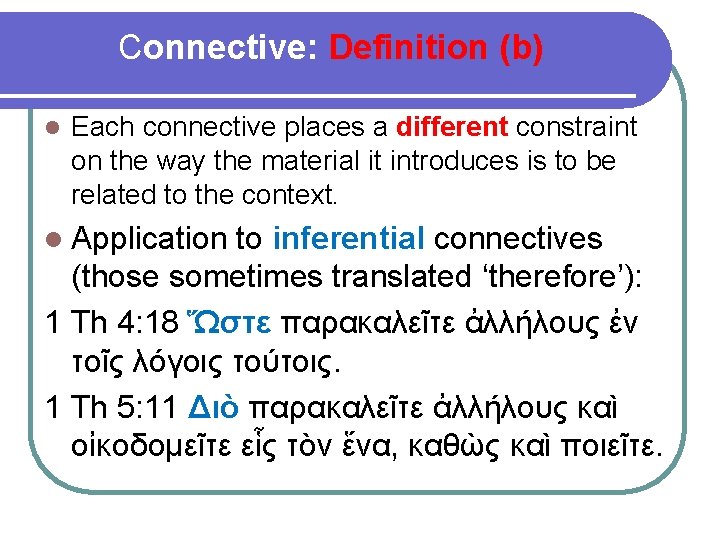
Connective: Definition (b) “A linguistic marker which: (b) gives instructions as to how to relate this unit to its context; ” l Each connective places a different constraint on the way the material it introduces is to be related to the context.
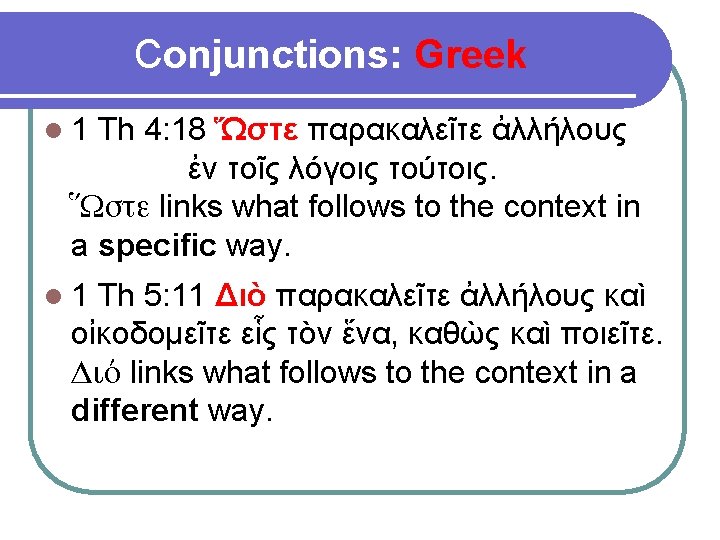
Connective: Definition (b) l Each connective places a different constraint on the way the material it introduces is to be related to the context. l Application to inferential connectives (those sometimes translated ‘therefore’): 1 Th 4: 18 Ὥστε παρακαλεῖτε ἀλλήλους ἐν τοῖς λόγοις τούτοις. 1 Th 5: 11 Διὸ παρακαλεῖτε ἀλλήλους καὶ οἰκοδομεῖτε εἷς τὸν ἕνα, καθὼς καὶ ποιεῖτε.
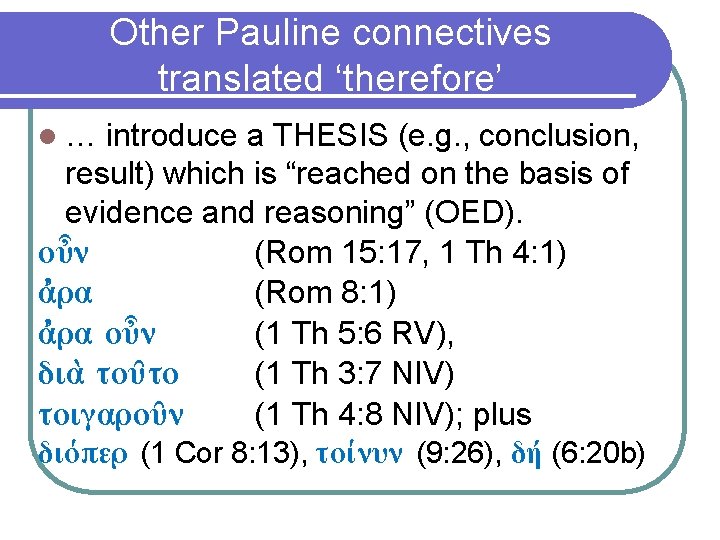
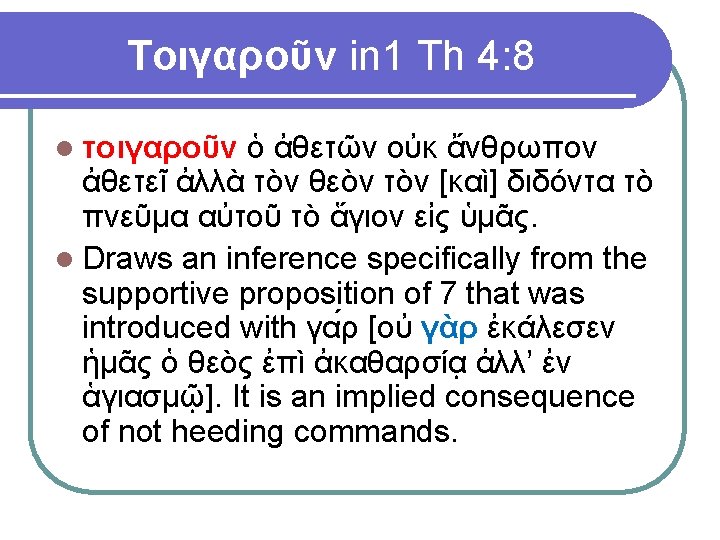
Other Pauline connectives translated ‘therefore’ l… introduce a THESIS (e. g. , conclusion, result) which is “reached on the basis of evidence and reasoning” (OED). οὖν (Rom 15: 17, 1 Th 4: 1) α ρα (Rom 8: 1) α ρα οὖν (1 Th 5: 6 RV), δια του το (1 Th 3: 7 NIV) τοιγαροῦν (1 Th 4: 8 NIV); plus διόπερ (1 Cor 8: 13), τοίνυν (9: 26), δή (6: 20 b)
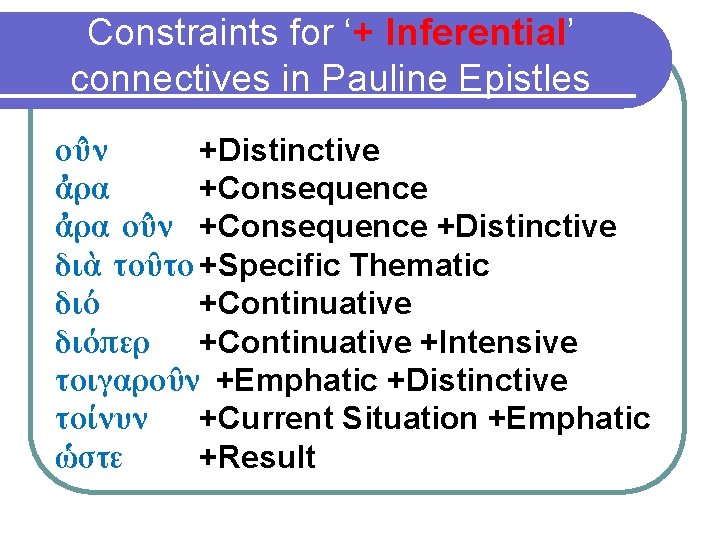
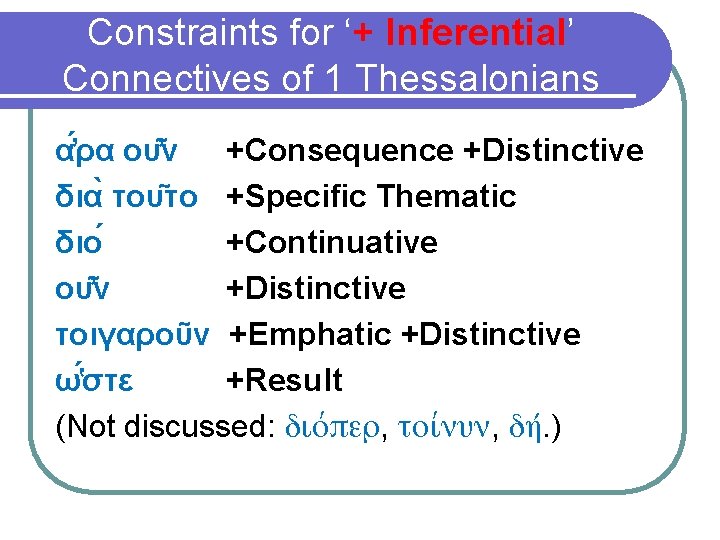
Constraints for ‘+ Inferential’ connectives in Pauline Epistles ου ν +Distinctive α ρα +Consequence α ρα ου ν +Consequence +Distinctive δια του το +Specific Thematic διο +Continuative διόπερ +Continuative +Intensive τοιγαροῦν +Emphatic +Distinctive τοίνυν +Current Situation +Emphatic ω στε +Result
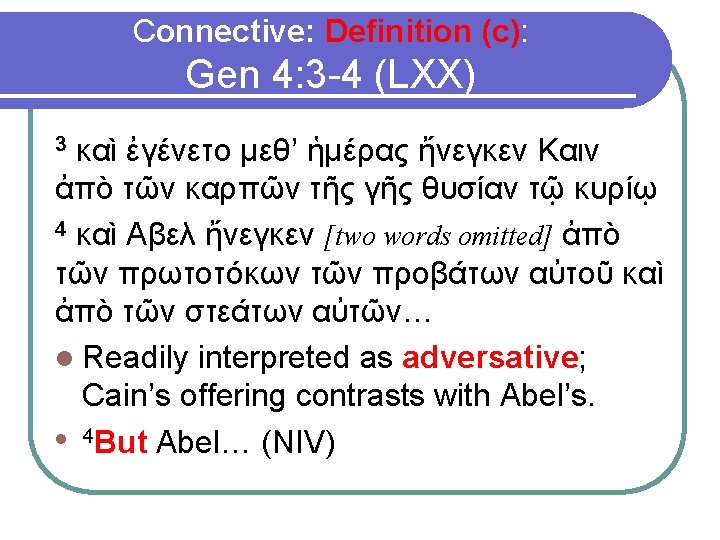
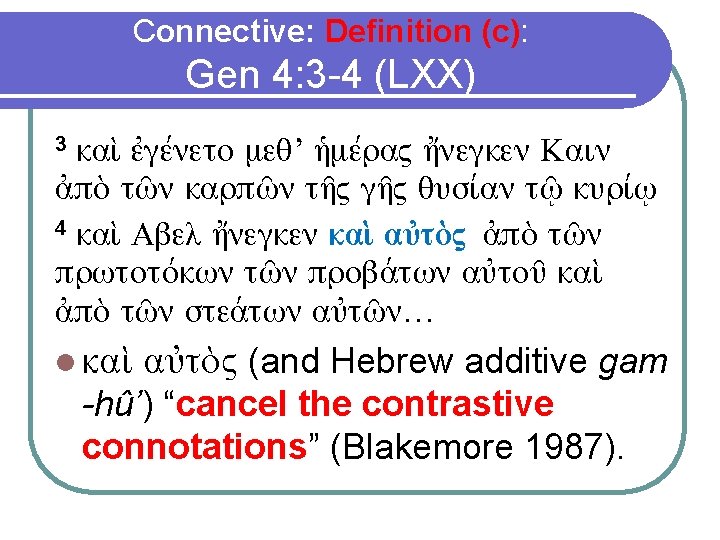
Connective: Definition (c) A connective is a linguistic marker which: (c) “constrains conclusions to be drawn on the basis of this connection that might not have been drawn had it been absent”. l. Addresses senses that are NOT consistent with the connective’s constraint on interpretation (e. g. , adversative sense of οὖν).
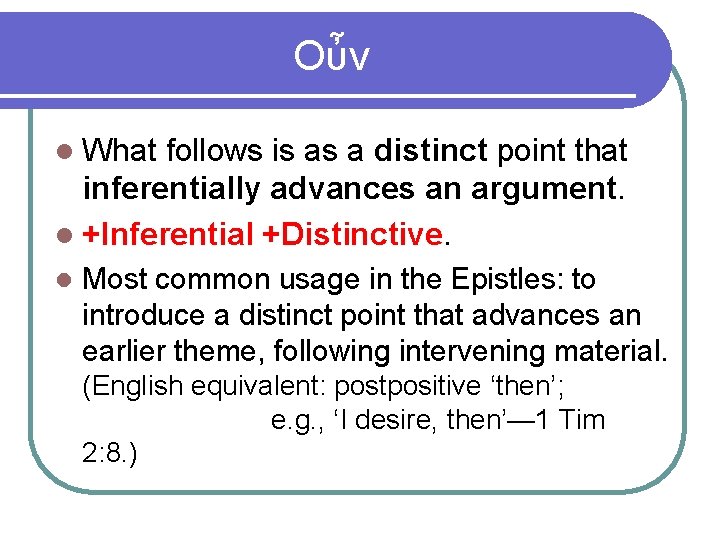
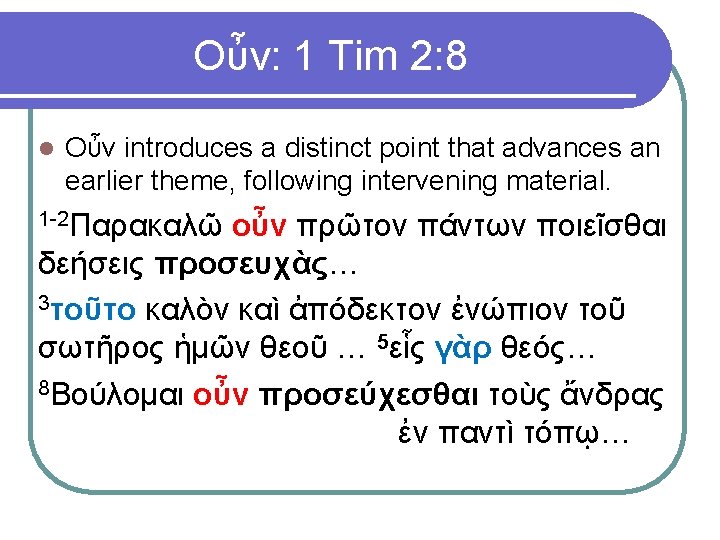
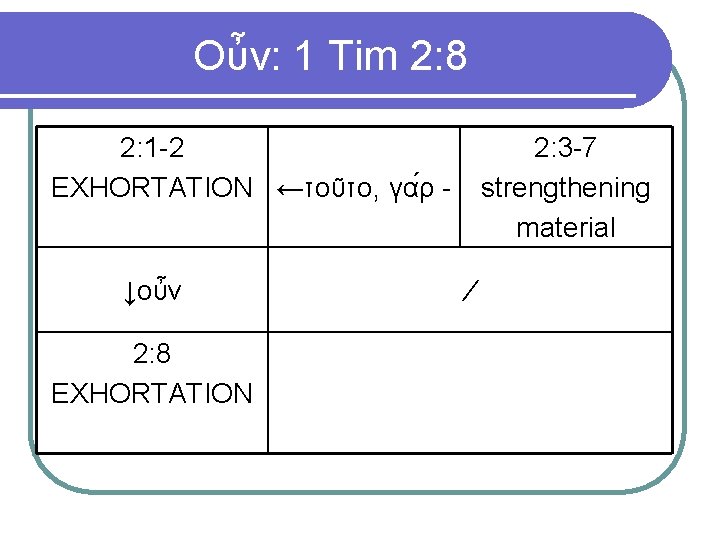
Oὖν l What follows is as a distinct point that inferentially advances an argument. l +Inferential +Distinctive. l Most common usage in the Epistles: to introduce a distinct point that advances an earlier theme, following intervening material. (English equivalent: postpositive ‘then’; e. g. , ‘I desire, then’— 1 Tim 2: 8. )
Oὖν: 1 Tim 2: 8 2: 1 2 EXHORTATION ←τοῦτο, γα ρ ↓oὖν 2: 8 EXHORTATION 2: 3 7 strengthening material ⁄
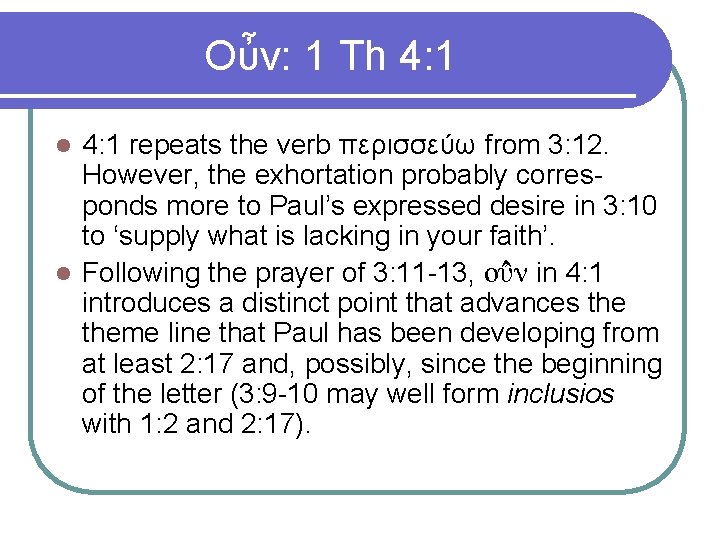
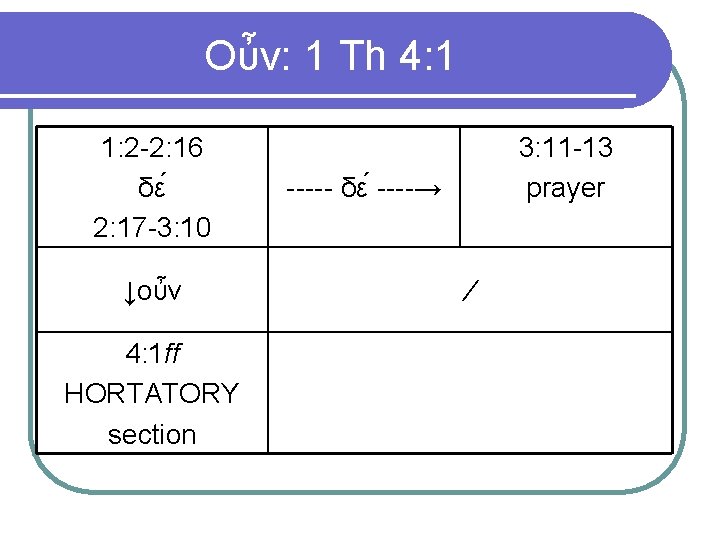
Oὖν: 1 Th 4: 1 repeats the verb περισσεύω from 3: 12. However, the exhortation probably corres ponds more to Paul’s expressed desire in 3: 10 to ‘supply what is lacking in your faith’. l Following the prayer of 3: 11 13, oυ ν in 4: 1 introduces a distinct point that advances theme line that Paul has been developing from at least 2: 17 and, possibly, since the beginning of the letter (3: 9 10 may well form inclusios with 1: 2 and 2: 17). l
Oὖν: 1 Th 4: 1 1: 2 2: 16 δε 2: 17 3: 10 ↓oὖν 4: 1 ff HORTATORY section 3: 11 13 prayer δε → ⁄
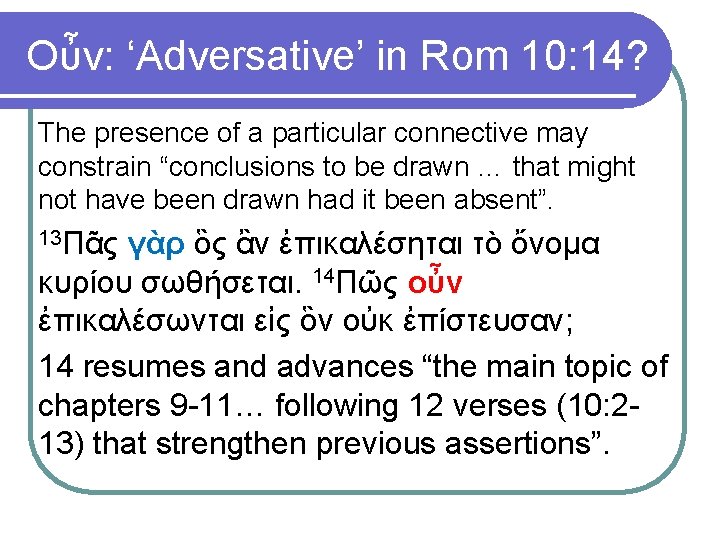
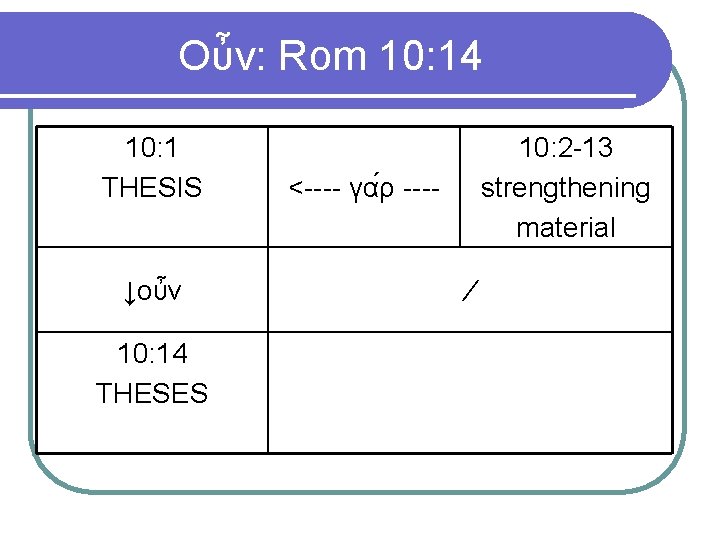
Oὖν: ‘Adversative’ in Rom 10: 14? The presence of a particular connective may constrain “conclusions to be drawn … that might not have been drawn had it been absent”. 13Πᾶς γὰρ ὃς ἂν ἐπικαλέσηται τὸ ὄνομα κυρίου σωθήσεται. 14Πῶς οὖν ἐπικαλέσωνται εἰς ὃν οὐκ ἐπίστευσαν; 14 resumes and advances “the main topic of chapters 9 11… following 12 verses (10: 2 13) that strengthen previous assertions”.
Oὖν: Rom 10: 14 10: 1 THESIS ↓oὖν 10: 14 THESES 10: 2 13 strengthening material < γα ρ ⁄
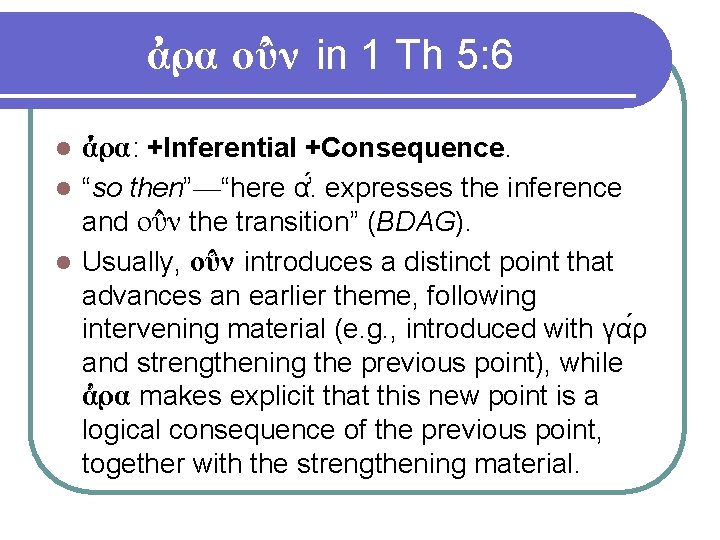
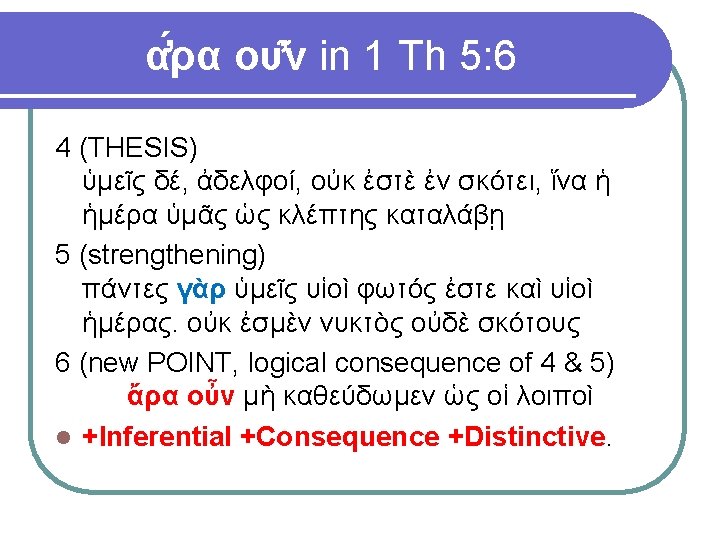
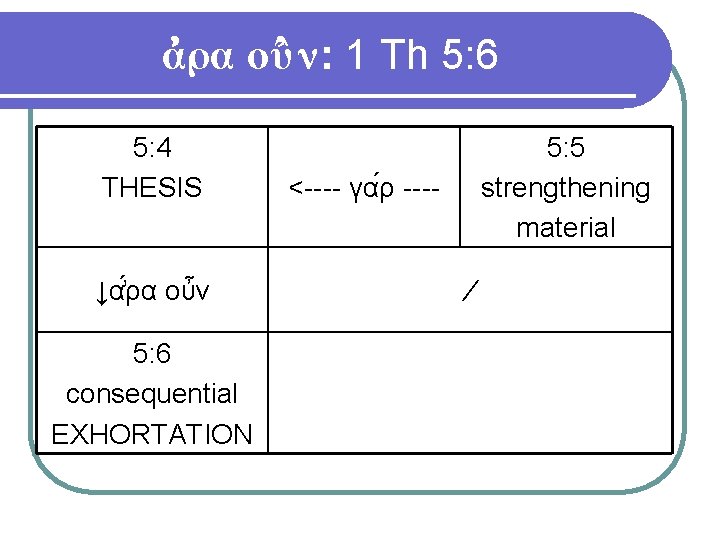
α ρα ου ν in 1 Th 5: 6 α ρα: +Inferential +Consequence. l “so then”—“here α . expresses the inference and ου ν the transition” (BDAG). l Usually, ου ν introduces a distinct point that advances an earlier theme, following intervening material (e. g. , introduced with γα ρ and strengthening the previous point), while α ρα makes explicit that this new point is a logical consequence of the previous point, together with the strengthening material. l
α ρα ου ν: 1 Th 5: 6 5: 4 THESIS ↓α ρα oὖν 5: 6 consequential EXHORTATION 5: 5 strengthening material < γα ρ ⁄
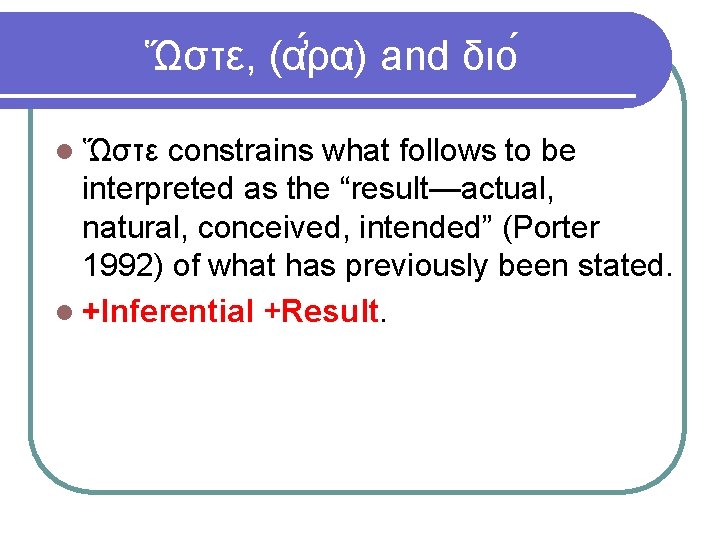
Ὥστε, (α ρα) and διο l Ὥστε constrains what follows to be interpreted as the “result—actual, natural, conceived, intended” (Porter 1992) of what has previously been stated. l +Inferential +Result.
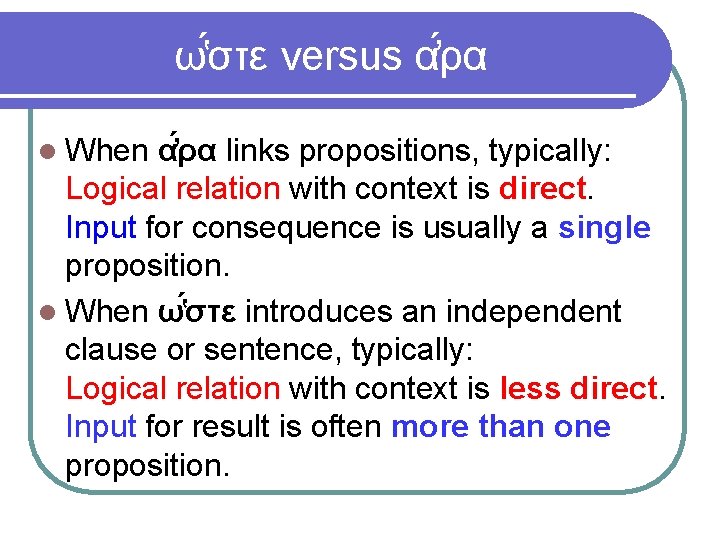
ω στε versus α ρα l When α ρα links propositions, typically: Logical relation with context is direct. Input for consequence is usually a single proposition. l When ω στε introduces an independent clause or sentence, typically: Logical relation with context is less direct. Input for result is often more than one proposition.
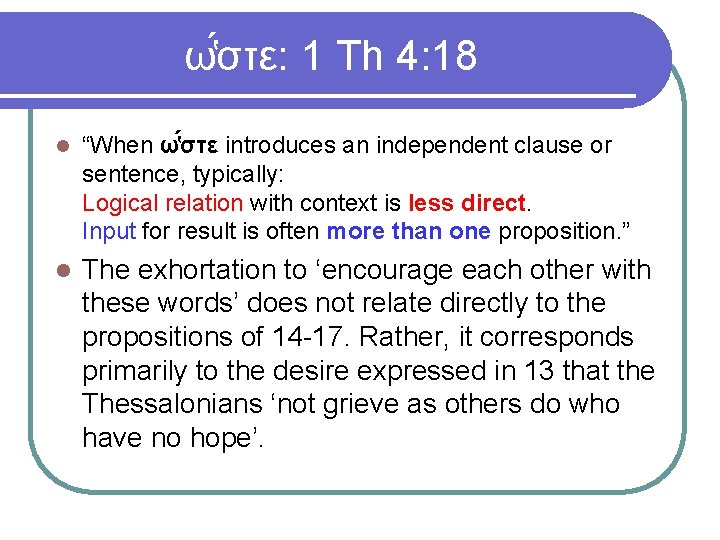
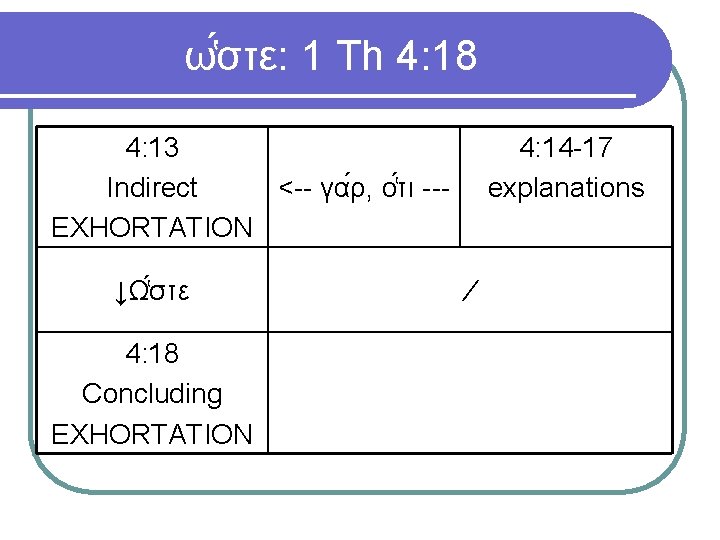
ω στε: 1 Th 4: 18 l “When ω στε introduces an independent clause or sentence, typically: Logical relation with context is less direct. Input for result is often more than one proposition. ” l The exhortation to ‘encourage each other with these words’ does not relate directly to the propositions of 14 17. Rather, it corresponds primarily to the desire expressed in 13 that the Thessalonians ‘not grieve as others do who have no hope’.
ω στε: 1 Th 4: 18 4: 13 Indirect < γα ρ, ο τι EXHORTATION ↓Ω στε 4: 18 Concluding EXHORTATION 4: 14 17 explanations ⁄
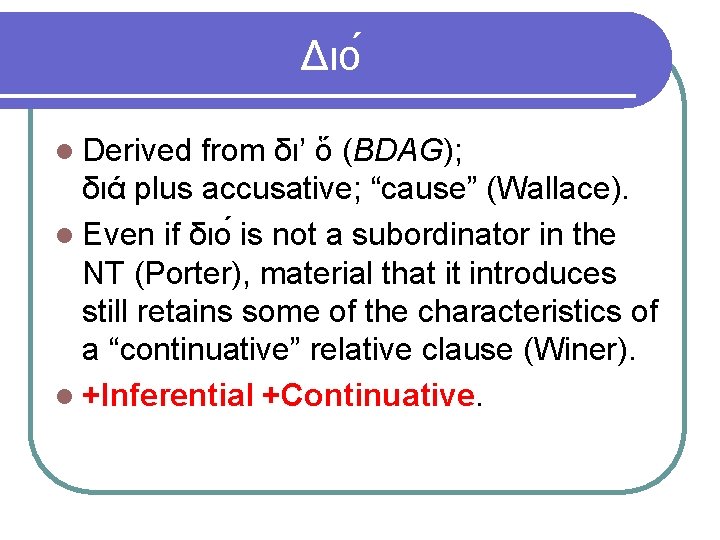
Διο l Derived from δι’ ὅ (BDAG); διά plus accusative; “cause” (Wallace). l Even if διο is not a subordinator in the NT (Porter), material that it introduces still retains some of the characteristics of a “continuative” relative clause (Winer). l +Inferential +Continuative.
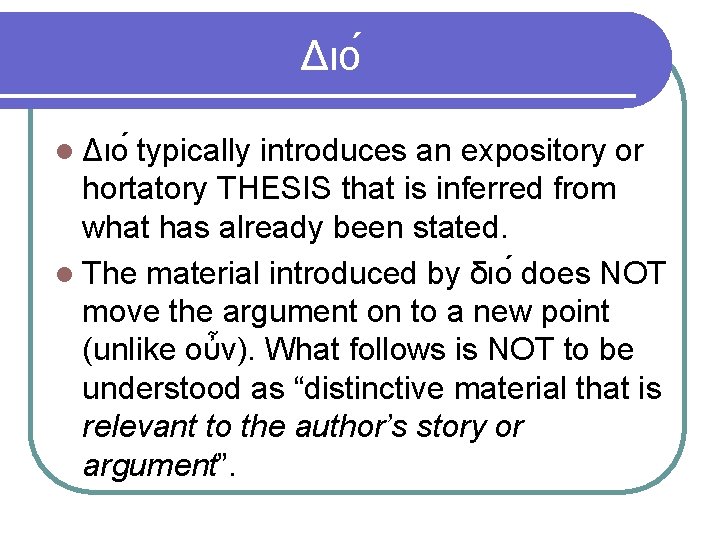
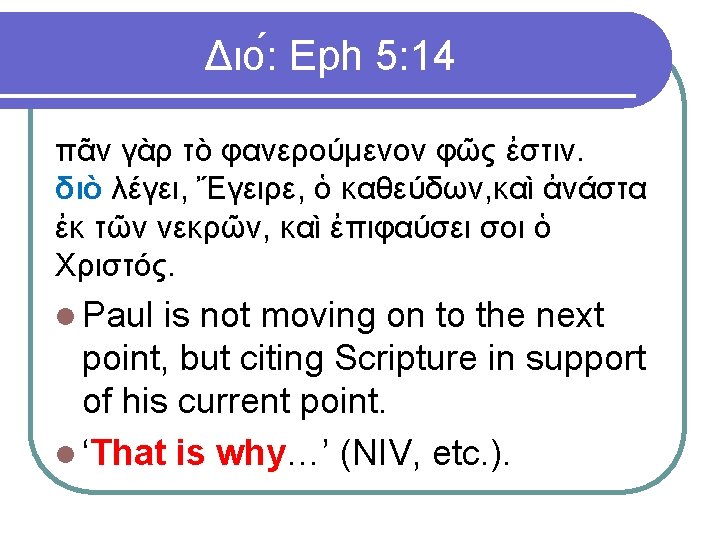
Διο l Διο typically introduces an expository or hortatory THESIS that is inferred from what has already been stated. l The material introduced by διο does NOT move the argument on to a new point (unlike οὖν). What follows is NOT to be understood as “distinctive material that is relevant to the author’s story or argument”.
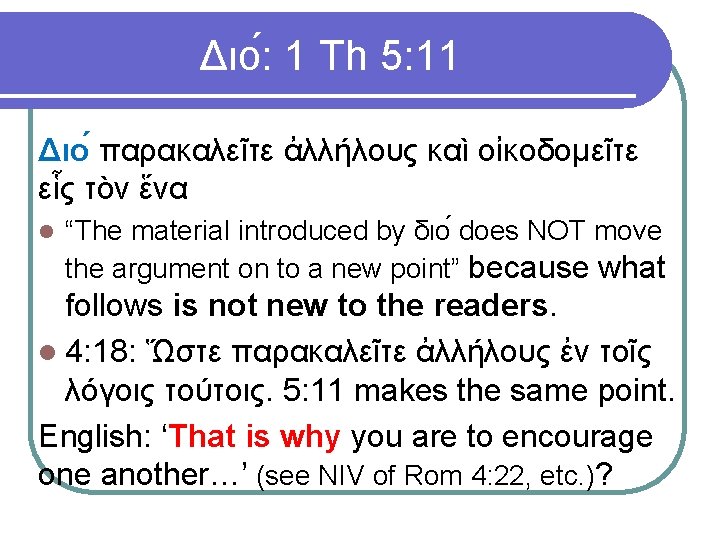
Διο : 1 Th 5: 11 Διο παρακαλεῖτε ἀλλήλους καὶ οἰκοδομεῖτε εἷς τὸν ἕνα l “The material introduced by διο does NOT move the argument on to a new point” because what follows is not new to the readers. l 4: 18: Ὥστε παρακαλεῖτε ἀλλήλους ἐν τοῖς λόγοις τούτοις. 5: 11 makes the same point. English: ‘That is why you are to encourage one another…’ (see NIV of Rom 4: 22, etc. )?
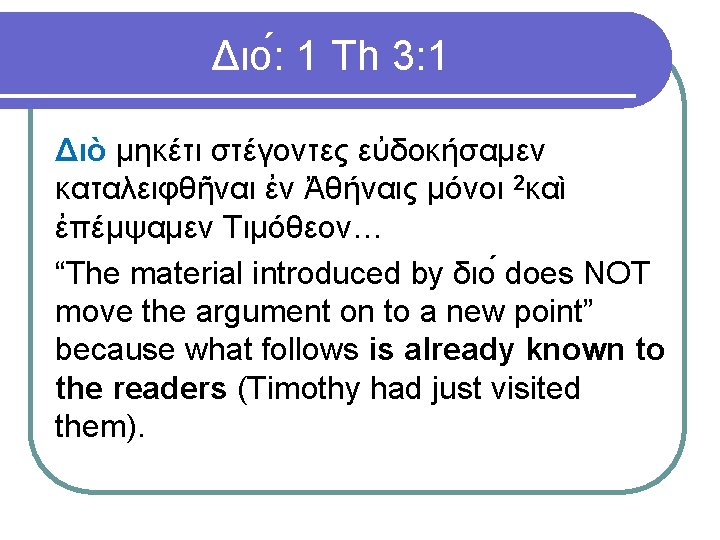
Διο : 1 Th 3: 1 Διὸ μηκέτι στέγοντες εὐδοκήσαμεν καταλειφθῆναι ἐν Ἀθήναις μόνοι 2καὶ ἐπέμψαμεν Τιμόθεον… “The material introduced by διο does NOT move the argument on to a new point” because what follows is already known to the readers (Timothy had just visited them).
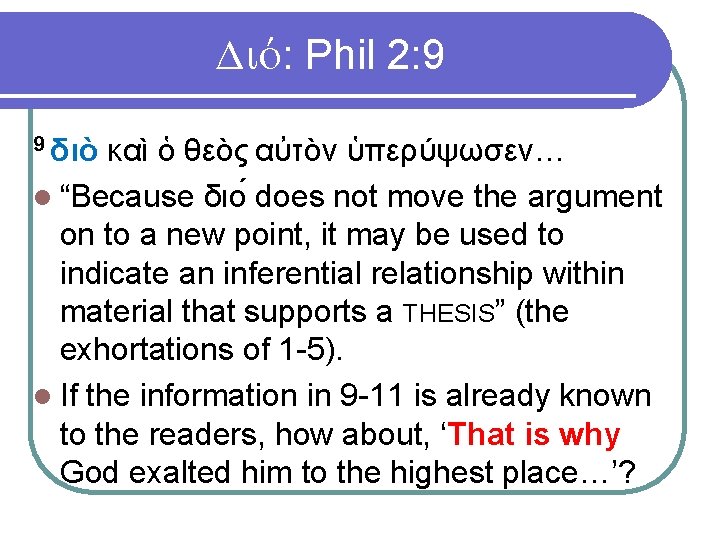
Διο : Phil 2: 9 9 διὸ καὶ ὁ θεὸς αὐτὸν ὑπερύψωσεν… l “Because διο does not move the argument on to a new point, it may be used to indicate an inferential relationship within material that supports a THESIS” (the exhortations of 1 5). l If the information in 9 11 is already known to the readers, how about, ‘That is why God exalted him to the highest place…’?
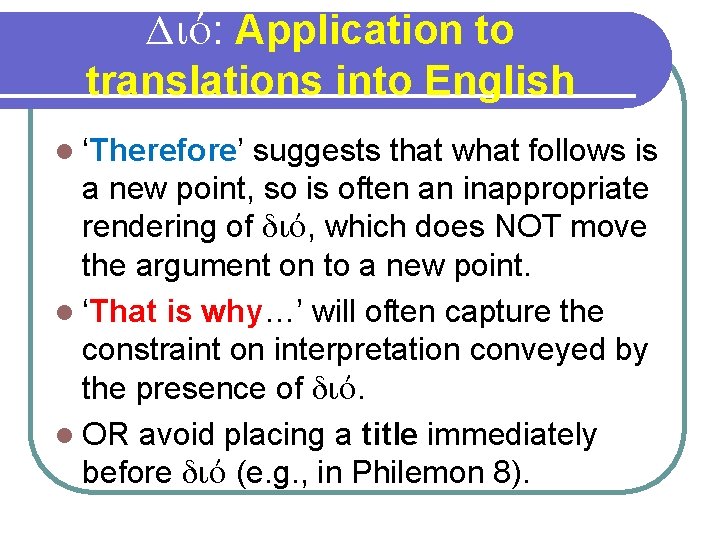
Διο : Application to translations into English l ‘Therefore’ suggests that what follows is a new point, so is often an inappropriate rendering of διο , which does NOT move the argument on to a new point. l ‘That is why…’ will often capture the constraint on interpretation conveyed by the presence of διο. l OR avoid placing a title immediately before διο (e. g. , in Philemon 8).
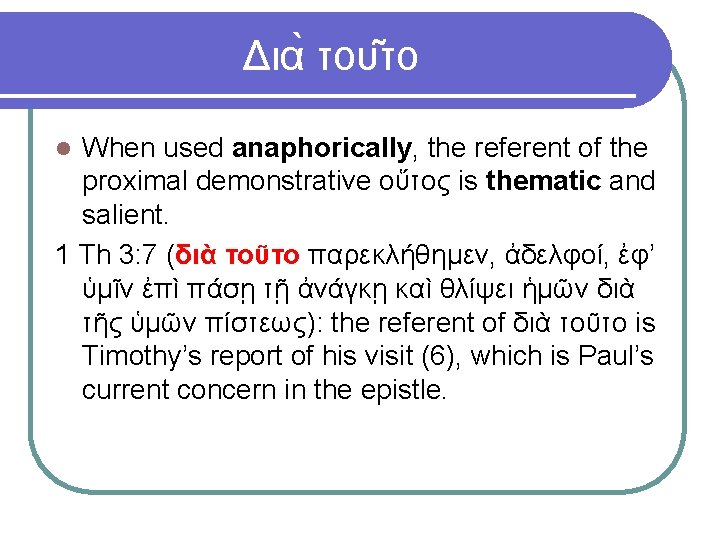
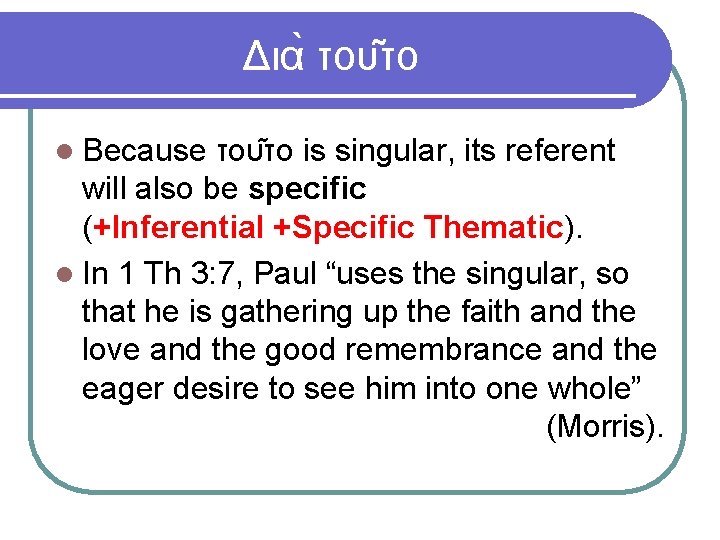
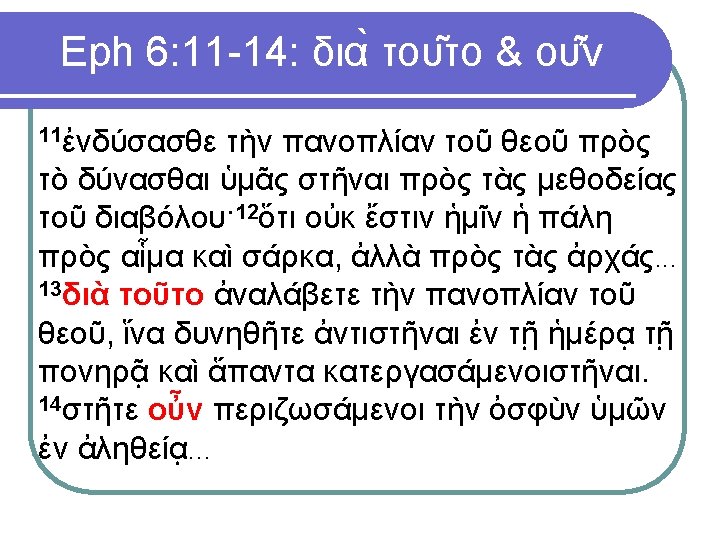
Δια του το When used anaphorically, the referent of the proximal demonstrative οὕτος is thematic and salient. 1 Th 3: 7 (διὰ τοῦτο παρεκλήθημεν, ἀδελφοί, ἐφ’ ὑμῖν ἐπὶ πάσῃ τῇ ἀνάγκῃ καὶ θλίψει ἡμῶν διὰ τῆς ὑμῶν πίστεως): the referent of διὰ τοῦτο is Timothy’s report of his visit (6), which is Paul’s current concern in the epistle. l
Δια του το l Because του το is singular, its referent will also be specific (+Inferential +Specific Thematic). l In 1 Th 3: 7, Paul “uses the singular, so that he is gathering up the faith and the love and the good remembrance and the eager desire to see him into one whole” (Morris).
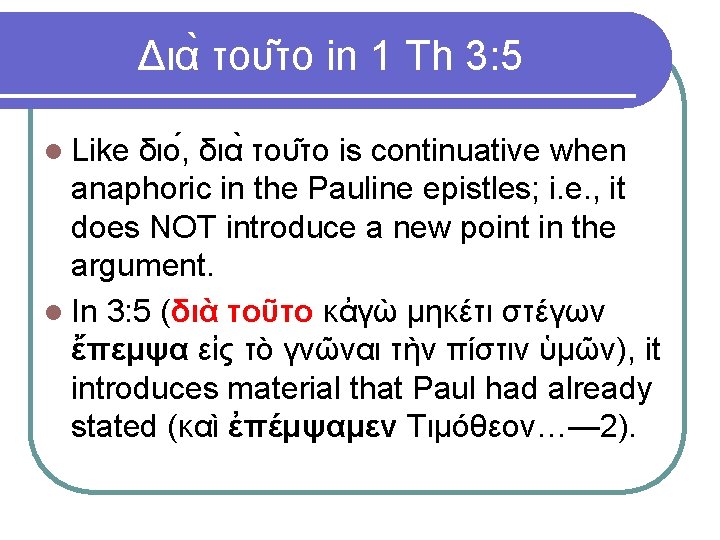
Δια του το in 1 Th 3: 5 l Like διο , δια του το is continuative when anaphoric in the Pauline epistles; i. e. , it does NOT introduce a new point in the argument. l In 3: 5 (διὰ τοῦτο κἀγὼ μηκέτι στέγων ἔπεμψα εἰς τὸ γνῶναι τὴν πίστιν ὑμῶν), it introduces material that Paul had already stated (καὶ ἐπέμψαμεν Τιμόθεον…— 2).
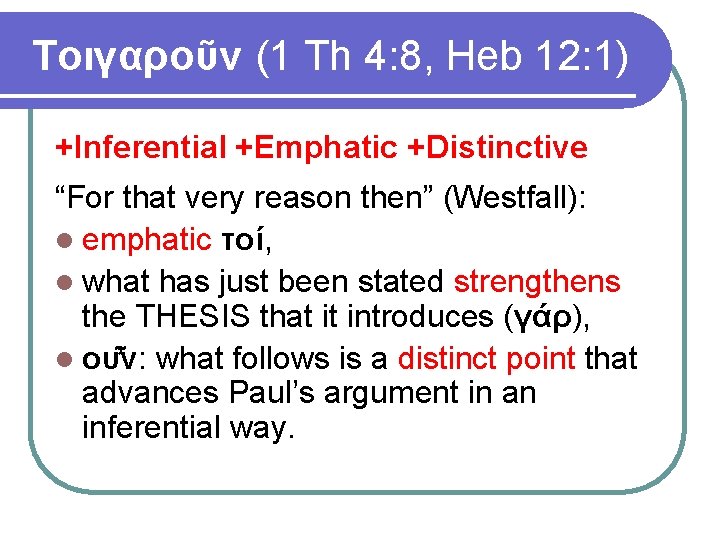
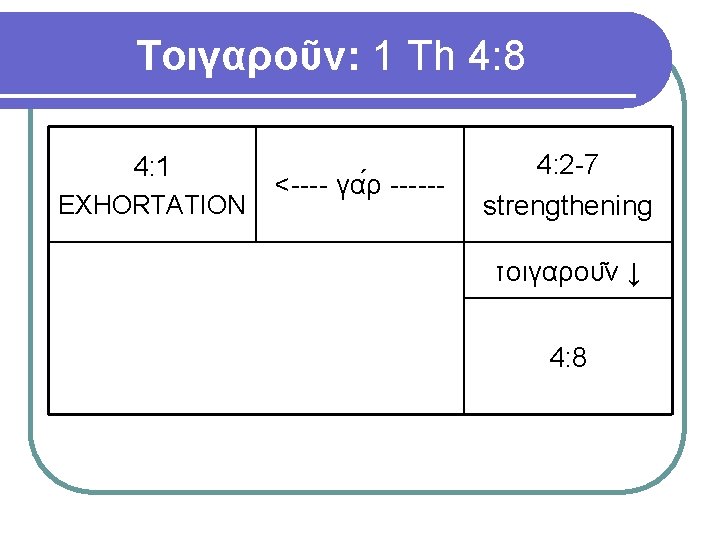
Τοιγαροῦν (1 Th 4: 8, Heb 12: 1) +Inferential +Emphatic +Distinctive “For that very reason then” (Westfall): l emphatic τοί, l what has just been stated strengthens the THESIS that it introduces (γάρ), l ου ν: what follows is a distinct point that advances Paul’s argument in an inferential way.
Τοιγαροῦν: 1 Th 4: 8 4: 1 EXHORTATION < γα ρ 4: 2 7 strengthening τοιγαρου ν ↓ 4: 8
Constraints for ‘+ Inferential’ Connectives of 1 Thessalonians α ρα ου ν +Consequence +Distinctive δια του το +Specific Thematic διο +Continuative ου ν +Distinctive τοιγαροῦν +Emphatic +Distinctive ω στε +Result (Not discussed: διόπερ, τοίνυν, δή. )
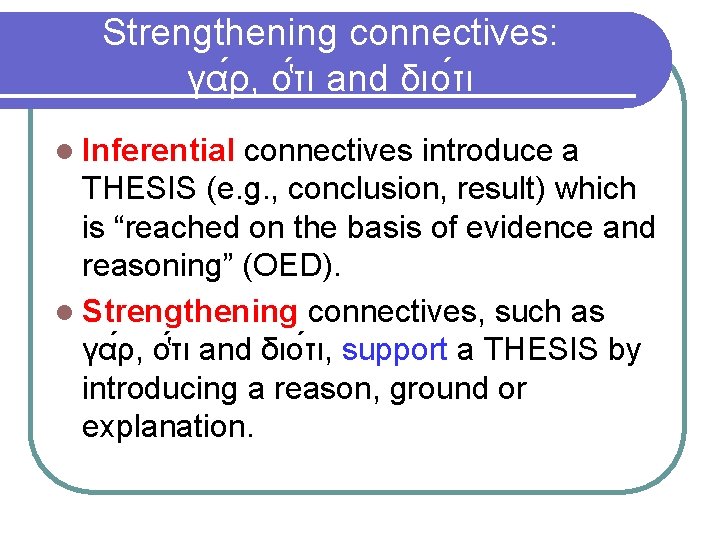
Strengthening connectives: γα ρ, ο τι and διο τι l Inferential connectives introduce a THESIS (e. g. , conclusion, result) which is “reached on the basis of evidence and reasoning” (OED). l Strengthening connectives, such as γα ρ, ο τι and διο τι, support a THESIS by introducing a reason, ground or explanation.
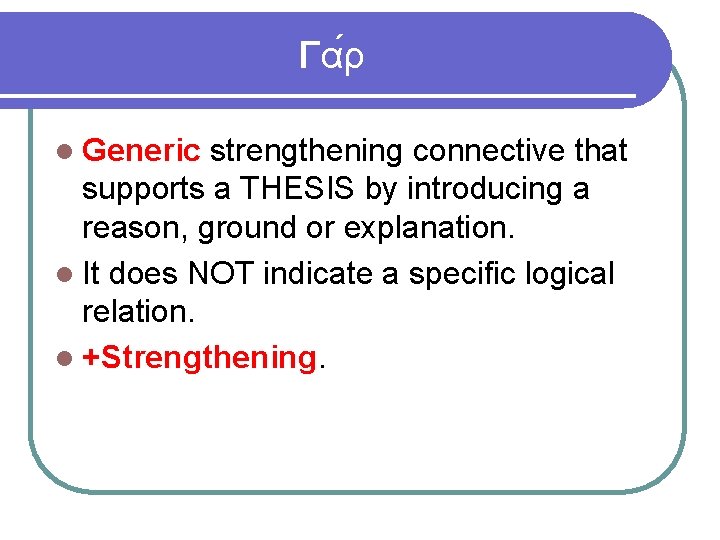
Γα ρ l Generic strengthening connective that supports a THESIS by introducing a reason, ground or explanation. l It does NOT indicate a specific logical relation. l +Strengthening.
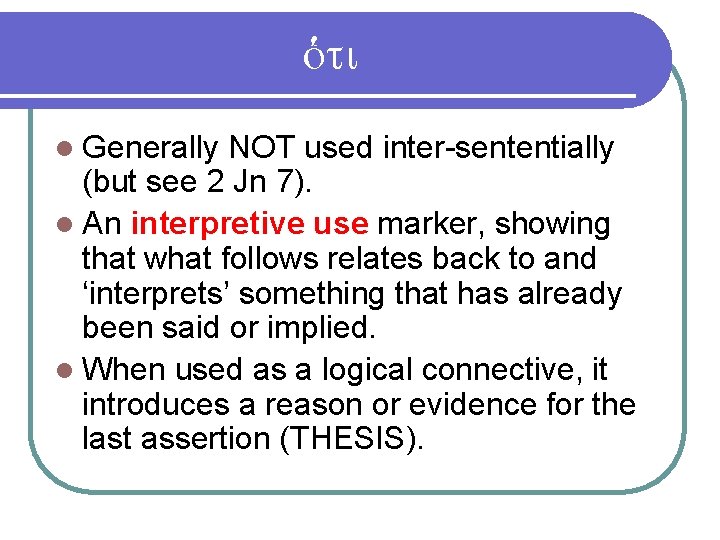
ο τι l Generally NOT used inter sententially (but see 2 Jn 7). l An interpretive use marker, showing that what follows relates back to and ‘interprets’ something that has already been said or implied. l When used as a logical connective, it introduces a reason or evidence for the last assertion (THESIS).
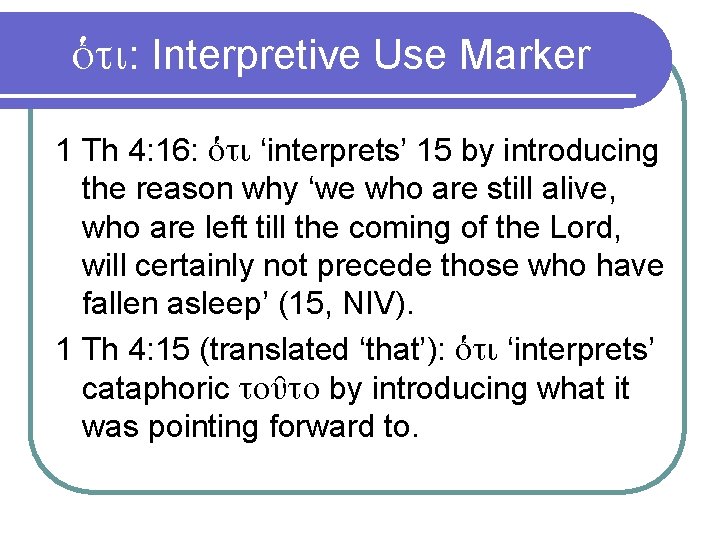
ο τι: Interpretive Use Marker 1 Th 4: 16: ο τι ‘interprets’ 15 by introducing the reason why ‘we who are still alive, who are left till the coming of the Lord, will certainly not precede those who have fallen asleep’ (15, NIV). 1 Th 4: 15 (translated ‘that’): ο τι ‘interprets’ cataphoric του το by introducing what it was pointing forward to.
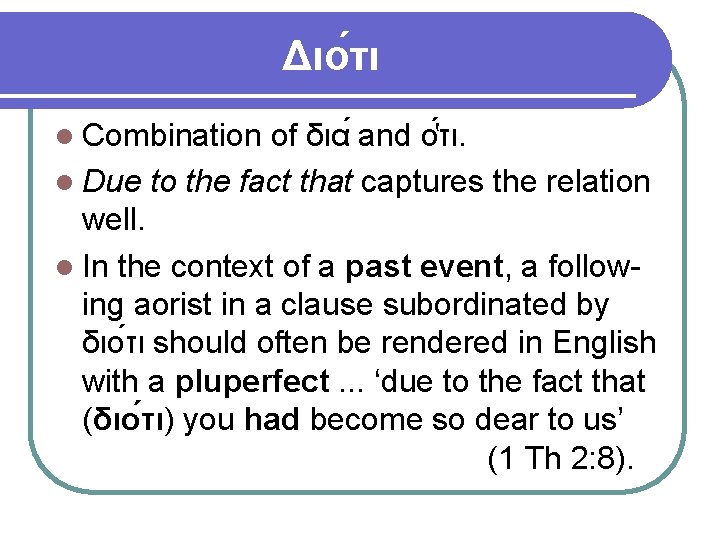
Διο τι l Combination of δια and ο τι. l Due to the fact that captures the relation well. l In the context of a past event, a follow ing aorist in a clause subordinated by διο τι should often be rendered in English with a pluperfect. . . ‘due to the fact that (διο τι) you had become so dear to us’ (1 Th 2: 8).
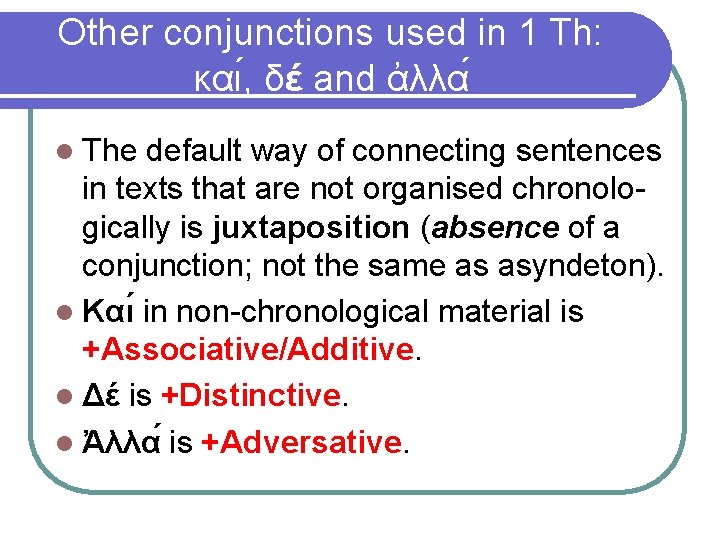
Other conjunctions used in 1 Th: και , δέ and ἀλλα l The default way of connecting sentences in texts that are not organised chronolo gically is juxtaposition (absence of a conjunction; not the same as asyndeton). l Και in non chronological material is +Associative/Additive. l Δέ is +Distinctive. l Ἀλλα is +Adversative.
Selected References Blakemore, Diane, Semantic Constraints on Relevance (Blackwell, 1987), 99. l ———, Relevance and Linguistic Meaning (Cambridge University Press, 2002), 184. l l Levinsohn, Stephen H. , ‘Therefore’ or ‘Wherefore’: What’s the Difference? , Perspectives on Linguistics and Ancient Languages 4 (Gorgias Press, 2013), 325 43.
Selected References (con. ) Levinsohn, Stephen H. , Is ο τι an interpretive use marker? In The Linguist as Pedagogue: Trends in the Teaching and Linguistic Analysis of the Greek New Testament, edited by Stanley E. Porter and Matthew Brook O’Donnell, (Sheffield: Sheffield Phoenix Press, 2009), 163 82. l ———, ‘Towards a Unified Linguistic Descrip tion of ου τος and ε κει νος’. In ibid. , 204 16. l
Selected References (con. ) l Reboul, Anne, et Jacques Moeschler, Pragmatique du discours: de l’interprétation de l’énoncé à l’interprétation du discours (Paris: Armand Colin, 1998).