
Conjunctions A conjunction is a word that connects












- Slides: 56
Conjunctions
A conjunction is a word that connects other words or groups of words.
There are three types of conjunctions:
The main conjunctions are: 1. Coordinating Conjunctions 2. Subordinating Conjunctions
The other type of conjunction is: Correlative Conjunctions
Coordinating Conjunctions
Coordinating conjunctions may join single words or they may join groups of words
No matter how many words they’re joining, Coordinating Conjunctions must always join equal parts of speech!
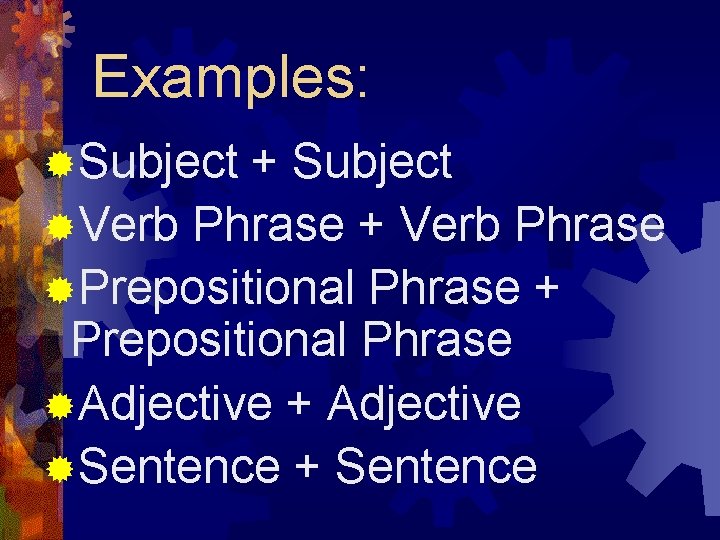
Examples: ®Subject + Subject ®Verb Phrase + Verb Phrase ®Prepositional Phrase + Prepositional Phrase ®Adjective + Adjective ®Sentence + Sentence
The 7 Coordinating Conjunctions: ®For ®And ®Nor ®But ®Or ®Yet ®So
An easy way to remember these seven conjunctions is to think of the word FANBOYS
FOR: Introduces the reason for the preceding clause
Example: She went to bed at 7: 30 PM, for it was a long day at work.
AND: Joins two similar ideas together
Example: Lucy studies often, and she does well in school.
NOR: This coordinating conjunction is not used nearly as often as its counterparts, but still be familiar with it. Its most common use is as the little brother in the correlative pair, neither-nor.
Example: I won’t eat asparagus, nor will I eat caviar.
BUT: Joins two contrasting ideas together
Example: Baking is fun, but cleaning the kitchen is boring.
OR: Joins two alternative ideas
Example: I could cook dinner, or we could order Chinese food.
YET: Similar to 'but' as it also joins two contrasting ideas together
Example: The flower has delightful colors, yet its fragrance is revolting.
SO: Shows that the second idea is the result of the first
Example: She was sick, so she went to the doctor.
The most common coordinating conjunctions are AND, BUT, and OR.
Subordinating Conjunctions
A subordinating conjunction is a word that joins a dependent clause and an independent clause.
Subordinating Conjunctions introduce Dependent Clauses.
Dependent clauses cannot stand alone as a single sentence.
In fact, the dependent clause relies on the rest of the sentence for its meaning.
Example: Since I will not be home, Tina will answer the phone.
"Since I will not be home" doesn't make sense by itself. It is dependent on the rest of the sentence for its meaning.
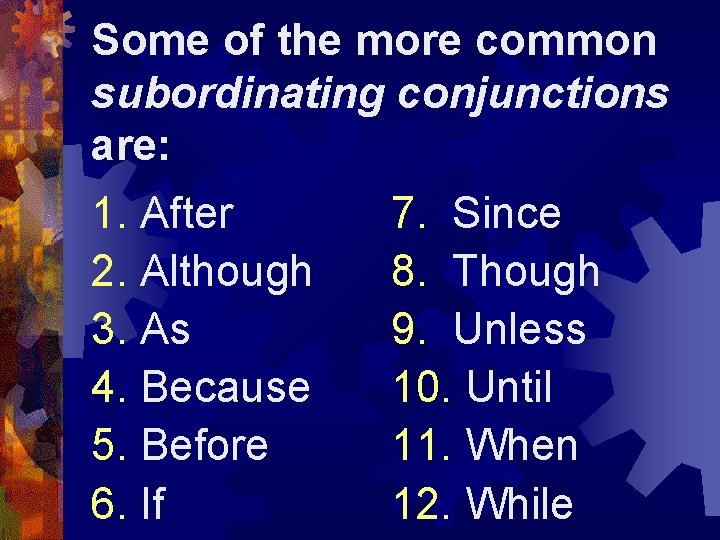
Some of the more common subordinating conjunctions are: 1. After 2. Although 3. As 4. Because 5. Before 6. If 7. Since 8. Though 9. Unless 10. Until 11. When 12. While
Correlative Conjunctions
Some conjunctions combine with other words to form what are called correlative conjunctions.
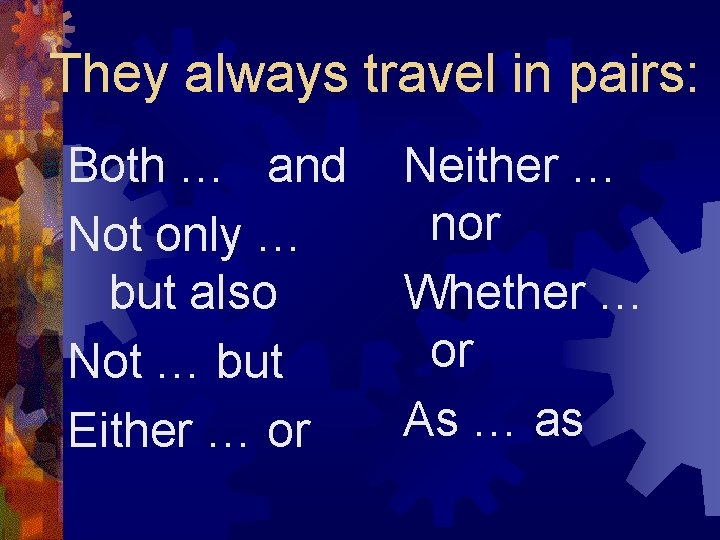
They always travel in pairs: Both … and Neither … nor Not only … Whether … but also or Not … but As … as Either … or
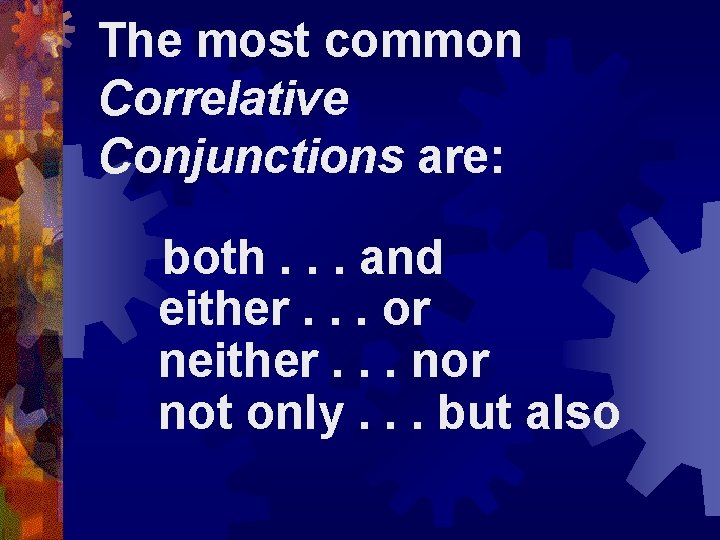
The most common Correlative Conjunctions are: both. . . and either. . . or neither. . . nor not only. . . but also
Let’s Practice Find the conjunctions in the following sentences. Decide if they are coordinating or subordinating.
1. He listened to the man's story and reported it to the policeman on duty.
Answer: 1. and, coordinating
2. I haven't seen my brother since he left for college.
Answer: 2. since, subordinating
3. Your aunt or your uncle will pick you up from school today.
Answer: 3. or, coordinating
4. Tom, Jane, Sue, and Tim will be going on the trip.
Answer: 4. and, coordinating
5. I remember the old school book, for it was once mine.
Answer: 5. for, coordinating
6. Sarah did not feel well, but she went to class anyway.
Answer: 6. but, coordinating
7. Although the old man was hungry, he never said a word to anyone.
Answer: 7. although, subordinating
8. I think I heard that on the television or radio, although I am not sure.
Answer: 8. or, coordinating; although, subordinating
Labeling a Conjunction Simply write an uppercase C on the top of conjunctions.