
Conjunction Assessment Risk Analysis Satellite CA Risk Analysis

- Slides: 27
Conjunction Assessment Risk Analysis Satellite CA Risk Analysis for “Dilution Region” Events: Issues and Operational Approaches M. D. Hejduk, Astrorum LLC (for The Aerospace Corporation) D. E. Snow, Omitron Inc. L. K. Newman, NASA GSFC
Agenda • On-orbit CA defined • Probability of Collision (Pc) explained • “Dilution region” defined and significance explained • CA risk assessment as a statistics problem – Setting the null hypothesis for this problem – Dilution region events considered in a statistics context • Approaches to risk reduction in the dilution region – Maximum Pc constructs – Ellipse overlap constructs – Performance of above methods against historical conjunction datasets • Conclusions / best practices recommendations CA for “Dilution Region” Events | February 2019 | 2
ON-ORBIT CA DEFINED CA for “Dilution Region” Events | February 2019 | 3
On-Orbit CA • On-orbit CA is the practice of predicting close approaches between space objects, and working to remediate those that present a serious likelihood of collision • On-orbit CA comprises three parts: – Geometric screening of protected primary objects against the remainder of the catalogue to identify close approaches – Risk assessment of the identified close approaches to determine which present truly risky situations that will require conjunction remediation – The facilitation of remediation activities to lessen or eliminate the collision risk for a particular risky encounter • The present study concerns the second of these three parts— risk assessment CA for “Dilution Region” Events | February 2019 | 4
2 -D PC CALCULATION EXPLAINED CA for “Dilution Region” Events | February 2019 | 5
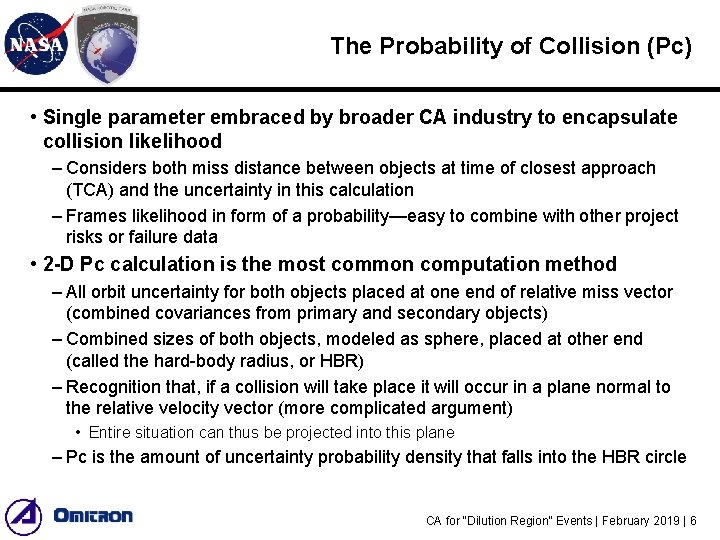
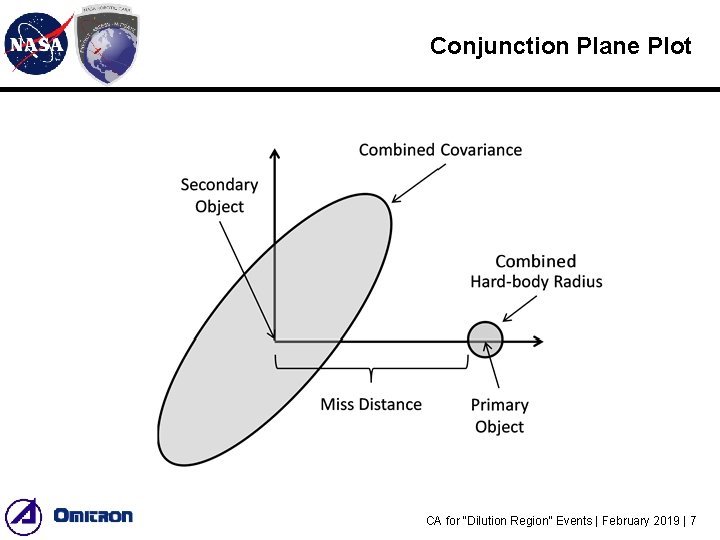
The Probability of Collision (Pc) • Single parameter embraced by broader CA industry to encapsulate collision likelihood – Considers both miss distance between objects at time of closest approach (TCA) and the uncertainty in this calculation – Frames likelihood in form of a probability—easy to combine with other project risks or failure data • 2 -D Pc calculation is the most common computation method – All orbit uncertainty for both objects placed at one end of relative miss vector (combined covariances from primary and secondary objects) – Combined sizes of both objects, modeled as sphere, placed at other end (called the hard-body radius, or HBR) – Recognition that, if a collision will take place it will occur in a plane normal to the relative velocity vector (more complicated argument) • Entire situation can thus be projected into this plane – Pc is the amount of uncertainty probability density that falls into the HBR circle CA for “Dilution Region” Events | February 2019 | 6
Conjunction Plane Plot CA for “Dilution Region” Events | February 2019 | 7
DILUTION REGION DEFINED/ EXPLAINED CA for “Dilution Region” Events | February 2019 | 8
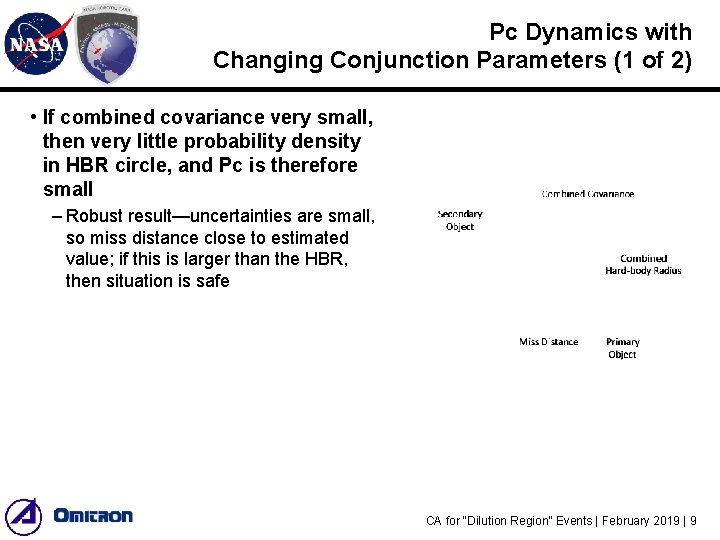
Pc Dynamics with Changing Conjunction Parameters (1 of 2) • If combined covariance very small, then very little probability density in HBR circle, and Pc is therefore small – Robust result—uncertainties are small, so miss distance close to estimated value; if this is larger than the HBR, then situation is safe CA for “Dilution Region” Events | February 2019 | 9
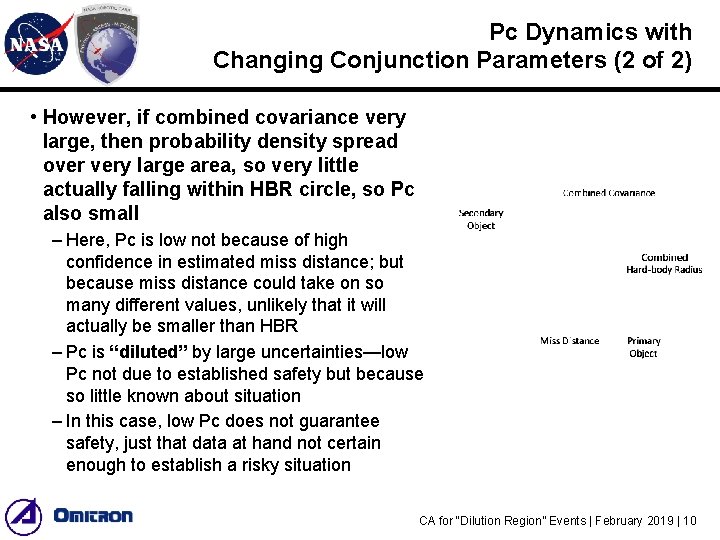
Pc Dynamics with Changing Conjunction Parameters (2 of 2) • However, if combined covariance very large, then probability density spread over very large area, so very little actually falling within HBR circle, so Pc also small – Here, Pc is low not because of high confidence in estimated miss distance; but because miss distance could take on so many different values, unlikely that it will actually be smaller than HBR – Pc is “diluted” by large uncertainties—low Pc not due to established safety but because so little known about situation – In this case, low Pc does not guarantee safety, just that data at hand not certain enough to establish a risky situation CA for “Dilution Region” Events | February 2019 | 10
“Dilution Region” Analogy: Car Proximity in Parking Lot • Two cars parked in large parking lot—are they next to each other? • If known that one car near one side of the lot and the other near the other side, then unlikely that cars parked next to each other • However, if nothing is known about where the two cars are in the lot, then also unlikely that two cars parked next to each other – Not because of any evidence establishing that they are far apart, but only because unlikely than any two cars in a large parking lot will happen to be next to each other – Equivalent to “dilution region” • Latter situation does not promote conclusion that cars not adjacent – If more were know about the cars’ location, one could conclude perhaps easily that they are adjacent CA for “Dilution Region” Events | February 2019 | 11
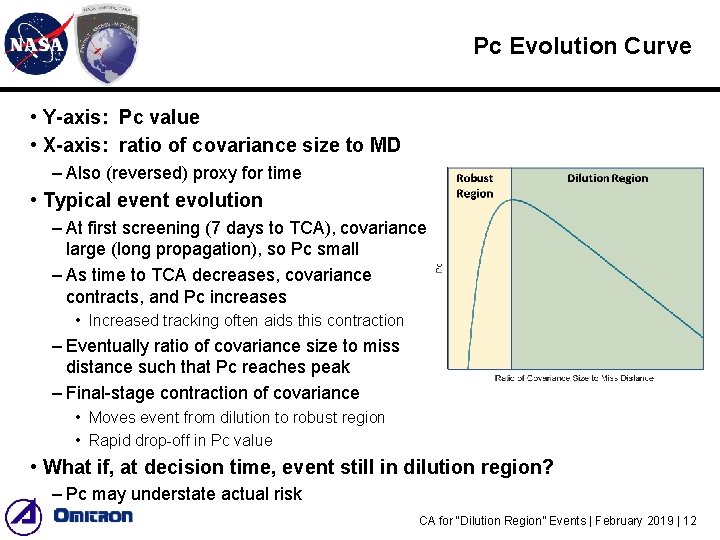
Pc Evolution Curve • Y-axis: Pc value • X-axis: ratio of covariance size to MD – Also (reversed) proxy for time • Typical event evolution – At first screening (7 days to TCA), covariance large (long propagation), so Pc small – As time to TCA decreases, covariance contracts, and Pc increases • Increased tracking often aids this contraction – Eventually ratio of covariance size to miss distance such that Pc reaches peak – Final-stage contraction of covariance • Moves event from dilution to robust region • Rapid drop-off in Pc value • What if, at decision time, event still in dilution region? – Pc may understate actual risk CA for “Dilution Region” Events | February 2019 | 12
CA RISK ASSESSMENT AS STATISTICS PROBLEM CA for “Dilution Region” Events | February 2019 | 13
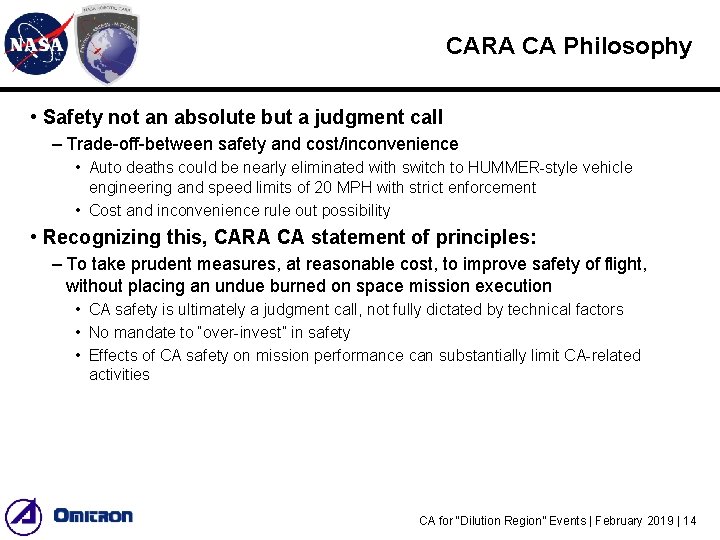
CARA CA Philosophy • Safety not an absolute but a judgment call – Trade-off-between safety and cost/inconvenience • Auto deaths could be nearly eliminated with switch to HUMMER-style vehicle engineering and speed limits of 20 MPH with strict enforcement • Cost and inconvenience rule out possibility • Recognizing this, CARA CA statement of principles: – To take prudent measures, at reasonable cost, to improve safety of flight, without placing an undue burned on space mission execution • CA safety is ultimately a judgment call, not fully dictated by technical factors • No mandate to “over-invest” in safety • Effects of CA safety on mission performance can substantially limit CA-related activities CA for “Dilution Region” Events | February 2019 | 14
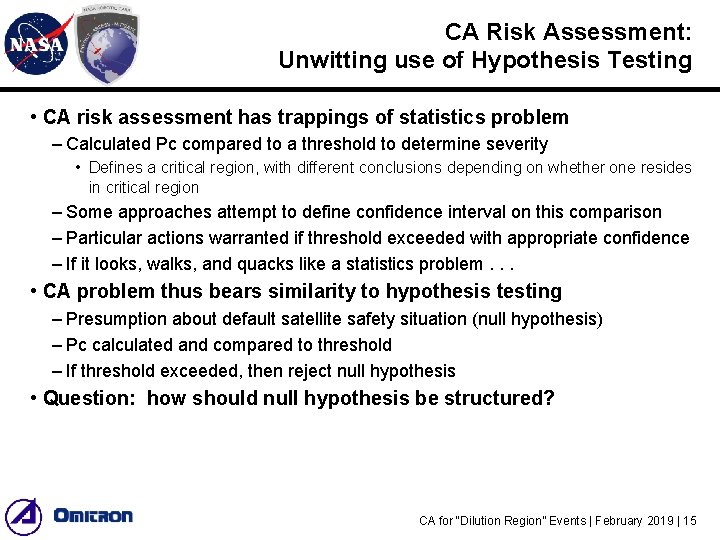
CA Risk Assessment: Unwitting use of Hypothesis Testing • CA risk assessment has trappings of statistics problem – Calculated Pc compared to a threshold to determine severity • Defines a critical region, with different conclusions depending on whether one resides in critical region – Some approaches attempt to define confidence interval on this comparison – Particular actions warranted if threshold exceeded with appropriate confidence – If it looks, walks, and quacks like a statistics problem. . . • CA problem thus bears similarity to hypothesis testing – Presumption about default satellite safety situation (null hypothesis) – Pc calculated and compared to threshold – If threshold exceeded, then reject null hypothesis • Question: how should null hypothesis be structured? CA for “Dilution Region” Events | February 2019 | 15
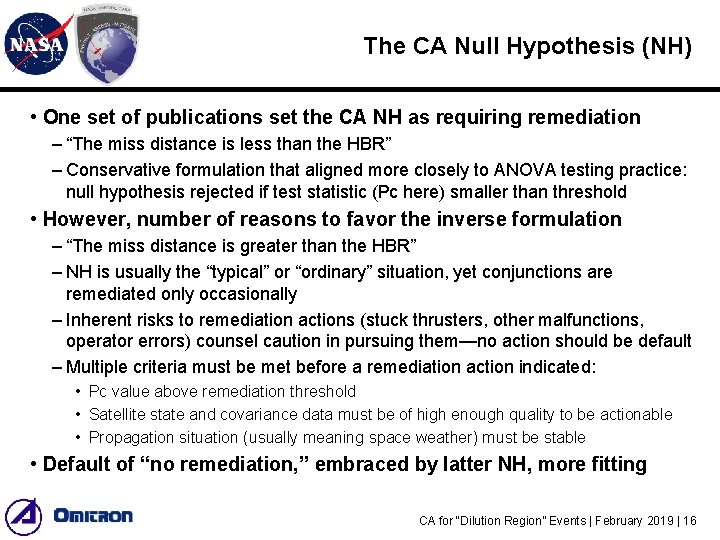
The CA Null Hypothesis (NH) • One set of publications set the CA NH as requiring remediation – “The miss distance is less than the HBR” – Conservative formulation that aligned more closely to ANOVA testing practice: null hypothesis rejected if test statistic (Pc here) smaller than threshold • However, number of reasons to favor the inverse formulation – “The miss distance is greater than the HBR” – NH is usually the “typical” or “ordinary” situation, yet conjunctions are remediated only occasionally – Inherent risks to remediation actions (stuck thrusters, other malfunctions, operator errors) counsel caution in pursuing them—no action should be default – Multiple criteria must be met before a remediation action indicated: • Pc value above remediation threshold • Satellite state and covariance data must be of high enough quality to be actionable • Propagation situation (usually meaning space weather) must be stable • Default of “no remediation, ” embraced by latter NH, more fitting CA for “Dilution Region” Events | February 2019 | 16
RISK ASSESSMENT IN DILUTION REGION CA for “Dilution Region” Events | February 2019 | 17
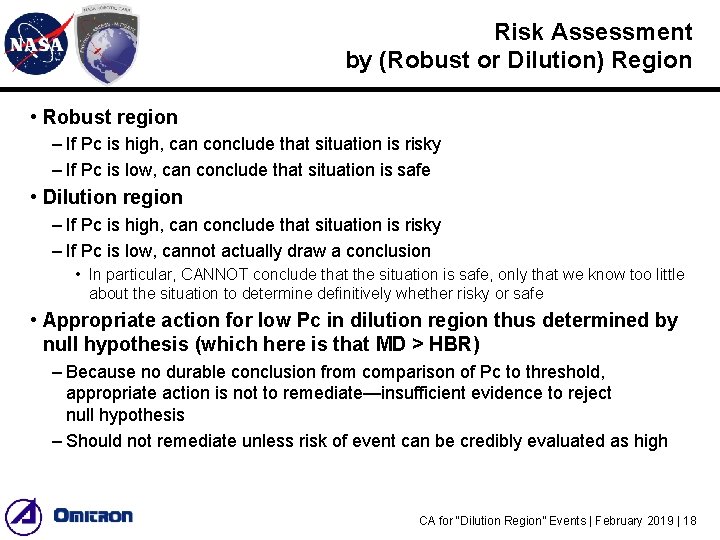
Risk Assessment by (Robust or Dilution) Region • Robust region – If Pc is high, can conclude that situation is risky – If Pc is low, can conclude that situation is safe • Dilution region – If Pc is high, can conclude that situation is risky – If Pc is low, cannot actually draw a conclusion • In particular, CANNOT conclude that the situation is safe, only that we know too little about the situation to determine definitively whether risky or safe • Appropriate action for low Pc in dilution region thus determined by null hypothesis (which here is that MD > HBR) – Because no durable conclusion from comparison of Pc to threshold, appropriate action is not to remediate—insufficient evidence to reject null hypothesis – Should not remediate unless risk of event can be credibly evaluated as high CA for “Dilution Region” Events | February 2019 | 18
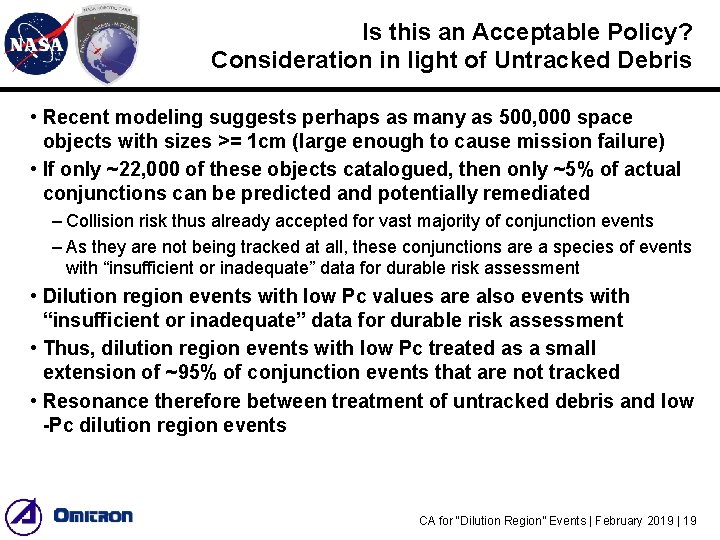
Is this an Acceptable Policy? Consideration in light of Untracked Debris • Recent modeling suggests perhaps as many as 500, 000 space objects with sizes >= 1 cm (large enough to cause mission failure) • If only ~22, 000 of these objects catalogued, then only ~5% of actual conjunctions can be predicted and potentially remediated – Collision risk thus already accepted for vast majority of conjunction events – As they are not being tracked at all, these conjunctions are a species of events with “insufficient or inadequate” data for durable risk assessment • Dilution region events with low Pc values are also events with “insufficient or inadequate” data for durable risk assessment • Thus, dilution region events with low Pc treated as a small extension of ~95% of conjunction events that are not tracked • Resonance therefore between treatment of untracked debris and low -Pc dilution region events CA for “Dilution Region” Events | February 2019 | 19
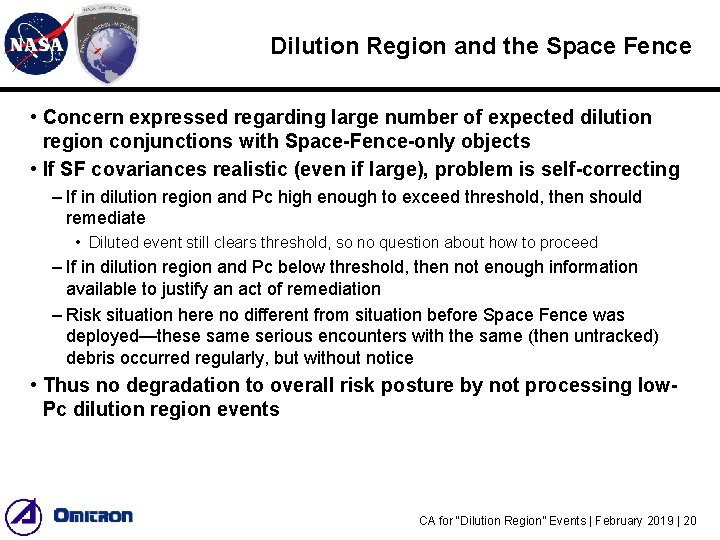
Dilution Region and the Space Fence • Concern expressed regarding large number of expected dilution region conjunctions with Space-Fence-only objects • If SF covariances realistic (even if large), problem is self-correcting – If in dilution region and Pc high enough to exceed threshold, then should remediate • Diluted event still clears threshold, so no question about how to proceed – If in dilution region and Pc below threshold, then not enough information available to justify an act of remediation – Risk situation here no different from situation before Space Fence was deployed—these same serious encounters with the same (then untracked) debris occurred regularly, but without notice • Thus no degradation to overall risk posture by not processing low. Pc dilution region events CA for “Dilution Region” Events | February 2019 | 20
DILUTION REGION SAFETY PROPOSALS CA for “Dilution Region” Events | February 2019 | 21
Maximum Collision Probability • Technique originally constructed by S. Alfano (2005) to address issue of Probability Dilution – If in non-dilution region, use covariances as submitted – If in dilution region • • Freeze miss distance Contract secondary (or joint) covariance incrementally, maintaining aspect ratio Find maximum Pc value (peak of Mahalanobis distance curve) and use this value If this value above threshold, consider remediation action • Essentially moves along Pc curve by varying covariance for given miss distance until maximum Pc found for covariance smaller than or equal to nominal size – Presumption is that more data would produce a smaller covariance, moving to the max value of Pc CA for “Dilution Region” Events | February 2019 | 22
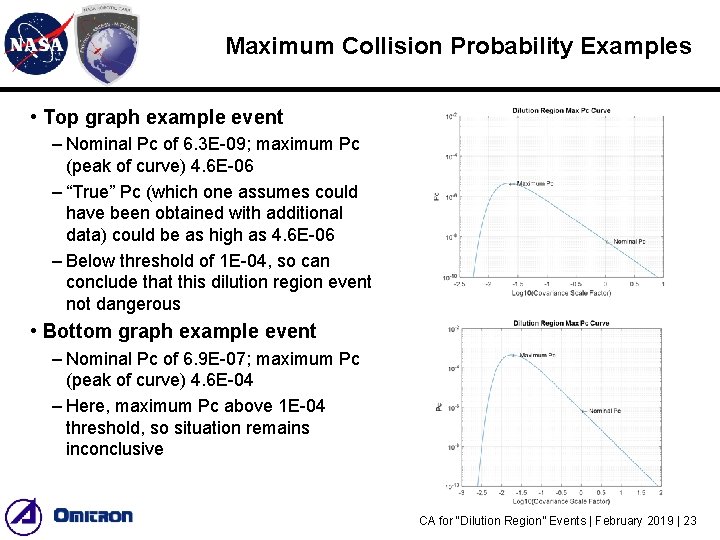
Maximum Collision Probability Examples • Top graph example event – Nominal Pc of 6. 3 E-09; maximum Pc (peak of curve) 4. 6 E-06 – “True” Pc (which one assumes could have been obtained with additional data) could be as high as 4. 6 E-06 – Below threshold of 1 E-04, so can conclude that this dilution region event not dangerous • Bottom graph example event – Nominal Pc of 6. 9 E-07; maximum Pc (peak of curve) 4. 6 E-04 – Here, maximum Pc above 1 E-04 threshold, so situation remains inconclusive CA for “Dilution Region” Events | February 2019 | 23
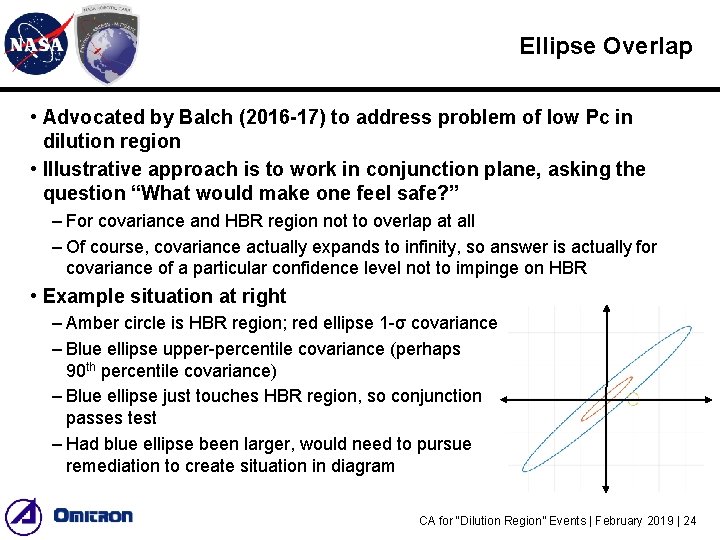
Ellipse Overlap • Advocated by Balch (2016 -17) to address problem of low Pc in dilution region • Illustrative approach is to work in conjunction plane, asking the question “What would make one feel safe? ” – For covariance and HBR region not to overlap at all – Of course, covariance actually expands to infinity, so answer is actually for covariance of a particular confidence level not to impinge on HBR • Example situation at right – Amber circle is HBR region; red ellipse 1 -σ covariance – Blue ellipse upper-percentile covariance (perhaps 90 th percentile covariance) – Blue ellipse just touches HBR region, so conjunction passes test – Had blue ellipse been larger, would need to pursue remediation to create situation in diagram CA for “Dilution Region” Events | February 2019 | 24
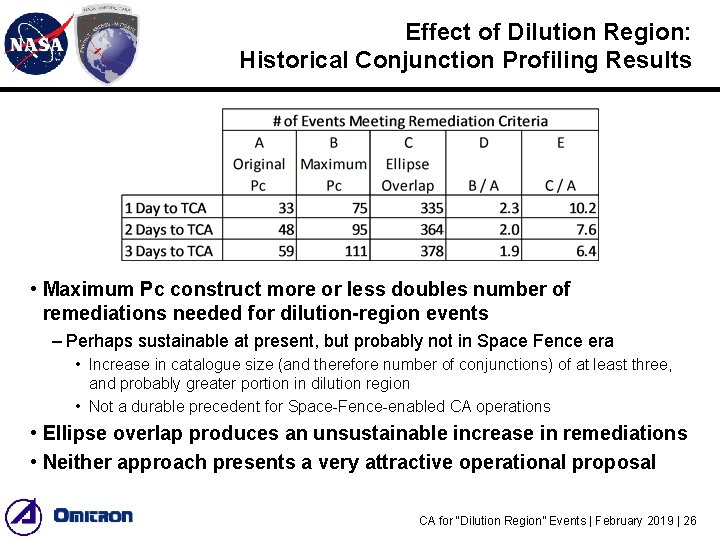
Effect of Dilution Region Safety Approaches: Historical Conjunction Profiling • Profiled CARA conjunction database for protected assets in nearcircular, 700 km orbit (12 satellites; 2017 -18 conjunction data) • Each unique event examined at 3, 2, and 1 days to TCA (represents three typical “remediation action commitment times”) – Examined only events in dilution region at each such time • Number of “remediation” events determined, based on three different criteria: – Nominal Pc > 1 E-04 at remediation action commitment time – Maximum Pc > 1 E-04 at remediation action commitment time – 90 th percentile joint covariance impinging on HBR region • Comparative counts and ratios generated CA for “Dilution Region” Events | February 2019 | 25
Effect of Dilution Region: Historical Conjunction Profiling Results • Maximum Pc construct more or less doubles number of remediations needed for dilution-region events – Perhaps sustainable at present, but probably not in Space Fence era • Increase in catalogue size (and therefore number of conjunctions) of at least three, and probably greater portion in dilution region • Not a durable precedent for Space-Fence-enabled CA operations • Ellipse overlap produces an unsustainable increase in remediations • Neither approach presents a very attractive operational proposal CA for “Dilution Region” Events | February 2019 | 26
Conclusions • Dilution region events with low Pc pose a problem for CA, as they do not allow a clear conclusion of a risky or safe conjunction • However, setting the risk assessment null hypothesis in favor of no remediation action allows such events to be handled reasonably – “Prudent measures, at reasonable cost, without an undue burden to operations” argues for a balanced and measured approach to space safety – “Typical” situation of no remediation favored in absence of compelling evidence – Low-Pc, dilution region events grouped with the assumed risk of the ~95% of untrackable conjunctions that are sustained daily in operations • Additional safety measures exist for dilution region events, but profiling analysis indicates they will be operationally burdensome • Reasonable guidance is, for remediation suitability, to treat low-Pc dilution region events in the same manner as all other CA events CA for “Dilution Region” Events | February 2019 | 27