
Conjugate gradients sparse matrixvector multiplication graphs and meshes
- Slides: 44
Conjugate gradients, sparse matrix-vector multiplication, graphs, and meshes Thanks to Aydin Buluc, Umit Catalyurek, Alan Edelman, and Kathy Yelick for some of these slides.
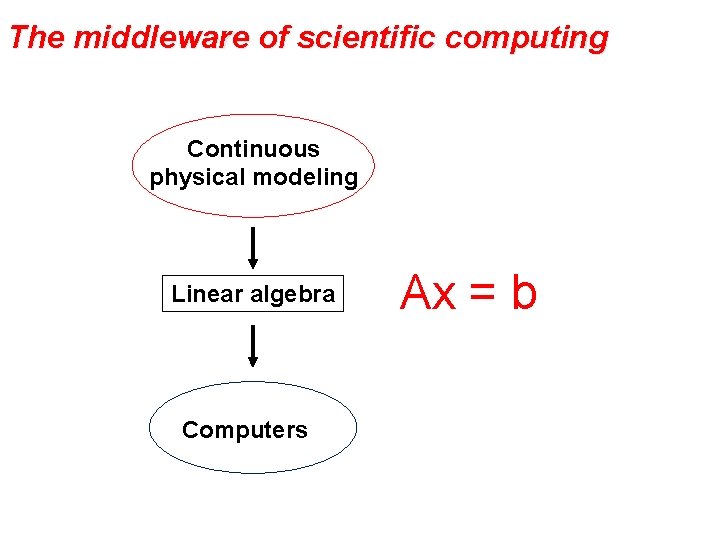
The middleware of scientific computing Continuous physical modeling Linear algebra Computers Ax = b
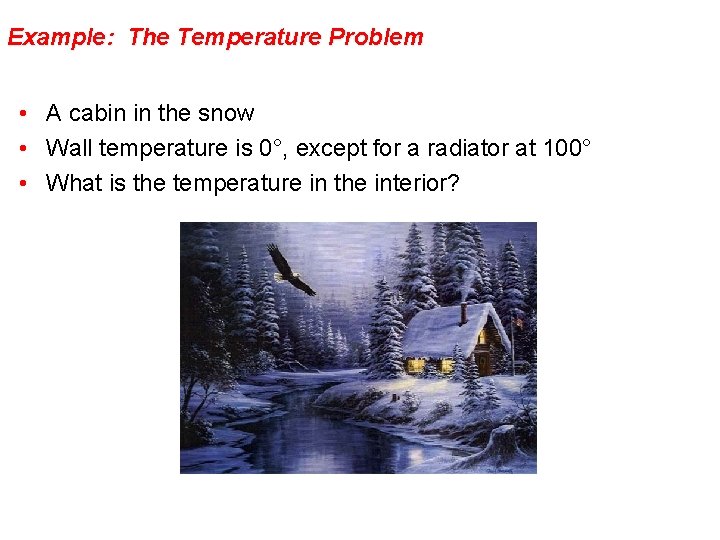
Example: The Temperature Problem • A cabin in the snow • Wall temperature is 0°, except for a radiator at 100° • What is the temperature in the interior?
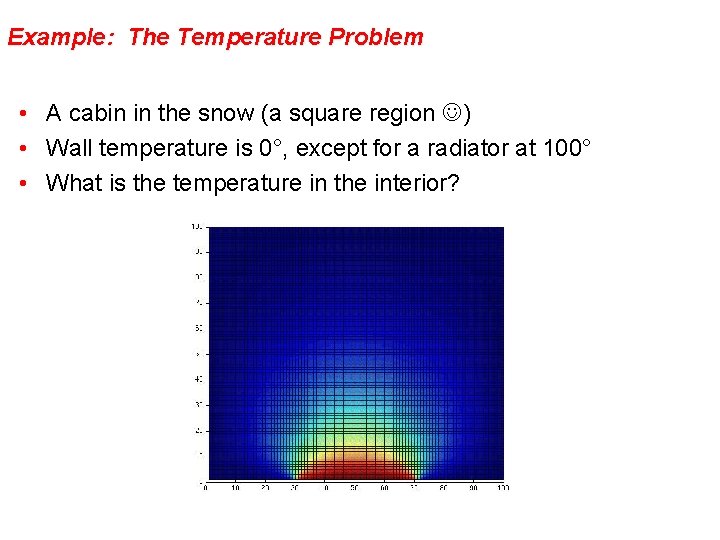
Example: The Temperature Problem • A cabin in the snow (a square region ) • Wall temperature is 0°, except for a radiator at 100° • What is the temperature in the interior?
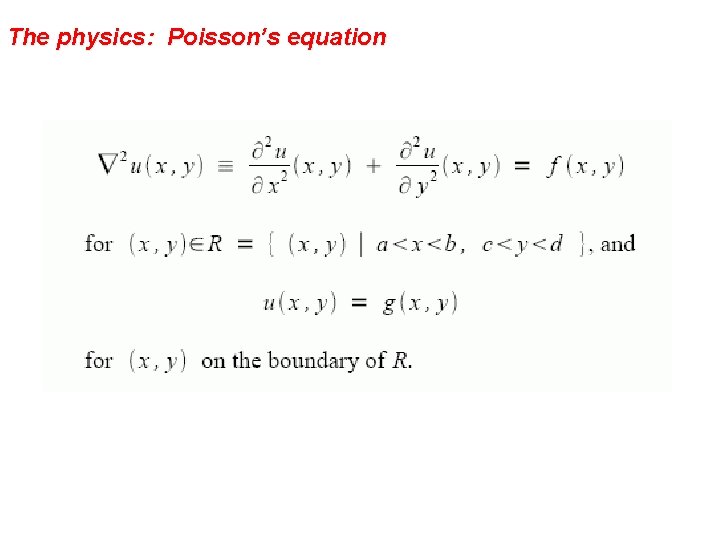
The physics: Poisson’s equation
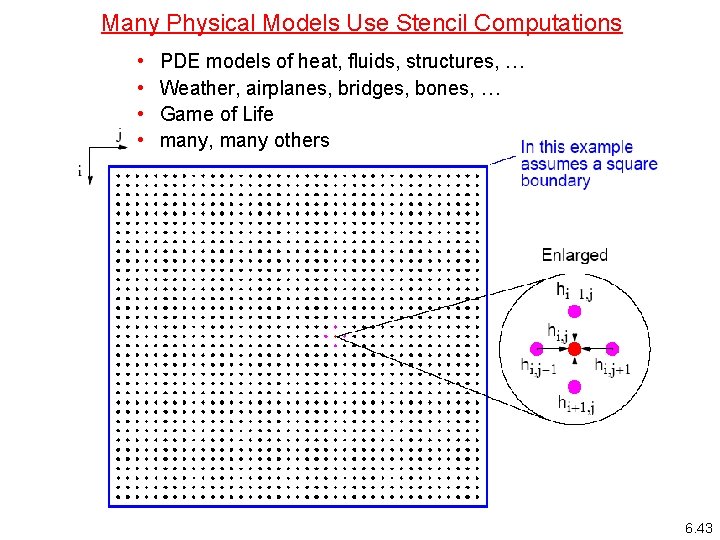
Many Physical Models Use Stencil Computations • • PDE models of heat, fluids, structures, … Weather, airplanes, bridges, bones, … Game of Life many, many others 6. 43
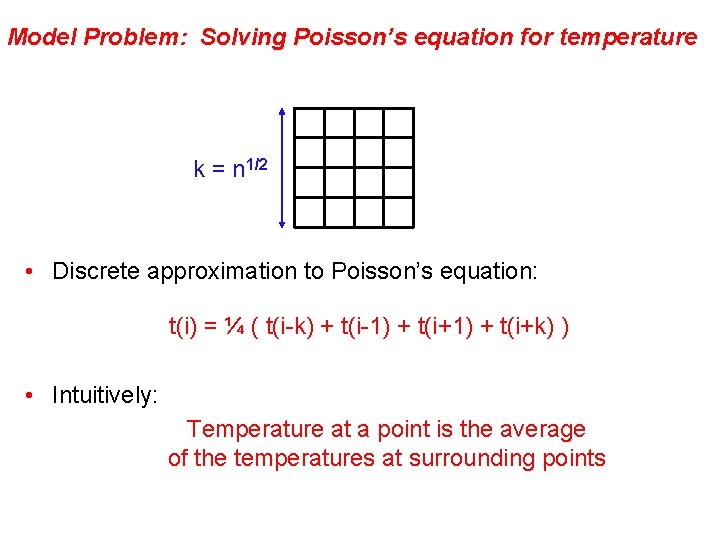
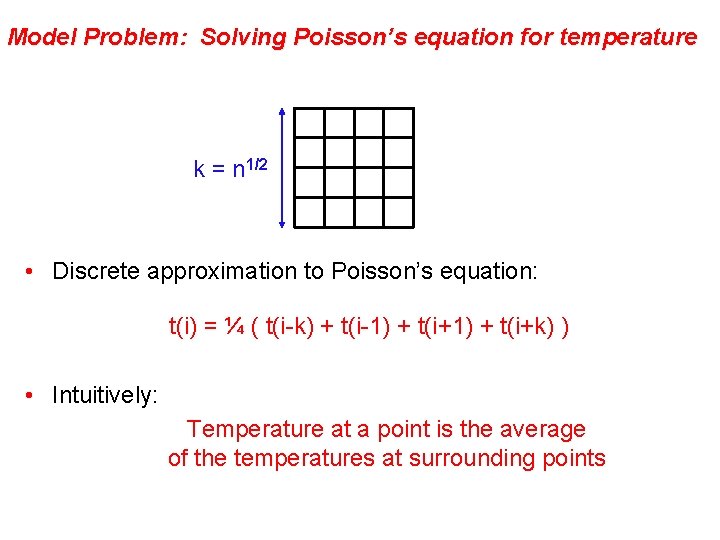
Model Problem: Solving Poisson’s equation for temperature k = n 1/2 • Discrete approximation to Poisson’s equation: t(i) = ¼ ( t(i-k) + t(i-1) + t(i+k) ) • Intuitively: Temperature at a point is the average of the temperatures at surrounding points
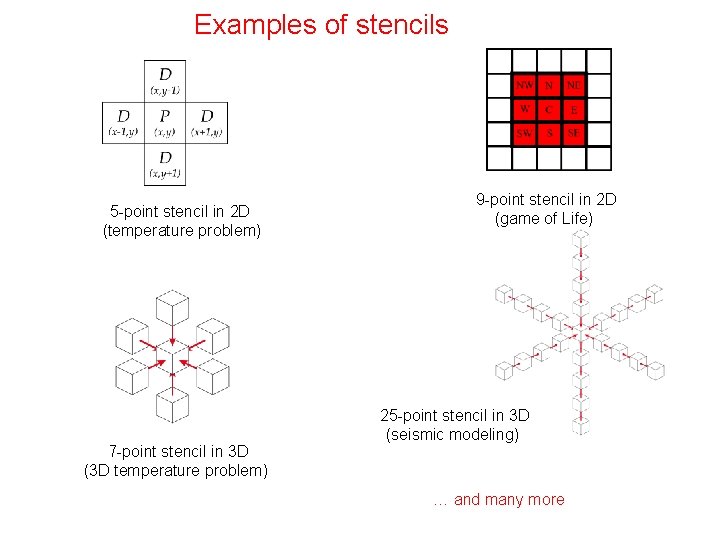
Examples of stencils 5 -point stencil in 2 D (temperature problem) 7 -point stencil in 3 D (3 D temperature problem) 9 -point stencil in 2 D (game of Life) 25 -point stencil in 3 D (seismic modeling) … and many more
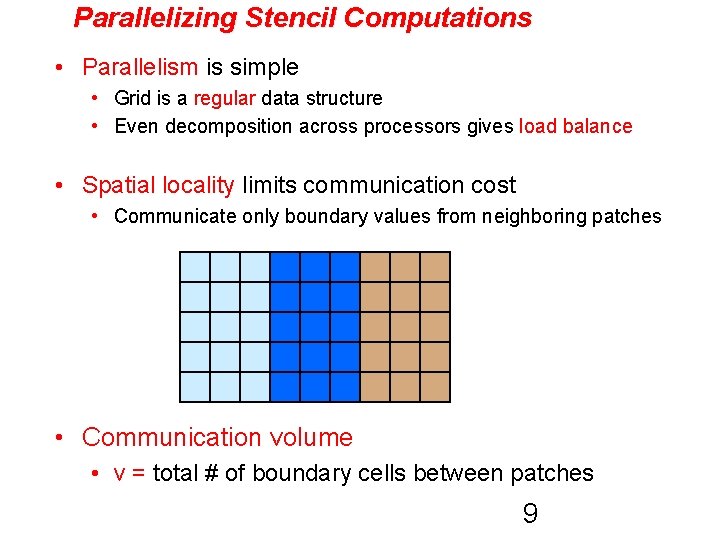
Parallelizing Stencil Computations • Parallelism is simple • Grid is a regular data structure • Even decomposition across processors gives load balance • Spatial locality limits communication cost • Communicate only boundary values from neighboring patches • Communication volume • v = total # of boundary cells between patches 9
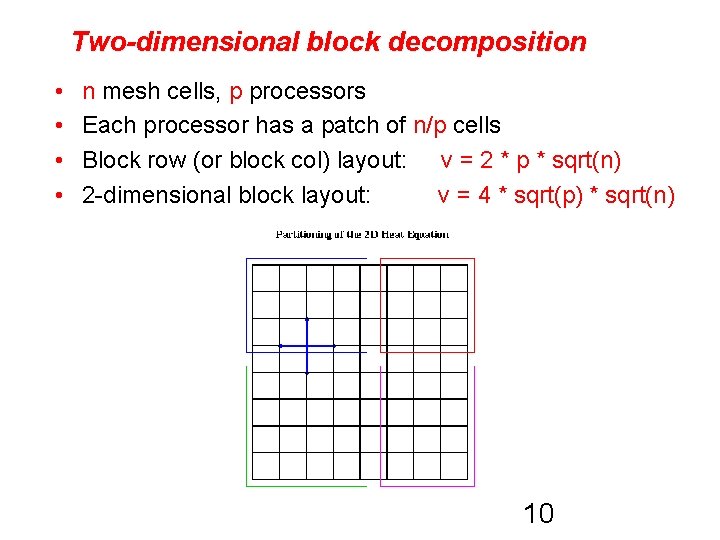
Two-dimensional block decomposition • • n mesh cells, p processors Each processor has a patch of n/p cells Block row (or block col) layout: v = 2 * p * sqrt(n) 2 -dimensional block layout: v = 4 * sqrt(p) * sqrt(n) 10
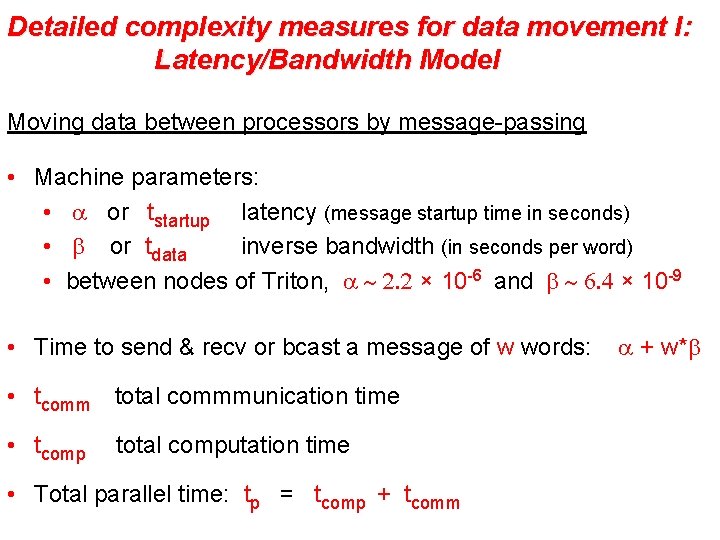
Detailed complexity measures for data movement I: Latency/Bandwidth Model Moving data between processors by message-passing • Machine parameters: • a or tstartup latency (message startup time in seconds) • b or tdata inverse bandwidth (in seconds per word) • between nodes of Triton, a ~ 2. 2 × 10 -6 and b ~ 6. 4 × 10 -9 • Time to send & recv or bcast a message of w words: • tcomm total commmunication time • tcomp total computation time • Total parallel time: tp = tcomp + tcomm a + w*b
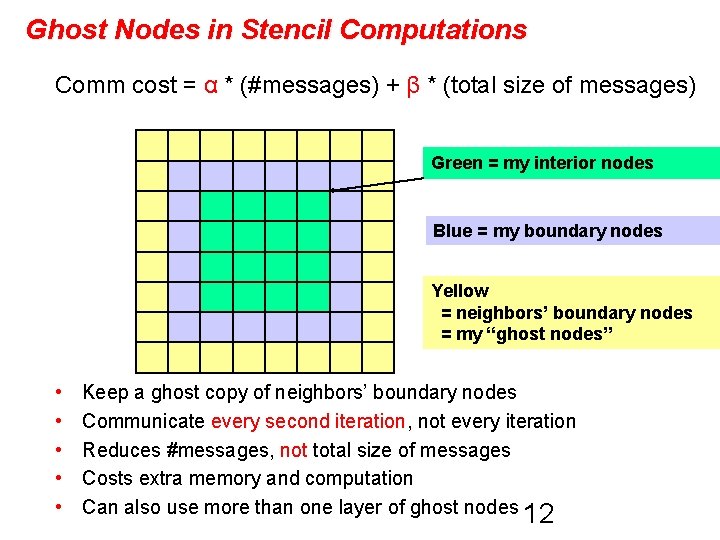
Ghost Nodes in Stencil Computations Comm cost = α * (#messages) + β * (total size of messages) Green = my interior nodes Blue = my boundary nodes Yellow = neighbors’ boundary nodes = my “ghost nodes” • • • Keep a ghost copy of neighbors’ boundary nodes Communicate every second iteration, not every iteration Reduces #messages, not total size of messages Costs extra memory and computation Can also use more than one layer of ghost nodes 12
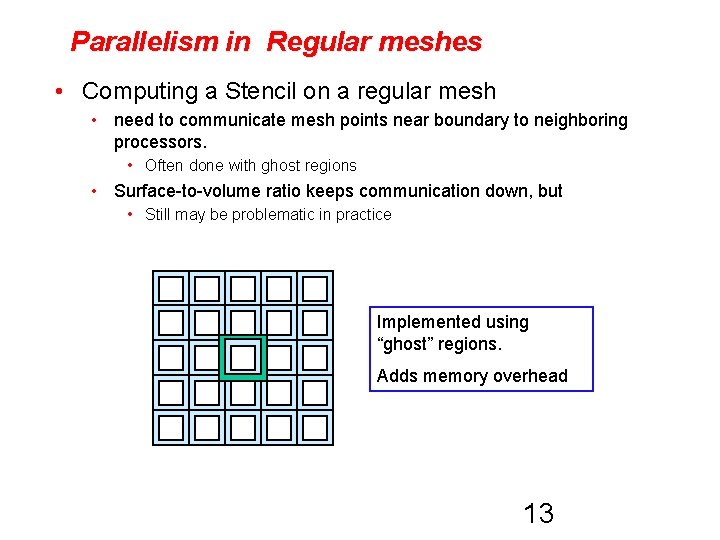
Parallelism in Regular meshes • Computing a Stencil on a regular mesh • need to communicate mesh points near boundary to neighboring processors. • Often done with ghost regions • Surface-to-volume ratio keeps communication down, but • Still may be problematic in practice Implemented using “ghost” regions. Adds memory overhead 13
Model Problem: Solving Poisson’s equation for temperature k = n 1/2 • Discrete approximation to Poisson’s equation: t(i) = ¼ ( t(i-k) + t(i-1) + t(i+k) ) • Intuitively: Temperature at a point is the average of the temperatures at surrounding points
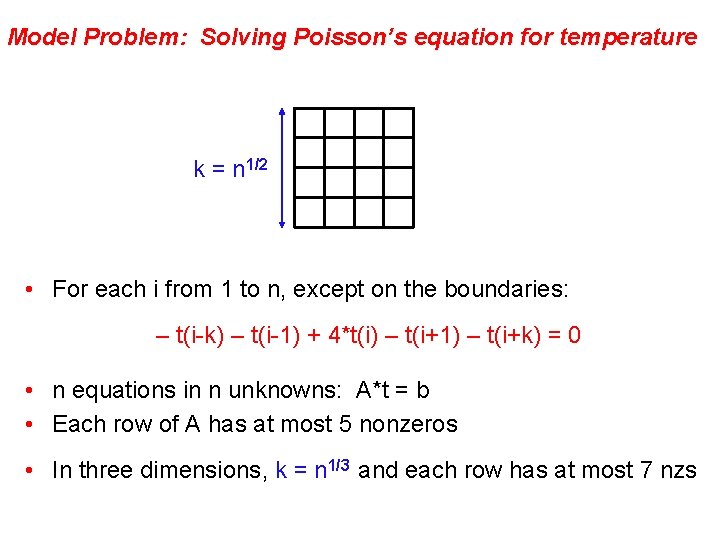
Model Problem: Solving Poisson’s equation for temperature k = n 1/2 • For each i from 1 to n, except on the boundaries: – t(i-k) – t(i-1) + 4*t(i) – t(i+1) – t(i+k) = 0 • n equations in n unknowns: A*t = b • Each row of A has at most 5 nonzeros • In three dimensions, k = n 1/3 and each row has at most 7 nzs
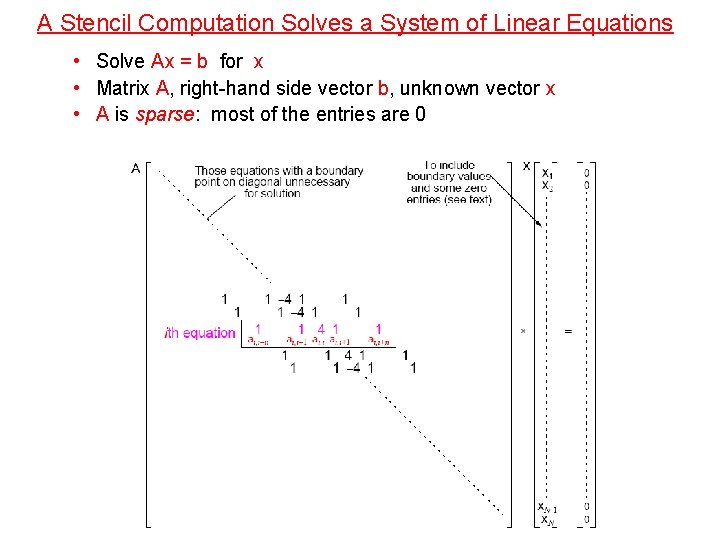
A Stencil Computation Solves a System of Linear Equations • Solve Ax = b for x • Matrix A, right-hand side vector b, unknown vector x • A is sparse: most of the entries are 0
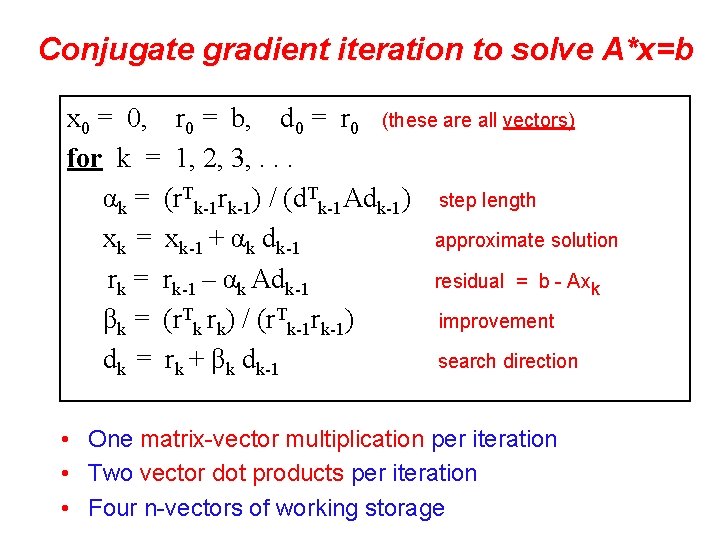
Conjugate gradient iteration to solve A*x=b x 0 = 0, r 0 = b, d 0 = r 0 (these are all vectors) for k = 1, 2, 3, . . . αk = (r. Tk-1 rk-1) / (d. Tk-1 Adk-1) step length xk = xk-1 + αk dk-1 approximate solution rk = rk-1 – αk Adk-1 residual = b - Axk βk = (r. Tk rk) / (r. Tk-1 rk-1) improvement dk = rk + βk dk-1 search direction • One matrix-vector multiplication per iteration • Two vector dot products per iteration • Four n-vectors of working storage
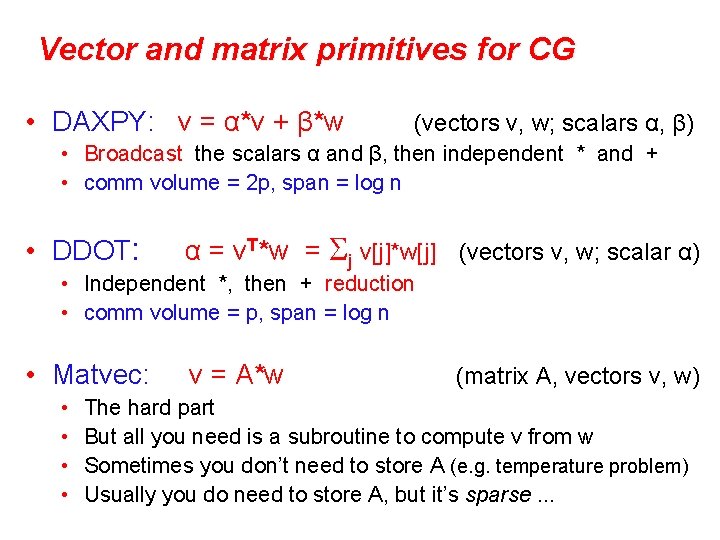
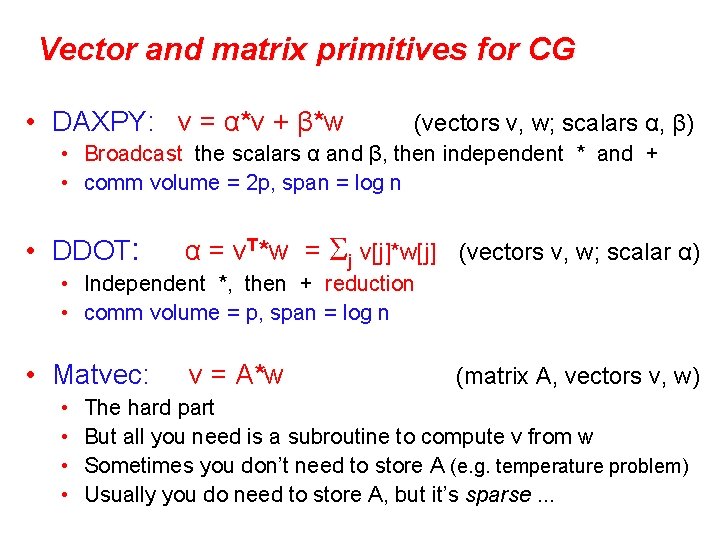
Vector and matrix primitives for CG • DAXPY: v = α*v + β*w (vectors v, w; scalars α, β) • Broadcast the scalars α and β, then independent * and + • comm volume = 2 p, span = log n • DDOT: α = v. T*w = Sj v[j]*w[j] (vectors v, w; scalar α) • Independent *, then + reduction • comm volume = p, span = log n • Matvec: • • v = A*w (matrix A, vectors v, w) The hard part But all you need is a subroutine to compute v from w Sometimes you don’t need to store A (e. g. temperature problem) Usually you do need to store A, but it’s sparse. . .
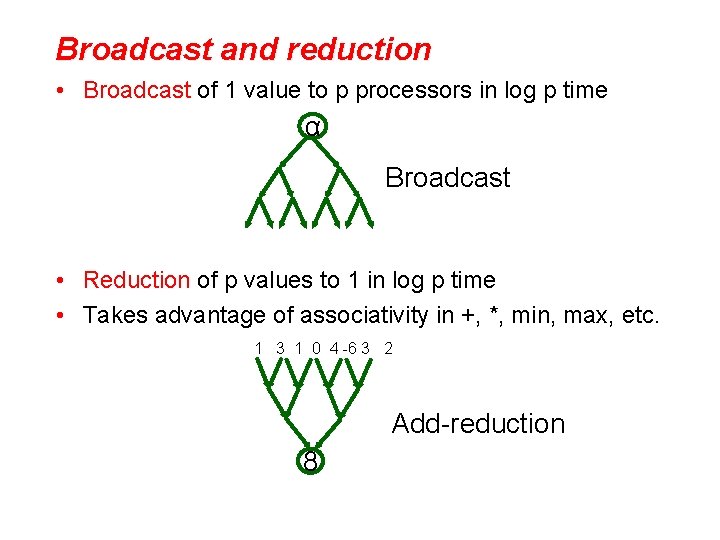
Broadcast and reduction • Broadcast of 1 value to p processors in log p time α Broadcast • Reduction of p values to 1 in log p time • Takes advantage of associativity in +, *, min, max, etc. 1 3 1 0 4 -6 3 2 Add-reduction 8
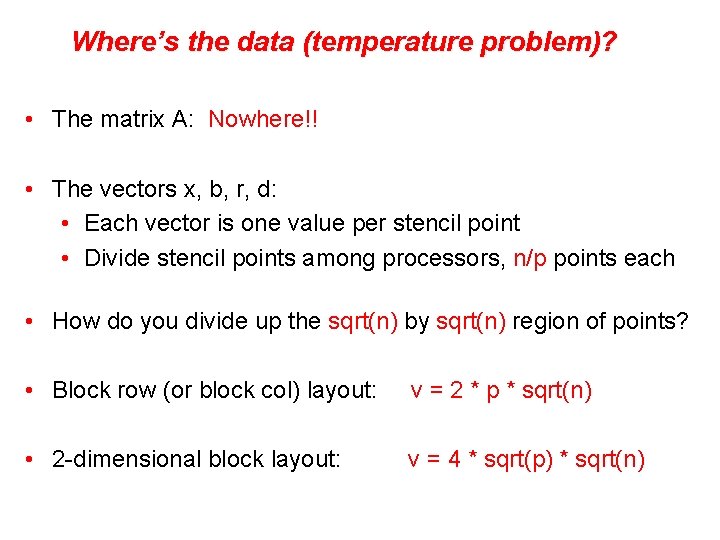
Where’s the data (temperature problem)? • The matrix A: Nowhere!! • The vectors x, b, r, d: • Each vector is one value per stencil point • Divide stencil points among processors, n/p points each • How do you divide up the sqrt(n) by sqrt(n) region of points? • Block row (or block col) layout: v = 2 * p * sqrt(n) • 2 -dimensional block layout: v = 4 * sqrt(p) * sqrt(n)
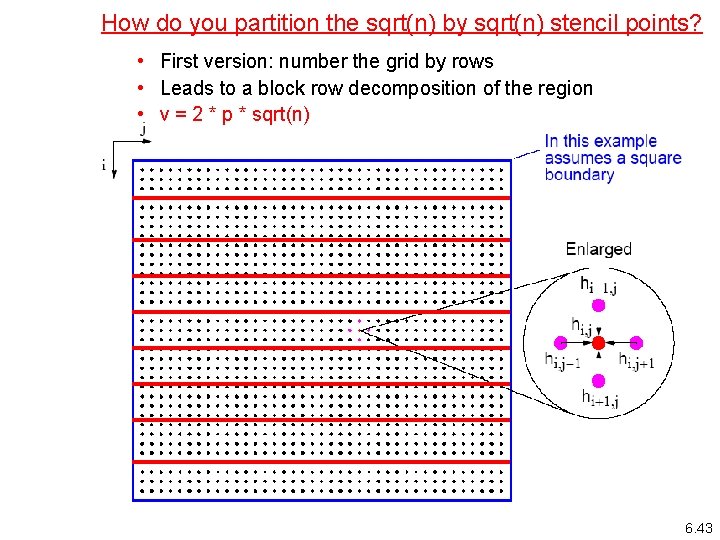
How do you partition the sqrt(n) by sqrt(n) stencil points? • First version: number the grid by rows • Leads to a block row decomposition of the region • v = 2 * p * sqrt(n) 6. 43
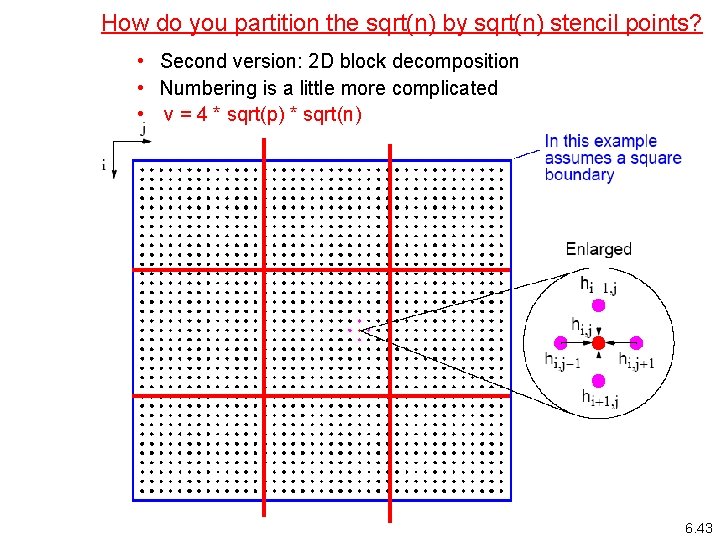
How do you partition the sqrt(n) by sqrt(n) stencil points? • Second version: 2 D block decomposition • Numbering is a little more complicated • v = 4 * sqrt(p) * sqrt(n) 6. 43
Where’s the data (temperature problem)? • The matrix A: Nowhere!! • The vectors x, b, r, d: • Each vector is one value per stencil point • Divide stencil points among processors, n/p points each • How do you divide up the sqrt(n) by sqrt(n) region of points? • Block row (or block col) layout: v = 2 * p * sqrt(n) • 2 -dimensional block layout: v = 4 * sqrt(p) * sqrt(n)
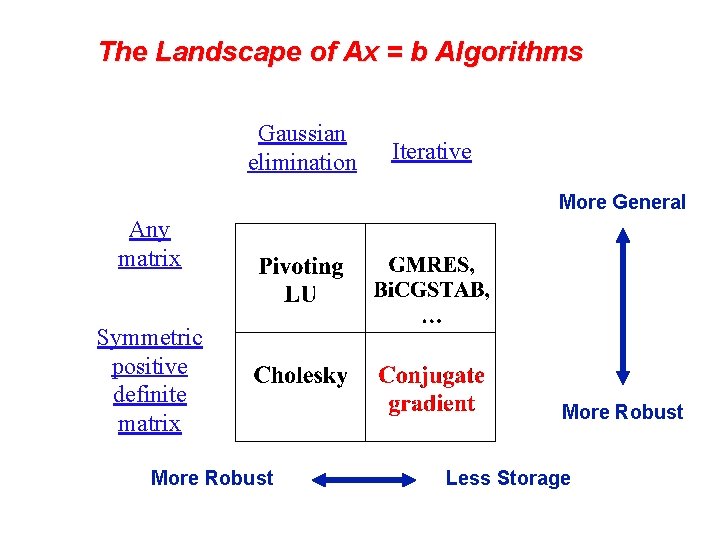
The Landscape of Ax = b Algorithms Gaussian elimination Iterative More General Any matrix Symmetric positive definite matrix More Robust Less Storage
Conjugate gradient in general • CG can be used to solve any system Ax = b, if …
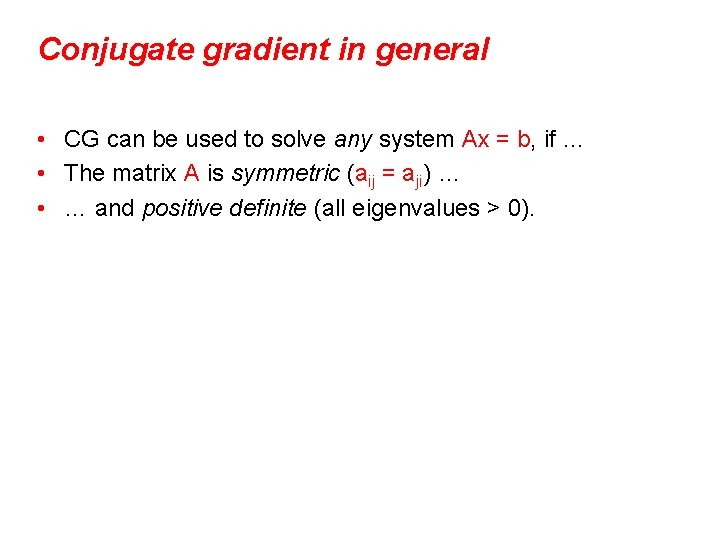
Conjugate gradient in general • CG can be used to solve any system Ax = b, if … • The matrix A is symmetric (aij = aji) … • … and positive definite (all eigenvalues > 0).
Conjugate gradient in general • CG can be used to solve any system Ax = b, if … • The matrix A is symmetric (aij = aji) … • … and positive definite (all eigenvalues > 0). • Symmetric positive definite matrices occur a lot in scientific computing & data analysis!
Conjugate gradient in general • CG can be used to solve any system Ax = b, if … • The matrix A is symmetric (aij = aji) … • … and positive definite (all eigenvalues > 0). • Symmetric positive definite matrices occur a lot in scientific computing & data analysis! • But usually the matrix isn’t just a stencil. • Now we do need to store the matrix A. Where’s the data?
Conjugate gradient in general • CG can be used to solve any system Ax = b, if … • The matrix A is symmetric (aij = aji) … • … and positive definite (all eigenvalues > 0). • Symmetric positive definite matrices occur a lot in scientific computing & data analysis! • But usually the matrix isn’t just a stencil. • Now we do need to store the matrix A. Where’s the data? • The key is to use graph data structures and algorithms.
Vector and matrix primitives for CG • DAXPY: v = α*v + β*w (vectors v, w; scalars α, β) • Broadcast the scalars α and β, then independent * and + • comm volume = 2 p, span = log n • DDOT: α = v. T*w = Sj v[j]*w[j] (vectors v, w; scalar α) • Independent *, then + reduction • comm volume = p, span = log n • Matvec: • • v = A*w (matrix A, vectors v, w) The hard part But all you need is a subroutine to compute v from w Sometimes you don’t need to store A (e. g. temperature problem) Usually you do need to store A, but it’s sparse. . .
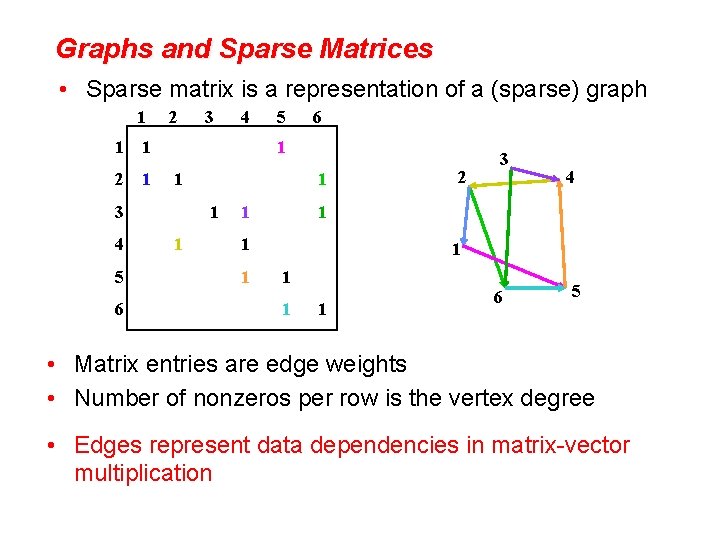
Graphs and Sparse Matrices • Sparse matrix is a representation of a (sparse) graph 1 1 2 6 5 6 1 1 3 5 4 1 2 1 4 3 1 1 4 1 1 1 2 3 1 1 6 5 • Matrix entries are edge weights • Number of nonzeros per row is the vertex degree • Edges represent data dependencies in matrix-vector multiplication
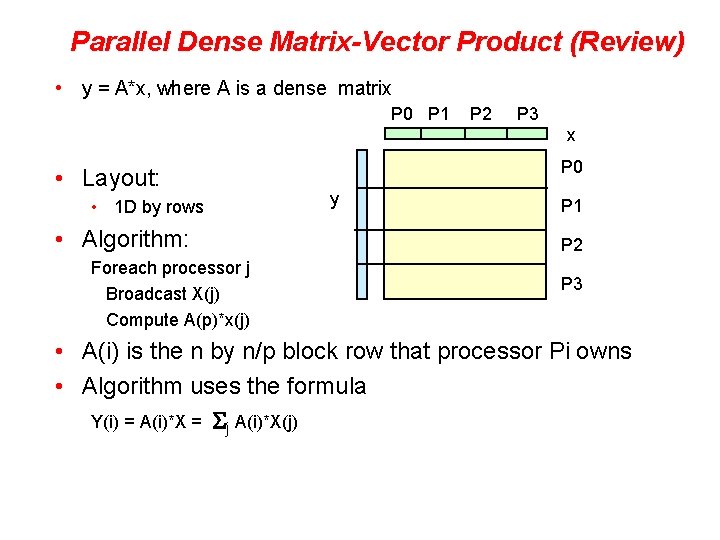
Parallel Dense Matrix-Vector Product (Review) • y = A*x, where A is a dense matrix P 0 P 1 P 2 P 3 x • Layout: • 1 D by rows • Algorithm: Foreach processor j Broadcast X(j) Compute A(p)*x(j) P 0 y P 1 P 2 P 3 • A(i) is the n by n/p block row that processor Pi owns • Algorithm uses the formula Y(i) = A(i)*X = Sj A(i)*X(j)
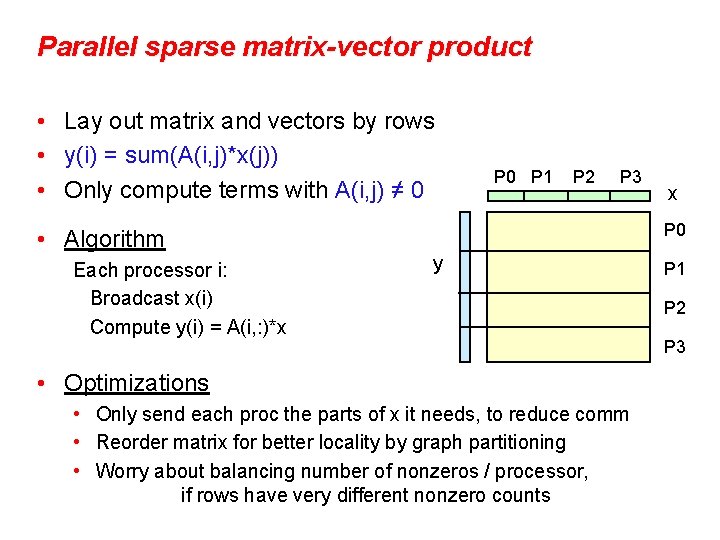
Parallel sparse matrix-vector product • Lay out matrix and vectors by rows • y(i) = sum(A(i, j)*x(j)) • Only compute terms with A(i, j) ≠ 0 • Algorithm Each processor i: Broadcast x(i) Compute y(i) = A(i, : )*x P 0 P 1 P 2 P 3 x P 0 y • Optimizations • Only send each proc the parts of x it needs, to reduce comm • Reorder matrix for better locality by graph partitioning • Worry about balancing number of nonzeros / processor, if rows have very different nonzero counts P 1 P 2 P 3
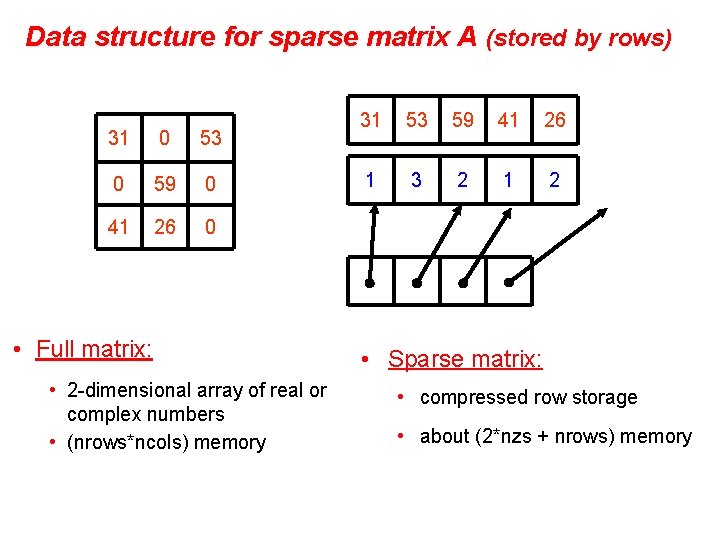
Data structure for sparse matrix A (stored by rows) 31 0 53 0 59 0 41 26 0 • Full matrix: • 2 -dimensional array of real or complex numbers • (nrows*ncols) memory 31 53 59 41 26 1 3 2 1 2 • Sparse matrix: • compressed row storage • about (2*nzs + nrows) memory
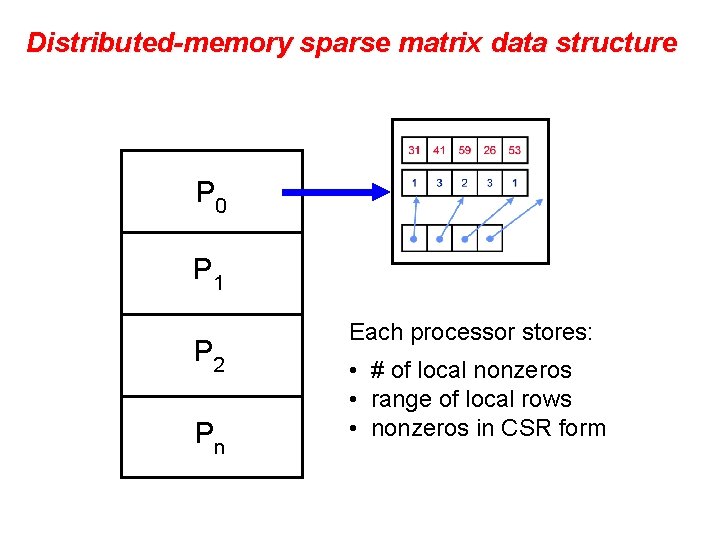
Distributed-memory sparse matrix data structure P 0 P 1 P 2 Pn Each processor stores: • # of local nonzeros • range of local rows • nonzeros in CSR form
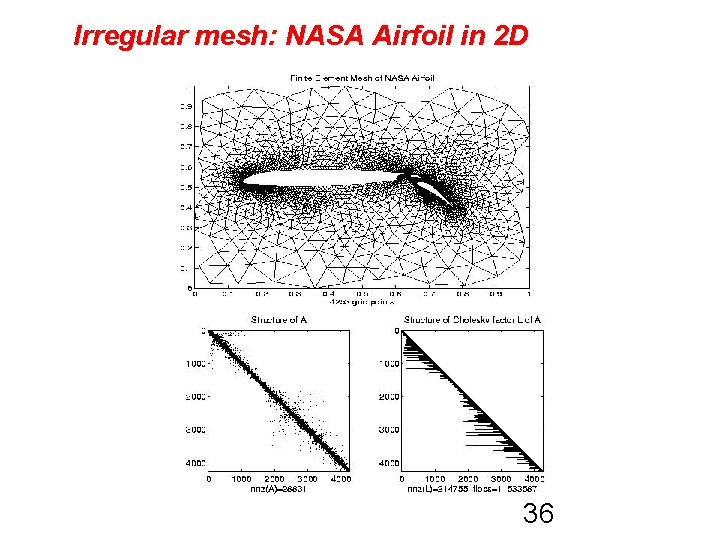
Irregular mesh: NASA Airfoil in 2 D 36
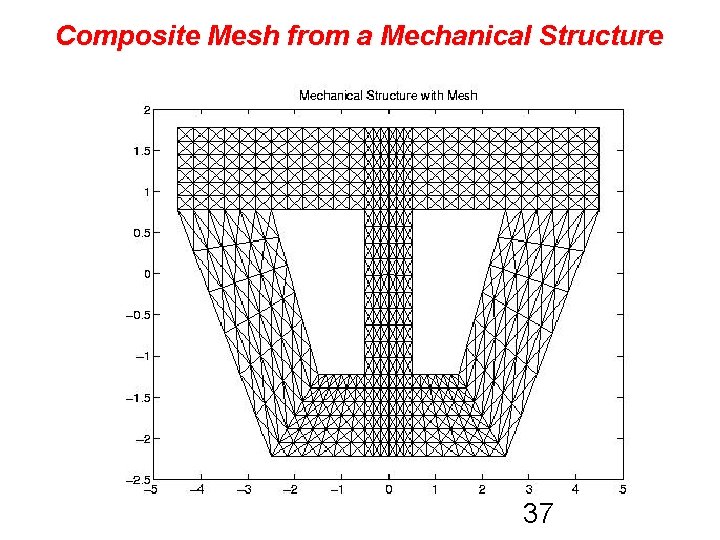
Composite Mesh from a Mechanical Structure 37
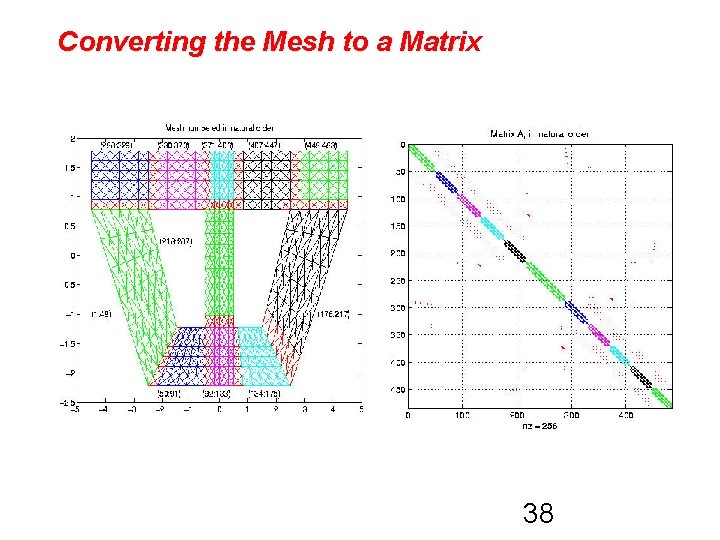
Converting the Mesh to a Matrix 38
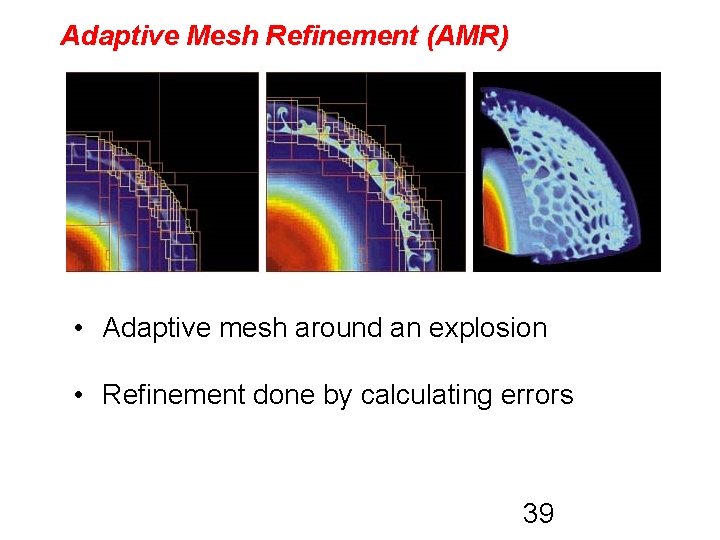
Adaptive Mesh Refinement (AMR) • Adaptive mesh around an explosion • Refinement done by calculating errors 39
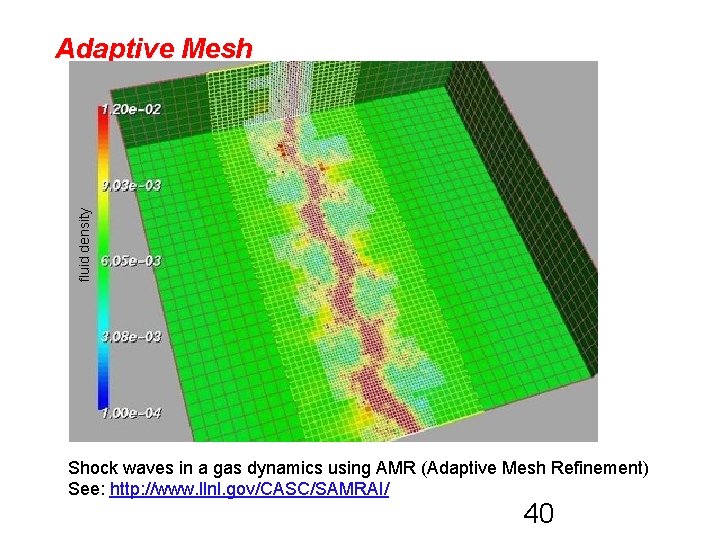
fluid density Adaptive Mesh Shock waves in a gas dynamics using AMR (Adaptive Mesh Refinement) See: http: //www. llnl. gov/CASC/SAMRAI/ 40
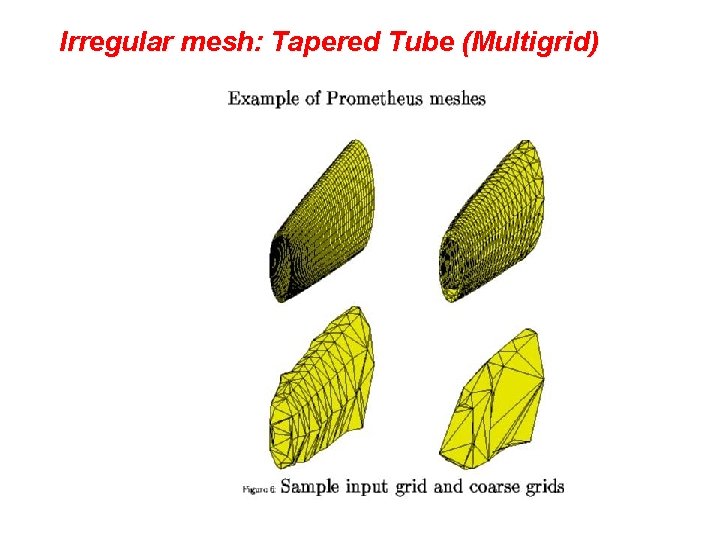
Irregular mesh: Tapered Tube (Multigrid) 41
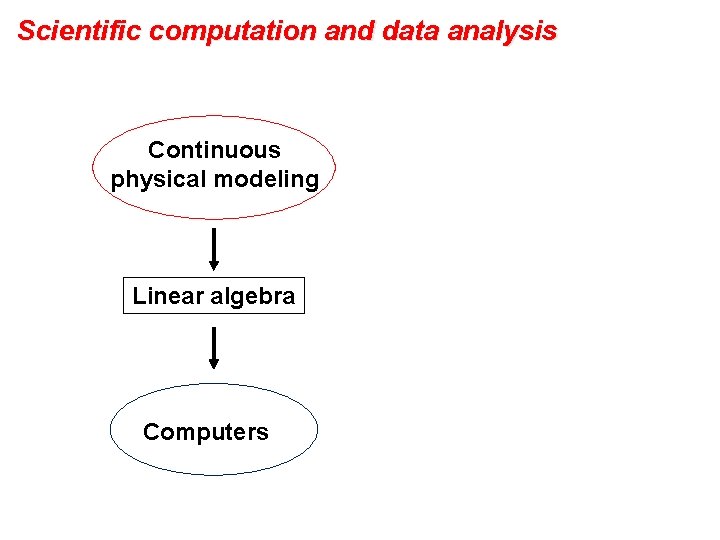
Scientific computation and data analysis Continuous physical modeling Linear algebra Computers
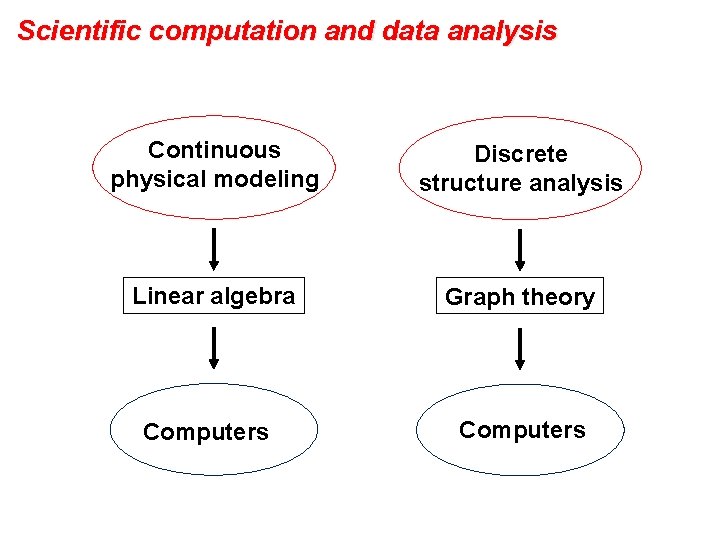
Scientific computation and data analysis Continuous physical modeling Discrete structure analysis Linear algebra Graph theory Computers
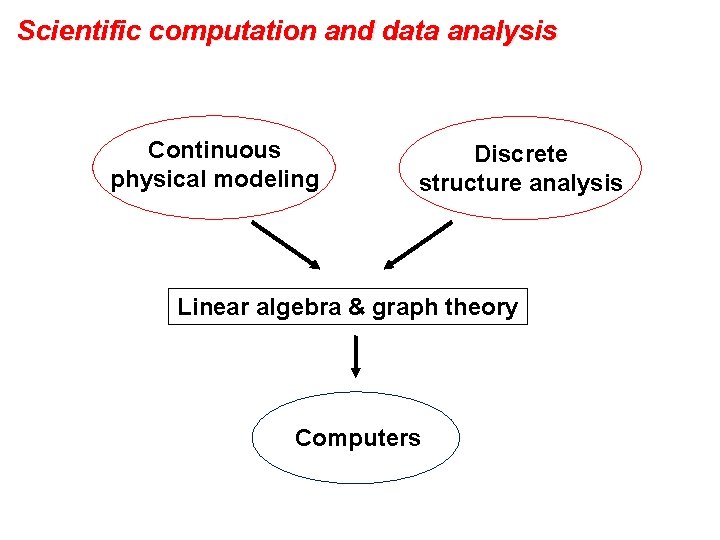
Scientific computation and data analysis Continuous physical modeling Discrete structure analysis Linear algebra & graph theory Computers