
Conjugate acids and bases Different definitions of acids
Conjugate acids and bases
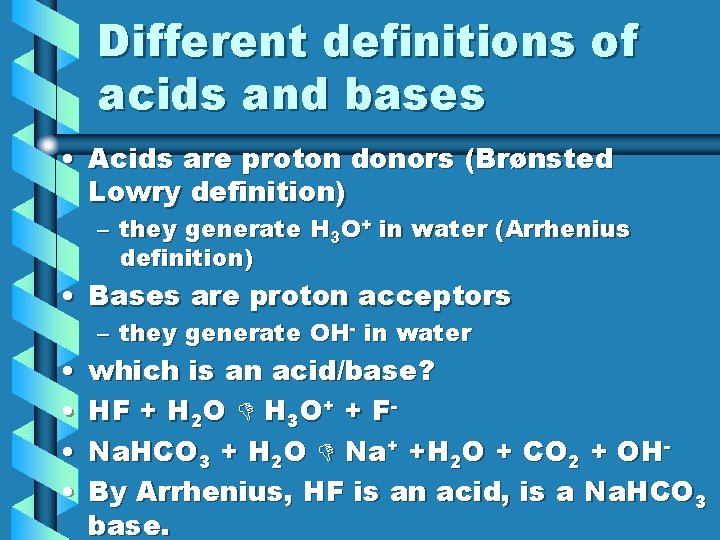
Different definitions of acids and bases • Acids are proton donors (Brønsted Lowry definition) – they generate H 3 O+ in water (Arrhenius definition) • Bases are proton acceptors • • – they generate OH- in water which is an acid/base? HF + H 2 O H 3 O+ + FNa. HCO 3 + H 2 O Na+ +H 2 O + CO 2 + OHBy Arrhenius, HF is an acid, is a Na. HCO 3 base.
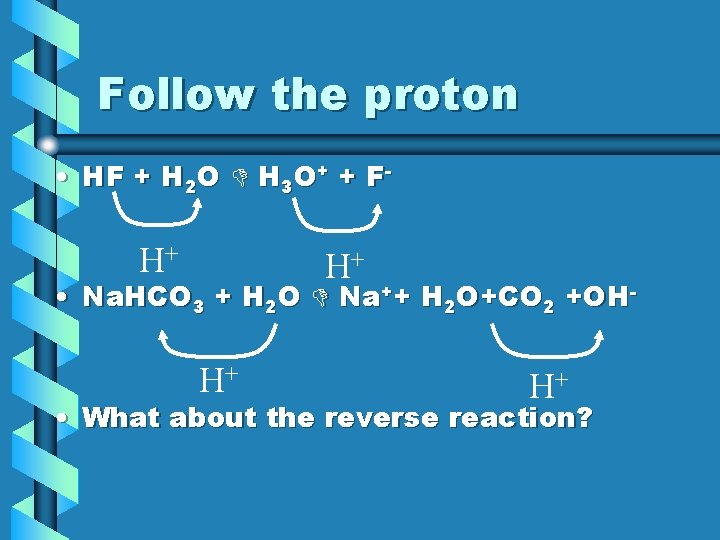
Follow the proton • HF + H 2 O H 3 O+ + F- H+ H+ • Na. HCO 3 + H 2 O Na++ H 2 O+CO 2 +OH- H+ H+ • What about the reverse reaction?
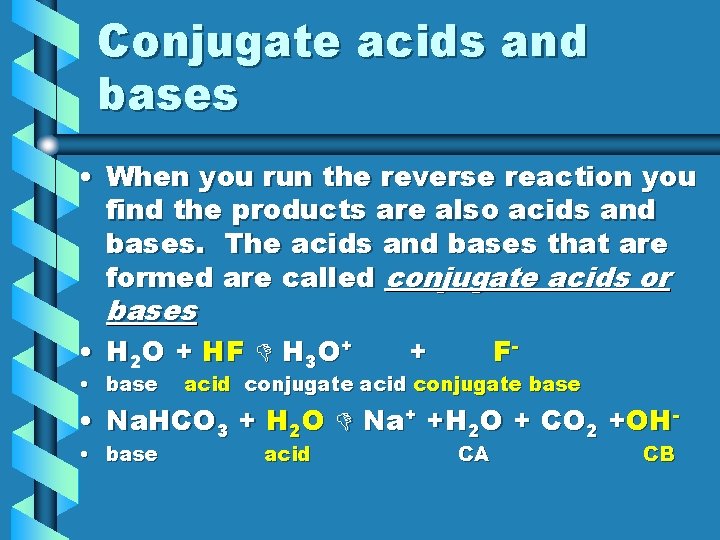
Conjugate acids and bases • When you run the reverse reaction you find the products are also acids and bases. The acids and bases that are formed are called conjugate acids or bases • H 2 O + HF H 3 O+ + F • base acid conjugate base • Na. HCO 3 + H 2 O Na+ +H 2 O + CO 2 +OH • base acid CA CB
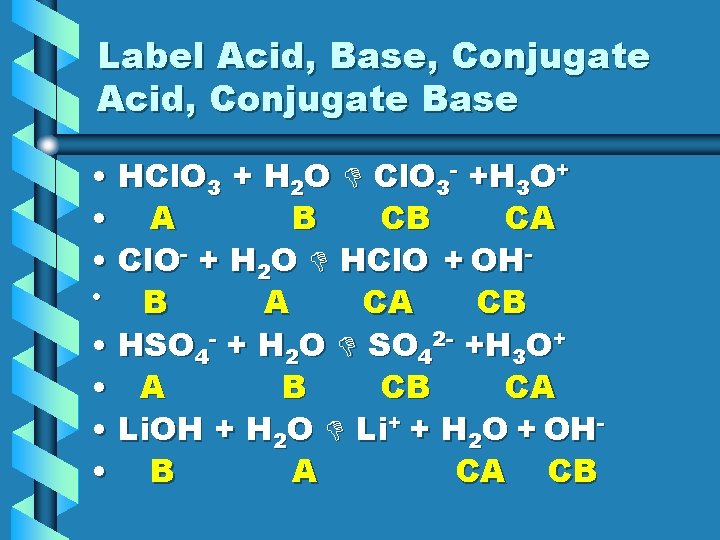
Label Acid, Base, Conjugate Acid, Conjugate Base • HCl. O 3 + H 2 O Cl. O 3 - +H 3 O+ • A B CB CA • Cl. O- + H 2 O HCl. O + OH • B A CA CB • HSO 4 - + H 2 O SO 42 - +H 3 O+ • A B CB CA • Li. OH + H 2 O Li+ + H 2 O + OH • B A CA CB
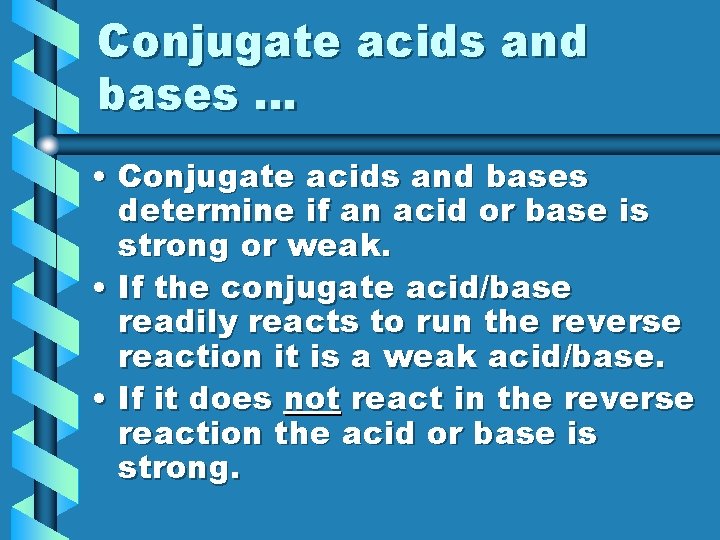
Conjugate acids and bases … • Conjugate acids and bases determine if an acid or base is strong or weak. • If the conjugate acid/base readily reacts to run the reverse reaction it is a weak acid/base. • If it does not react in the reverse reaction the acid or base is strong.
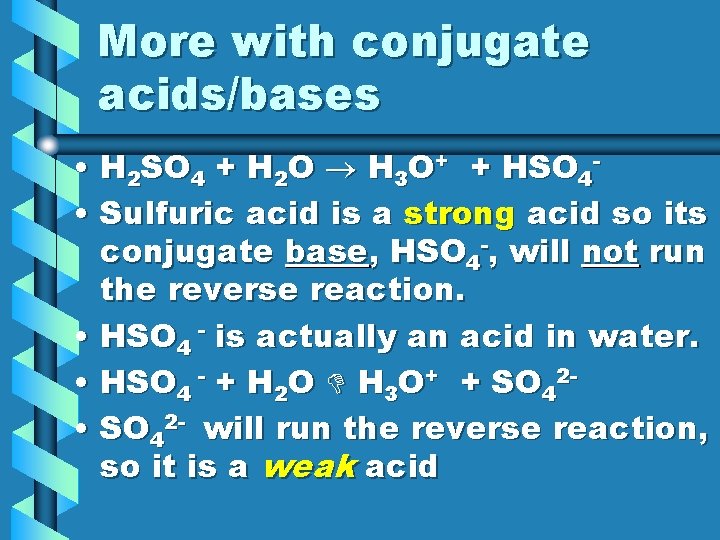
More with conjugate acids/bases • H 2 SO 4 + H 2 O H 3 O+ + HSO 4 • Sulfuric acid is a strong acid so its conjugate base, HSO 4 -, will not run the reverse reaction. • HSO 4 - is actually an acid in water. • HSO 4 - + H 2 O H 3 O+ + SO 42 • SO 42 - will run the reverse reaction, so it is a weak acid
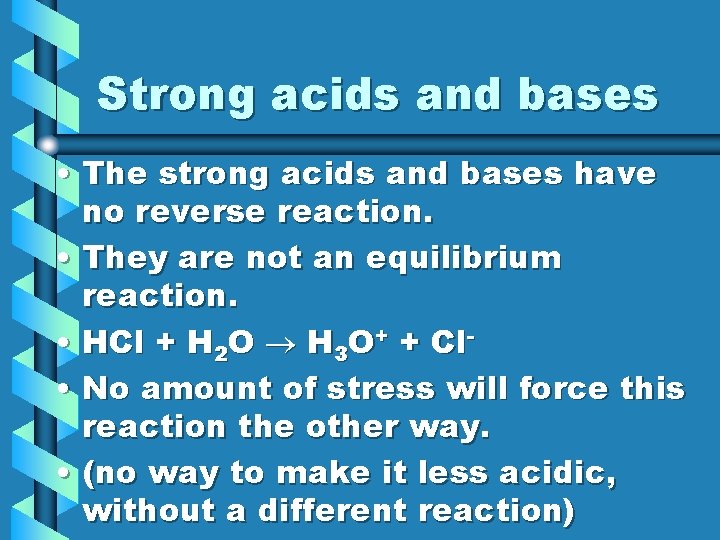
Strong acids and bases • The strong acids and bases have no reverse reaction. • They are not an equilibrium reaction. • HCl + H 2 O H 3 O+ + Cl • No amount of stress will force this reaction the other way. • (no way to make it less acidic, without a different reaction)

Strong acids Acid formula Acid Formula Hydrochloric acid Hydrobromic acid Hydriodic acid HCl Sulfuric Acid Nitric Acid H 2 SO 4 Perchloric Acid HCl. O 4 HBr HI HNO 3
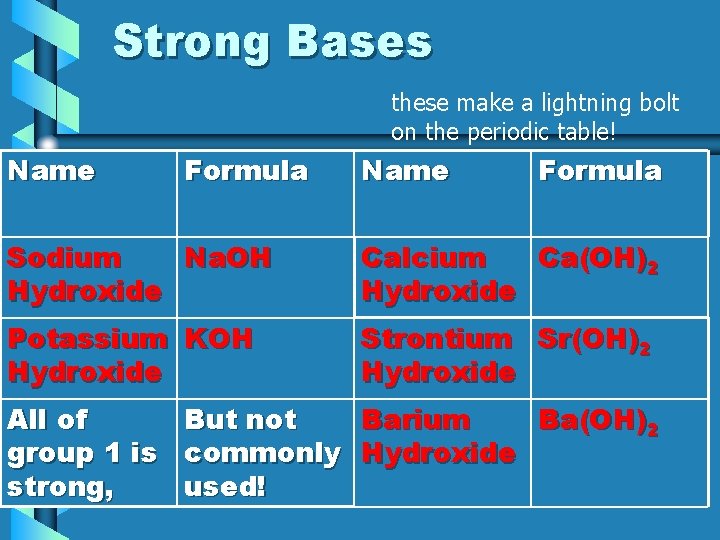
Strong Bases these make a lightning bolt on the periodic table! Name Formula Sodium Na. OH Hydroxide Calcium Ca(OH)2 Hydroxide Potassium KOH Hydroxide Strontium Sr(OH)2 Hydroxide All of But not Barium Ba(OH)2 group 1 is commonly Hydroxide strong, used!
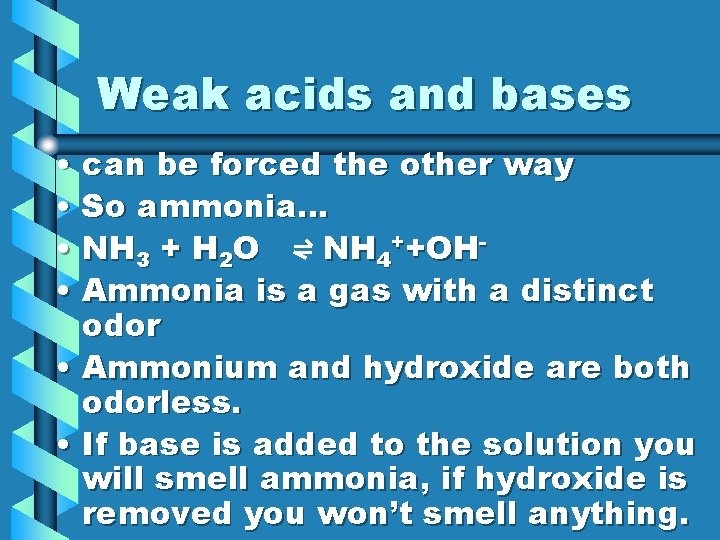
Weak acids and bases • can be forced the other way • So ammonia… • NH 3 + H 2 O NH 4++OH • Ammonia is a gas with a distinct odor • Ammonium and hydroxide are both odorless. • If base is added to the solution you will smell ammonia, if hydroxide is removed you won’t smell anything.
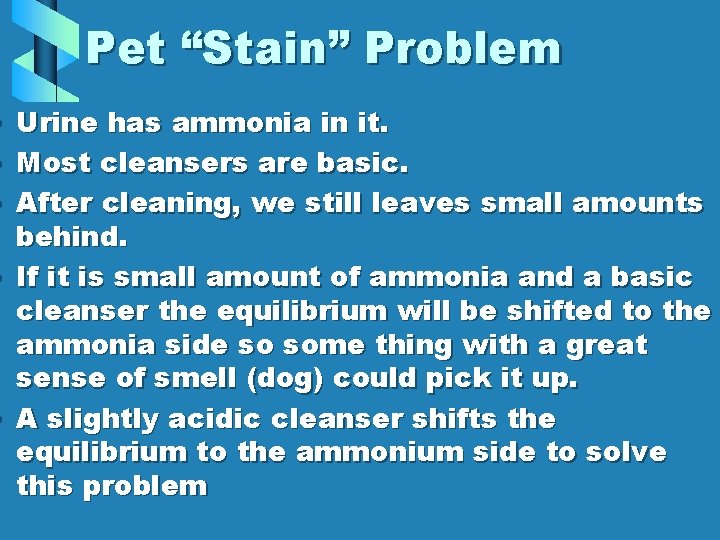
• • • Pet “Stain” Problem Urine has ammonia in it. Most cleansers are basic. After cleaning, we still leaves small amounts behind. • If it is small amount of ammonia and a basic cleanser the equilibrium will be shifted to the ammonia side so some thing with a great sense of smell (dog) could pick it up. • A slightly acidic cleanser shifts the equilibrium to the ammonium side to solve this problem
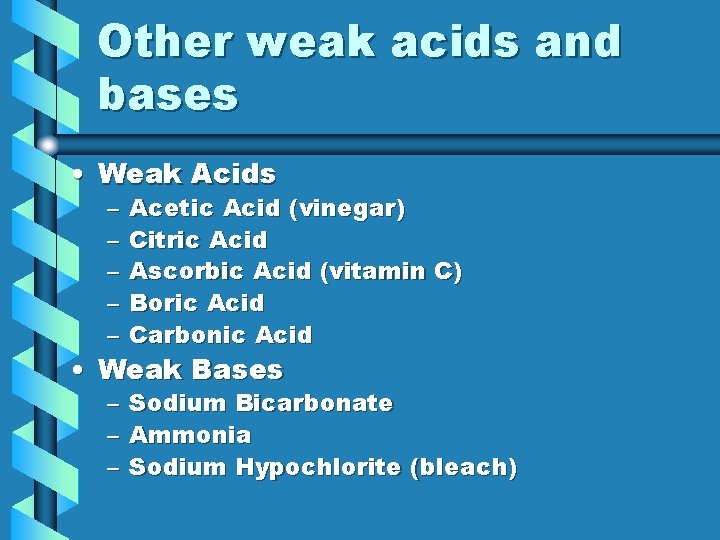
Other weak acids and bases • Weak Acids – – – Acetic Acid (vinegar) Citric Acid Ascorbic Acid (vitamin C) Boric Acid Carbonic Acid – – – Sodium Bicarbonate Ammonia Sodium Hypochlorite (bleach) • Weak Bases
Indicators • Indicators are a substance that change color in the presence of (whatever they check for) • They do this because of Le Châtelier’s principle. All you need an equilibrium reaction with different colored products and reactants. • The pen used to check for counterfeit money is a starch indicator
How an acid base indicator works • A generic indicator will follow this reaction, HID is the reactant indicator, and ID- is its product • [HID] + H 2 O ⇌ H 3 O+ + [ID] • The color differences are important, HId is one color and Id- is a different color! • in an acidic solution (high H 3 O+) you see reactant • [HID] + H 2 O ⇌ H 3 O+ + [ID]- • in a basic solution (low H 3 O+) you see product • H[ID] + H O ⇌ H 3 O+ + [ID]2
Acid Base indicators • Acid base indicators change color at certain p. H levels • They don’t have to change at 7 (most don’t) • Universal indicator solution (phenolphthalein, bromthymol blue and methyl red dissolved changes color at each integral p. H value in ethanol and water)
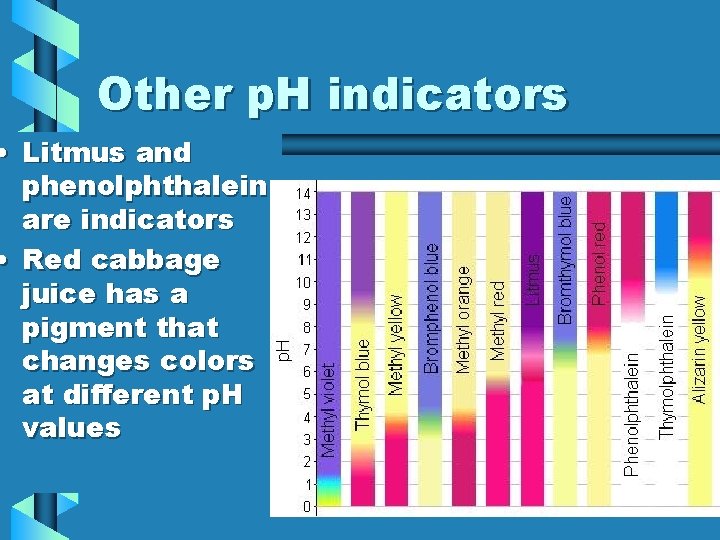
Other p. H indicators • Litmus and phenolphthalein are indicators • Red cabbage juice has a pigment that changes colors at different p. H values
Buffers • Buffers are solutions that don’t change in p. H when acids or bases are added. • They use weak acids/bases and Le Châtelier’s principle. • You will have a large amount of weak acid and conjugate base • WA = weak acid • HWA + H 2 O H 3 O+ + WA-
p. H • p. H depends on the concentration of hydronium • p. H = -log [H 3 O+] • Concentration of hydronium is the ratio of solute to solvent or in this case H 3 O+ / H 2 O
What it does • HWA + H 2 O H 3 O+ + WA • adding H 3 O+ forces the equation to SHIFT the left • Which makes more water and removes some H 3 O+, so the [H 3 O+] remains constant
What it does • HWA + H 2 O H 3 O+ + WA • removing H 3 O+ (adding OH-) forces the equation to SHIFT to the right • Which make more H 3 O+, and removes some water • so the [H 3 O+] remains constant • There is a breaking point where the p. H will change.
What does this have to do with my life? • Your blood is a buffered solution • The p. H must remain between 7. 35 -7. 45 • Outside of that range can kill you • below this range is called acidosis • above is called alkalosis
- Slides: 22